The first catalogue entries that are geared to ‘Upholsterers’ tools can be first found in the 1873 Catalogue, wherein are listed these pages:
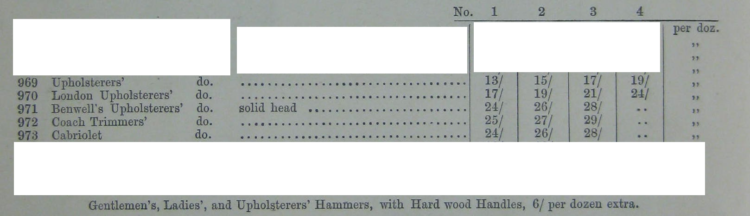


Then in the 1888 Catalogue we have these pages listed:


Followed by the issue of 1897:


After that followed the 1909 Catalogue files:


The next pages are from the 1928 Catalogue:


The 1938 Catalogue images follow:


1959 Catalogue:


The 1965 images are below:


The following is a brief description of the Upholstery tools that were manufactured by MARPLES over time, but you will please note that I have restricted this list to only the major tools, having not described needles, skewers and regulators etc.:
HAMMERS:
Upholsterers’ Common Hammer: Started in the 1873 Cat as #969, #1100A in the 1888 Cat. and eventually #3900 in 1909 and until delisted after 1938. [Pre-War]
Upholsterers’ London Pattern Hammer: Started in the 1873 Cat. as #970, #1101 in the 1888 Cat. and eventually #3901 in 1909 and until delisted after 1938 [Prewar]
Benwell’s Upholstery Hammer: Started life in 1873 as #971, #1102 in the 1888 Cat. and eventually #3902 in 1909. This is the most long lived of the MARPLES Upholsterers’ hammers as it was eventually delisted shortly after Nov. 1969.
Coach Trimmers’ Hammer: Another long lived hammer that started in 1873 as #972, #1104 in the 1888 Cat. and eventually as #3908 in 1909 and until its’ demise shortly after Nov. 1963.
Cabriolet Common Uph. Hammer: Is first seen in 1888 as #1103A and eventually #3903 in 1909, when it was de-listed shortly thereafter.
Cabriolet ‘London’ pattern Uph. hammer: Introduced in 1873 Cat. as #973, #1103 in the 1888 Cat. and #3904 in the 1909 Cat. and until de-listed shortly after Nov. 1963.
Scale Tanged Uph. hammer: First seen in 1909 as #3904A, changed to #3904.1/2 in 1928 and last seen in the 1938 Cat.
Double faced Uph. Hammer: This hammer can only be found #3903 in the 1938 Cat. and again was a casualty of war. Thanks again to Mr. Hilter.
Magnetic Uph. Hammer: A great idea for a hammer and continued today by other manufacturers, but MARPLES introduced their version #3890 in 1938 and surprisingly it lasted until November 1963.
PINCERS:
Upholsterers’ Pincers: #1134 are only seen in the 1873 Cat. as they were supplanted by a better design shortly thereafter….. ‘Best Uph. Pincers’.
See the pictures to note the design differences.
‘Best’ Upholsterers’ pincers:
Again introduced in the 1873 Cat. as #1135 with widths of 7″;8″;9″ and 10″.
In 1888 the number changed to #1143, but in the same sizes available. In 1897 the number remained as #1143 but the 10″ width was not available.
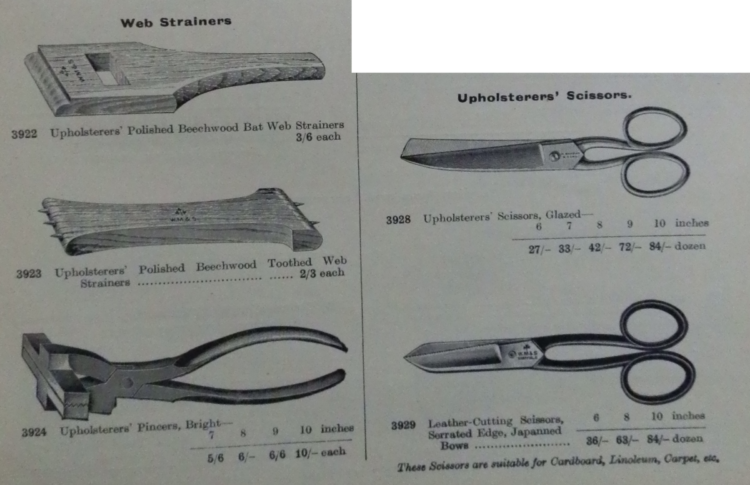
The 1909 Cat. #3924 lists all four sizes again, although only the 8″ size is listed in 1921. All four sizes are again shown up to the 1938 Cat. [Pre-War] but only 7″; 8″ and 9″ were available post war in the 1959 Cat. and then again only the 8″ was shown in 1965 and until Nov. 1969.
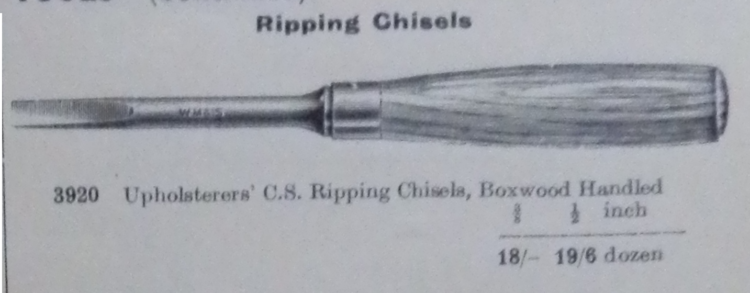
Ripping Chisel: Introduced as #3920 in 1909 and last seen in Nov. 1963.
Web Strainers: The 1909 Cat. introduced these tools as #3922 and they were available until Nov.1963.

Above is an ‘Upholsterers’ Polished Beechwood Bat Web Strainer‘ Item #3922
Toothed Web Strainers: For some reason these did not last as long as the plain type in that with #3923 of 1909 they existed as such until the 1938 Catalogue, a consequence of WW!!

This item above is described as ‘Upholsterers‘ Polished Beechwood Toothed Web Strainer’ Item #3923 . 3 teeth at one end and 2 at the other
Upholsterers’ Scissors: Introduced as #3928 in 1938 and lasted until November 1963.
Leather cutting scissors: were first seen in 1928 as #3919 changed to #3929 in 1938 and this number and product endured until Nov 1963.
Tack Claws: Over time these tools have been moved by MARPLES in and out of the category ‘Upholsterers’ Tools, but I will include them here briefly, although more detail may be found under ‘TACK CLAWS‘ in the index.
Beech Tack Claws: #935 in 1897,#3947 in 1909 and #3541 in 1928 lasted as such until Sept. 1972.
Rosewood Tack Claws: #935A in 1897 and #3948 in 1909, after which they do not appear anywhere.
Beech Strong Tack Claws #3949 of Cat. 1909 became #3546 in 1928 and no further.
Ash handled Tack Claw #3542 was only shown in the 1938 Catalogue.
Short shank Beech Tack Claw: #3543 introduced in 1938 and lasted until November 1963
Awls: So many Awls were made by MARPLES , the following are just those such described as ‘Upholstereres”:
Pritch Awls: #3936 was first shown in 1909 and last shown in 1928.
Garnish Awls: the catalogue of 1897 first shows this as #1143E but it is numbered #3935 in 1909 and until delisted in November 1963.
Garnish Awl Boxwood: Was available as #3935.1/2 from the 1928 Catalogue and was last listed in the November 1963 PL.
Square Awls: These square shaped awls were introduced by MARPLES in the 1909 Catalogue as Item #3937 and they lasted as such until the War [1938], but no further.
Trimmers’s Awls Boxwood…:Introduced c.1928 as #3938 and continued on as far as the PL of November 1963.
Trimmers’ Awl c. Egg handle box handle: Again a 1938 introduction #3939 which last in manufacture by MARPLES until November 1963 PL
Trimmers’ Awl Solid all thru : Probably the best Awl produced by MARPLES as it had a solid steel shaft from point to top of handle. #3941 endured from introduction in 1938 until de-listed shortly after November 1969.
This section has been the most time consuming that I have ever done on this site. This because MARPLES chose, in the 1800s to not only change item numbers a few times but also to change the description of the tool. [Pricker Pads were synonymous with Hand Pads!]
The shear volume of slight variations in the introduction and then deleting of certain lines has led to total confusion today . Such that it is virtually impossible to write any form of table that is understandable. So therefore, I will merely insert the various pages below on a year by year format until we get to an time [1928?] when the volume of products and the cataloguing thereof has decreased to an understandable level! After that I have constructed a table for you to follow.
We can start with the listings shown in the 1846 sheet: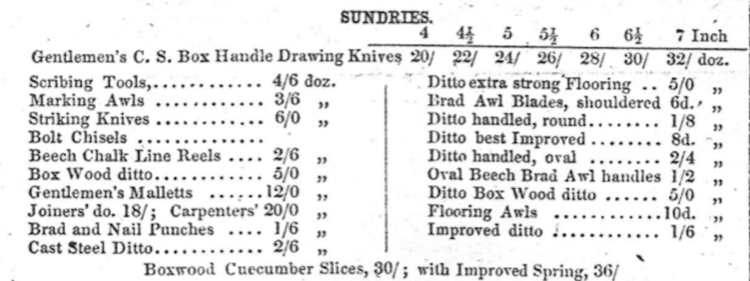
We can then proceed to the listings shown in the rare 1861 Catalogue:


Then to 1873:


1888 is next:


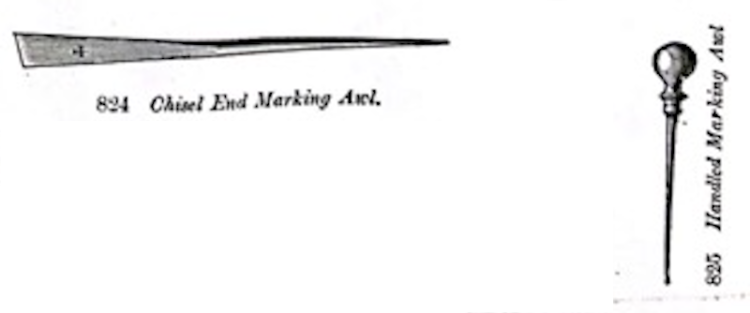


Above is a perfect example of number AND description change.
1897 is next:


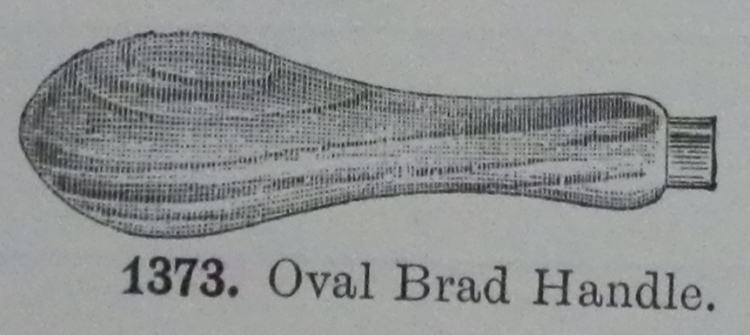


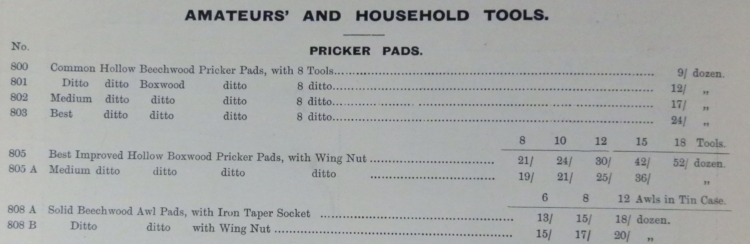
1909:





1921 Awls, reduced in number after the War:


Then we go to the increased 1928 Catalogue:


1938:




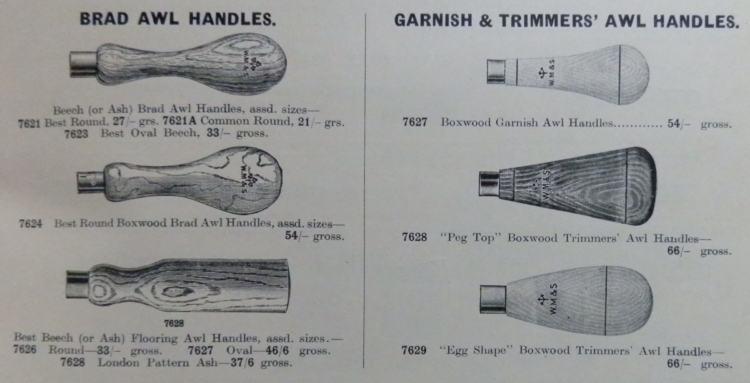
After the War the next real catalogue was 1959:


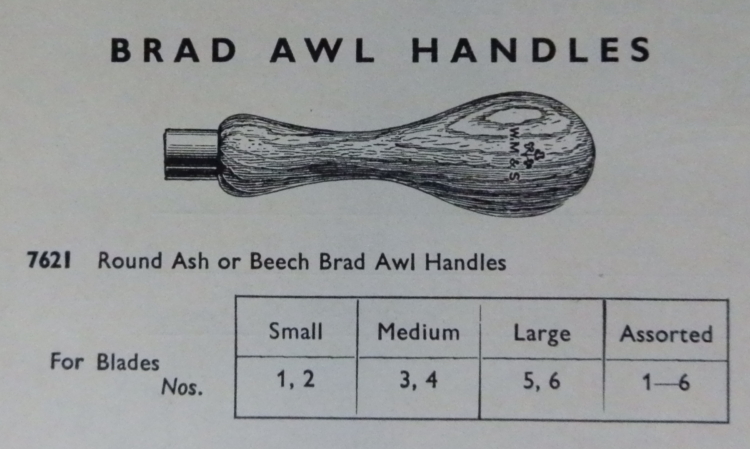
The next real catalogue issued was in 1965, after C&H Hampton had taken over the company and many items were now dropped from production:


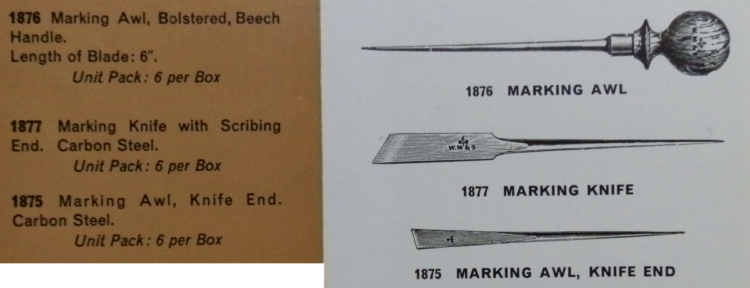

In 1972 we see even more items lost:

Below is a table constructed from 1928 onwards of the Awls that Marples produced until no longer produced.

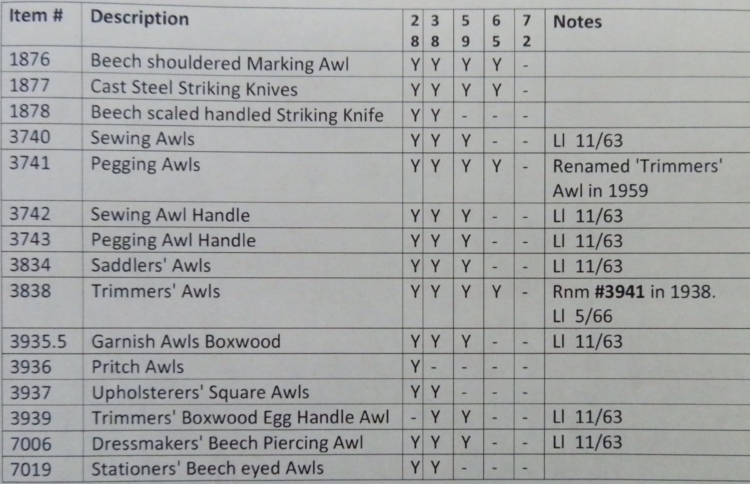
I had to use shortcuts for words to be able to construct this chart and here are the shortcuts:
Bch = Beech
Box = Boxwood
Brad = Bradawl
Imp = Improved
Ll = Last listed
Rnm = Re-numbered
Wd = withdrawn
Wgnt = Wing Nut
Next I will show some examples of these Awls and Pads:
The Tri Grip Bradawl [No. 1828] was introduced in September 1968 and there were 3 different coloured handles to denote length of bradawl. Small was Blue [1.3/8″]; Medium was Red [1.5/8″] and Large Yellow [1.7/8″].


Here is a photo of these 3 Tri-Grip bradwals, but please note that the literature does not mention that the diameter of the bradawl shaft increases in size as the length increases.

Below are 2 Mint #1826 Ash handled Bradawls. They were not ‘pinned’, this variety being numbered with a ‘P‘ after the number. This was the very basic and first Bradawl to be produced by MARPLES and they were made in many different sizes [#1-6 representing 1″ – 2″ lengths] They started out not being numbered in 1862 [or before] and we numbered as #602 in 1873. They remained Beech handled through 1888 when they were #840 but this changed to Ash handled and re-numbered #1826 in 1909. In 1928 they were in either Beech or Ash but switched to all Ash after 1965. Lasted listed in 1977.
Below is a good example of a ‘pinned’ bradawl, a much stronger method of holding the blade in the handle. It is a #1826P. circa 1965…

Below are 3 different ages of Peg Top Bradawl.
#1834.1/2 until 1972 then re-numbered #1834A [hardwood handled]
The Left one is Boxwood c.1960
The Middle one is c.1965 Boxwood
The one on the Right is Ash and so marked c.1980
‘Peg Top Awls’ are very similar to ‘Trimmers’ Awls but the latter have stronger blades.

#3938 Trimmers’ Awl [missed in the Table above!] was available from 1928 to 1959+ .In the 1959 Catalogue there are 2 styles of Trimmers Awl…#3938 and #3941 [with blade running through the handle]
#3938 was described as a Trimmers’ Awl strong blade, 3 inches with a Peg-Top Boxwood handle. Shown below on the left. The one on the right is a modified Peg Top Bradawl [#1834A]:

Below here are 3 different ages of Birdcage Awl.
This Square bladed awl started life in 1909 as #1838 ‘Round Beech handled’
and was last listed in 1/2008 [Marples]
The examples below show :
On the left a c.1960’s example
Middle is c late 1980/90’s
Right is c.late 1960’s

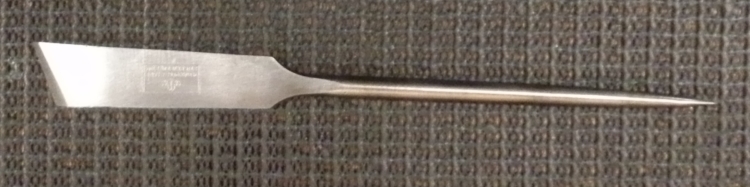
Below is a’Marking Knife with Awl’ #1877
And at last we have a selection of Tool Pads [called Pricker Pads up to the 1897 Catalogue!!]. The 3 ‘Wingnut’ tightened on the left are [ 1888 Cat.] #805; In 1909 the number changed to #1870 and they did not last through WW1.
The middle Wingnut Rosewood handled pad #1873 with 8 tools appears in 1909-1938
The Thumbscrew operated tool pad second right is only seen in 1888 as #807
The extreme right pad #1864 is only seen in 1938 Cat.


Above is ‘Best Improved Hollow Boxwood Pricker Pad’ with Wing Nut #805 in the 1897 Cat. and it came with 8,10,12,15 or 18 tools. By 1909 it had been renamed as a ‘Tool Pad’ and Item #1870 It appears in the 1928 and 1938 Cats. and was probably de-listed around 1940.
Item# M1838 is correctly described as a’BirdcageAwl’ and it always had a triangular cross section. First introduced c.1900 as Item #1825.1/2 until c.1928 and then from 1938< until at least 1974 as Item #1838. Listed as Round Beech until c.1960 then as Round Ash Handled. They had assorted
sizes Nos. 1-6

Below is an Awl that I can find nowhere in the catalogues!

Although not exactly conforming to the parameters of this Woodworking Tools site, Ice Skates was a commodity that supported MARPLES through some lean years and enabled the firm to survive. They are first seen in the 1861 Catalogue. The first item below is the cover page from a rare 1881 Skate Catalogue. See under ‘Catalogues’ for the complete scan of this rare skate catalogue.

To disassemble the wood/steel skates: The steel insert around the heel screw has to be removed [judicious use of a small screwdriver coaxed gently with a hammer!]. Then the point of the screw can be tapped down so that the whole screw assembly [which fits into a slot in the top of the steel skate] is free of the wooden base. Remove the screw. Then gently tap the rear of the steel skate to dislodge it forward such that a backward facing steel spike [on the front of the steel skate] is loosened from its’ hole in the front of the wooden base. The whole steel skate can then be inched out of its’ groove in the base.
The above is admirably demonstrated by my disassembly of a pair of skates as shown:


These skates [below] are quite rare and are shown in the 1897 Catalogue where they are listed as item #875 described as: Best polished Walnut, brass toeplates, iron and steel Rocker blades, for broad toe straps, all sizes, 11/6 per pair. Straps for ditto, 2/4 per set. [That is 2 shillings and four pence for the uninitiated] The Brass Toe Plates may have varied with time and operator, as the ones shown here do not conform exactly to the picture.


Another picture from the same page of the 1897 Catalogue showing Ice skates:

And here is a wonderful #864 with a number changed in the 1909 Cat to #9507, obviously missing the rear ankle straps:


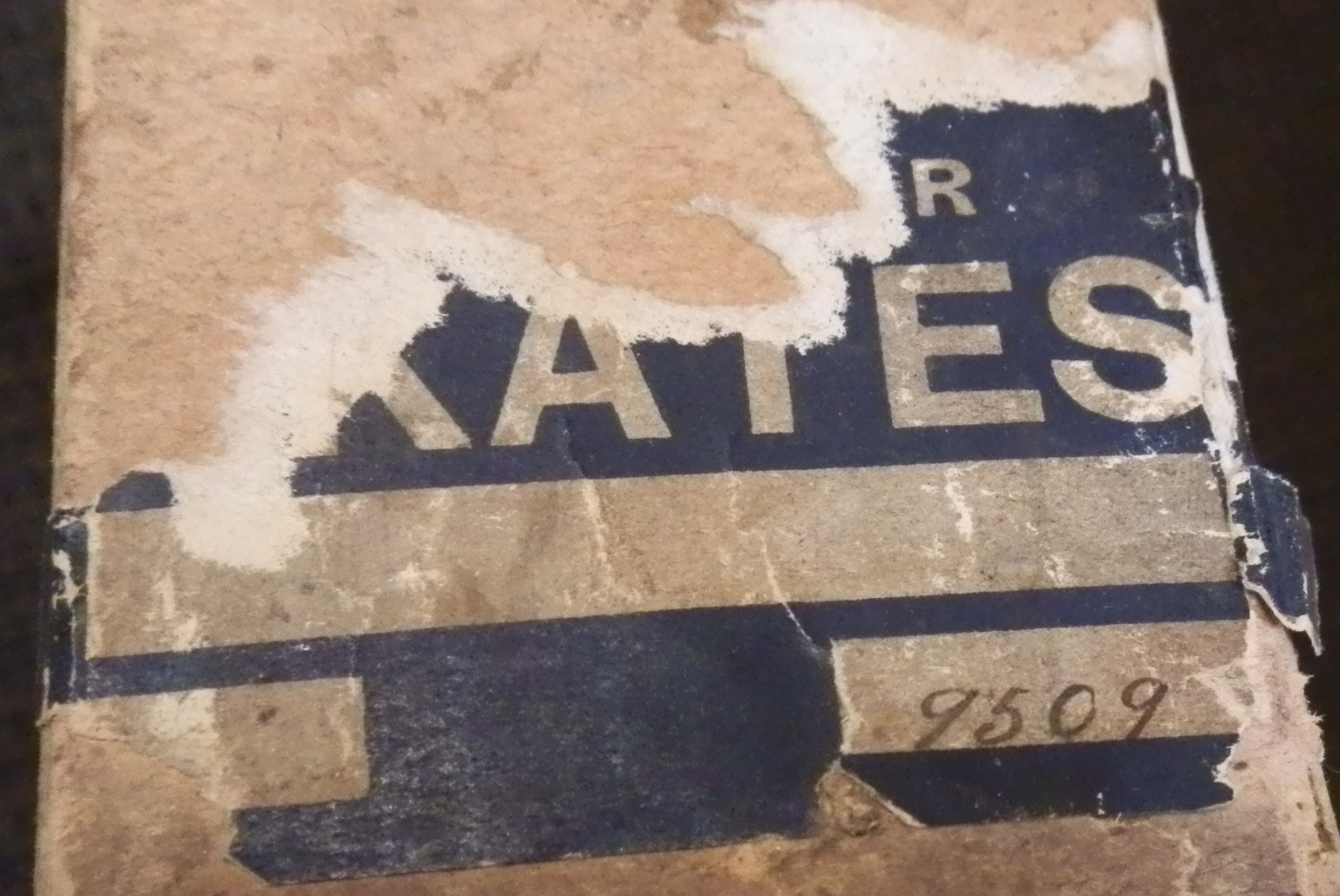
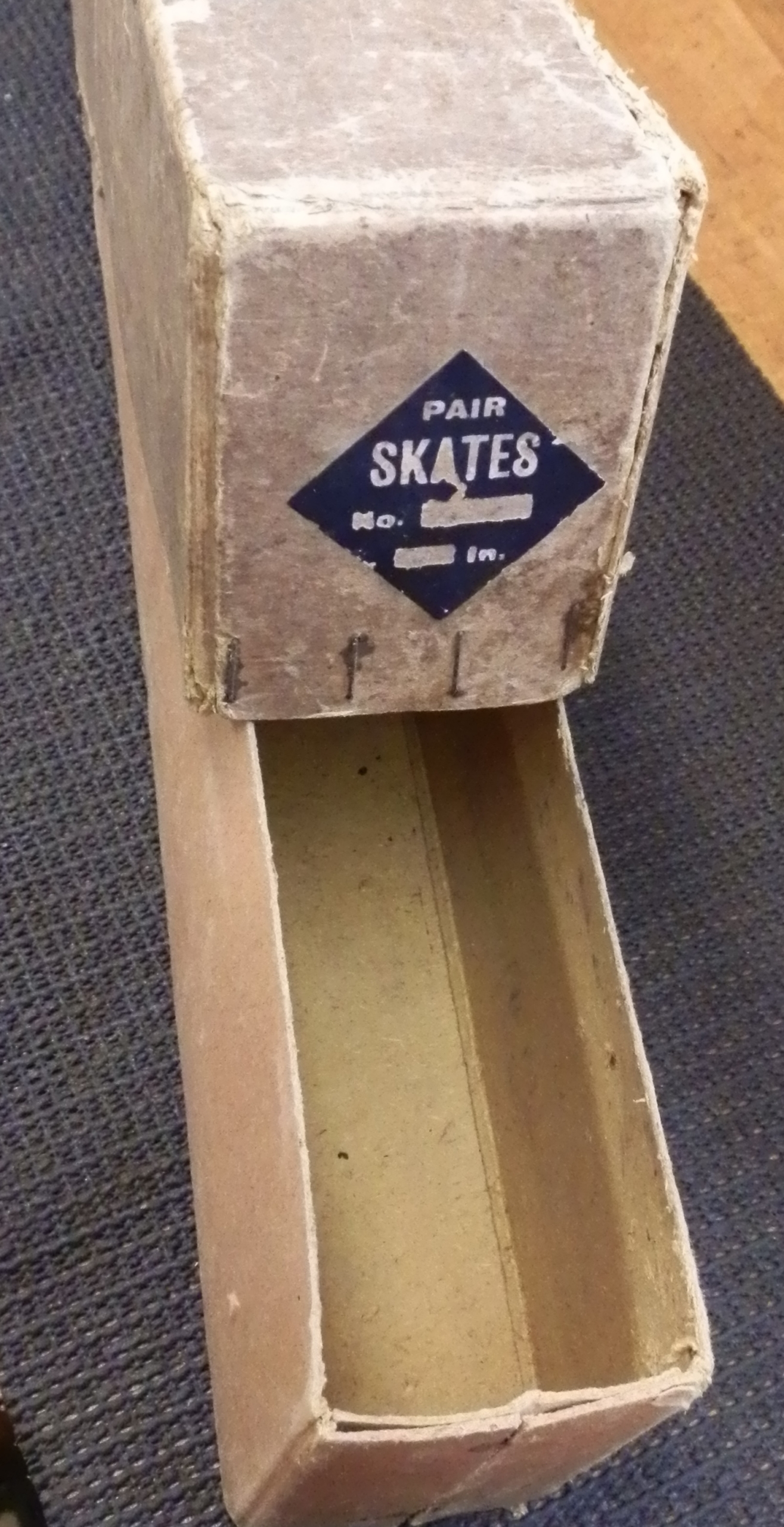
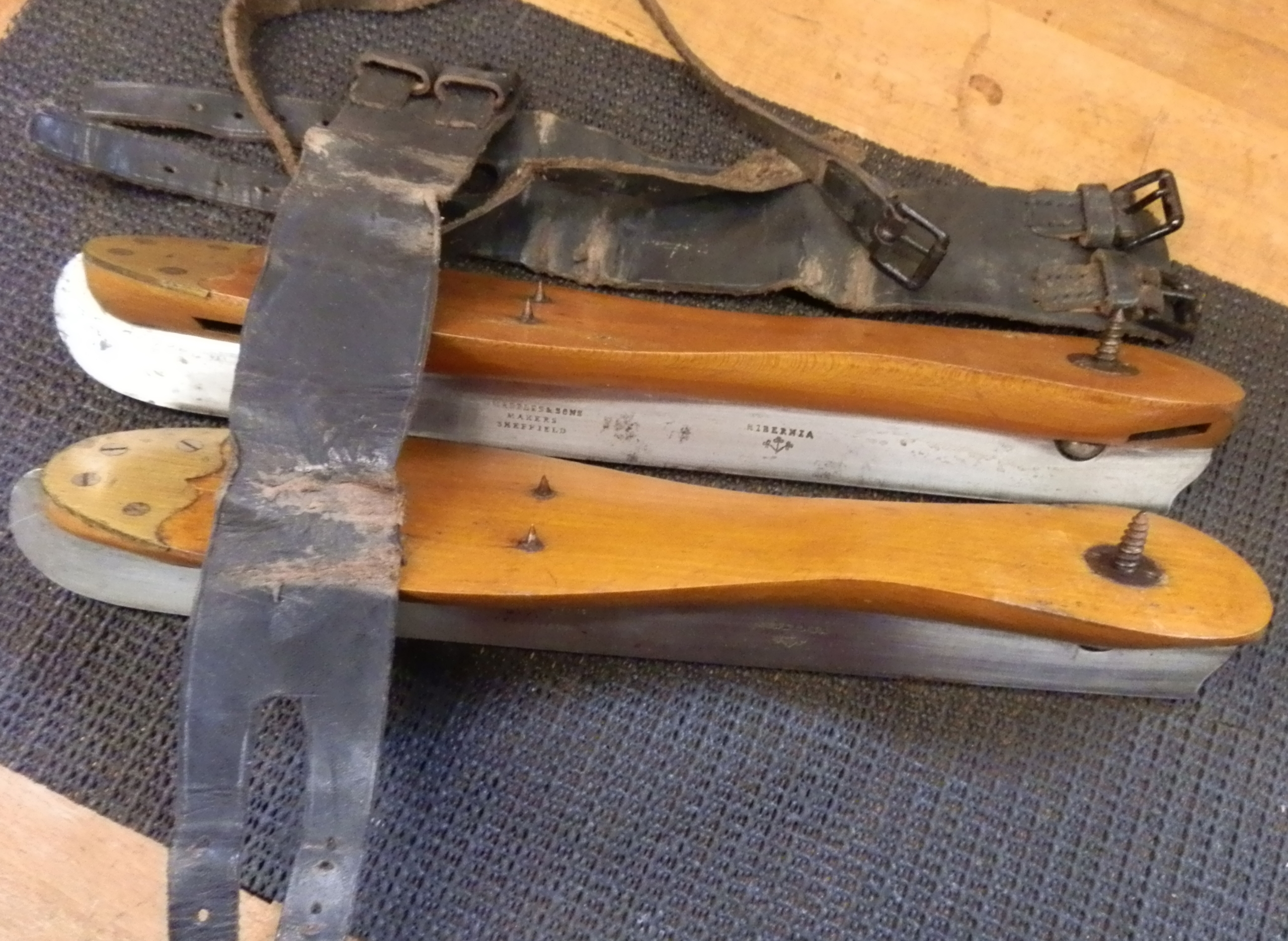
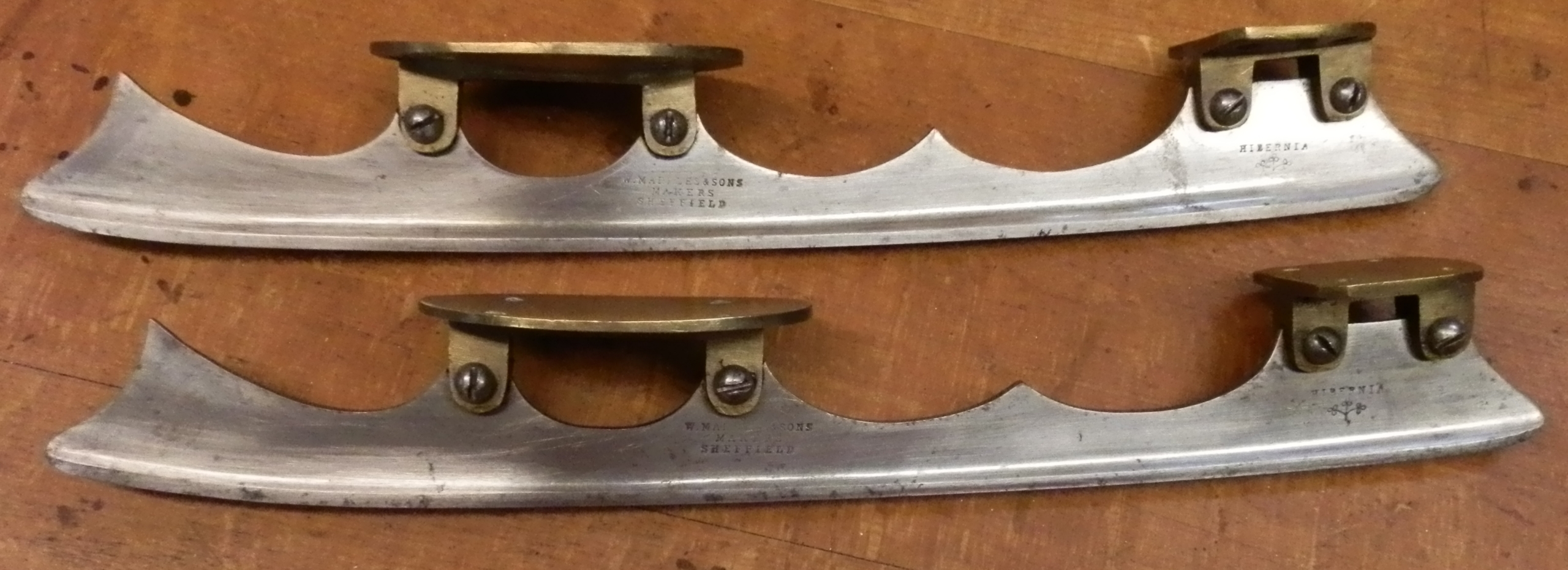
Below is a set of #9509 Polished Walnut skates that appear in the 1903 Cat. but have been delisted by 1909. In 1897 they are numbered #869... This pair gives us a view of how these skates were boxed and sold.
Below is a great set of ‘Runner Skates’ as shown in the 1909 Catalogue. From the pictures we can see that these were Item# 9524..although the literature does not mention any Brass Heel Plates.


The skates below are from c.1875 and in the 1888 Catalogue are described as ‘Racing & Hockey Skates Made to the National Skating Associations Approved patterns. They look to be the same as the ‘Runner’ skates of 1897 [above], but have a more ornate brass toe and no brass heel attachments.
Below is the 1888 page:


The skates below are first seen in 1881 and last appeared for sale in 1909.
They are best described in 1881 as: Best Polished Beechwood, raised toes and sunk heels, fancy brass toe plates, brass rings in heels, iron and steel irons. For broad two-banded toe straps. In 1903 they were re-numbered from the initial #872 to #9518 and we also then labelled as ‘Albert Pattern‘. 1909 is the last time these appear in Catalogues.


The Runner skates below are first seen in the 1873 Catalogue as #498 and in 1881 are #890.1/2:

These early skates are often found with decorative brass star inserts in the platform and heel [as shown here] but are not thus fully described in the catalogue. Walnut platforms, heel screw inside a star, star in sole and brass toe plate:


‘Mount Charles Skates’ [below] These skeleton skates are first seen in the 1909 Catalogue but are listed then as #9556.1/2 Nickeled blades and Aluminium tops.
They are missing from the 1921 Cat. but re-appear as #9557 in the 1928 Cat and again in 1938. They did not survive Mr. Hilter. Shown here is the #12 size, as can be seen on the middle picture below.


This next set is first seen in 1897 under the General Heading of ‘Skeleton Skates’…which meant that they had no wood filler above the raw skate but were meant to be affixed directly to a ‘boot’ or similar. In 1897 they are numbered # 857.1/2 :

In the 1909 Catalogue they are listed as Item # 9560 ‘St. Moritz‘ . Brass tops, Iron and Steel Blades, but by 1921 and onwards they are not to be seen. Therefore 1895-1914? is a good estimate of this skate being available. The photos below may show a later example towards 1914, having no fancy cutout on the front brass fixture.


Another example of a skeleton skate is first found in 1897:

Shown below, these skates are #857 DN being fully Nickel plated. The fancy shoes are made of brass and the Blades are of Steel. ‘Dowler’s Patent‘ was obviously the shape of the blades. In 1903 and 1909 the number is shown as #9559 and the Skate is called ‘Mount Charles Dowler‘, having ‘Dowler‘ blades. 1909 was the last appearance of these skates.


Also found in the 1909 Catalogue is this page devoted to the tools available to fix/repair the Ice Skates:

Below is another skeleton Skate appearing as #856.1/2 in 1897 and changed to #9552 in 1909 [wherein it is said to be ‘nickeled’.] It does not appear after 1909.

STAINLESS STEEL SAWS
Although Stainless Steel [SS] was not discovered/invented/stumbled upon until 1913, it was much later in September 1931 pocket cat. that we find SS MARPLES saws were introduced as Item #2515 a Skew Back, Carved English Beech handled Hand, Panel and Rip Saw. These were initially available in 22″ x 10 pts and 26″ x 6, 6.5 or 7pts, but sometime later [before 1938] a 24″ x 8 pts saw was added to the line.
In Sept 1931 there is no mention that these saws were a new addition, from which we may assume that they were probably introduced a little earlier. They are not mentioned in the June 1930 pocket catalogue, and I do not possess the March? 1931 pocket catalogue. These Panel saws were offered for sale up to around March 1940. A similar situation exists with Item #2528, an SS Tenon Saw, which is again first seen in September 1931 pocket cat. in sizes 10, 12, and 14″ and it available until at least September 1961. As with all other MARPLES saws the handle medallion is ‘generic’ in nature. The medallion and screws were nickel plated:

Below is a rare #2515 Hand Panel and Rip Saw:

Below are photos of the Tenon Saws


‘Later’ 12″ saw has 2.1/2″ blade depth. [shown above]


‘Early’ 10″ Open Handled SS Tenon saw with 2.1/2″ blade depth. [Above]

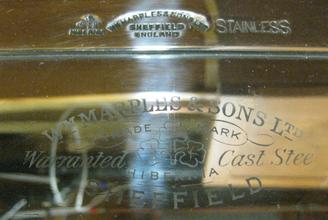
Above is an ‘Early'[ pre-war?] 12″ saw which has 3.1/4″ blade depth.
Things to note: The earlier SS saws did not have a ‘wheat’ pattern carving on the handle [<c.1937], had SHEFFIELD ENGLAND on the ‘Back’ and ‘Warranted Superior’ on the blade. The Open handle Tenon saw is presumed to be ‘Early’ as it does not appear in the 1938 cat. nor can I find it listed in any small catalogues before 1938!!. The ‘Early’ Tenon saws had deeper blades than ‘Later’. Saws after c.1937 show a ‘wheat’ pattern handle and were marked ‘SHEFFIELD‘ only on the ‘Back’ and ‘Warranted Cast Steel‘ on the blade. Immediately below are Catalogue entries dated 1931:

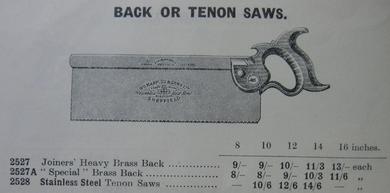
From the above Catalogue entry you will see that the Beech handles are said to be ‘Polished all over’ i.e. they had a clear varnish finish and were NOT painted Black. From the photo below I note that the Medallion is different and, as with the screws, is Brass coloured. So I assume that this is how the SS saws were first introduced, but for how long is not known only that the handles were described as being painted Black in 1938. It can be seen that both saws below have the Wheat Pattern carving in the handles.

Catalogue 1938: 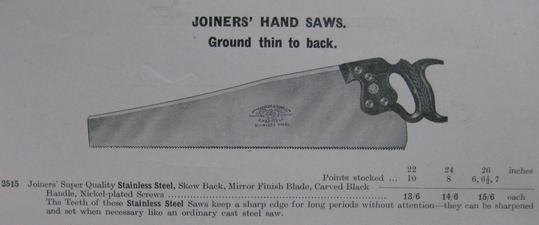
 You will note that the 1938 Cat. does not show a Cat. # for 2528! [as shown above]
These hand operated large boring drills were very short lived.
The first entry is in the 1888 Catalogue and is Item #1191 …’Bright All-Iron double Speed Breast Drill‘ 11/- each. [There is no picture but this number became Item # 6045 in 1903.]
I can then only find them listed in the 1897, 1903 and 1909 Catalogues, outside of that I see no listings.
I think it safe to estimate that these now rare drills were offered for sale from c.1895 to c.1912.
If you can find them they will be in poor shape and probably with missing parts. [Especially the ‘level’ on those drills that were provided with such.] The Rosewood turning handle is particularly prone to having a rusted out centre steel rod which has expanded and therefore cracked the Rosewood handle. Expert restoration is needed in this case.
Here are the 1897 Listings:


And here are the 1903 listings:


And below here are the last entries of 1909:
The only drills that survived from the 1897 listings are shown here with their re-listed numbers:
Breast Drill No.1191 became #6045
Breast Drill No.1191A became #6046
All the other 1897 Breast Drills became obsolete and were discontinued in favour of new drills as shown in the 1909 Catalogue. [below]

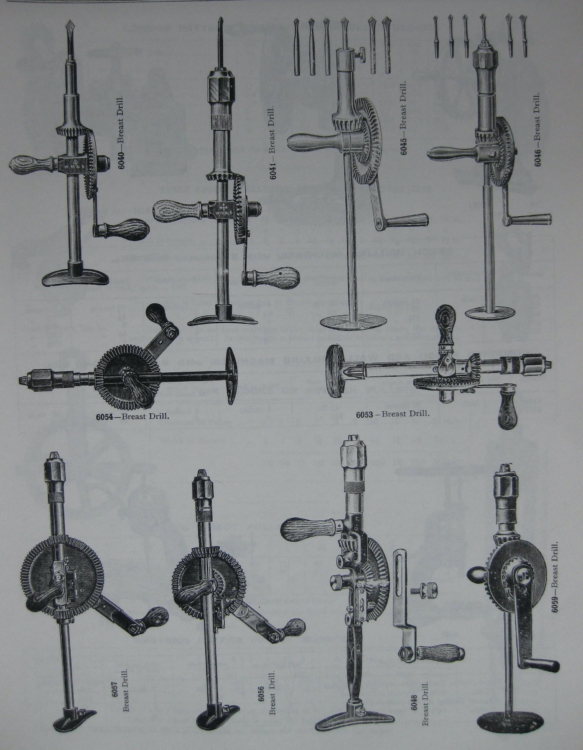
Here is what I think is a #6407 Breast Drill:


And below is a #1191B:
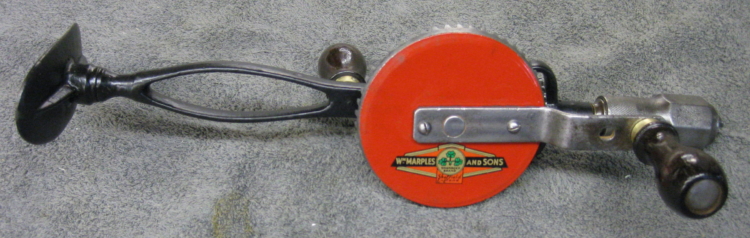


The next example has a MARPLES chuck and therefore British [BSF or BSW] chuck thread [which would not fit on an American Breast Drill frame] but I cannot locate this example in the catalogues that I have. It may be a later or earlier #6407 or even a #6506, the latter of which we have no pictures.

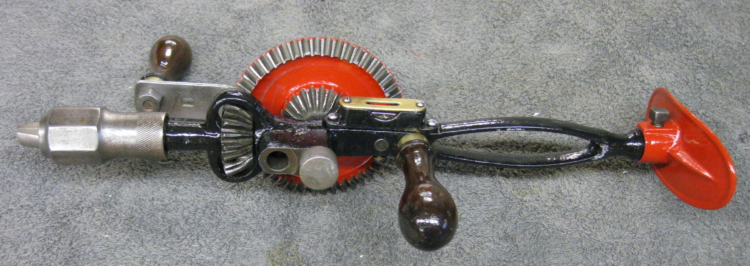

Below is a rare #6504.
This drill was the cheapest [ 9/6d.] one that MARPLES made and it only appears in the 1909 Catalogue, no wonder very few exist. The breast ‘plate’ is an uncomfortable convex hollowed circular disc that was fixed to the main frame by just a peening over of the end of the circular frame.
I had to do a lot of restoration to get it to the condition shown in the photos!!
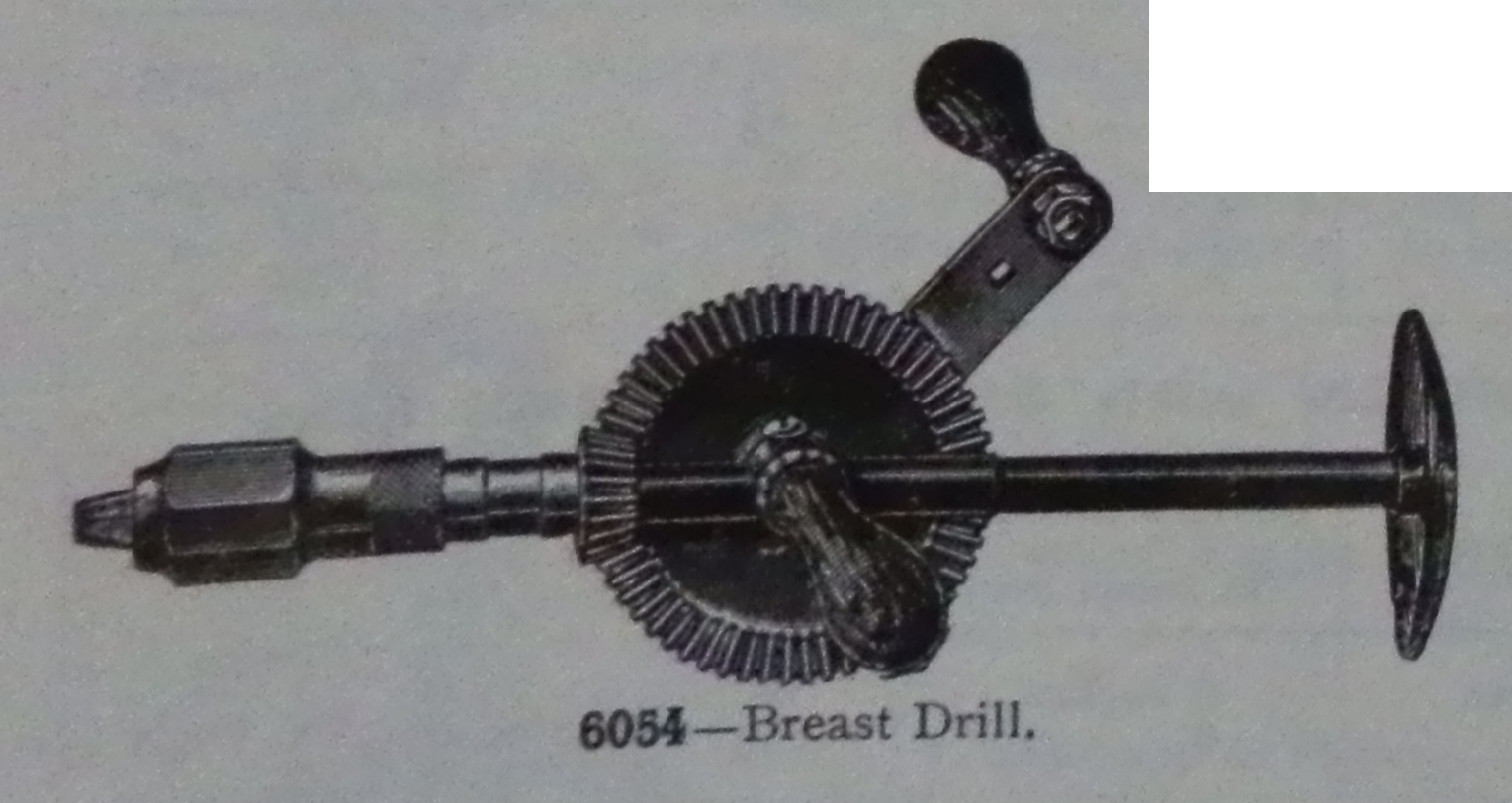
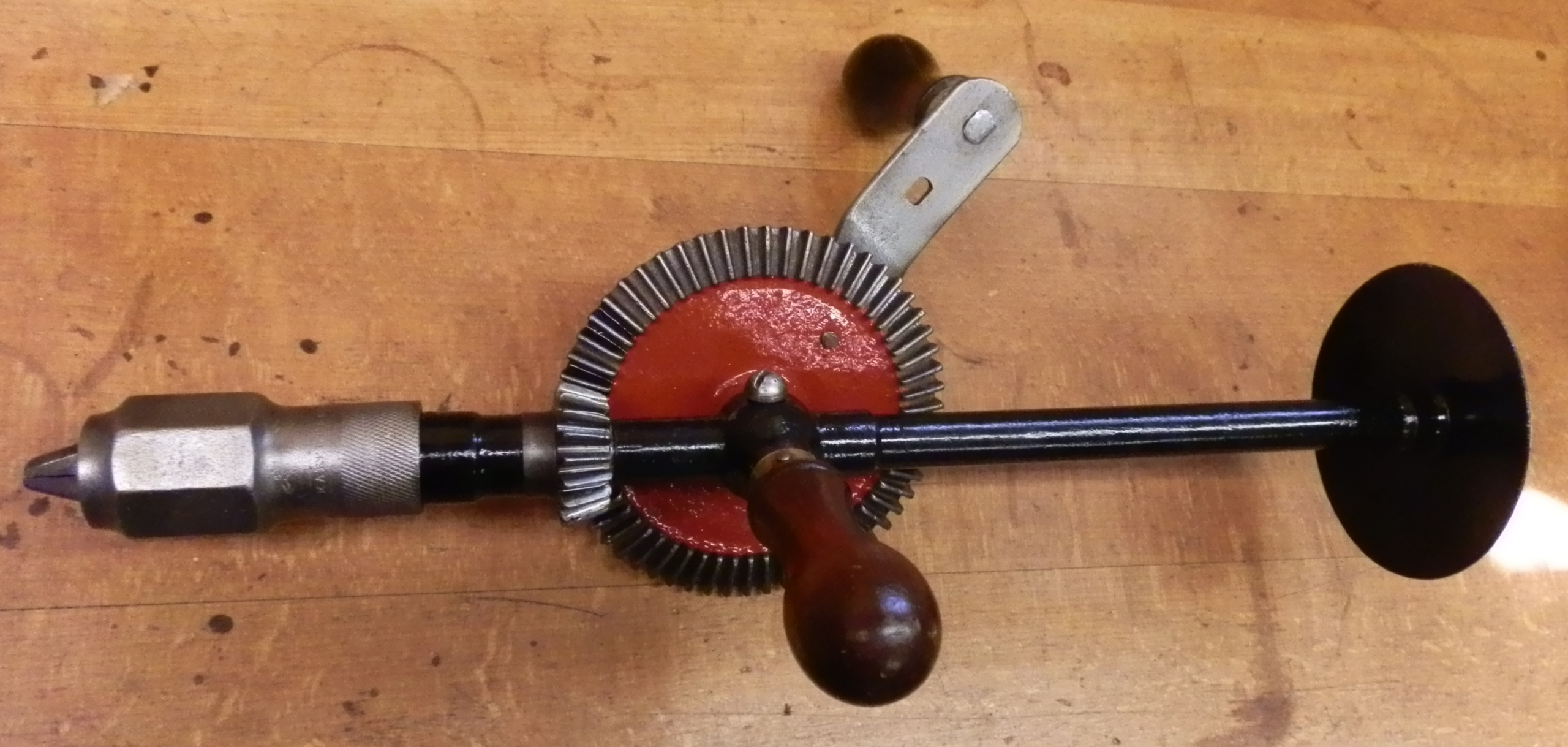
These planes were basic to any woodwork shop and can be therefore found as far back as the 1861 Catalogue:
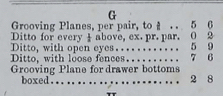
I am unsure what ‘with open eyes‘ and ‘with loose fences‘ mean but the latter may be an early term for Moving Grooving planes. It seems that even at this stage these planes were always of necessity sold in pairs [one for tongueing and one for grooving, in other words ‘matched‘].
The 1873 Catalogue shows that a numbering system had been introduced:
{Actually the numbering system is first found in the 1868 Catalogue}


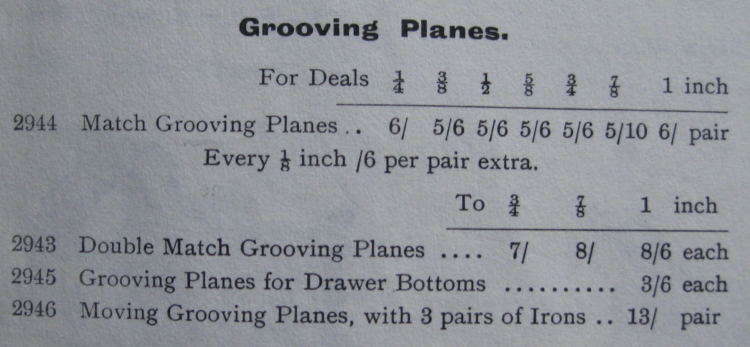
The 1897 Catalogue shows these entries with newly assigned numbers:

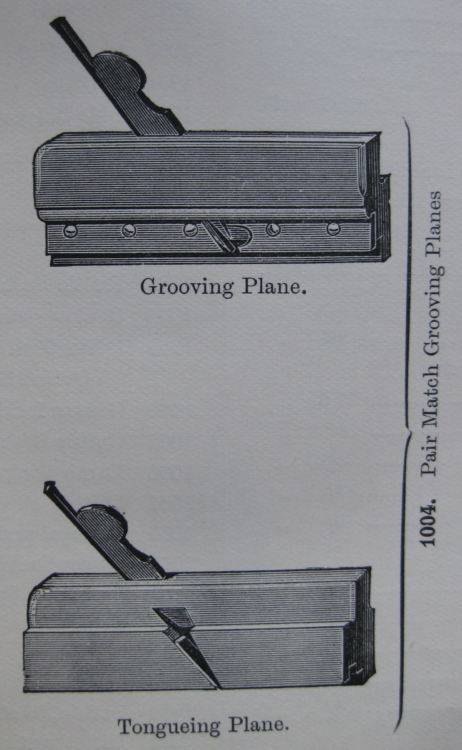
It should be noted that the sizes given above for the Match Grooving planes are for the width of the edge of the boards on which a Tongue and Groove joint is to be enacted. Each of these planes has, according to edge width, a fence cut into the base against which the board is in contact throughout the cut. The inch markings on the Heel are therefore not the width of the actual Tongue or Groove. The width of the Tongue or Grooving cutters is set at close to 1/3rd the board edge width.
So by 1909 we see this [different item numbers again!] and note the introduction of the Double Match Grooving plane, which could perform both of the functions of the individual planes [i.e. Tongueing AND Grooving].
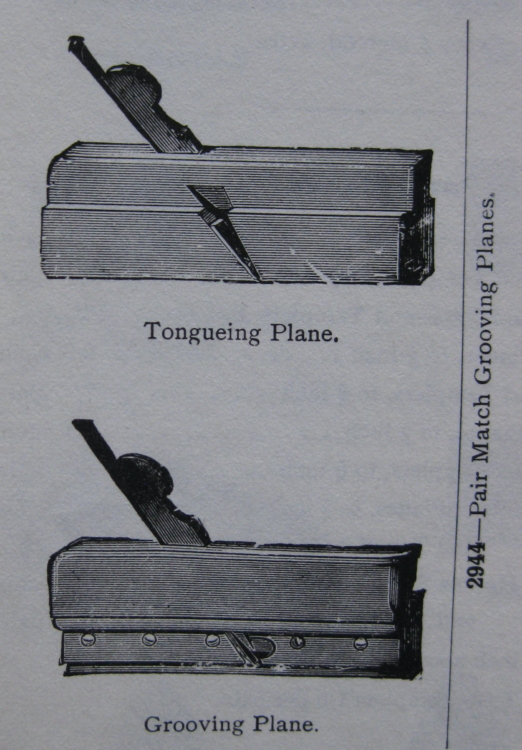

Here is the 1921 entry showing little difference to 1909:
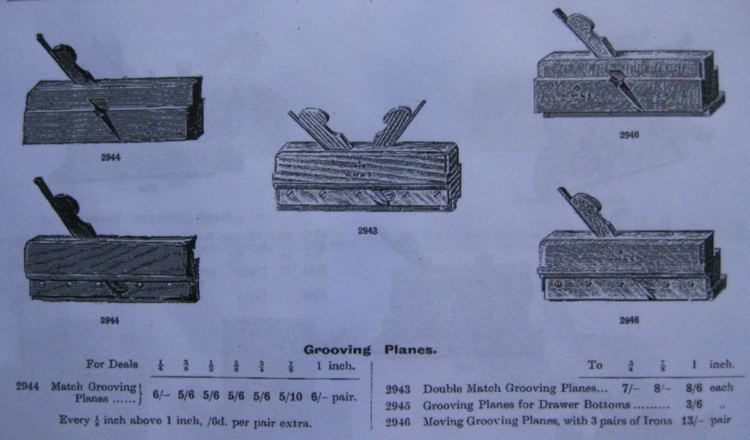
1928 shows that #2944 stays the same number, whereas the Moving Grooving planes now are numbered #2947 and are also now called ‘Match Grooving Planes with Moving Fence‘; the Drawer Bottom Grooving Planes are now #2948 and the Double Match Grooving Planes become #2949. As shown here:

1938, note the reduction in variety offered, the Double Match Grooving is de-listed as is the Drawer Bottom Grooving plane:
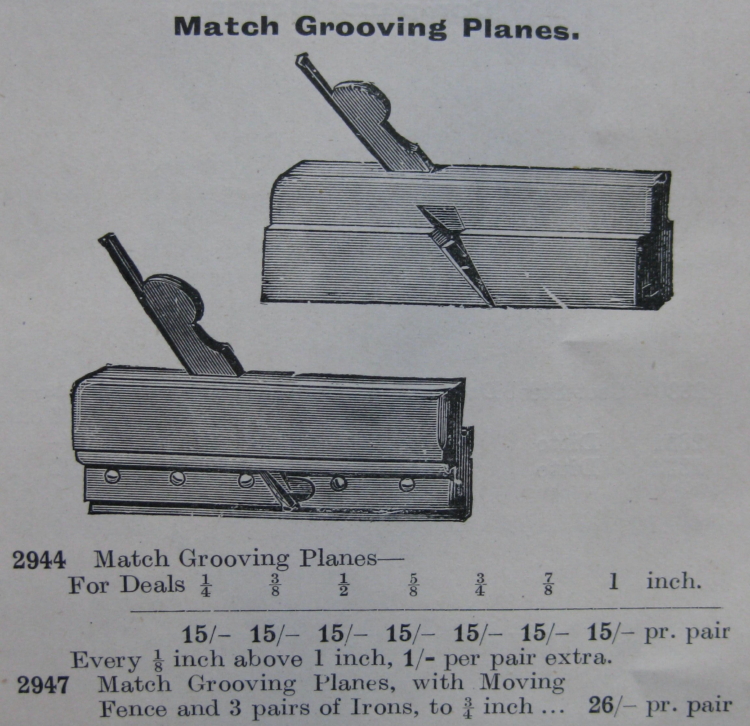
1959, offered the same planes as in 1938:

The last listing for these planes appears to be November 1963 when #2944 were 39/9d per pair and #2947 were 63/- each
GALLERY
Below are pictures of a ‘Matched pair of planes’ in beech:
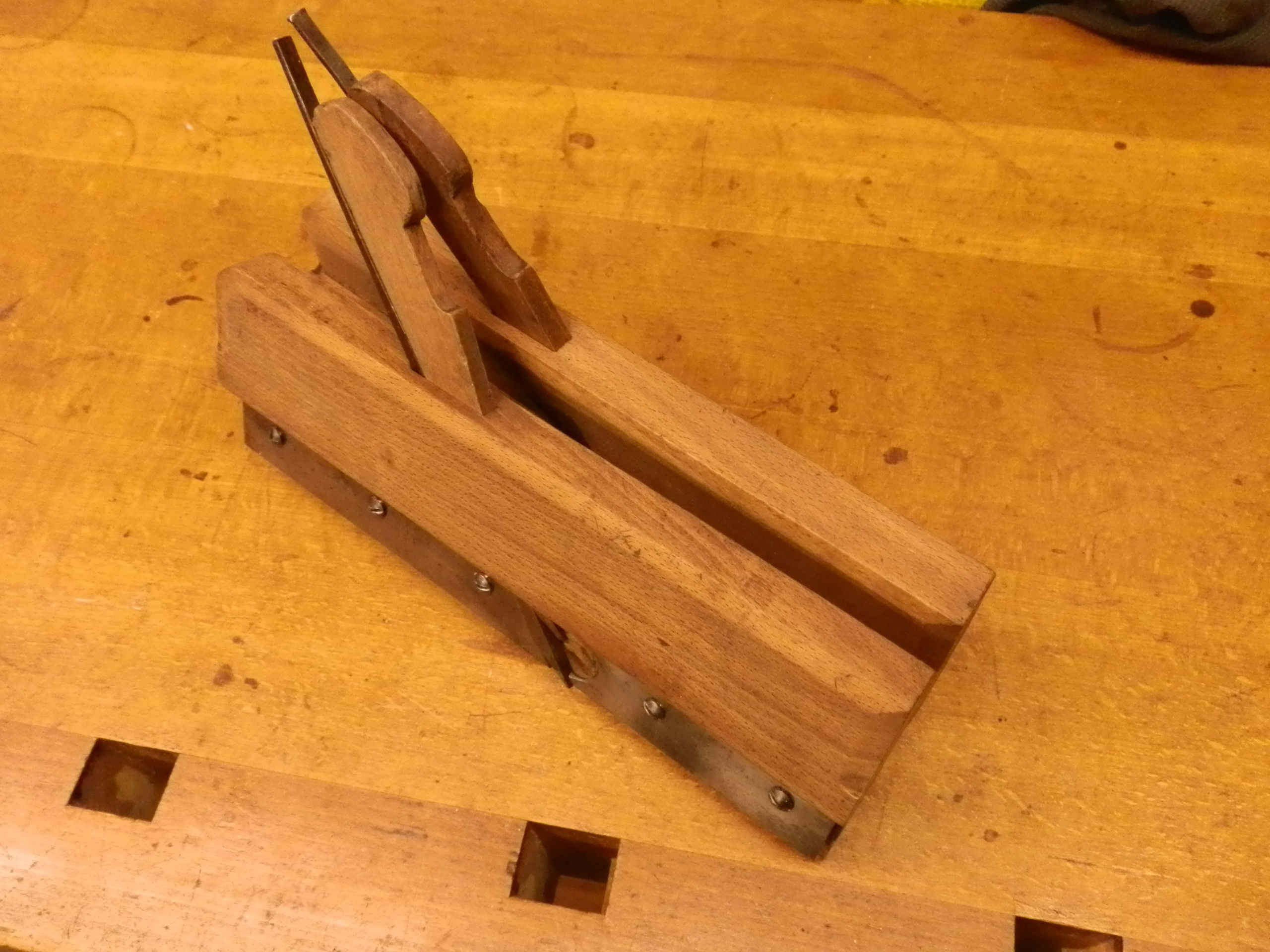
 only
only
The ‘Grooving Planes for Drawer Bottoms‘ first appeared in 1861, when it is noted that they were ‘Boxed’. They went through many Item # changes …#884 in 1873; #1011 in 1897; #2945 in 1909 and #2948 in 1928. They are not seen in the 1938 Catalogue. In none of the Catalogues is an actual picture shown, but I am assuming that the two planes shown here are ‘Grooving Planes for Drawer Bottoms’. The cutters are 1/4inch wide but I cannot fathom out why there should be 2 ‘mirror image’ planes for this task unless to only accommodate grain direction?


These planes seem to vary in their spelling..Filister and Fillister.
MARPLES initially made them in all 3 forms, Standing Fillister; Moving Fillister and Sash Fillister.
The Standing Fillister was basically a Rabbet Plane with a fence cut solid in the stock.
The Moving Fillister plane had a adjustable fence that moved under the stock so as to expose as much of the cutting iron as was needed for the rebate that was to be made.
When working sash timbers the rebates may be cut on either the left-hand or right-hand sides of the wood. The ordinary Moving Fillister can be used for the left side, but for the far side, a Sash Fillister plane is used that has the cutter, stop and spur mounted on the left-hand side of the stock, instead of the right. Thus the fence bears on the face of the work and is carried on two stems like a Plough Plane. [This description is from Salaman’s ‘Dictionary of Tools’]
These planes are to be found firstly in the 1861 Catalogue:


The 1873 listings are here with item numbers, and it can be seen that the Standing Fillisters are no more [see 1909!]:


We then jump to the 1897 listings which again show new item numbers.
But you will see that the #1003 Sash Fillister image is numbered incorrectly, as in fact #1002 Shoulder Boxed plane is shown. This error was perpetuated until it was corrected in the 1921 Catalogue!


Here are the 1909 listings, again with a new item numbering system and the re-introduction of some Standing Fillister Planes. [#2935 image is in fact #2934].


Here are the 1921 listings, but with the Standing Fillister planes no longer presented. [#2934 image is now correct].


1928: Sash Fillister plane shown as #2935 is AGAIN numbered incorrectly and should be shown as #2934 !

1938:

And then on to the last showing in 1959. At last, again, the #2934 image is correctly numbered:


The last listing to all of these planes seems to be found in November 1963,
as around this time the last craftsman Moulding plane maker employed by MARPLES retired.
Gallery:
Sash Fillister Planes:
Below are 2 Sash Fillister planes, one is Shoulder Boxed and one Dovetail Boxed.


detail of the side:

I have found a variation on the ‘Dovetail Boxed’ variety and so it may be that the example above was also a ‘Shoulder Boxed’ plane that had dovetails securing it. [Shoulder boxed means that the lower left hand edge of the plane was boxwood and this could be achieved by either a dovetail method or a more simple joint as shown.] The variation I have may be the true ‘Dovetail Boxed’ in that the lower portion of the Filister body has been replaced by double dovetailed boxwood that extended the whole length of the body. But there again it may be that the first example is an earlier version of ‘Dovetail Boxed’ ! See below:


The early Sash Fillister planes show a Patent number [19943] on the Brass Screw stop thumb turn and the Brass fence itself, and also show that the steel threaded rod of the stop was held in place by 2 brass counter tightened nuts. I do not know for how long this securing method was used or whether it was part of the Patent.[This Pat. Date was not a MARPLES Patent, so they must have been Licensed to use that Patent.] The stamped MARPLES mark shows as being c.1880-90 which ties into the Pat. date of 1885:


Here is #2935 from the 1909 Catalogue and with a Boxwood Fence:

Moving Fillister Planes:
The first plane shows the Brass Slip Stop and Tooth [the latter being a single blade which is dovetail fitted into a groove in the side of the body.]


The second plane shows a Brass Screw Stop and Forked Tooth, Dovetail Boxed:


Standing Fillister Planes:
The plane shown is my only example of a Standing Fillister and I assume that these came in different widths because this one is marked 1/2 on the heel? It does indeed look like a Standard plough plane with an integral fence cut into the sole.


These planes, used to start a moulding, were produced and sold in matching pairs so as to overcome grain direction.
The 1861 MARPLES Catalogue lists them as ‘Snipes Bill‘{singular}:

The 1873 Catalogue now gives them item numbers and changes the name to ‘Snipe Bills‘{pair} :

Both Snipe Bills and Side Snipes appear in the 1888 Catalogue as #1053 and 1055 respectively.
The 1897 listing is below, showing new Item numbers:

1909 shows another number change:
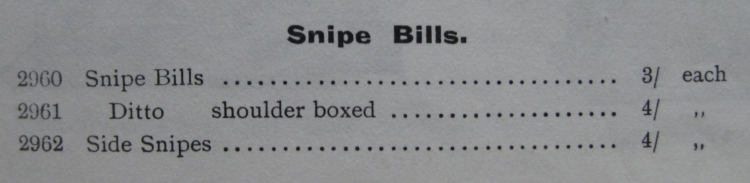
They are omitted from the 1921 Catalogue but re-appear in 1928 [below], but that was the last catalogue reference that I can find for Snipe Bills.

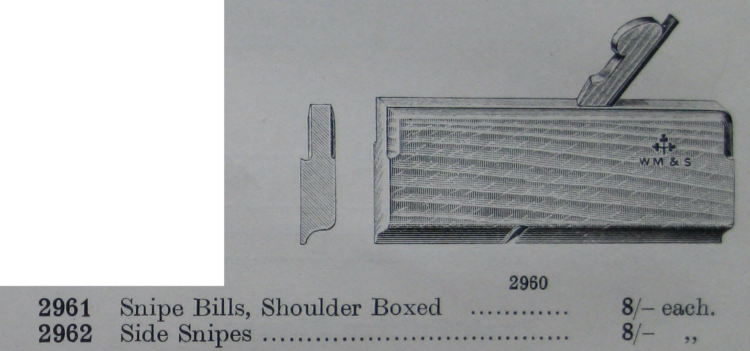
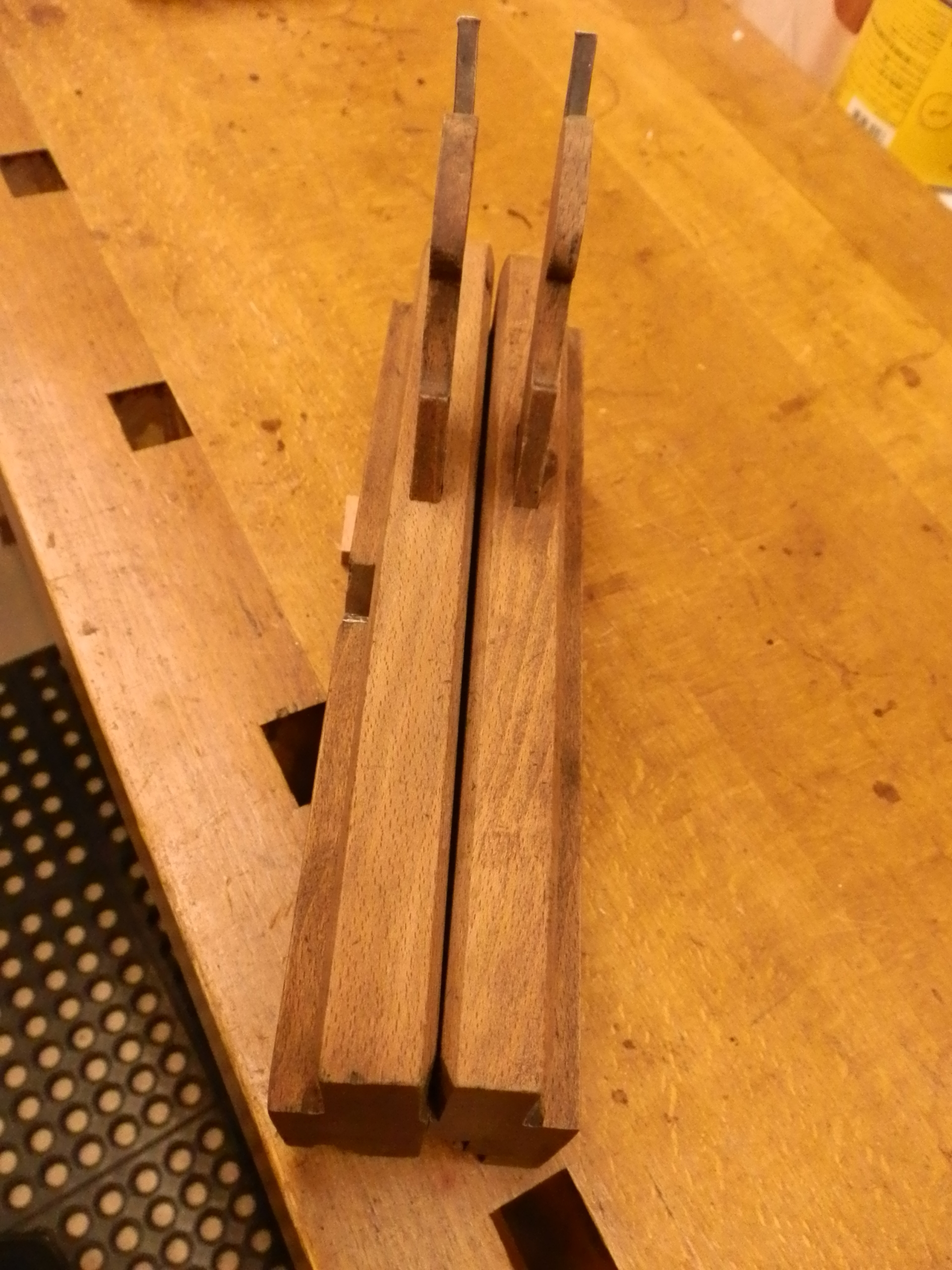
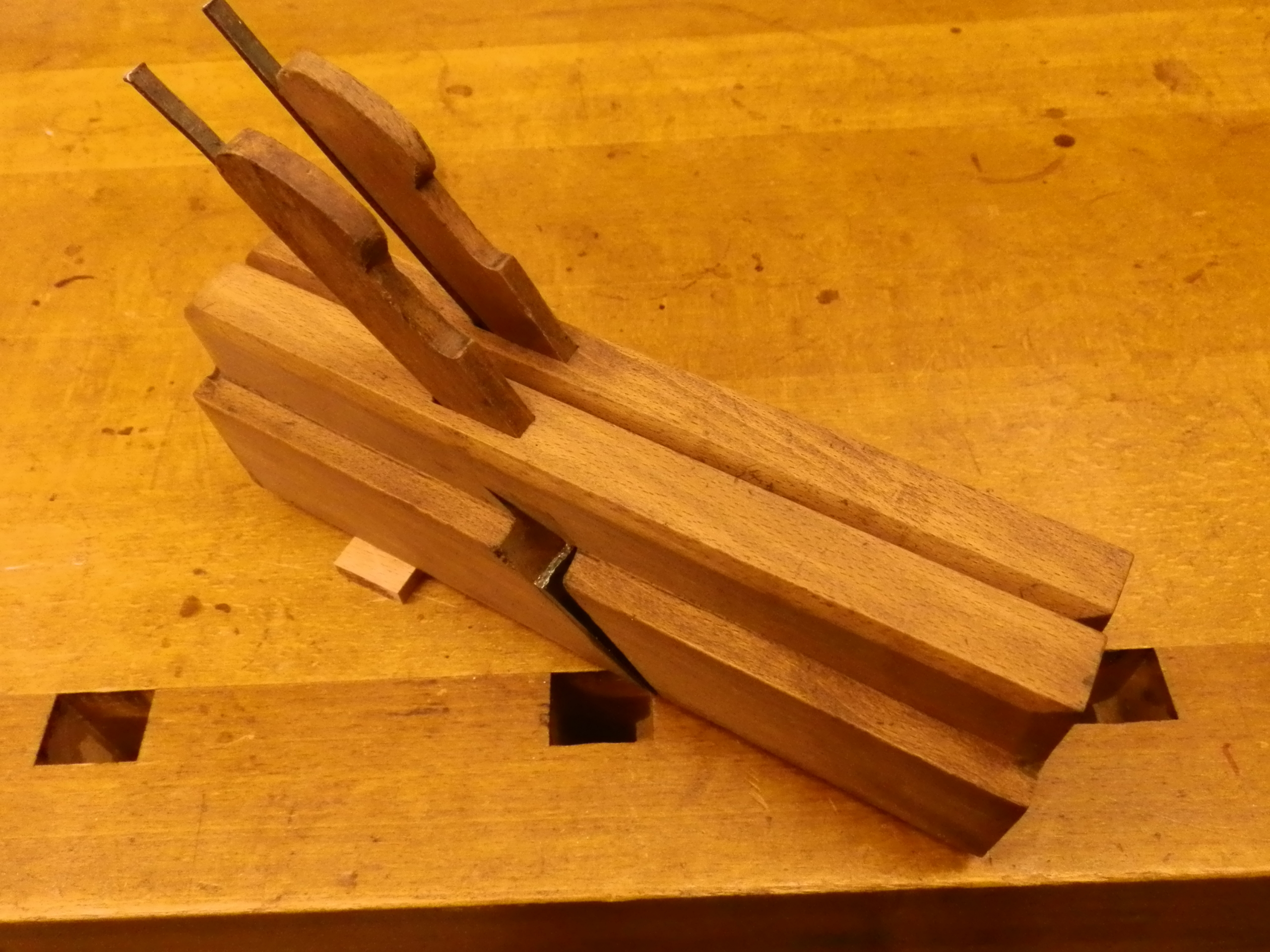
In no catalogues can I find an illustration of Side Snipes. These tools had an almost vertical side cutting edge and were used, as were Snipe Bills, to trim and clean up mouldings and Snipe Bills could also have been used to start a moulding. They were generally sold in pairs so as to deal with grain direction. A pair of Side Snipes is shown below:

Shuteing Planes, also called Mitre Shuteing planes or Mitre Planes seem to have entered into the production by MARPLES around 1903?. They are not shown in 1897 but are in the 1909 Catalogue and presently I have no access to the 1903 Catalogue.
The initial showing in 1909 [below] indicates a range of sizes and blade configurations but this was short lived.
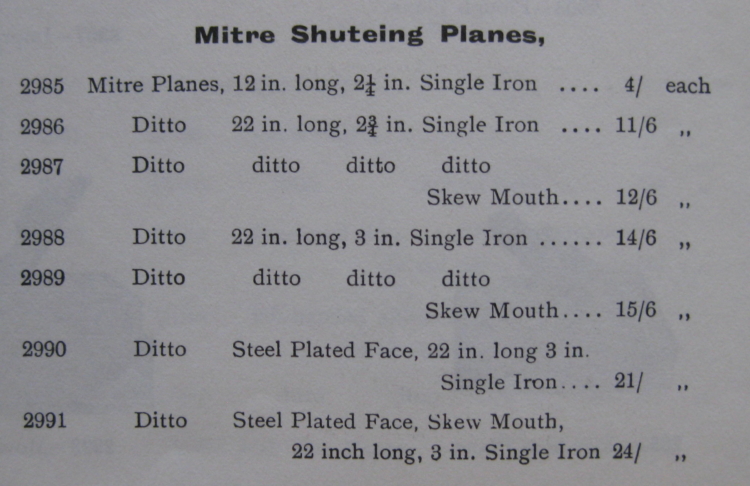

By 1921, admittedly just after WW1, when across the board there was a reduction in variety of tools available from MARPLES, it can be seen that fewer of these tools were offered. The planes numbered 2988: 2989; 2990 and 2991 are no longer to be found as available.

The 1928 and 1938 listings are exactly the same in availability and price and you will see that the short 12 inch #2985 is no longer listed:

The next entry is in the 1959 Catalogue which shows that by then the Square Mouth #2986 has been dropped from production [because the skew blade is so much more efficient for these cuts]. ALSO the remaining plane has been re-numbered from #2987 to #2988.

The last listing that I can find for this plane is in the November 1963 Price List, it is not shown in the March 1964 PL and I surmise that the last offerings were c.December 1963.
Below is a 22 inch Skew Mouth Shuteing plane with a 3 inch single iron, #2989. This plane is only seen in the 1909 Catalogue, maybe because it is huge and heavy! { I do note that the side handle is forward of the cutter rather than behind as depicted?}
