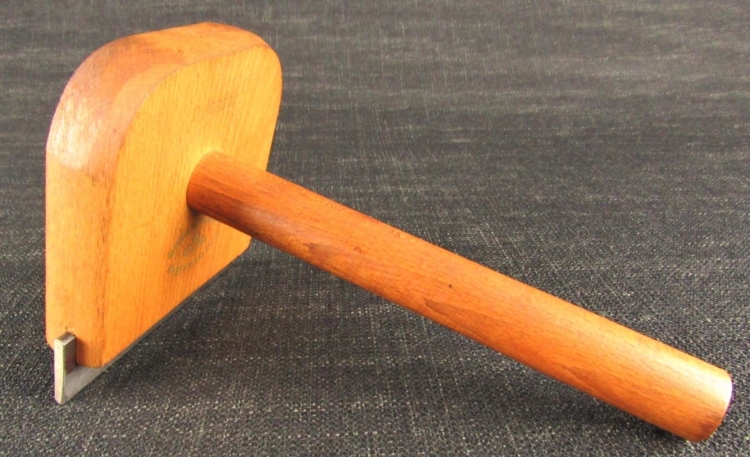
Veneer Hammer
Called a ‘Veneer Flattener‘ throughout MARPLES history, the first reference to this is found in 1897, when it is described as Item # 1115 ‘London-pattern Veneering Hammer‘. There are no illustrations, but I hazard that this was an Iron head for a shaft to be fitted.
The Wooden Veneer Flattener appears in 1909 as Item # 3907 and this item number endured until the very end of production and with exactly the same illustration! It can be found listed under ‘Upholsterers’ Tools'[?] , and was produced until February 1962 [listed at 6/6d each.] The photos below show a great example and the catalogue reference is from 1928.


SHEEP SHEARS
I have found ‘Sheep Shears ‘ listed in the Catalogues as far back as 1873 [below]:

Those in 1897 are shown below:


Those of 1909 are shown below:


Those of 1928 are shown below:


Those of 1938 [below] are virtually the same as 1928 although just a little more expensive:

1959 Shears available are below:
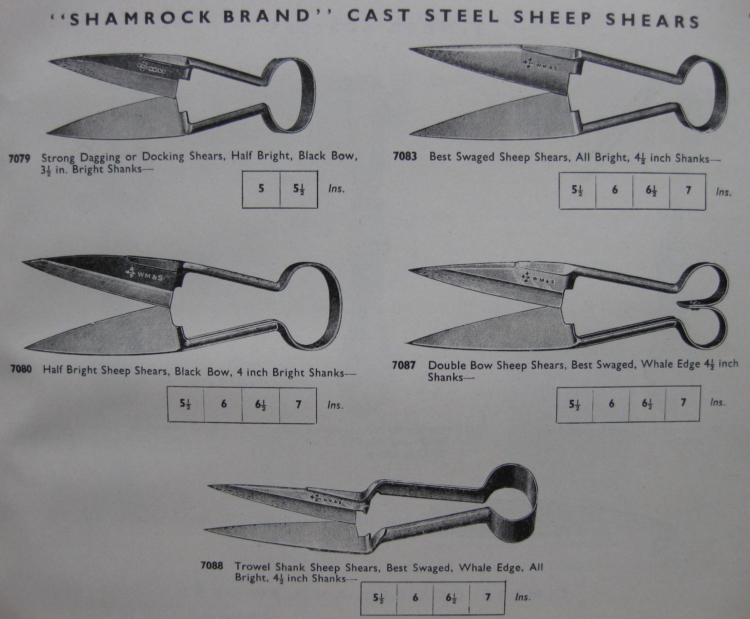
The April 1961 PL shows the same item#s and sizes as in the 1959 Catalogue. The 1962 PL shows the presence of #7079 and #7080, but the numbers 7083; 7087 and 7088 were still available, but not in the 5.1/2″ size. By the 1964 PL only #7083 was available and then only in the 6.1/2″ size, and this was echoed in the May 1966 PL.
The catalogue entry for 1965 is below:

The last catalogue entry [ for #7083] that I can find is November 1969 priced at 25/6d. It is hard to judge the age of this good example:

In this section I will try to describe the tools that were used my ‘Tinmen’.
I will do this gradually as I acquire the tools, since this is not primarily a woodworking section!
TINMEN’S SNIPS
Shown below is Item #6703….’Tinmen’s ‘Safety’ Snips’. I have first found these in the 1938 Catalogue, but they were probably introduced before then, and they endured until the 1965 Catalogue and beyond. This pair shown here is pre-1965, because the handles are gloss paint Black, not a Crackle finish. This c.1940? MARPLES tool only states ‘Sheffield’ !! And surely there is an ‘S’ missing at the end of ‘SON’ !


Above is the 1938 listing.
Below is the 1959 listing and below that is the 1965 listing.
Note the differences in size availability between the years.


Item #6702 Tinmen’s ‘Safety Snips with Curved Blades’ c.1950? Hand forged. Available 6-12″. This example [above] may have been modified as the handle ends seem bent outwards. Non-Safety snips [<1940?] had the 2 handle ends meet, and caused pinched palms.
The snips below are Item# 6705.1/2 ‘Jeweller’s Snips with Curved blades’. Only sold in a 7 inch length they were available 1938 -1965 [although the 1965 entry shows the handles to be not closed at the ends.]

Below is Item #6690 ‘Solid forged Bow Snips, Bright blades, handles finished Green’. These heavy duty snips only appear in the 1938 catalogue available as 8″; 10″; and 12″ These black handled snips should be Green!!

TINMEN’S HAMMERS:
Below is an excerpt from the 1909 Cat. showing the hammers available:

#6778 Hollowing Hammer is first seen in 1897 Cat. but these hammers were not handled at that time. In 1938 handling was an extra cost whereas in 1959 the hammers were only offered handled. [as shown below]. The last listing I can find is in Nov. 1963 when only 1, 1.1/2 and 2lbs hammers were shown.

TINMEN’S MALLETS:
This wooden mallet is first introduced by MARPLES in 1909 Item #6718 Ash handled with a Boxwood 2.1/4″-3″ diameter head. The 1921 Cat shows the same listing, but in 1928 this listing appears as being available in either Boxwood head or Lignum Vitae head 1.1/2″-3″. The 1938 Cat shows the same, as does the post war 1959 Catalogue. In 1965 only 2″-3″ Box or Lignum Vitae was available and the last time this tool was offered for sale by MARPLES was in the Price List of November 1st 1969 as per 1965 listing sizes. Note: Over the years different wood shafts and heads were also offered under different item numbers.

It is apparent that MARPLES were involved in the manufacture of Spirit Levels very early on, since the first reference I can find is in the broadsheet of 1846:

By 1861 the range has expanded somewhat:


And has increased substantially by 1873:


Next are the 1888 catalogue entries:


The 1897 Catalogue entries are here:


Next is the 1909 Catalogue:


Next are the 1921 truncated catalogue offerings:

And then to the again expanded 1928 listings:


Those 1938 listings are here:


The 1959 issue catalogue shows a slight decrease in availability:


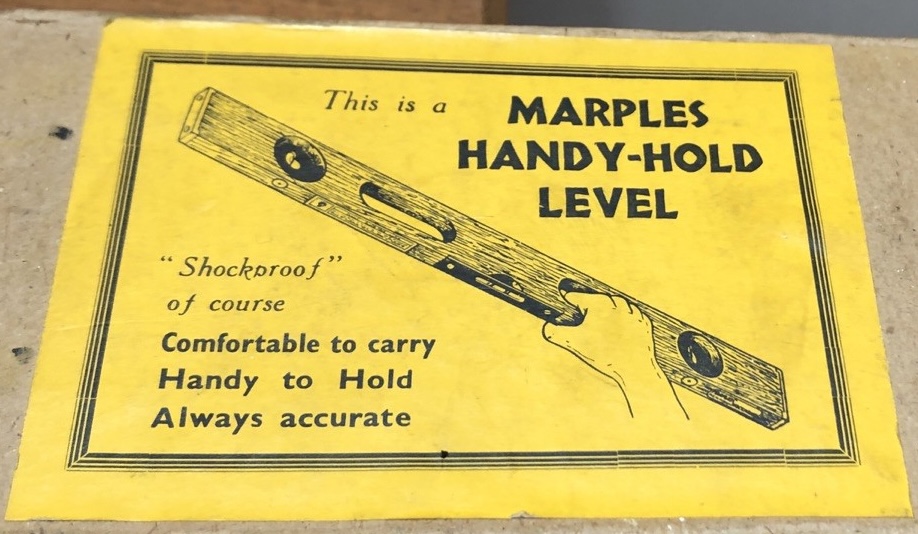
Below is a label from a box containing a level with a ‘Handy Hold’ feature:
But by the time the 1965 Catalogue was issued, things have changed:


The 1972 and Supplemental Catalogue show these levels:


Below is a table that I have constructed to show the Levels available from 1909 onwards and of necessity I have had to use short forms. Please understand that when, for example, a date of 38 [1938] is shown and nothing else, this indicates that the level is seen in the 1938 Catalogue but I have no information as to when it was introduced or discontinued as it obviously does not show in the 1928 or 1959 Catalogues.


Short Forms:
Adj. = Adjustable
Al = Aluminium
Box = Boxwood
Br = Brass
c = with
Hdwd = Hardwood
Mahog = Mahogany
N21 = Not listed in the 1921 Catalogue
P = Plated
Pl = Plumb
Rswd = Rosewood
S = Shockproof
SE = Straight Edge
TE = Tipped Ends
Here I can present to you some good examples of Spirit Levels:
It should be noted that the ‘Plate’ is the Brass plate affixed to the top of the Spirit Level and that the ‘Tips’ are the Brass plates affixed to the bottom of the Level at the ends.
#442 . You have to go back to 1873 to find this rarity. It is described as ‘End and Side view Spirit Level’, but clearly has an Early Field sight. I cannot find it in 1888, so cannot even guestimate start and end production dates. This level came as 8″; 9″; 10″ and 12 “. This one is 10″. A similar Level is shown in 1861 but that one is plated on the bottom as well. Rosewood and is Heavy plated:


#443. This pattern below appears in the 1873 Cat. and the example below is c.1880. They were manufactured as 8″;9″;10″ and 12″ and described as ‘Horizontal and Plumb Spirit Levels“.

#452 . Ebony Scotch Pattern Spirit level. First seen in 1861 it was numbered #452 in 1873 and renumbered #604 in 1888. Re-numbered again to #2286 in 1909 when it was available in 8″; 9″; 10″ and 12″. After that it is not to be found so maybe was phased out c.1914.

#453 [1873] Ebony Spirit Level with raised tube. Later renumbered in 1888 to #605. Not seen in the 1897 Cat.[ Listed as 10″ but actually 9.1/2″]:

#2270 Narrow Hardwood ‘Shockproof’:

#2277 Narrow Ebony plated Spirit Level was available up to c.1930. It was introduced in 1873 as #450, became #602 in 1888 and #2277 in 1909. It is seen with a thick plate and tips:

#2280 Best Rosewood, Strong Plated [but not ‘tipped’] Noted for its’ square ends it is first seen in the 1862 catalogue, became #440 in 1873, #591 in 1888 and finally #2280 in 1909 and lasted up to c.1928. The rounded side porthole would indicate a very early issue. The 6 inch size was added in 1873 and at that time sizes available were: 6; 8; 9; 10; 12; 14; 16; and 18 inch. In 1909 the range has depleted to just 8; 9; 10 and 12 inch

The two shown below are both 10″ and the earliest one is at the front:

Below is a 6″ #591 c.1870 with brass screws holding the strong brass plate.

#2285 Rosewood Scotch Pattern Spirit Level. This level is hard to distinguish from #2272 which was made of Walnut. In the photo below the middle level could be #2272.

#2286 Ebony Scotch Pattern with Brass Mounts, this one is 8″ :

#2290 This is the level with the brass slide over the glass tube. Ebony based.
c.1909 to c.1928

#2301 Walnut with Plumb tube and end tipped. Was available as 8;9;10;12;14;16 and 18 inch lengths. 1″ wide and 1.1/2″ deep this one is 8″ long:

#2306 Best Walnut with Plumb and Field Sight:


#2317 Thin Mahogany Boat shaped level. Quite a common level which became ‘Shockproof‘ c.1935. First seen and numbered #620 in 1888 it became forever #2317 in 1909 and until 1972.[ The ‘Shockproof‘ Patent was numbered 423896 and was stamped on the plate on all levels so equipped and they all had coloured liquid {1928<} in the vials.] In the photo below both the front and back levels are not Shockproof and the front level is the oldest of the group. Presently I am unable to explain why some levels have a brass cross-piece in the plate , whereas others do not!!


#2318 Narrow Hardwood with Plumb Tube, Brass Tipped, Shockproof:

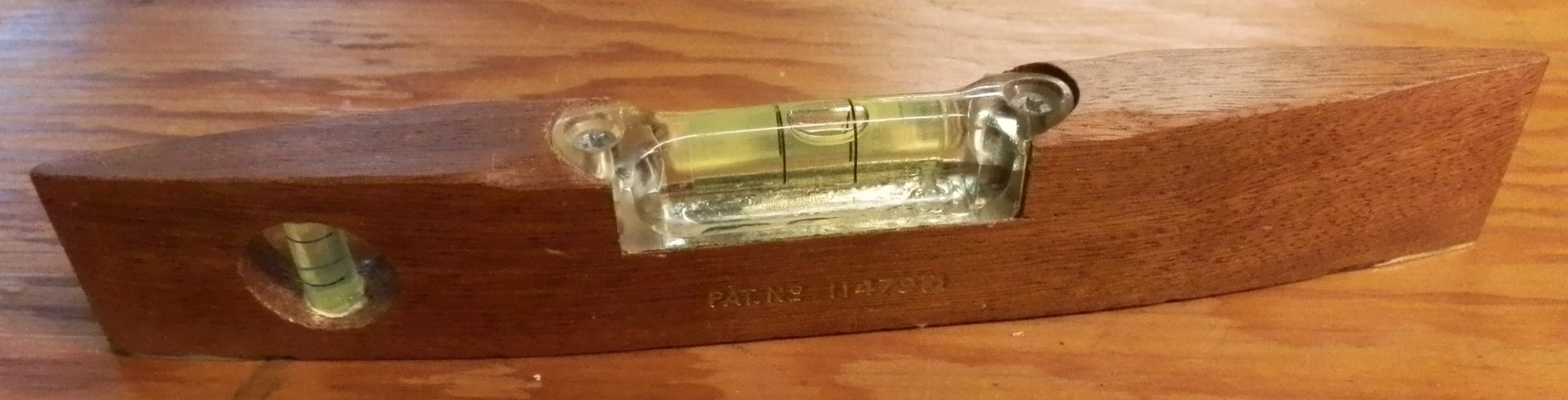
#2320 Easy View Pocket Level:
This 9 inch level had a Patent number of 1147981 which was granted on 10th April 1969. It may have neen introduced earlier but it first appears in the 1972 Catalogue. The horizontal level was completely of clear plastic and was virtually indestructible. It was available for a very short time and does not show in 1977. The earlier ones had the plumb level inserted from the top and the hole filled with a brass washer…the later ones had the level inserted from the bottom and the hole was sealed with plaster.


Below is another 2320 level..but with the plumb level inserted from below?:
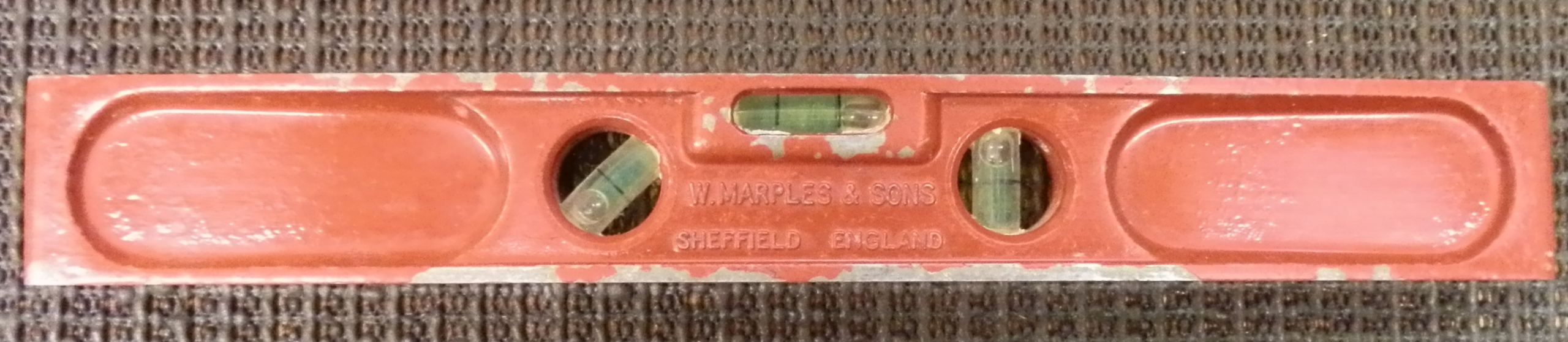
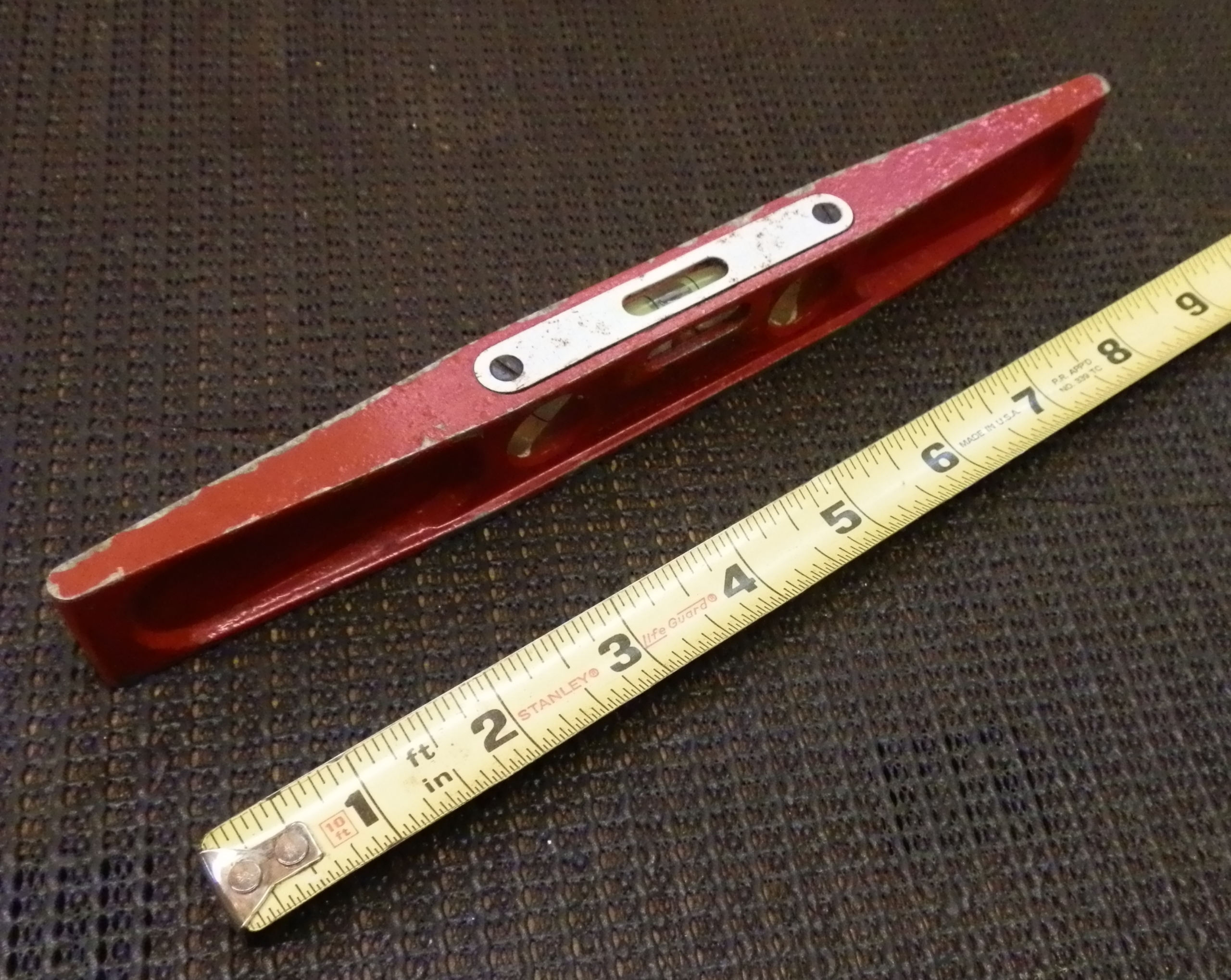
#2321 Cast Aluminium ‘Boatshape’ with Plumb and Mitre Tubes:

The #2321 was first seen in the 1938 Cat. where it was listed as having ‘Shockproof‘ vials. But by 1959 the design had been changed and although listed as #2321 ‘Bright’ it was also to be had in 6 different colours [Item #2321 C6] The level was still listed as such in 1972 and maybe for a year or so after. Below is the 1938 initial listing:

Below is the 1959 listing:

And here is a Red variation of #2321 C6:
#2327 Narrow Boxwood [3/4″] Rule marked and available in 1928 as 6;8;9;10 and 12 inch lengths. Later issues were ‘Shockproof’. The 1959 Cat. indicates that these had tipped ends and available as 8;9;10 and 12 inch.
Available 1928-12/63:


#2328 Masons’ Boxwood, Rule-Marked with Plumb. This level was discontinued in 1928:

#2328 Pocket Clip Spirit Level. Available 1965-c.1972.

#2329 ‘Roadmakers’ Brass Level’ [shown is a later example]. They were listed 1909-1938 and therefore may have been available c.1902-1940


#2331 Engineers’ Adjustable Brass Tube with Revolving Tube protectors. The second photo is of a later less fancy design:


#2332 Builders’ Hardwood with Plumb. Tubes protected by glass’ Windows’:

#2333.1/2 Builders’ Adjustable Spirit Level 36″

#2336 Builders’ Shockproof Spirit Level:


#2336H Builders’ Shockproof with ‘Handy-Hold’:

#2338 Tube levels 2.1/2″ Assorted colours:

#2346 Builders’ ‘Magnesium Alloy Girder section:

#2349 Six way adjustable level 2ft:

#2358H Builders Six Way Spirit Level. This is the best that I can do as the actual level is longer than I can effectively photograph!

#2359H Builders’ Level 48″ and 42″


A page still under construction March 202


This next object [above] is from the Machinists line really, but it is unusual to find it in this fine condition today. It is in the 1928 Catalogue as Item #6290 and described as a Double Circular Imperial Standard Wire gauge Sized 1-26.
A page that is still under construction. March 2023
BENCH HOOKS
These wooden tools were designed to help saw at the bench with a Tenon Saw and also to avoid damage to the bench when chiselling etc. and were first seen in the MARPLES catalogue of 1909 as Item# 4737 sized at 6″ x 10″ x 5/8″ thick. It can be seen that the cross pieces traverse the whole width of the base piece and therefore these Hooks were not, at this time, destined for use in sawing.
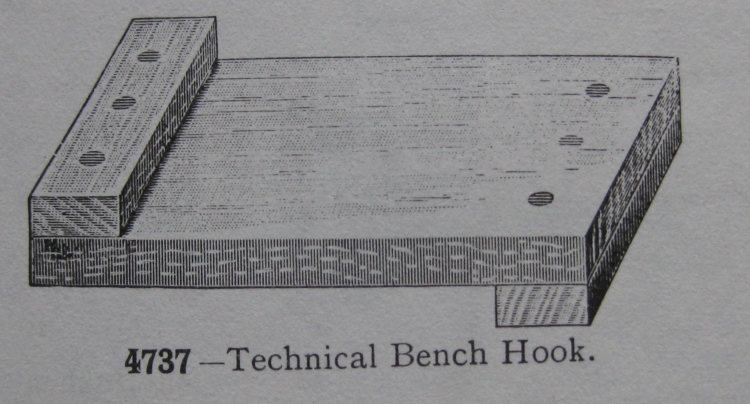
A listing in the index of the 1921 Catalogue shows up, but that is all there was, no page number given or further description. I surmise that, as with many other tools , these were de-listed around 1915 due to the upheaval of WWI.

The Hook in the 1928 Cat. [above] is now Numbered 7737.
The listing in 1938 is essentially as above except priced at 1/9 each and showing another Item number change to 4697.

In 1959 the same picture is shown [below], but I well remember my woodwork classes in 1957 and having a Bench Hook with shortened cross pieces for sawing. So the 1959 and 1965 images were probably outdated.

Even in the 1965 Cat. the modification is not yet shown! :

The 1971 Catalogue shows the Hook #4697 as being made of Hardwood, but no doubt it was Beechwood, as before. It seems to have no dowels in the cross pieces and at this time it would appear that the Hook was only designed for Right-handed people. See below.

In the August 1973 Cat. no Dowels are again shown. Item # M4697 below:
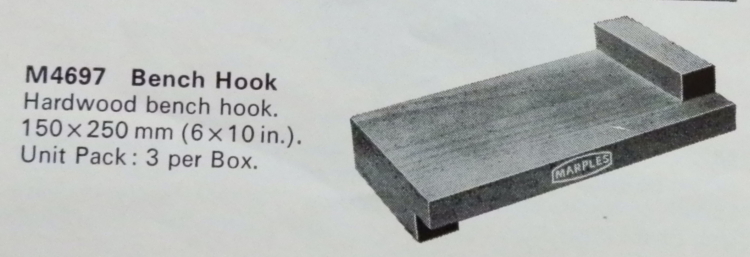
July 1979 still shows a size of 6″ x 10″ at a price of £4.70.
In 1983 the listing was changed to show a smaller sized Bench Hook
5″ x 8″ and re-numbered to MR4697 [MARPLES RIDGWAY].


In the latter part of 1988 the number was changed to MW5

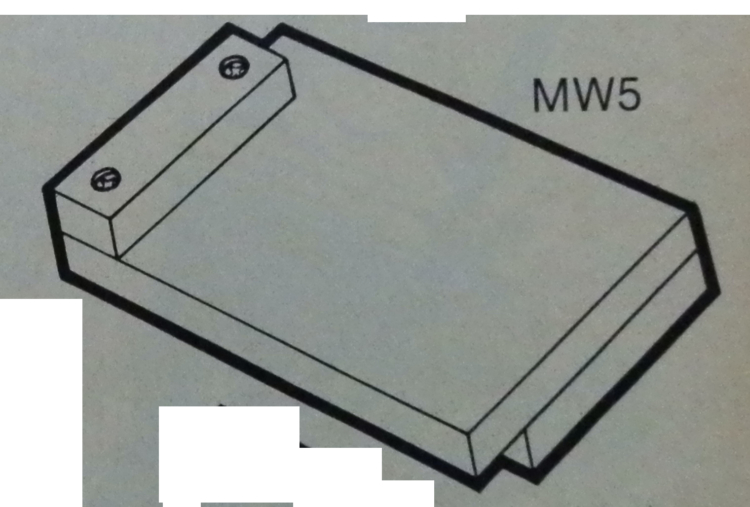
And if we are to believe this picture, the Hook can now be used by Left and Right handed sawyers.
The July 1979 information shows this very confusing statement and I find it hard to believe that the cross pieces were nailed and glued!

By May 1991 I find that the number has reverted again to MR4697 and the Hook is again made of Beech [and probably always was]. The size was probably retained at 5″ x 8″. This was when the Company was named Wm. Marples & Sons Ltd.
The pictures below show a late MR4697 and it can be seen that the Guide Blocks were placed in the centre of each edge and that they were glued and nailed.

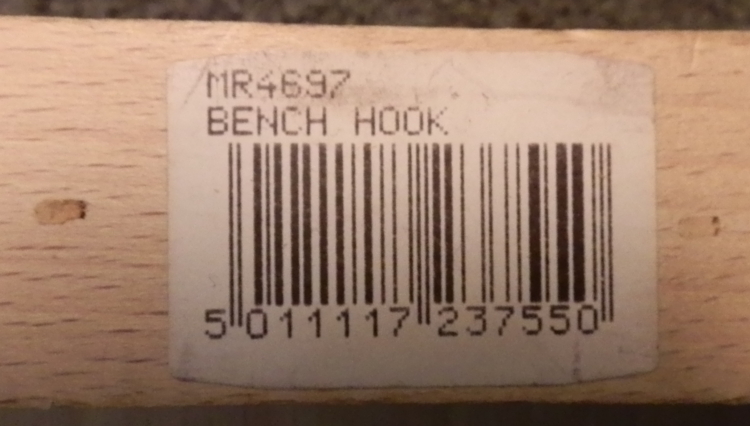

There is no mention of a Bench Hook in 1993 literature.

This page will be updated as I find new or different information.
‘Plumber’s Strong Lead Cutting knife’ c.1910 Item #6556. Beechwood scale handles.
This article has had a tough life as the blade appears shorter than illustrated, as shown below.
[Alternatively, it may be a Linoleum Knife [#3921], but these always had a LONGER blade, the handle did not turn up at the heel and was 3-pinned towards the blade end only. In other words, was not as robust.]


The above is the 1909 Catalogue entry for #3921 and below that is the 1928 Listing….note the different design.
Leather Washer Cutters:
These tools were used in a brace to cut leather washers for plumbing purposes and are first seen in the 1888 Cat. where there are 2 examples….#2039 ‘Single’ and #2039A ‘Double’.

In 1897 a new model [#2039B called ‘New Pattern’] is introduced and listed are now 3 types: 2039; 2039A and 2039B.

In 1909 the numbers all change and we see these numbers: 6560 [single]; 6561 [Double] and 6562 [Improved Double]. #2039B [with what looks like a ‘tap’ tightening clamp] seems to have disappeared.

1921 is here:

1928 shows a ‘New Design’ Double washer cutter which has Ruler markings.

1938 shows the same as 1928 but with slight price differences.:

1959 is remarkably the same as 1938!

The whole line was dropped around the end of 1963.
GALLERY:
Leather Washer Cutter #6561.1/2 [Below] is first seen in the 1928 MARPLES Catalogue and remained in production until the 1959 Catalogue and maybe beyond. It is not listed in 1965.


Leather Washer Cutter #6562 was introduced in the 1909 Cat. and endured into the 1959 Cat. and beyond. My example below unfortunately shows that one cutter hass been shortened….


PLUMBERS’ SHAVE HOOKS:
The research I did on these tools surprised me as I had always thought that they we ‘Paint Scrapers’ for mouldings. That is what my Dad used them for anyway! But apparently they can only be found in the MARPLES Catalogues under ‘Plumbers’ Tools. I have yet to discover how or where they were used in this trade and I am willing to be educated! Here are the 2 examples that I have bought:


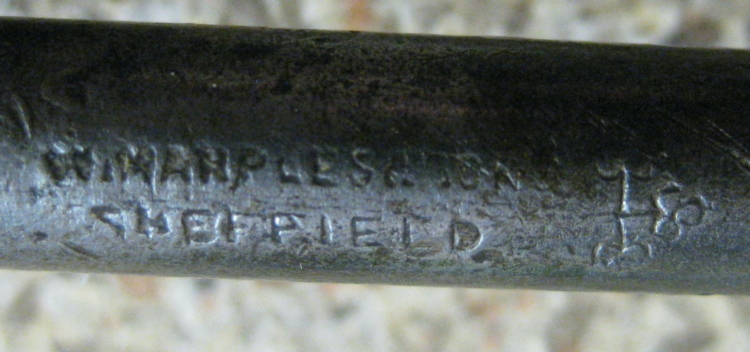
My earliest reliable catalogue of 1897 lists these 2 Shaves as #1900..Heart Shaped with Beech handles and #1902 as being a Triangular Shave. There was also a #1901 which was listed as a Heart Shaped shave with a Bent Shank:.

By 1903 the numbers had changed and #6520 was Heart Shaped, #6521 was the Triangular shape and a new shave #6525 was an Improved Shave Hook having 6 interchangeable blades of different sorts:

1909 saw further changes in that #6525 was now available with either 4 or 6 blades:


1921 Catalogue only shows [post war] Items #6520 and 6521.
But the 1928 Catalogue lists a few more shapes:
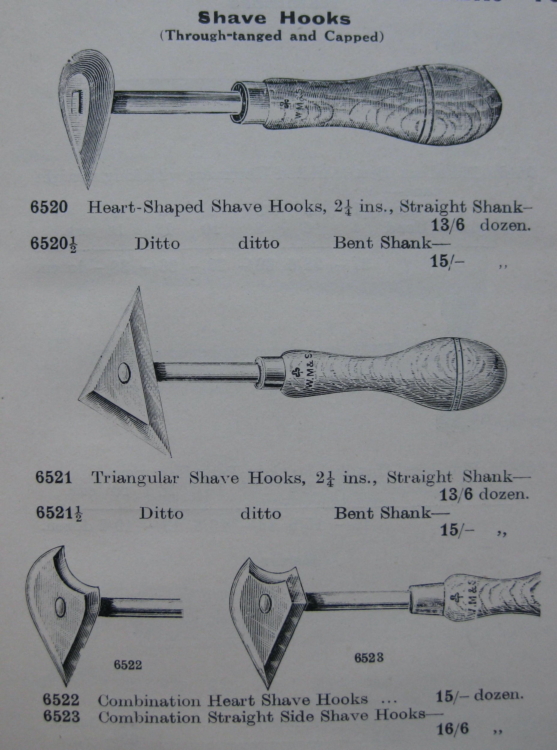
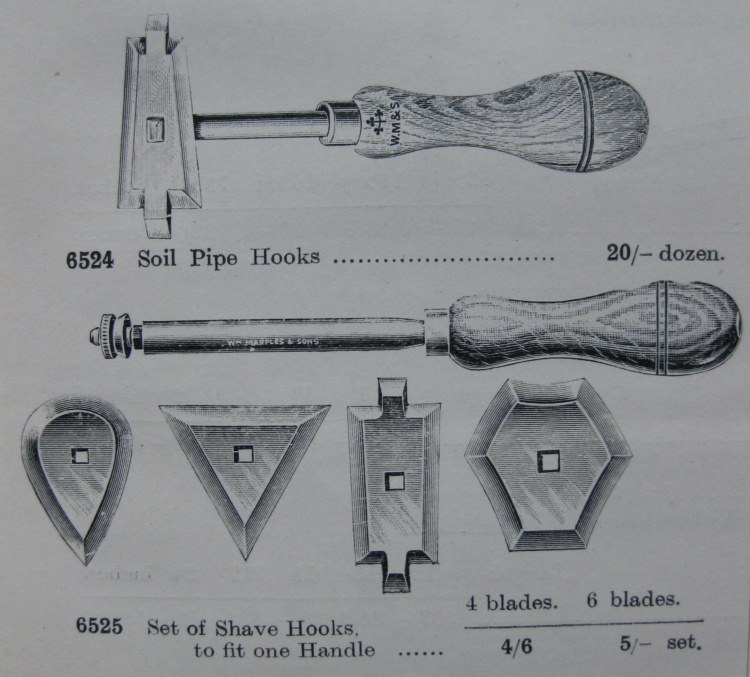
In the 1938 Catalogue the only difference is that the Item #6522 Combination Heart Shave Hook has been discontinued.
The next hard backed catalogue of 1959 shows an expected diminution of available shaves:
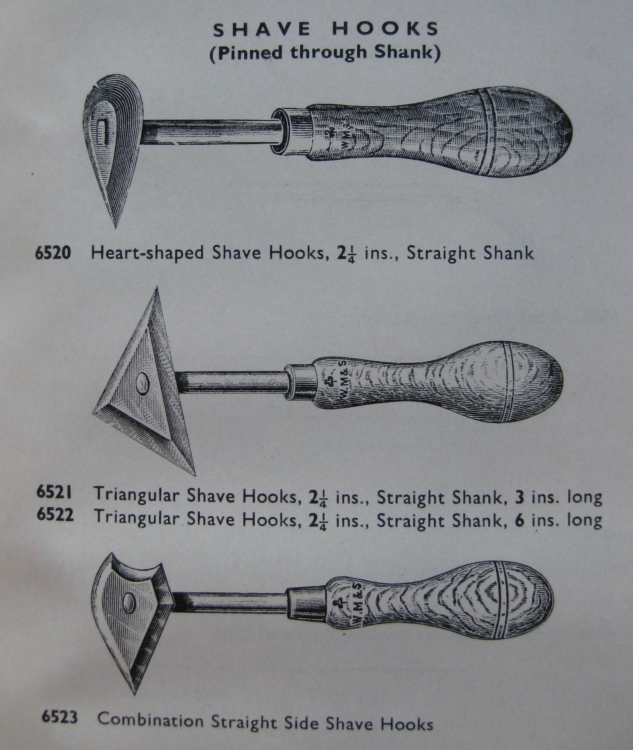
The 1965 is again reduced in availability, but these tools are listed under ‘Decorators Tools’.
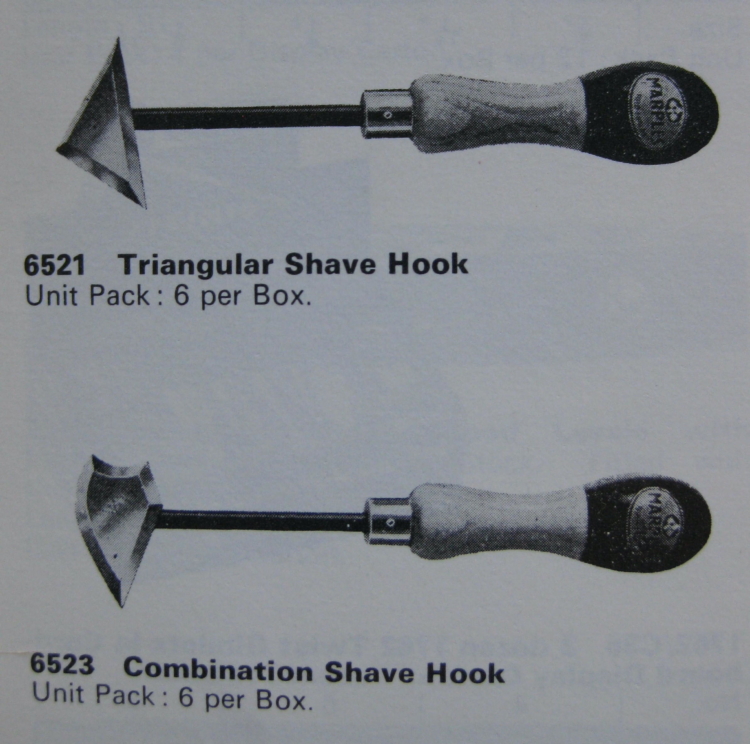
It would therefore appear that my Dad was right, they were then re-purposed and used as Paint Stripping Tools!

And in 1971 only this is shown:
SPOON HOOKS
Apparently this strange tool only appears 1909-1928 and I have no idea what it was used for!!! Item#6526


I have no idea why this tool would be marked as pre-1875~!! Unless I missed something in the catalogues.
WASHER/WAD PUNCHES
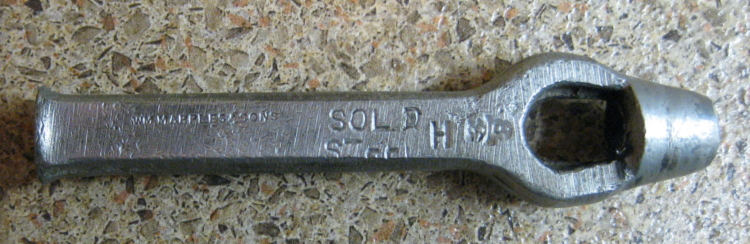
These leather washer punches are first to appear in the 1909 Catalogue listed as ‘#6558 Single Washer Punches‘ and listed as such under ‘Plumbers‘ Tools. They were to be had in sizes 3/4″ to 3″ diameter. Although made from ‘SOLID STEEL‘ they were never sold/advertised as such. The 1909 listings are shown below:


In the 1921 Catalogue they are listed as above with 3/4″ -3″ as ‘Single Wad Punches’ being available.
In the 1928 Catalogue they are shown as now being available as 5/8″-3″ diameter sizes. Still #6558.
They are listed under Plumbers’ Tools as Washer Punches.
1938 sees little change, just the price:

By 1959 ‘Single Washer or Wad Punches #6558 have been reduced in size availability. Now only 1/4″ – 1″.

The last listing that I can find is in the price list of November 1969 when they are still shown as being available 1/4″-1″.
But by 1971 they are not shown as being available.
The following example must be [at 3/8″ diameter] an example from at least 1959 onwards.
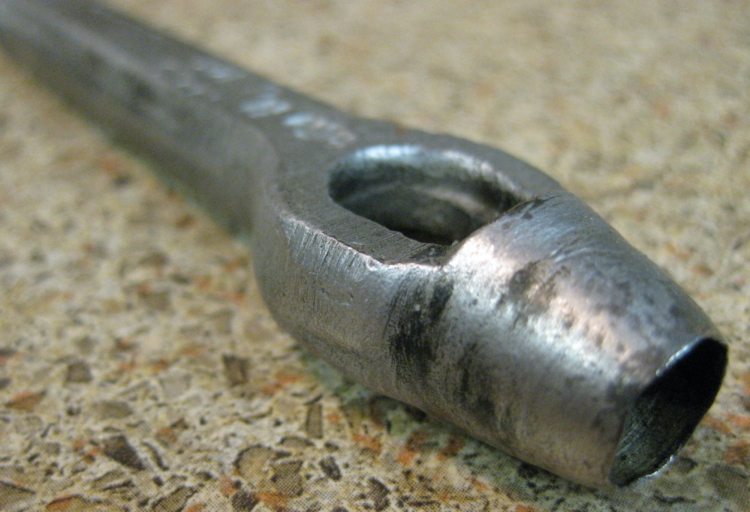
The Hammer below is c.1930-50?? and I believe is a ‘Plumbers’ with long straight pane. #6540 and came in sizes: 1;2;3;4;5&6 with head weights of 4;6;8;10;12 and 16 ozs. In these sizes it was listed 1897-1938 and only as 16 & 20 ozs in the 1888 Catalogue. There was also produced a Plumbers Hammer having a smaller length pane…not to be confused with this long pane type.
Shaped Boxwood tools were used extensively by Plumbers in the days that Lead was still in use in the Plumbing trade and below is a Boxwood ‘Dresser’ [or ‘Lead Beater’ as described in 1928!] the purpose for which I have no idea!! If you look at the mark carefully you will see that is says that MARPLES were in Sheffield & London! These Boxwood tools do not appear in the 1959 Catalogue.


TURNPINS:
These came in Boxwood or Lignum, according to the 1928 Cat. Again, I have no idea how they were supposed to be used!! Many sizes 1-4 inches in diameter. Here is a 1.1/4 inch one:

BACK NUT WRENCH
This ‘Back Nut Wrench is a more modern tool and is first seen in 1938 as Item#6552 and was made until at least 1972. In 1965 it is described as having an Aluminium colour finish.


Plumber’s Mallet:
As far as I can deduce this tool was available to plumbers as of c.1880 onwards numbered #1413.
The first picture we have is from the 1888 catalogue [ #1413] which is vastly different to later pictures. The tool was only available with a Boxwood Head and Ash handle and in sizes of head: 2,1/2; 3 and 3.1/2″

The 1897 Catalogue shows the same information
In 1909 the number and picture was changed to #6500 and sizes available were 2.1/4; 2.1/2; 2.3/4 and 3″

In 1928 the sizes available had been increased to : 1.1/2; 1.3/4; 2; 2.1/4; 2.1/2; 2.3/4 and 3″ and the head could be had in either Boxwood or Lignum.
These same specs were in affect until and including the 1959 Catalogue.
In 1965 they could only be had with Lignum heads and 2; 2.1/4; 2.1/2; and 3″
This tool was de-listed around December 1970.

LEAD PIPE OPENERS, SCREW NOSE:
Item# 6528 in 1928 Cat. these openers came in 3/4″; 1″ and 1.1/4″ sizes. Prior to 1928 they were also available in 1.1/4″ size, but with a Plain Nose.
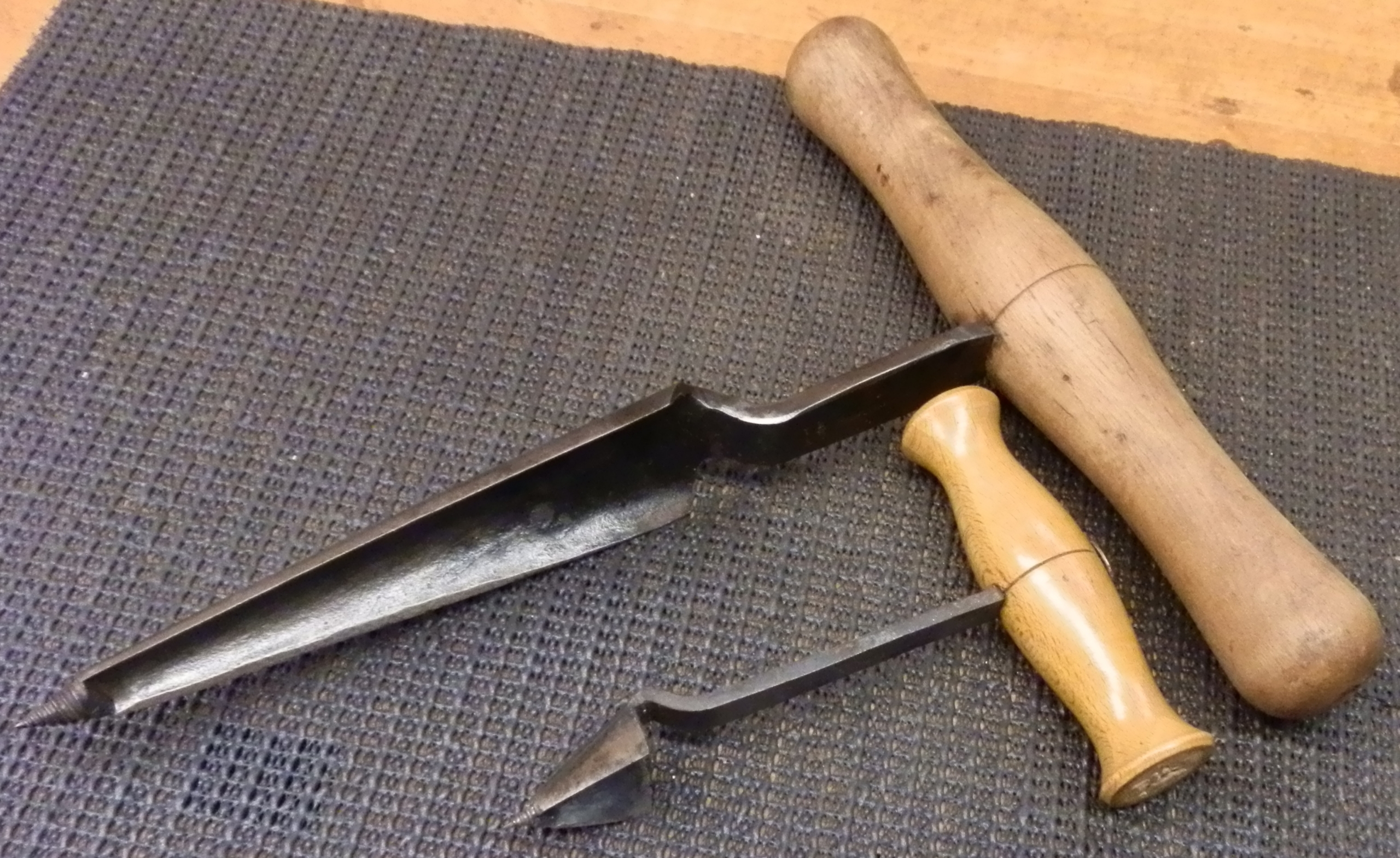
This tool is often confused with a Coopers’ ‘Tap Borer’. { which has a much longer tapered cutter as shown in picture below}

This is another page under construction. March 2023


The unit above was a merchandising helper to store and promote ‘punches’ in a retail establishment, as shown in the 1959 Catalogue.
A page under construction March 2023

Here is a Leather workers tool [above] that was given to me by Robert Isdale from Brisbane, Australia.
It is a Shoe or Saddlers’ Oval Cutting Punch that I see in the 1862 Catalogue with no number but sized 0-20
In the 1873 Cat. it is item #1154 and numbered 1-16. [these were round punches]
In the 1897 Cat. it is item #1167 and numbered 1-16 [Round] and item#1167A numbered 17-30 [Oval]
In the 1909 Cat. it is item #3780 and numbered 0-16 + larger [All Round] and item #3782 numbered 17-31 [Oval]. Both shape punches were available up to c.1959
I deduce that the Oval Punch was introduced around 1880 as the punch shown here has the number 30, HIBERNIA and single Shamrock.
Number 30 is listed as being 9/16″ measured on the larger width of an oval.


Above is a Solid Steel Saddlers’ Punch and I have found it as listed:
#3781 in Cat 1909 1/8″-3/4″.
#3780B in Cat 1928 3/64″-3/4″.
#3780B in Cat 1938 3/64″- 3/4″.
#3780B in Cat 1959 3/64″-1″
#3780B in Cat 1965 1/16″- 1/2″
Presently under Construction March 2023
Below you will find Item #8366 in the 1959 Catalogue described as ‘ Best Solid Steel Pruning Shears, Double Cut with Wirecutter. Available as 6,7 & 8″ sizes. Around this time MARPLES seemed to have adopted a preference for ‘Green’. Research has shown that these pruners may have been available back in 1909 or before as Item#8356 in 6,7,8&9″ models. They are not listed in 1921 but re-appear in 1928 as 6-9″, but there is a ‘Cheaper Quality’ shown [#8367] which had ‘rivetted Blades’ in 7 or 8 inch sizes. This option is again shown in 1938. But in 1959 only the ‘best’ is shown #8366.

A recent find of which I have no information just now…a Garden Spray tool:

