The premier site for William Marples & Sons Tools.
Author: Roger Ball
Wing Compasses
A subject not yet finished March 2023
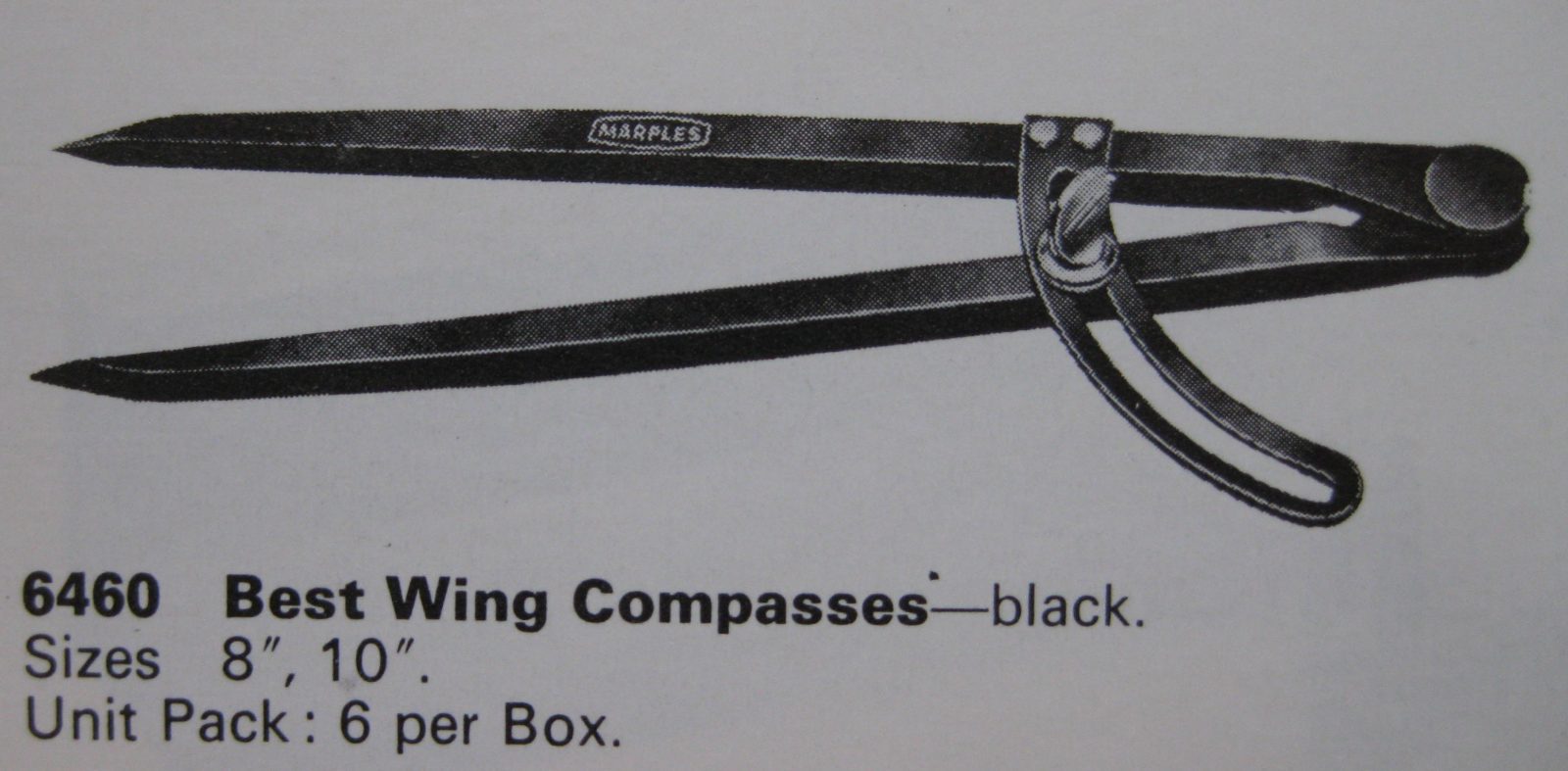
Best Lancashire Black Wing Compass. This Compass started life prior to 1862, when it had no number, but was available in 5″-12″ lengths. In 1873 [or maybe before] it was given the number 1064. and by 1897, under Item # 1234 it was available from 4″ to 12″ and similarly in a ‘Bright‘ version #1233. By 1903 the number had changed to #6460 and the ‘Bright‘ version as #6462. but now in lengths 5″-12″. The 1909 Catalogue shows the same listings. The 1921 shows the same listing of #6460, but no ‘Bright‘ option is mentioned. The 1928 and 1938 Catalogues show exactly the same listings as in 1921.
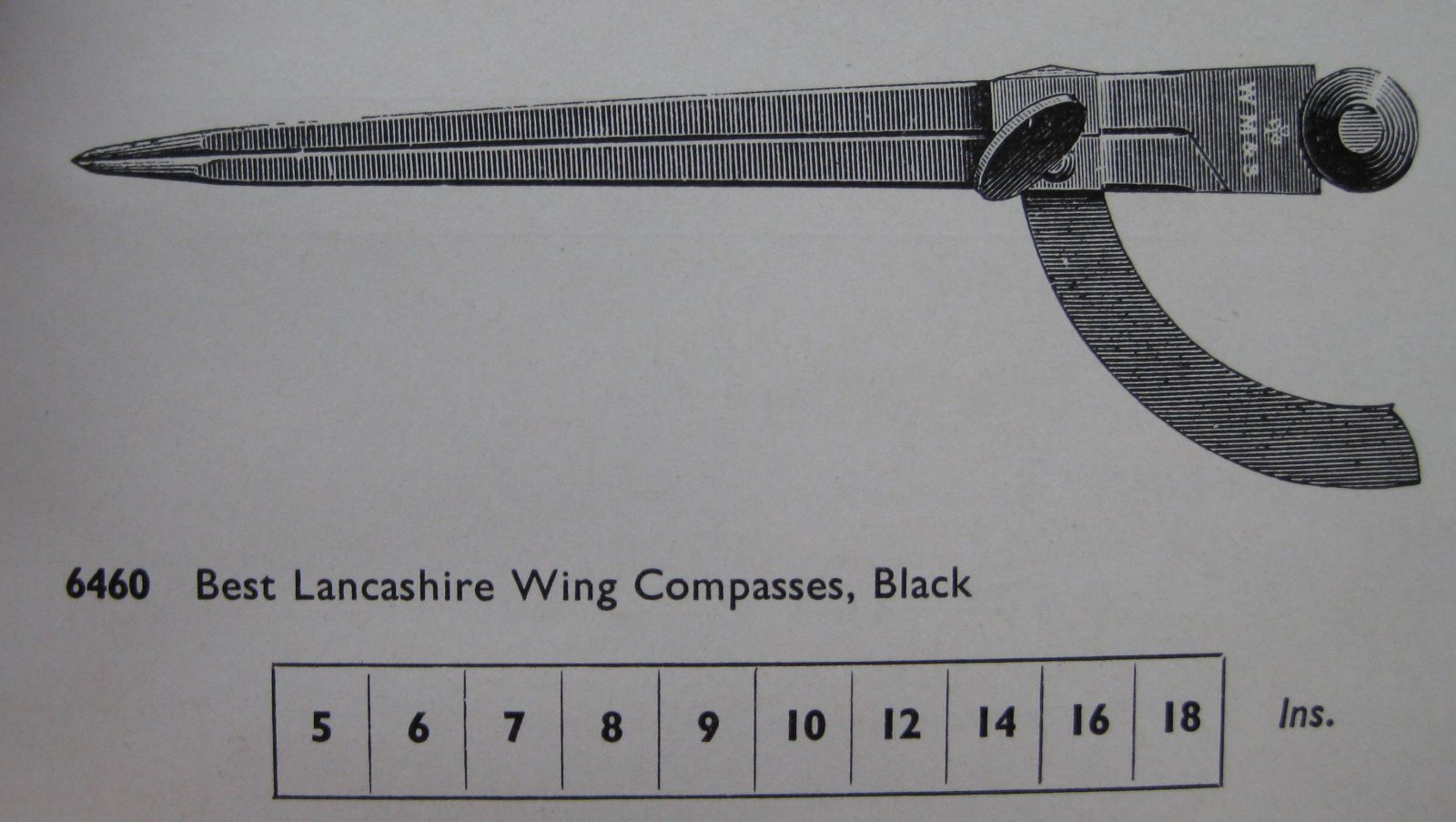
In the 1959 Catalogue is shown an expanded range of 5,6,7,8,9,10,12,14,16,and 18″. And this is the photo shown below.
By 1965 the range was reduced to just 6,7,8,10 and 12″. By 1971 there is shown a re-design of the Compass, but only now listed with 8″ and 10″ sizes. Photo below. Note the change in the securing of the Wing.
1959 Catalogue Image.
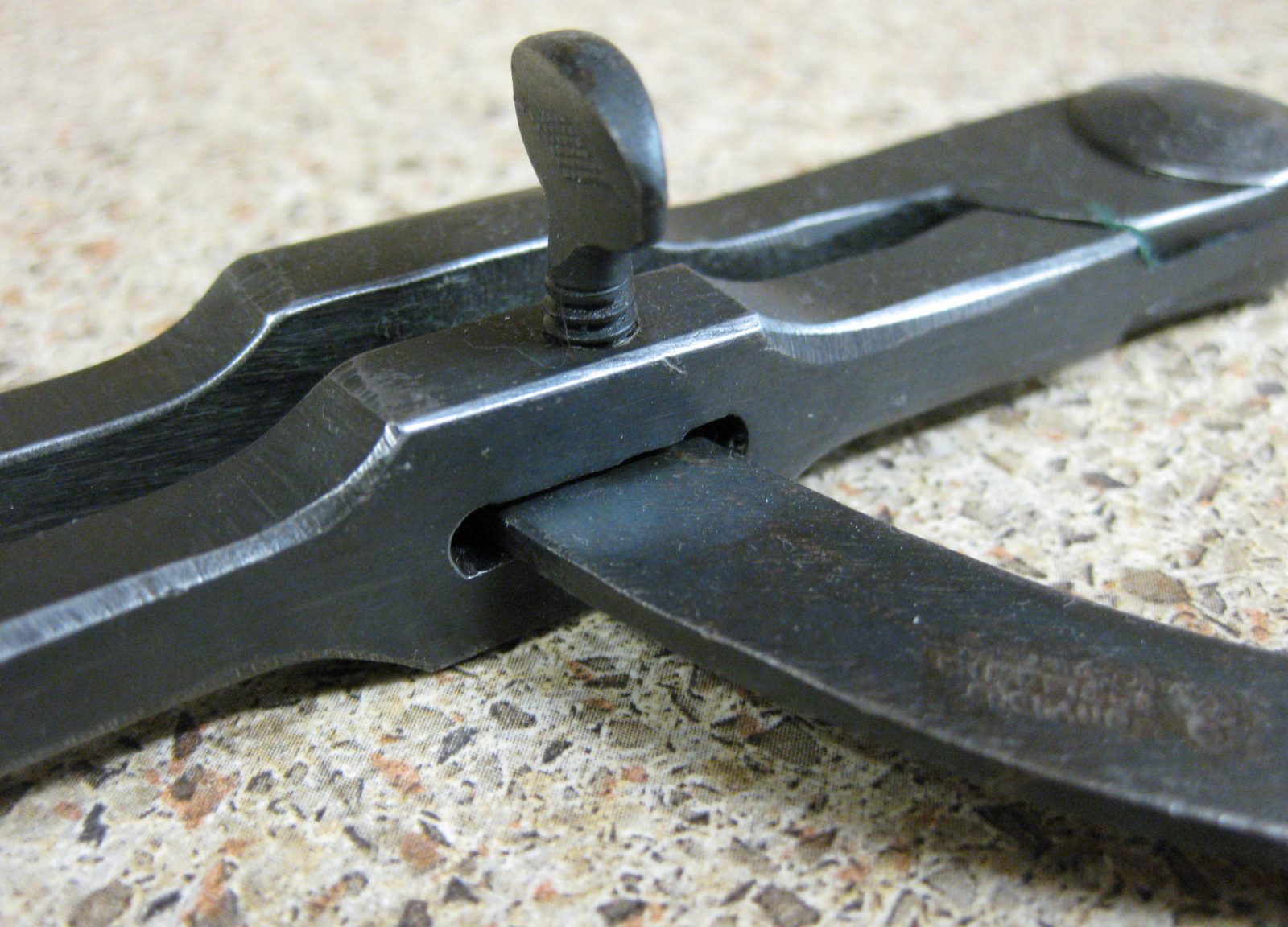
Below are a couple of images of a 6″ Best Lancashire Wing Compass, obviously prior to 1971.
The Diamond motif on the Wingbolt denotes after 1945
Combination Tool
This tool is a real rough and ready tool for almost any function!
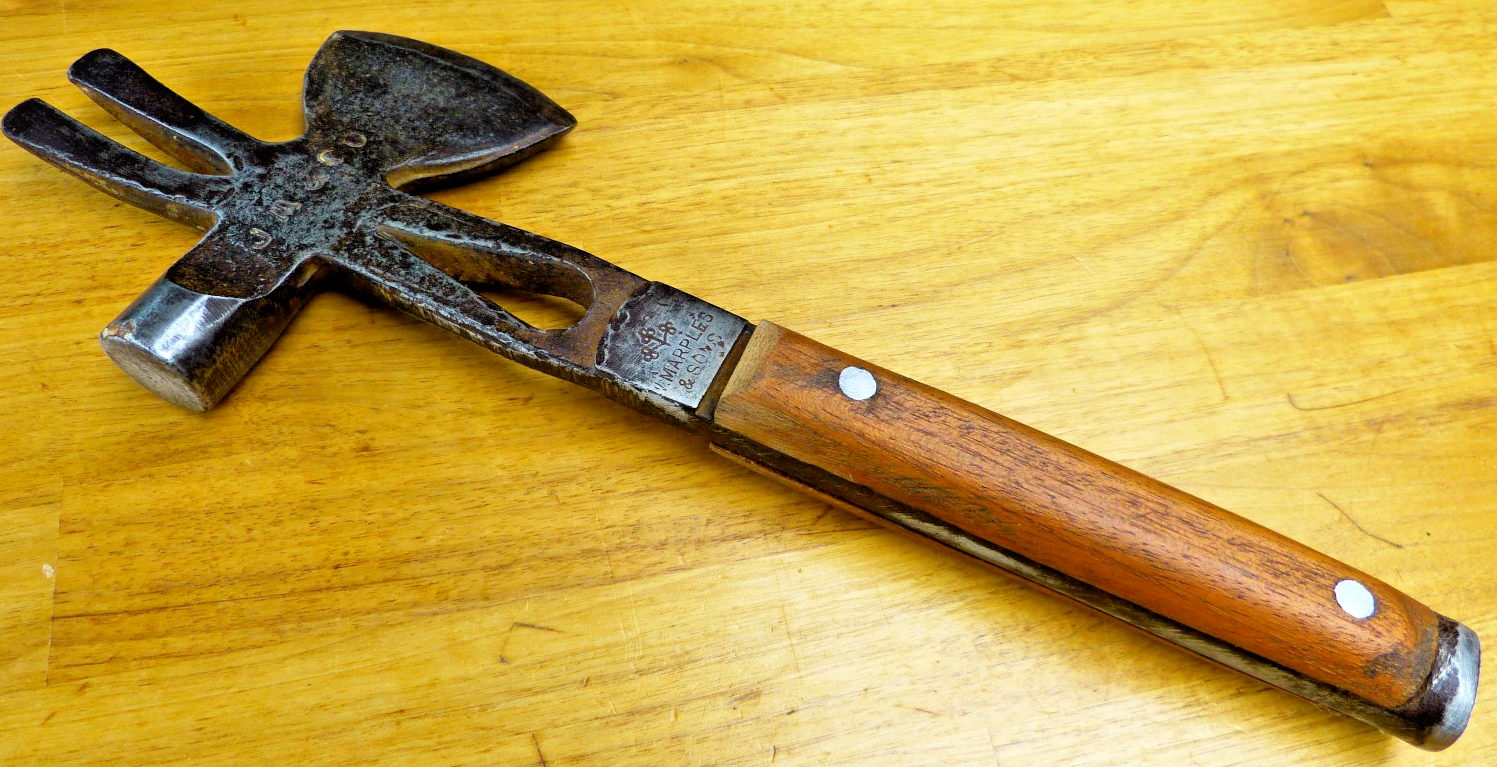
Item #3620 is listed as a Combination Tool under Case Openers and first found in the 1928 Catalogue, and this tool [below] was indeed as described, having a hammer, hatchet, nail extractor and Case opener. Listed in 1928 at 4/6d each, in 1938 they were 5/- each. In the 1959 Catalogue it is no longer shown as having rivetted wooden handles, but only as a shrink wrapped vinyl over steel handle [uncomfortable to be sure] and at 13/- ea. The last listing I can find is in the April 1962 Price List at 14/3d each.
Above is the 1959 offering with a photo below: Many times this tool will be found without the handle covering and I doubt that this was ever issued as such[below]:
Below is a pre-1959 example with wood applied and rivetted handles, it has had a tough life!:
and here is another one with wood handles:
Joiner’s Dogs
A small subject indeed, but pertinent to this Woodwork Site
Below you will find photos of “Joiners’ Dogs or Joint Cramps”
The first reference I can find is in the 1897 Catalogue, but they may have been in production before then. They are listed there as #835A, but that number changed to #1897 by 1909. They are listed as being ‘Stamped’, but ‘Strong Forged'[ Item #1898] were also available at a higher price. The ‘Stamped’ variety [shown] were available into the 1959 Catalogue but only the ‘Forged’ were available in 1965 onwards. They were available 1.1/2″– 3.1/2″, but this varied a little over time. Shown here are some 2.1/2″, and they are 5/32″ thick. They did however tend to be prone to bending with hard use, whereas the ‘Forged’ variety were certainly stronger. In the 1959 Catalogue they are named “Joiner’ Dogs”
Stripping Knives
A new subject that may have additional works to update it. March 2023
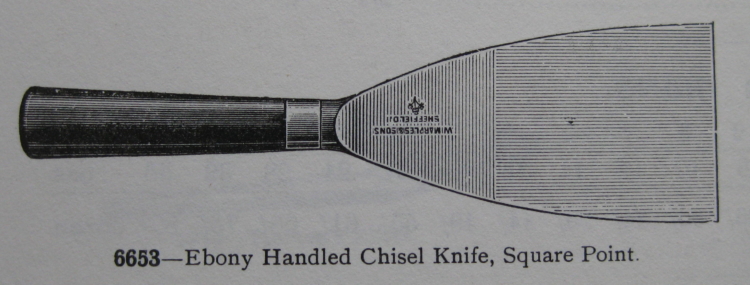
MARPLES Stripping knives seem to have been introduced c.1890 and they appear in the 1897 Catalogue as Item # 1729A and are described as ‘Painters Ebony handled chisel knives, with Brass ferrules’.
Sizes were [width] 2.1/2″; 3″; 3.1/2″; and 4″.
In the 1903 Catalogue they are described as ‘Painter’s Ebony handled Chisel Knives, Brass ferruled. Same widths as 1897 but with a new number #6653. In 1909 these widths of #6653 were available: 5 x 2″; 5 x 2.1/2″; 5.1/2 x 3″; 6 x 3.1/2″ and 6 x 4″.
The 1921 and 1928 Catalogue entries are the same and also the same widths as in 1909 are offered.
The 1938 Catalogue entries show the same sizes, but there was a price decrease on all sizes!!
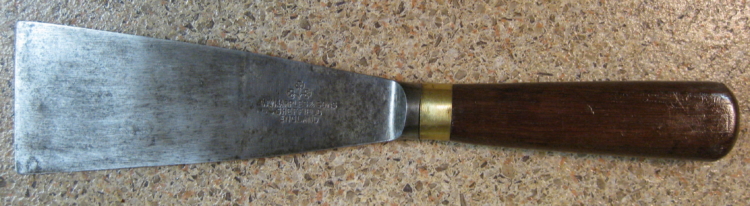
By 1959 the following sizes of #6653 are offered: 1″; 1.1/2″; 2″; 2.1/2″; 3″; 3.1/2″; 4″ and 5″. The big difference from pre-war is the fact that now the handles are only in Rosewood
2 inch example shown below:
1965 shows the following entry:
These #6653 tools are listed in the 1971 Addendum, but I can find no further listings:
You will have noted that there are only minor differences between ‘filling’ and ‘stripping’ knives.
‘Filling knives’ are ground to have a thinner, more flexible blade. Whereas ‘Stripping Knives’ need to have more substance in the blade strength and are therefore ground slightly thicker. This can be hard to discern.
Wrenches
A page that is far from complete and will be added too as time permits. March 2023
Below is another real old one, ‘Single Bar Coach Wrench‘ #093 that is seen in the 1861/2 Catalogue. 6″-18″. These lengths endured for the whole date range of production. In 1921 the #093 is not listed in favour of an ‘Improved Steel Bar Coach Wrench’ with a single bar #091, but for some reason this product failed the test of time and #093 re-appears in 1928 but re-numbered to #3413 . It does not appear to be listed in 1938 or later.
The 1909 image, above, also shows the Double Bar Wrench
The Adjustable wrench below is listed [first that I can see] in 1888 as a ‘Gem’ Bicycle wrench #1180A I think that it was introduced even before that time as my example shows the single Shamrock emblem which should have ceased being used after 1875!!
It is hard to decide exactly which wrench is which given that the 1897 catalogue shows this:
In 1909 the ‘Gem’ Bicycle wrench is listed as #3450 at 10/-/doz and Malleable iron.
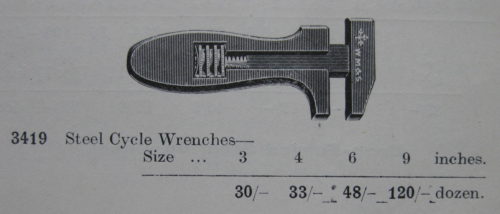
Nothing is listed in the 1921 Catalogue [post war], but #3419 ‘King Dick‘ Cycle wrench is found in the 1928 Catalogue:
and in 1938:
This wrench is still to be found in 1959 in the same sizes but does not appear in the 1965 Catalogue. The last listing I can find is in the Price List of April 1962, but not in PL March 1964. It was therefore dropped from the line around 1963, just about when C&J Hampton took over the reins of MARPLES and cut so many of the items from production. Goodbye Quality.
Grips
Another site that is far from complete and to which additional information will be added. March 202
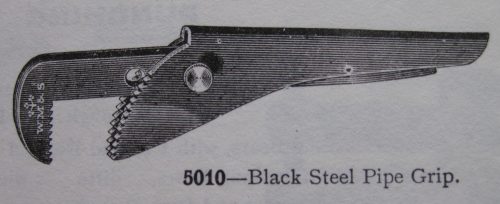
Below is shown Item# 5010 ‘Black Steel Pipe Grips‘ available 1909 -1959+. Not listed in 1965. In 1959 they are called ‘Footprint Pipe Grips‘. Always available in sizes from 6″ to 16″ and having jaws that could be adjusted in depth by moving the holding bolt through 3 different holes in the sliding jaws. The same image was used throughout the 5o+ years of its’ existence!
Spanners
This page is under construction and needs many more additions. March 202
Below is shown the ‘Clyburn’s Spanner‘, one that has been with us a long time. It is listed in 1861/2 Catalogue [where it is unusually numbered 020] under ‘Moveable Spanners’ and offered 4″-30″ in lengths capable of accepting 3/8″ -3″ nuts. In 1873 it has #1010. In 1897 it is #1181. In 1909 it is re-numbered back to #020 in sizes 4″-30″, but now accepting 1/2″-3″ nuts. Also in 1909 it appears as a straight handle variety #021. 1921 sees the spanner only offered 6″-30″, with no straight handle option [post war shrinkage]. In 1928 it is again re-numbered to #3420 and again 4″-30″, but now 5/8″ -3″ nuts are accepted. The straight handle appears again #3421. The line is again reduced to 6″-30″ in 1938. Post war in 1959 it still has the same configuration as pre-war but with no straight handle offered. It was de-listed entirely before 1965.
Above is as it appears in 1938.
Copper Plate Engravings
This page is complete as to March 2023, but more engravings may be found
Above is an Old copper engraved advertisement. Apparently these engravings were copied many times to keep up with the wear that they received during the printing process. Therefore any one engraving will not necessarily be the ‘original’ engraving. As to how these detailed engravings were actually reproduced accurately 100 years ago is a mystery. Below is the engraving used to print a ‘Gentlemen’s Registered Tool Cabinet‘, and the same cut is shown 1897-1928. [In 1897 the item# is 918…I have no information before this time as the present ‘Directors’ of the Hawley Museum in Sheffield seems to refuse to help me in my quest for copies of earlier catalogue images, which they possess.]
I have secured FOUR copper plate engravings that MARPLES used in their Catalogues, as shown here:
1897 Engineer’s Solid Steel Hammer No.8
The above Copper Plate is from the 1928 Catalogue.
1897. #1994A Handled Joiners’ Hammer
1897. #1990 Handled Exeter Hammer.[left]
Below here are some more Copper Engraving printers Blocks, one is of a Splitproof B/E chisel [#373] and the other a ‘BB‘plane.
Glass Cutters
This is a page that is presently under construction March 2023
A Glass cutter #2077 called ‘Plate Diamonds for Glass 1/4″- 1/2″ thick‘ is found in the 1888 Catalogue and was re-numbered to #6689 in 1903. It was re-numbered again in 1909 to #6617 and appears as such in 1921. In 1928 it is shown as being available with 3 sizes of diamond; R, S and T [the largest] and this continued through catalogues 1938 and 1959, but not in the 1965 catalogue. The example shown here is ‘S‘. The inscription reads ‘LONDON‘ so the cutters were probably made by a London firm forMARPLES. The handle is Rosewood.
Mincing Knives
MINCING KNIVES
These tools, which were designed for Kitchen use, are what I suppose were used before ‘Minced Meat’ was available from our local butcher. They would have been used to ‘mince’ or shred meat or other foods into small pieces.
From the catalogues I can deduce that these Knives were available in 1888 and probably a good few years before then.
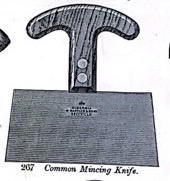
Below are the 1888 entries:
Here are the 1897 entries;
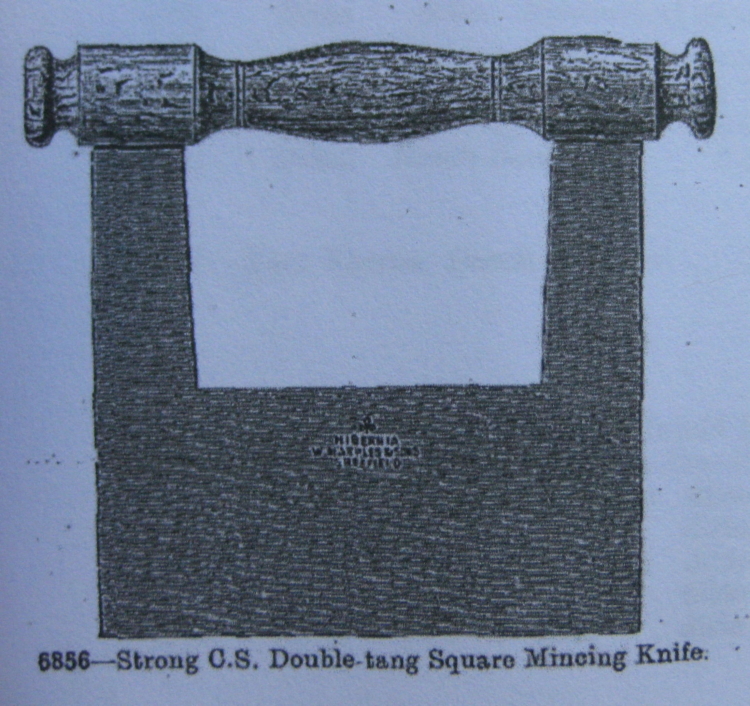
The #273 Strong Cast Steel Double-Tang Square Mincing Knife was available at this time. [See below for a new 1909 number for this knife Item #6856]
The 1903 Catalogue shows no differences with the 1897 Catalogue.
Here are the 1909 Catalogue entries:
You will see that the 5.1/2″size Square Mincing Knife is no longer available and the 1903 Catalogue also shows this. [otherwise everything else is the same]
The 1921 catalogue shows a reduction in styles [post war] with only a Square and Half-Round knife shown as being available:
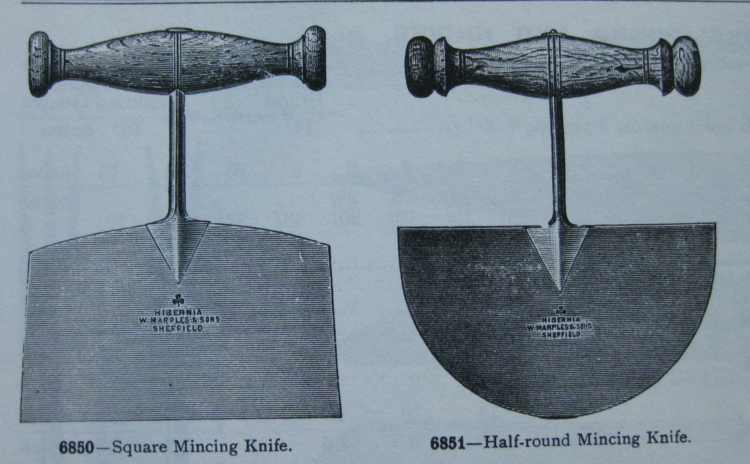
And by 1928 these are shown:
1938 sees the last mention of these kitchen utensils and you will note that the 6.1/2″ has been omitted then these Kitchen Utensils disappeared forever..
So there is no mention of these knives in the 1959 Catalogue and we must assume that their function was overtaken by more modern technology shortly after the War.
Some examples:
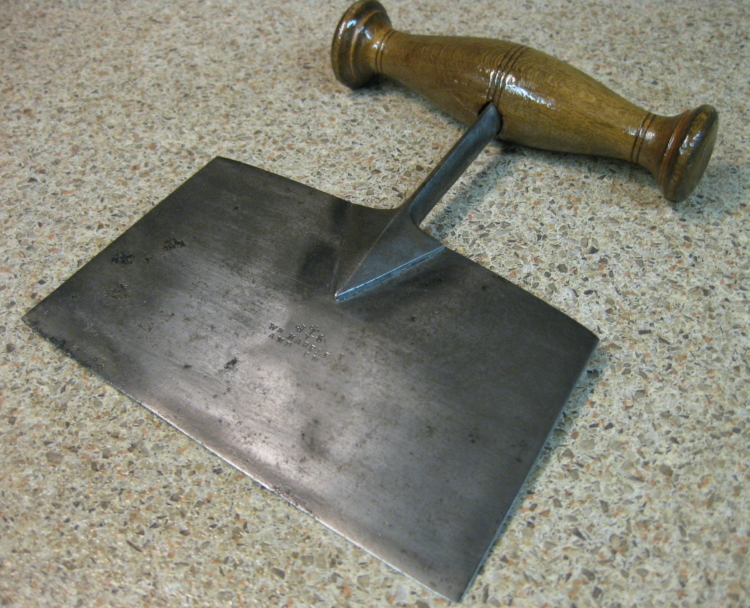
This is a fairly early Square Mincing Knife, probably pre-1909 and therefore numbered 269.
Below is a new discovery of what must be a very early #269 Square Mincing Knife, as the blade attachment looks inferior to later methods.
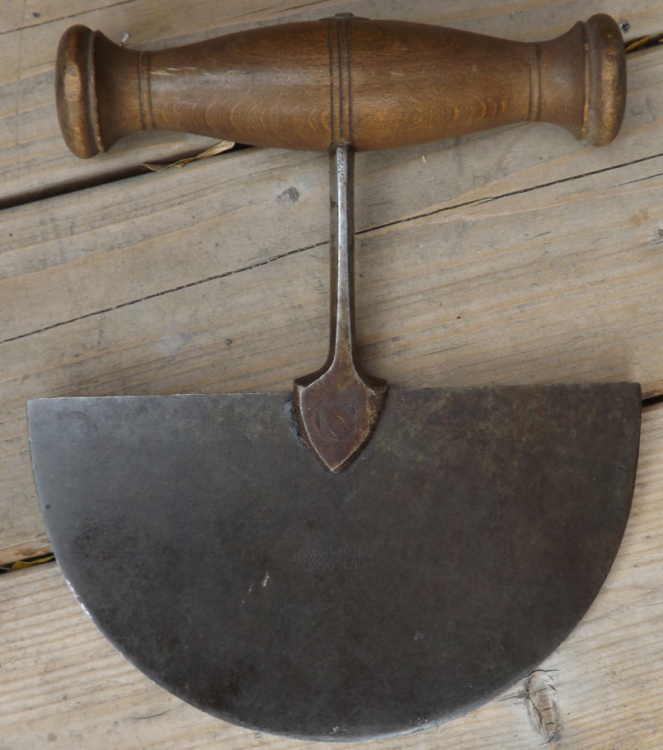
Below is a great ‘Half Round‘ knife with a mark suggesting c.1870 . These knives were numbered 270 in 1897 and changed to #6851 in 1909 and until produced no more.
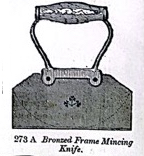
This is a rare one, it can be seen only in the 1888 Catalogue. #273A
Although described as ‘Bronzed Frame‘ it appears that the steel frame was merely coated with Bronze coloured paint.



 Many times this tool will be found without the handle covering and I doubt that this was ever issued as such[below]: