The premier site for William Marples & Sons Tools.
Author: Roger Ball
Cooper’s Tools
I started on this project and within weeks discovered that this subject cannot be totally dealt with on this page. There are simply too many tools, too many slightly different tools and too many entries in the catalogues to be able to actually put everything down on paper and keep all the tools in line and subject together.
Therefore the best that I can do with this subject is show all the pages that dealt with Coopers’ Tools over the years and let you sort it all out as to whether your tool fits this description. Sorry!!
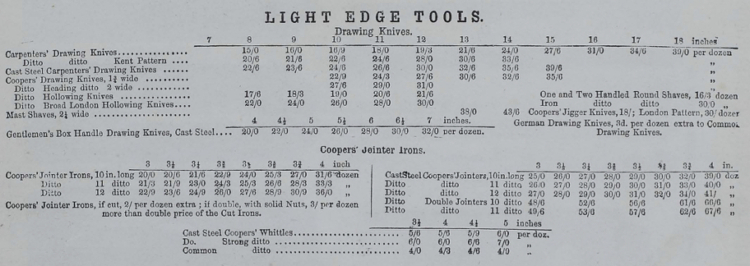
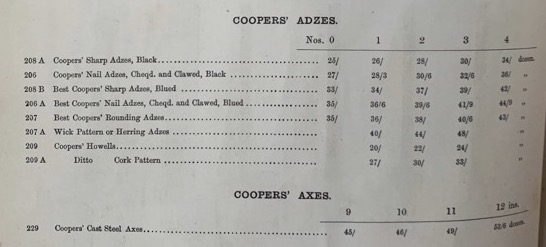
So we start with the first indication that Wm. MARPLES made tools for the Cooper Trade in the 1846 Price List:
From there we go to the 1862 Catalogue entries:
Then to the 1873 entries:
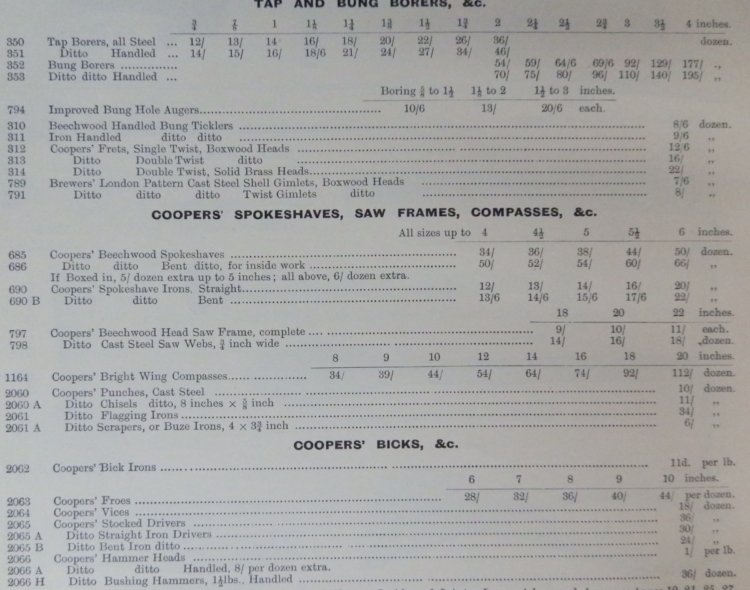
The 1888 Catalogue entries are next:
1897 Catalogue entries:
I am sorry that I cannot make these images larger to make them more easily read…I am restricted in the width by the programme.
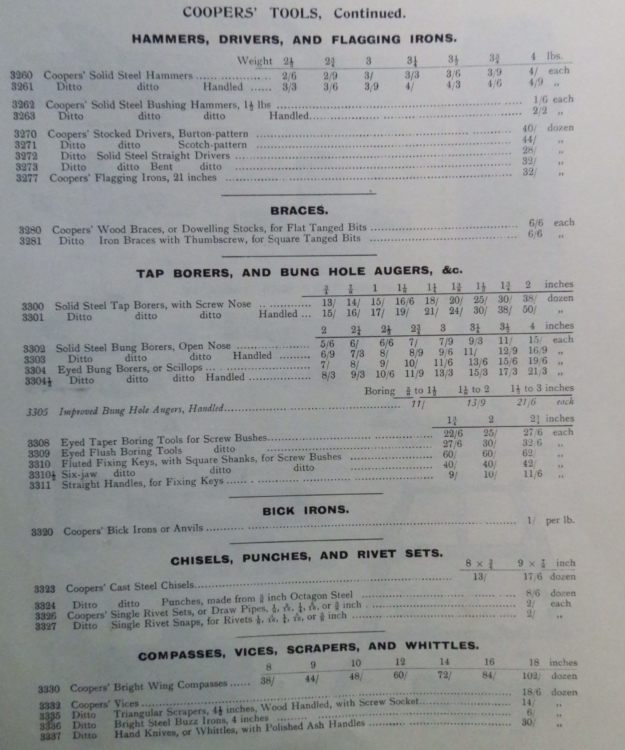
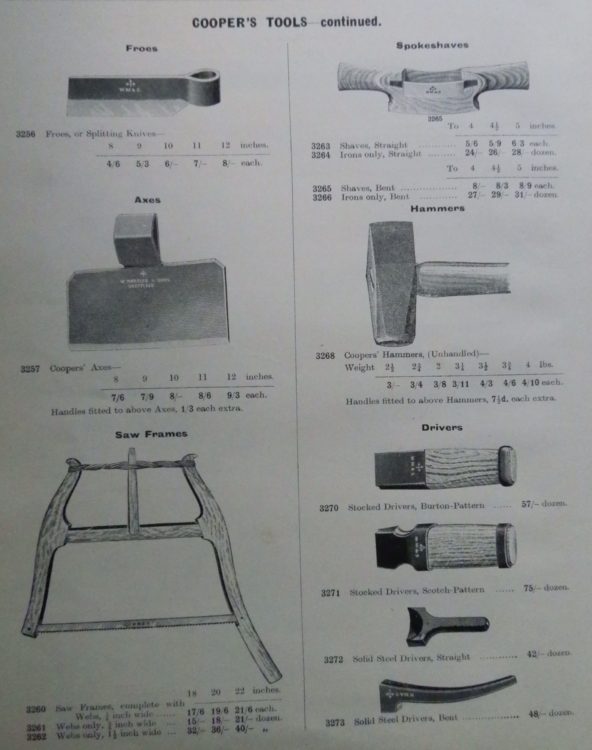
1909 Catalogue entries:
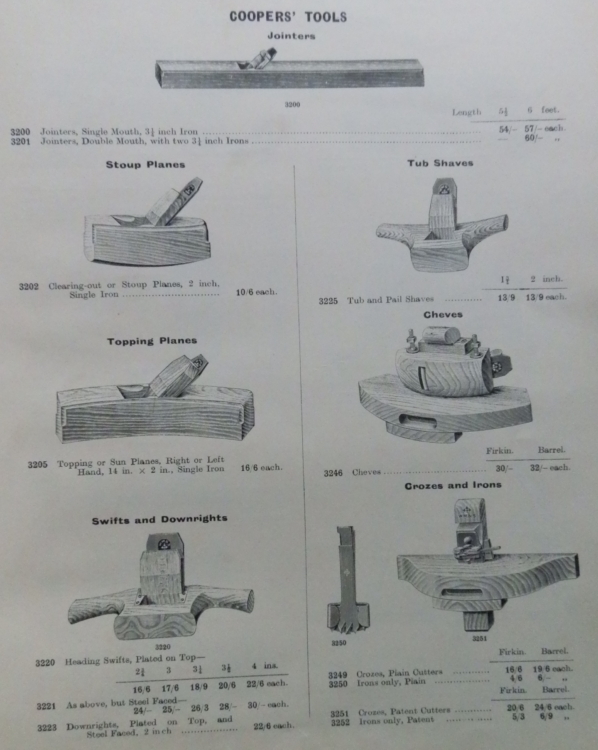
The 1921 issues follow:
The 1928 Catalogue entries are here:
1938 entries:
The 1959 Catalogue sees a drastic reduction in tools offered:
ALL of the tools above shown in the 1959 Catalogue were still available up to the November 1963 Price List. The April 1964 Price List shows that none were then available, so when C&J Hampton [RECORD] took over, all the old non-profitable tools were abandoned as per the wishes of the bean-counters.
GALLERY:
Coopers’ Straight Spokeshave:
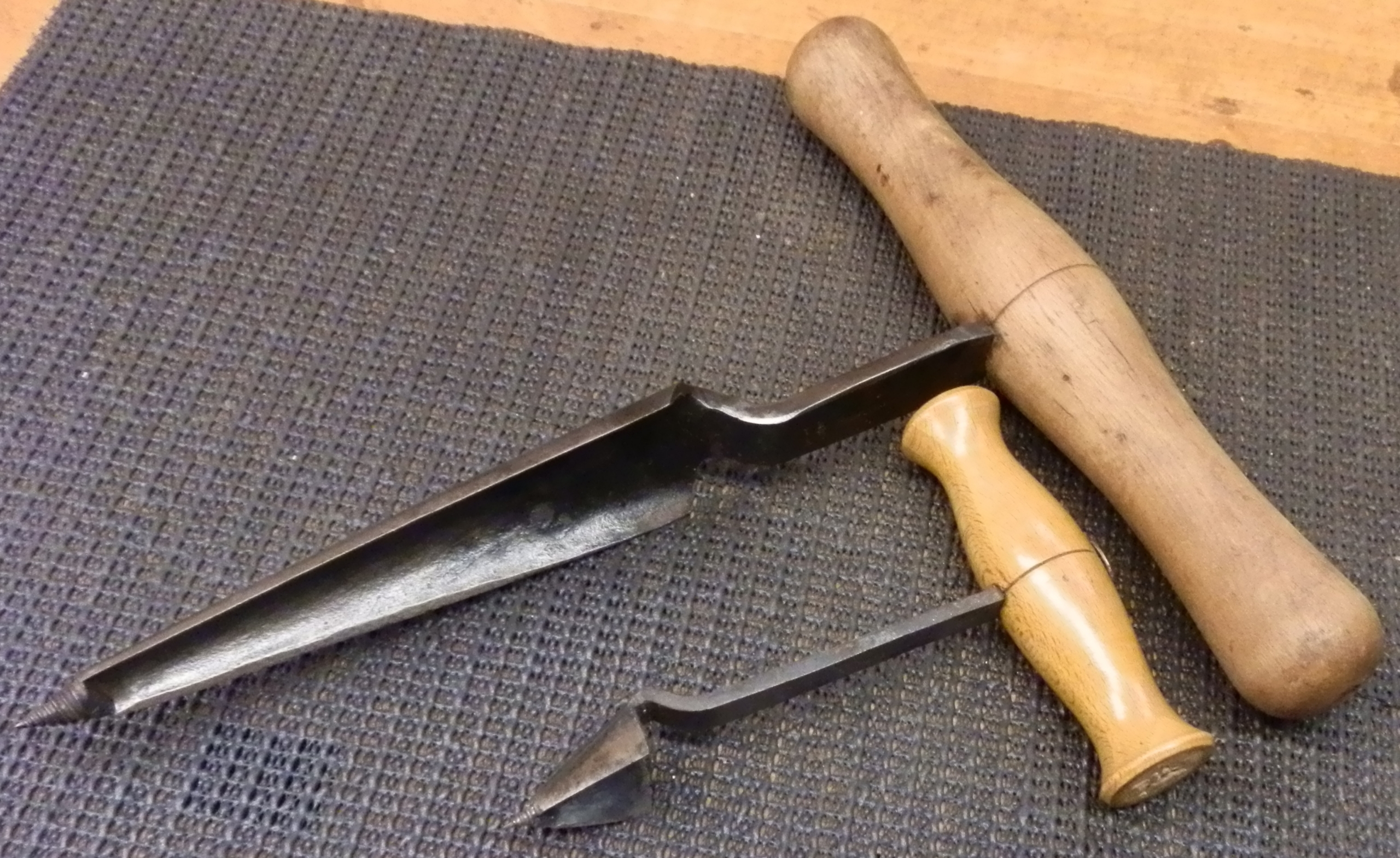
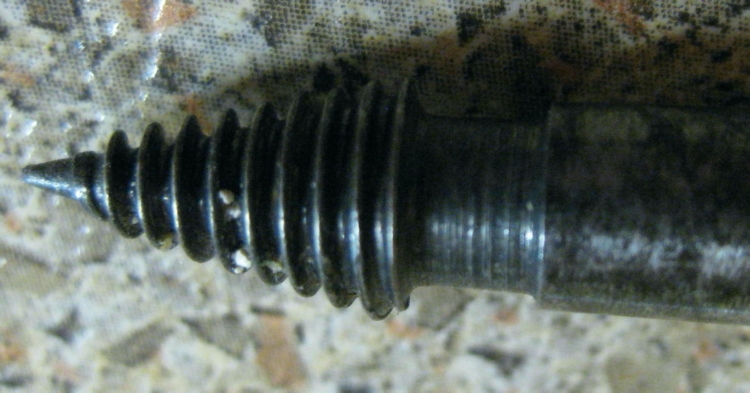
Coopers’ Handled Tap Borer:
These tools came in sizes 3/4″- 2″ and are first seen c.1873 [#273]. In 1888 and 1897 Cats. the number is 351 and this was again changed in 1909 to 3301. This endured until WWII and then these tools do not show in 1959.
Not to be confused with the shorter plumber’s Pipe Opener!…..
Gimlets…Shell and Twist:
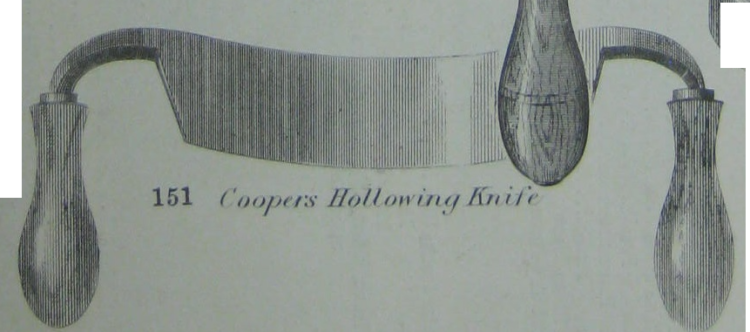
1201 Belfast-Pattern Crum Knife: This pattern of ‘Jigger’ is first seen in 1909 and was last listed c.1940 [It was not available in the 1921 Catalogue..like many other tools.]
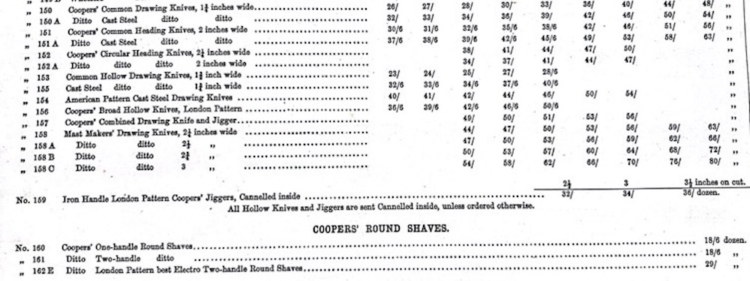
COOPERS’ ROUND SHAVE:
It is hard to judge from just a description, but this Round Shave may have been listed in the 1846 List but definitely is shown as Item#162E ‘BestLondon Pattern Round Shave‘ in the 1888 Catalogue. In 1897 the number has changed to #162, and in 1909 it changed to #1207 with this number enduring until the last listing shown in 1938.
Only the #1206 Round Shave is shown in 1959.
COOPERS’ COMPASS:
Why Coopers needed a special compass is not known but they first appear in the 1873 Catalogue and at sizes by individual inches of 5-24.Numbered 1123
In the 1888 Catalogue the range seems to be somewhat diminished to: 8;9;10;12;14;16;18;20 inches.
In the 1897 Catalogue the range was again reduced to 8,9,10,12,14,16,18 inches . Item # 1164. The number changed to # 3330 in 1909 and this number lasted until 1928 in the same sizes. In 1938 there are no listings so we can assume that the product line was dropped c.1935?
Below is a nice example of a 10 inch Cooper’s Compass:
Coachmakers’ & Wheelwrights’ Tools
It was not until the publication of the 1888 Catalogue do we see that MARPLES got into the manufacture of specialised Coachmakers’ Tools.
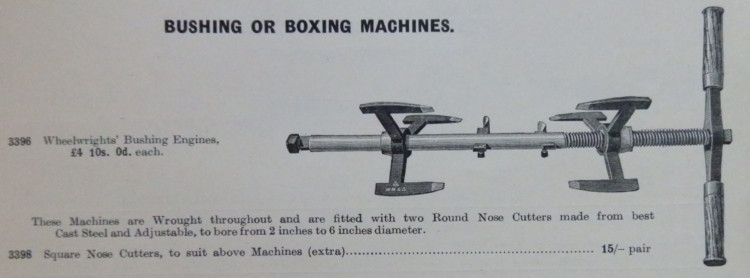
Also included on this page will be Wheelwrights’ tools, as they are listed together by MARPLES.
There we see a Coach Side Axe:
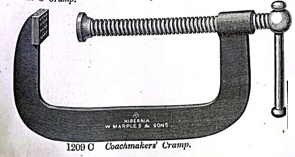
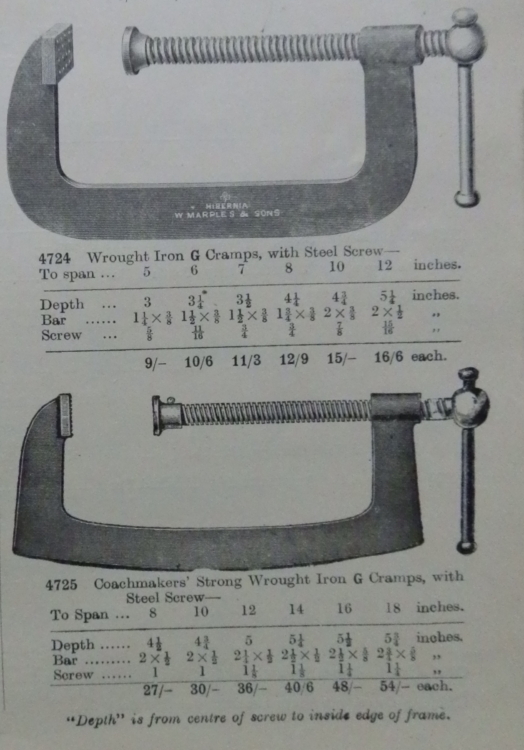
Strong Wrought Iron Cramps5″-12″:
Draw Borers, which really were straight!:
T-Plane irons up to 2″ in 1/8th increments, but no plane bodies:
Also listed, but with no images, are ‘Iron Stock Squares‘ in sizes 6″;8″ and10″, and a Trimmers Hammer in #2 size.
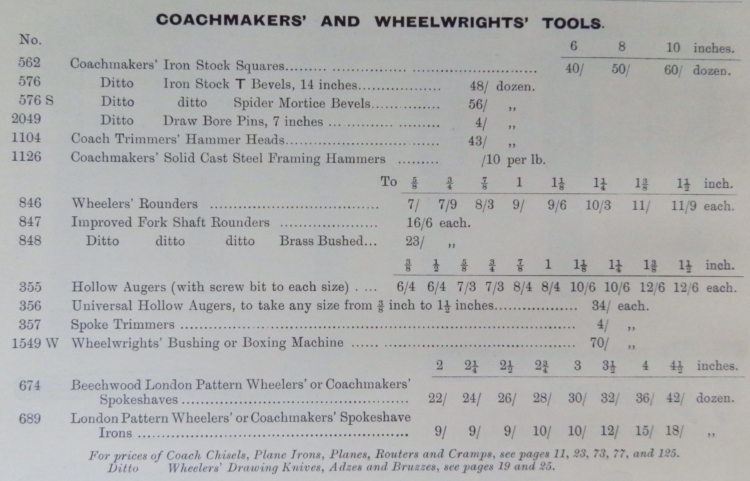
The 1897 Catalogue shows the following:
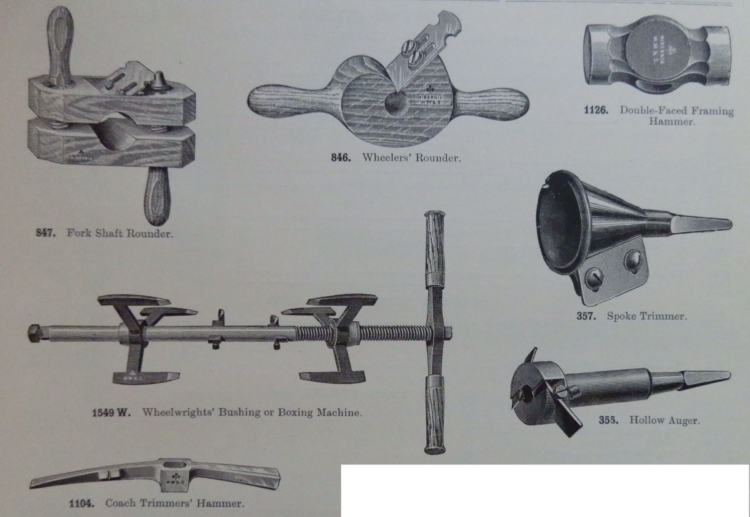
Please note that Side Axe; Cramps; Draw Bore pins; Trimmers’ Hammers and Squares are as per 1888 listings. The T plane irons#194 are only listed as being available 1″-2″. New listings are for Coachmakers’ chisels; 14″ Iron Stock T bevels; Solid Cast Steel Framing hammers [#1126 @ 10 pence per lb!!] ; Routers and ‘Spider MorticeBevels‘ [no image]. With other Wheelers’ tools.
Available 1/8″ -2″
1909 Catalogue has these entries:
Available 1/8″-2″
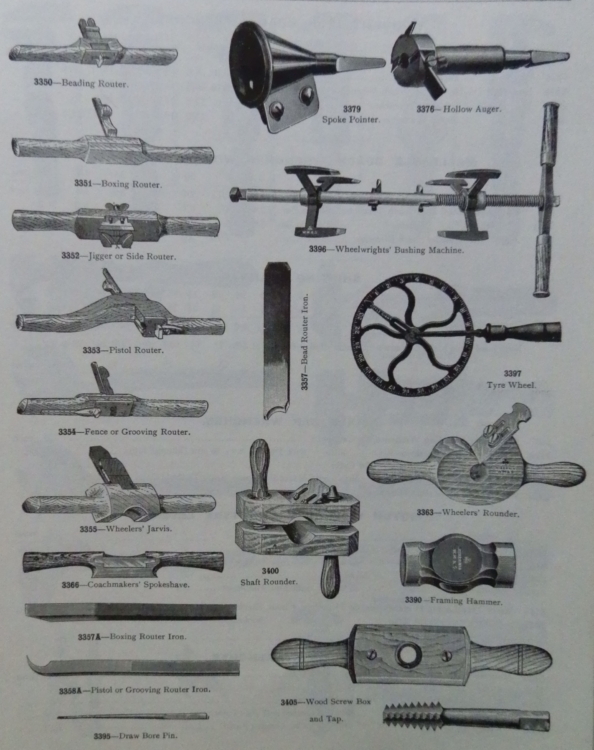
The Side Axe is now #1274 The Cast Steel chisel is now #650; the B/E chisel is #655 and the Incannelgouge is #660. The Bent Iron G cramp is now #4724 and a new item WeldedIron G cramp8″-18″is #4725. The Trimmers’ hammer is now #3908. Many other tools have been listed as shown above, but I do not see a listing for the T plane irons. The Framing hammers, now #3390, are available in 2.1/2-4lbs.
The 1928 Catalogue shows these pictures:
The above extract shows us, for the first time, an actual image of the Squares and Bevels. It also introduces Wheelers’ or Coach Shaves and 18″Panel Gauges.
I do note that the Trimmers’ hammer is still available, but it has been moved by MARPLES to be listed under ‘Upholsterers’ Tools‘!
Next are the 1938 tools:
As seen above the B/E chisel is no longer offered.
The Side Axe and Cramps are the same as 1928 and Trimmers’ Awls and Hammer are still to be found under Upholstery Tools.
The 1959 Catalogue listings show a drastic reduction in the availability of these specialised tools:
And then all three of these tools were discontinued at the end of 1963.
Wheelers’ Rounder:
This tool was made by MARPLES from 1897 to around 1962 and the first entry in 1897 [#846] does not state that they were ‘tapered’ but they would have to be. They were offered 5/8″-1.1/2″, [these figures being the larger diameter.] and in 8 sizes of which the 3/4″ was missing.
From 1909 #3363 to 1938 they came as the following 9 ‘tapering’ sizes: 3/4 x 1/2; 7/8 x 5/8; 1 x 3/4; 1.1/8 x 7/8; 1.1/4 x 1; 1.3/8 x 1.1/8; 1.1/2 x 1.1/4; 1.5/8 x 1.3/8; 1.3/4 x 1.1/2.
After the war they may have only been available as 3/4-1 and 7/8-1.1/8.
The early version was built from one solid piece of Beechwood, whereas the later [time unknown but probably post war] Rounders were made using inserted ‘dowel’ handles.
To compare the 2 sorts and with 2 different sizes:
Fork Shaft Rounder…Brass Bushed:
Below are some photos of a ‘Wheelers’ Jarvis’ . Numbered #2396 [with Brass faces] in 1897 and changed to #3355 in 1909. Not shown in 1921, by 1928 only the Iron faced type was still available and even this does not show in 1938.
Hammers
This subject must be dedicated to just those hammers that were/are used in the woodworking trade, since MARPLES manufactured literally dozens of different sorts of hammers geared to the various trades it is beyond the scope of this site to describe and analyse ALL of the hammers so made.
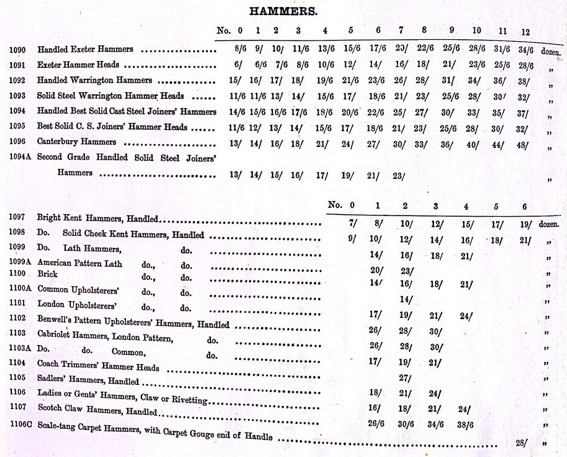
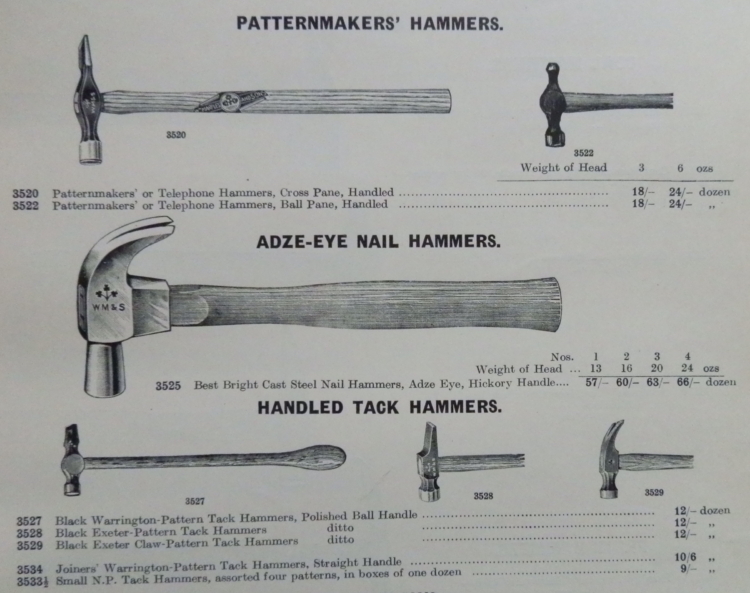
Back before 1909 things get a little hazy as item numbers were ever changing; descriptions of the tools changed from catalogue to catalogue and the names ascribed to the hammers also differed. [ e.g. Warrington hammers are not so described initially, but are listed under ‘Joiners’ hammers and then later under that Warrington name …see below]
It may be that ‘Joiner’s hammers and ‘Warrington’ style hammers co-existed before 1900, but eventually the two forms were amalgamated into being a ‘Warrington Joiner’s ‘ hammer. [The initial joiners’ hammer looks like a smaller version of a ‘Warrington’ with only slight differences in the face depth and profile.] MARPLES also re-used Catalogue numbers, for e.g:
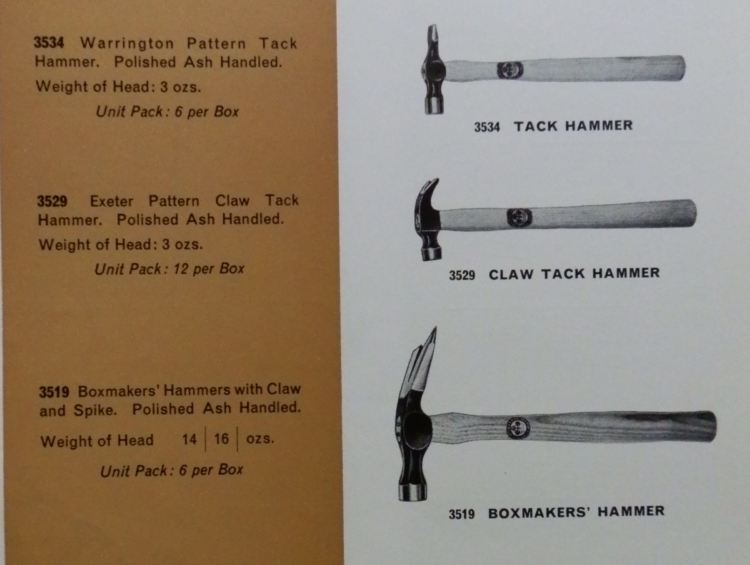
Tack hammer #3534 existed in one form up until 1909 and was then de-listed. But the #3534 was re-introduced as a Tack hammer of a different style in c.1935!! You will see that I have tried to blank out the information that does not pertain to this specific Hammer file, but you will find other trades’ hammers listed under those different trades, as they are published here.
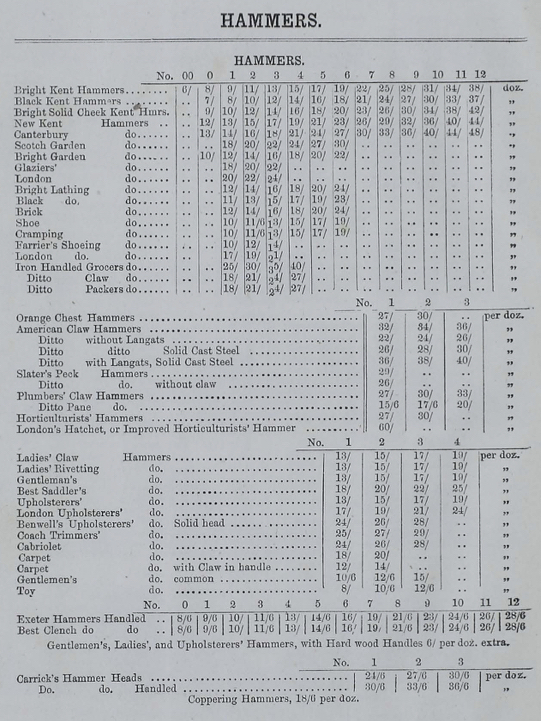
First to list are the 1861 entries:
And the 1873 entries:
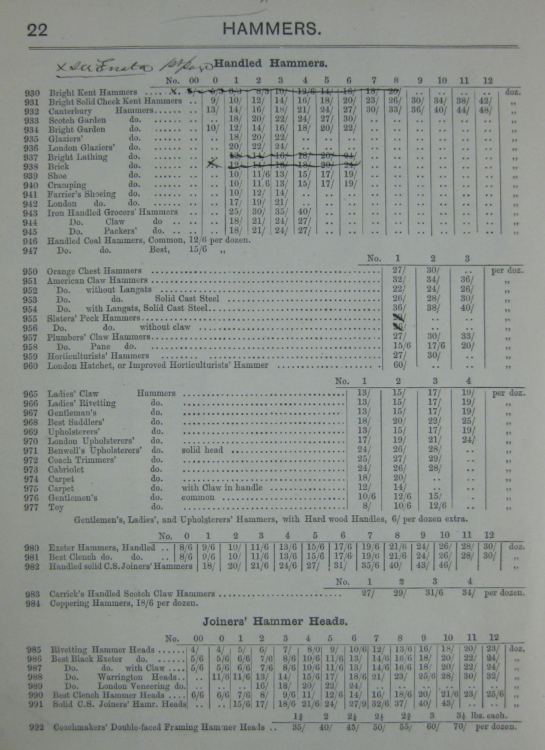
1888 entries follow:
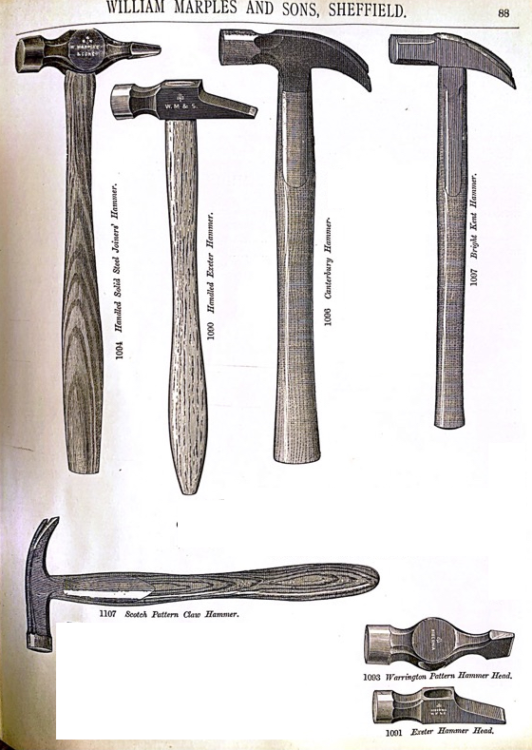
The 1897 catalogue lists these hammers:
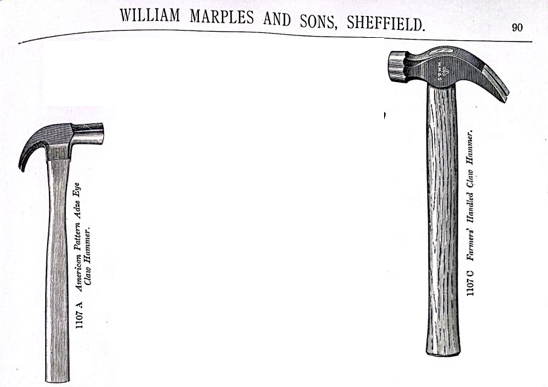
1909 listings:
1928 listings:
The 1938 listings are below:
The first hard catalogue post war of 1959 shows these:
1965 listings:
So as far as I can research, the following are the beginning/end dates of manufacture by MARPLES of the following Hammer ‘styles’:
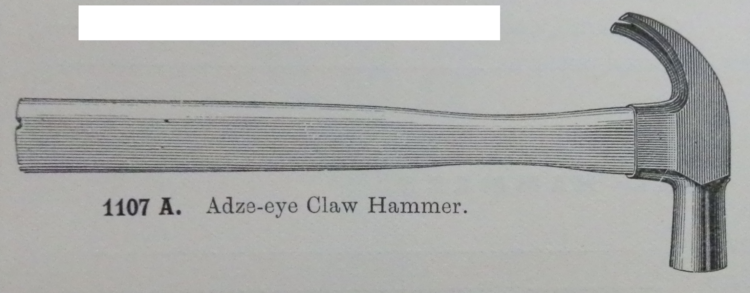
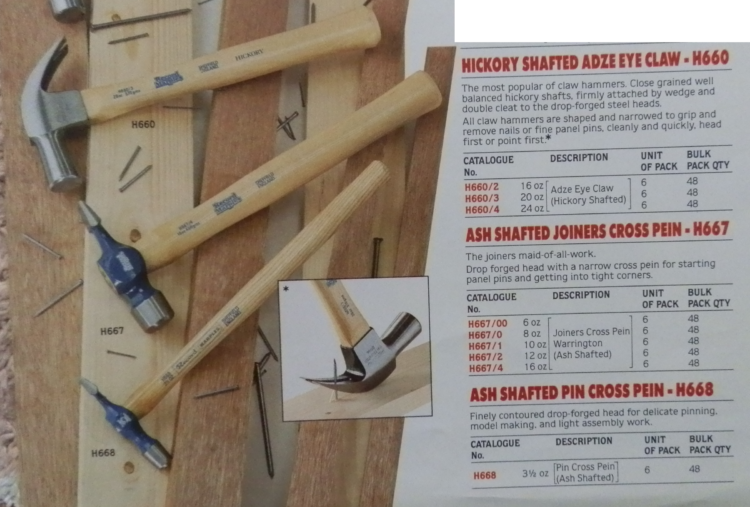
But when C&J Hampton [RECORD] took over MARPLES they eventually re-introduced RECORD-MARPLES hammers as Adze-Eye Claw; Warrington and Pin. These were purely RECORD hammers and I do not consider them in this study as being a MARPLES product.
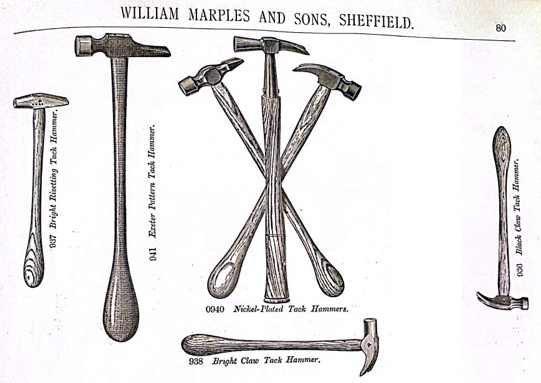
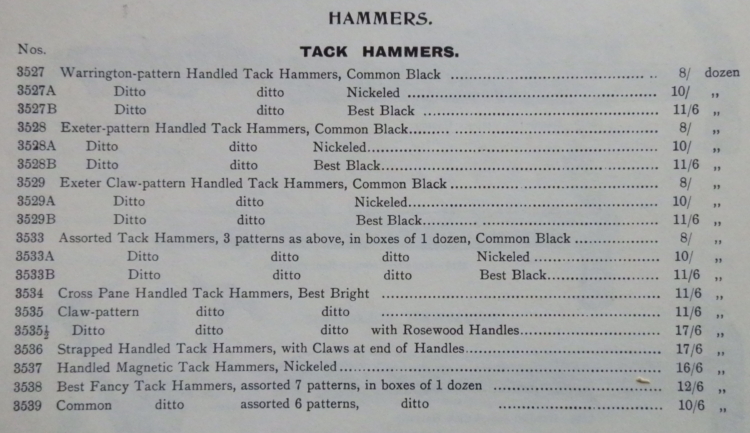
Tack Hammers: MARPLES manufactured many different sorts of Tack Hammer and some went out of favour while others were introduced. It is a confusing study because of the lack of uniformity of the numbering system and the descriptions ascribed to the tools. Combine this with the fact that not all hammers were pictured! So I have done my best to list the Tack hammers and their descriptions, but starting with the year 1897.
#3527 Black ‘Warrington’ style………… 1921-1959
#3528 Black Exeter……………………………. 1897[#941] – 1959
#3529 Black Exeter Claw……………………. 1897[#936] -1965
#3531 Best Bright Claw…………………………1928
#3534 Bright Tack Hammer………………….1897[#937] – 1909
#3534 Best ‘Warrington’ style ……………. 1938-1965
#3535 Tack ………………………………………..1897[#938] -1909
#3536 Tack with handle claw ………………1909
#3537 Magnetic ……………………………………1909
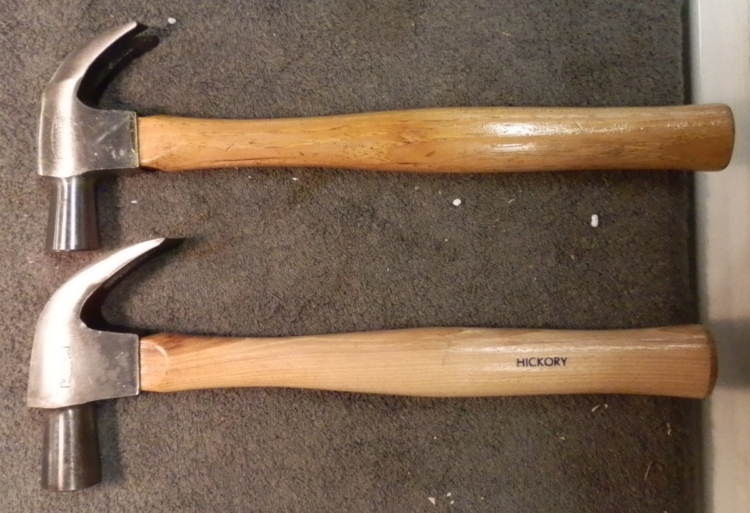
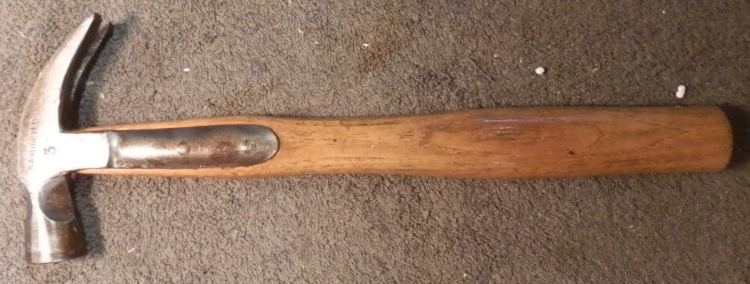
The following products are to be considered pure MARPLES hammers, except where noted. To find good clean examples of everyday hammers is very difficult, since, being hammers, generally they were ‘hammered’ to death. [Sorry!]. So here is a small selection of hammers that I have, along with their description.
Adze Eye Claw hammers…2 sizes:
Canterbury Pattern Claw hammer:
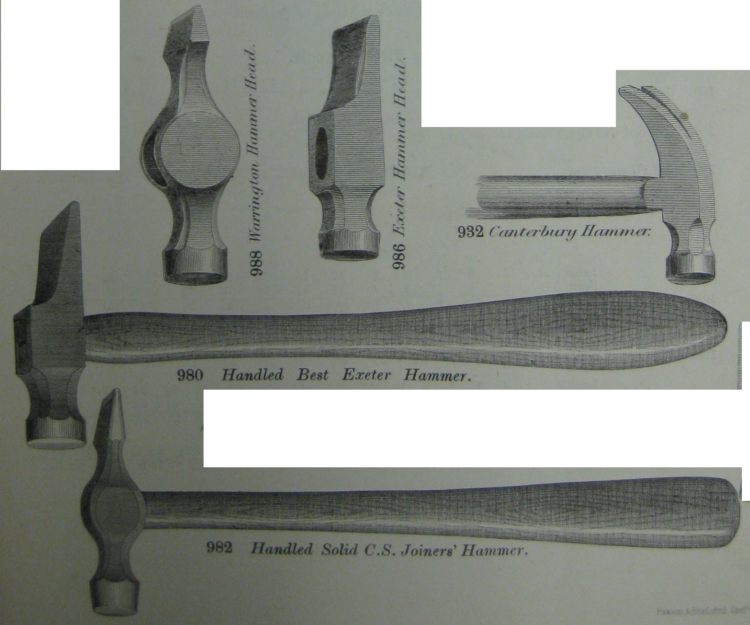
Exeter Pattern Hammer and Exeter Pattern Tack hammer:
The Exeter Pattern hammer below shows a single shamrock mark and is therefore pre-1875. The head and handle shape are singular design shapes of Exeter Pattern hammers.
Not all Marples hammers adhered to the same scale of weights and relative numbers therefore the weights give here only apply to Exeter pattern:
000=8oz; 00=4oz; 0= 6oz; 1=7oz; 2=8oz; 3=10oz; 4=11oz; 5=13oz; 6=15oz; 7=17oz; 8=19oz; 9=21oz, 10=24oz.
I do not know why MARPLES would adopt a simple ounce weight system to mark their hammers!!
In 1862 these hammers had no number until 1868 when they were fixed with #986 [handled or #980 un-handled]. In 1888 the handled version was changed to #1000 and in 1909 to #3510.
Bench/Farmer’s Hammer:
Warrington Hammers:
In the above photo at the top is shown a standard Record/Marples H667 Warrington hammer.
Warrington Pattern Tack Hammer and Patternmaker’s Cross Pein:
The cross pein Patternmaker’s hammer differs in the fact that it does not have a central circular polished poll.
Below is a mystery hammer which I have been unable to find either a description or a picture in all my catalogues. It may have been that it existed briefly in the years between 2 major catalogues and therefore missed inclusion in both! It looks like an Upholsterer’s hammer to me!
Tack Claws
TACK CLAWS
[These tools are also dealt with briefly under ‘Upholsterers’ Tools].
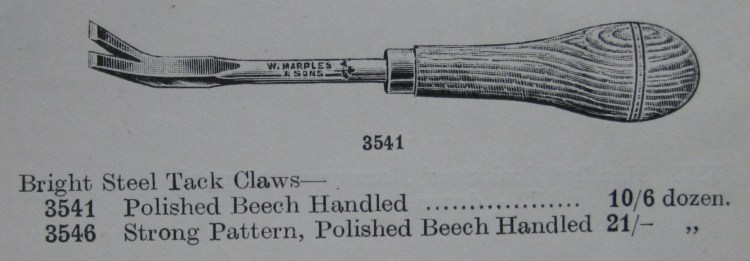
These tools, used to remove Tacks or small nails are first to found in the 1897 Catalogue, and probably were introduced before this time:
The 1909 Catalogue shows these entries:
As you can see this is a mirror image reversal of the 1897 Catalogue entry but with a newly assigned number, see also below showing 3 options of this tool:
These tools are not mentioned in the 1921 Catalogue, probably having still been dropped from the line due to financial constraints resulting from fighting the Germans. But the 1921 Catalogue does indicate that a full list of Upholstery tools may be had on application, indicating that the Catalogue was not a complete list.
They are re-introduced by the time the 1928 Catalogue was published but it looks as though old #3947 has been now numbered #3541 and old #3949 becomes new number #3546 and the Rosewood variety has been de-listed.:
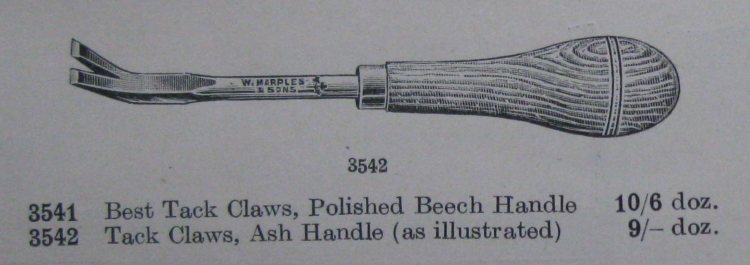
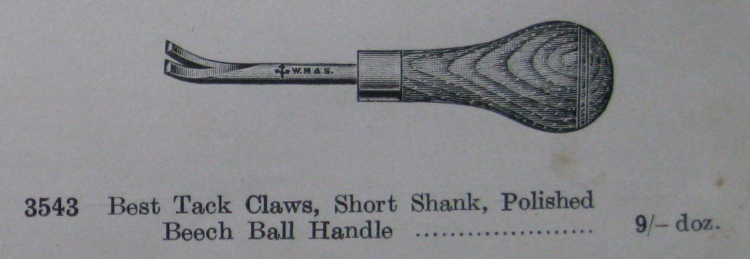
The listing in 1938 follows and shows that #3542 with an Ash handle is a new addition, that a short Beech Ball handled variety #3543 is in production but that the Strong Pattern #3546 has been dropped from the line:
We have to wait until 1959 to see the next catalogue entry showing that the Ash handled #3542 is no longer present:
In the 1965 Catalogue only the #3541 is mentioned and showing a Brown painted cap to the now Ash handle:
This #3541 continued through to August 1973 when it is shown in the M2MARPLES Catalogue having a ‘Hardwood‘ handle:
By July 1979 there is no mention that this tool was available, but suddenly in May1985 a ‘New Item’ was introduced…M180Tack Lifter costing £3.16. I can find no pictures of this item and surmise that it may well have been a plastichandled tool, as was common at that time. But by August 1987 even this M180 is no longer listed although having been still shown available in March 1986 .
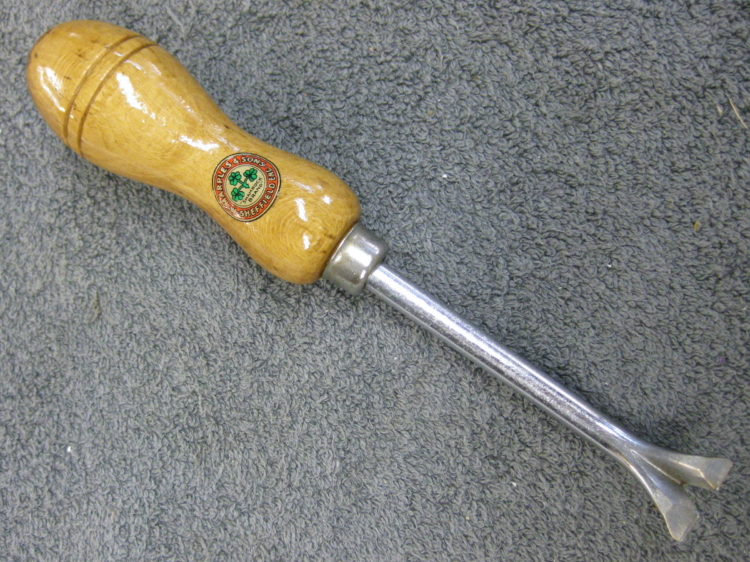
This #3541 shown below is probably from early 1960s?
The later one below also has a beech handle:
Carpet Stretchers
CARPET STRETCHERS
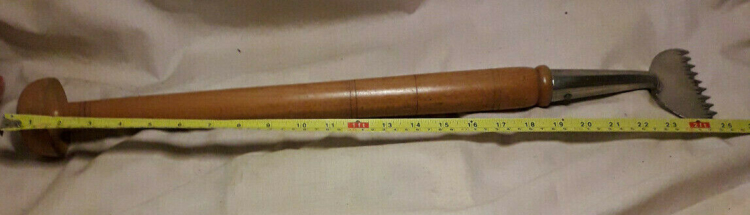
These tools were available in the 1861 catalogue but with no picture. At that time and for many years after they were called ‘Carpet Strainers‘ and the name only changed to ‘Stretchers‘ c.1938. These tools were used to catch the edge of a carpet with the teeth {of the tool!} and with a thump from the artisan’s knee [ouch!!] the carpet would be knudged slightly further toward the perimeter of the room where a fixed line of teeth [nails], embedded point up in a wooden strip, would grab hold of the underside of the carpet. In this way a carpet could be stretched taut in a room, avoiding any ripples on the carpet surface. This tool would have been used more by professional carpet fitters rather than by Joe Public!
The 1873 listing is shown here:
At this stage it is not stated that the Tools came with a handle and of note is that the teeth are single primary teeth only, with no secondary teeth in between…see later.
Below is a #1153 with 8 teeth and a handle, c.1873.
The 1897 Catalogue shows some changes in that the item numbers have changed, that a ‘handled’ option is available and a cheaper ‘Japanned’ variety could be had instead of the Nickel plated items. By this time only the ‘Bent Socket’ variety was offered. Judging from the drawing, it appears as though by 1897 a set of secondary teeth now is interspersed with the primary teeth.:
Moving on to 1909 we see this:
In 1909 we see that the numbers have again been changed , a ‘jointed’ handle could be had for 3/6d extra each and that the illustration now does not show the ‘secondary’ teeth!! I put this down to incorrect artist’s interpretation!! It would appear that the tool was primarily available without the Mushroom top [Item #3916], so maybe it was intended to be used by shoulder power? The Mushroom top variety was also offered [Item #3917] but at 6 shillings more per dozen.
The 1921 catalogue shows this:
It appears that the #3918 Common Japanned stretcher is now not listed, nor is the option to have a jointed 2 piece handle. [It is a common theme that the 1921 Catalogue shows only a reduced list of tools that were available before the 1914-18 War.]
The 1928 listings are shown below:
And there you can see that the Jointed handle to the Mushroom topped #3917 has been reinstated as Item#3917.1/2 and the Common Japanned variety has re-appeared. The Mushroom top also appears to be larger.
The 1938 Catalogue entries are offered here:
It seems that Item#3917 automatically comes with a Mushroom handle and no other handle style is offered. This is also the first time that the prices quoted are ‘each‘.
The 1959 Catalogue shows that the 8 tooth stretcher is no longer listed:
Again here is another case of MARPLES using old pictures years after the product has been updated. Above shows a Mushroom head picture which appeared in 1921 but which was updated to the modern fuller form in 1928!! Maybe nobody was taking sufficient care of their catalogues at this time. I wonder how more ‘mistakes’ show up in this 1959 Catalogue?
The last listing thjat I can find for these tools is in the Price List of November 1963. Here is an early #3915 unhandled stretcher showing 10 teeth and being 3.3/4″ across:
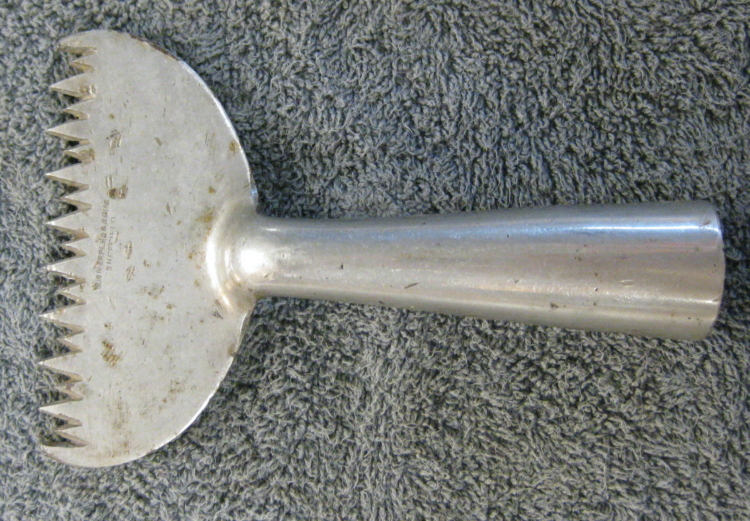
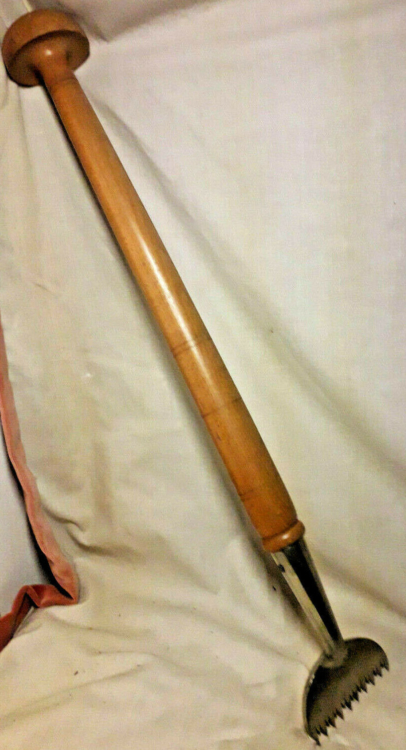
And here is a 3917.1/2 Jointed handle stretcher with 12 teeth and being 4.5/8″ across:
Below is a 10 teeth #3917:
Pushpin
PUSHPIN
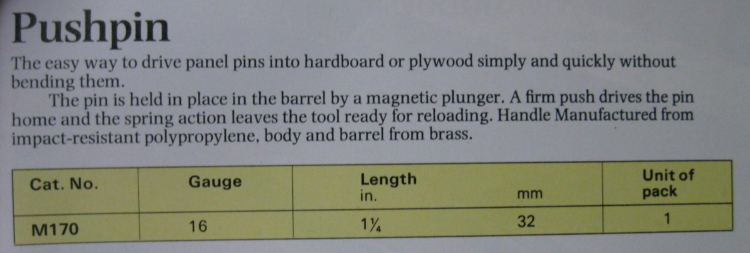
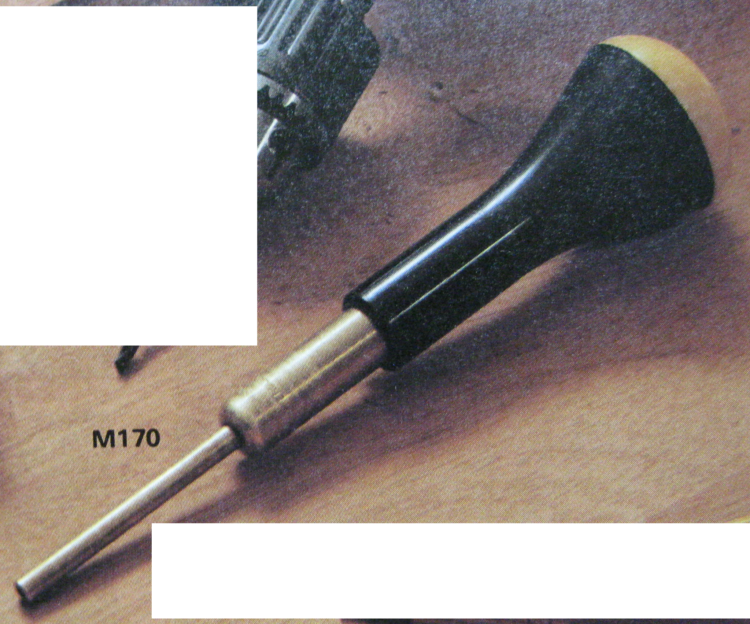
This handy tool, number M170, was introduced around 1977 and enabled the easy insertion of panel pins into hardboard or plywood. The first variety had a black handle with a yellow top and shows that there were 2 different sizes:
The 1978/9 catalogue shows this:
Here are excerpts from the May 1988 Catalogue which shows only M170 as being available..
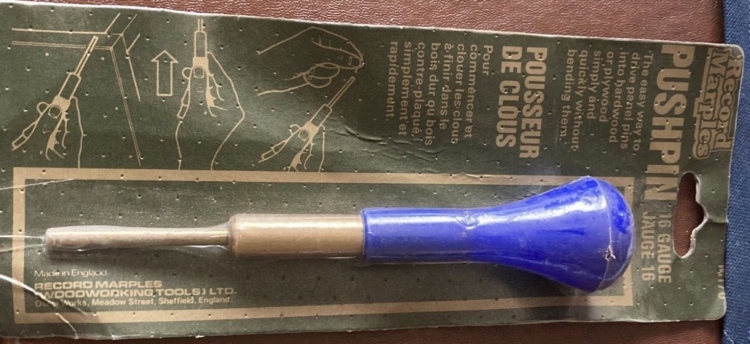
Around 1990 the polypropylene handle was changed to all Blue and this style continued through Jan 2006 when Irwin Marples had it numbered as TM170. I am unsure as to whether this product was continued when Irwin moved all production to China.
Timber Gouge
TIMBER TESTING GOUGE
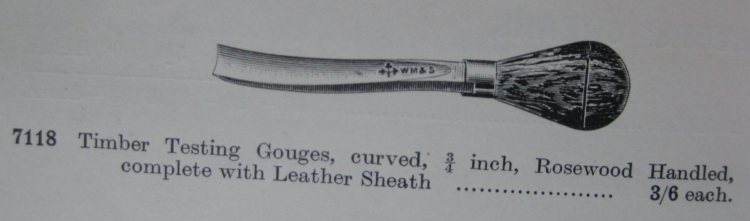
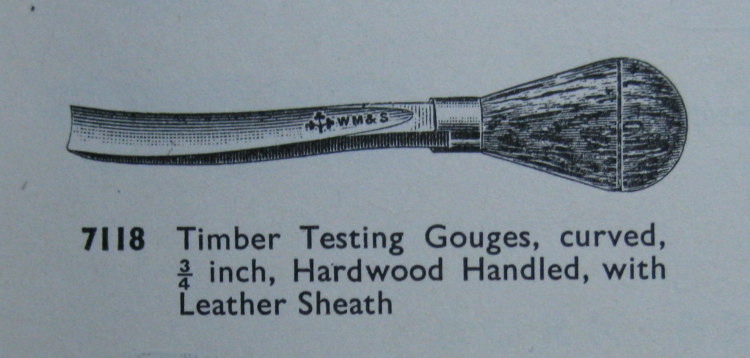
From my catalogues I deduce that this special gouge [which looks similar to a cheese tester!] was first seen around 1908 and was identified as Item #7118. [This same number endured with this tool until the very end of its’ production which was c. 1963.]
I have yet to find out how it was used, but maybe it was to produce a Timber sample that could be looked at under a Microscope for identification purposes?
The same print was used in all the catalogues, except that in the 1909 Catalogue there was no included picture of the item which was described as having a Rosewood Handle and a Bent blade and Leather Sheath, all for 2/6d.[as shown above].
By 1928 the price has risen to 3/6d and this price is also seen in 1938, with Rosewood Handles still being supplied.
We then jump to 1959 which is from the below picture. You will note that the handles are now of Hardwood [Beech]
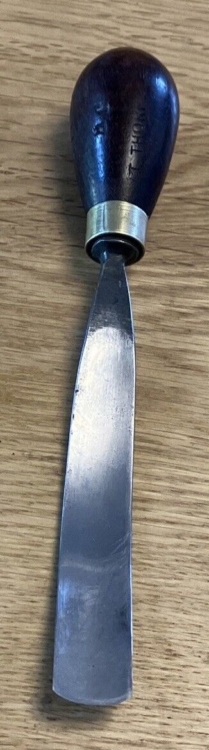
The pictures below may depict a later [post war] example of this tool since the blade seems to be sharpened completely differently to the pre-war example shown above AND there seems to be very litte, if any, curvature to the blade.
An earlier example with Rosewood Handles and a distinct blade curvature is shown here:
The last entry indicating that this tool was still available is in the April 1962 Price List and shows a price of 17/6d.
Stay Sharp
Record MARPLES STAY SHARP:
This was a short lived tool introduced c.1988 and not listed in May 1991. It was offered in two lengths..70mm and 100mm and was like a mini knife sharpener!
The ‘steel’ was housed within the plastic body being reversed for use, and the unit was provided with a pocket clip.
Screwstart
SCREWSTART
This device, which is to aid in the starting of wood screws, appears first in the 1988 Catalogue:
It can also be found in the October 1990 Catalogue, but with no picture.
I cannot find any further listings, so it would appear that this tool is a little rare to find since it had but a 2 years lifespan and the majority of those sold
were probably abused!
Below is a picture of the original Screwstart and a later version.
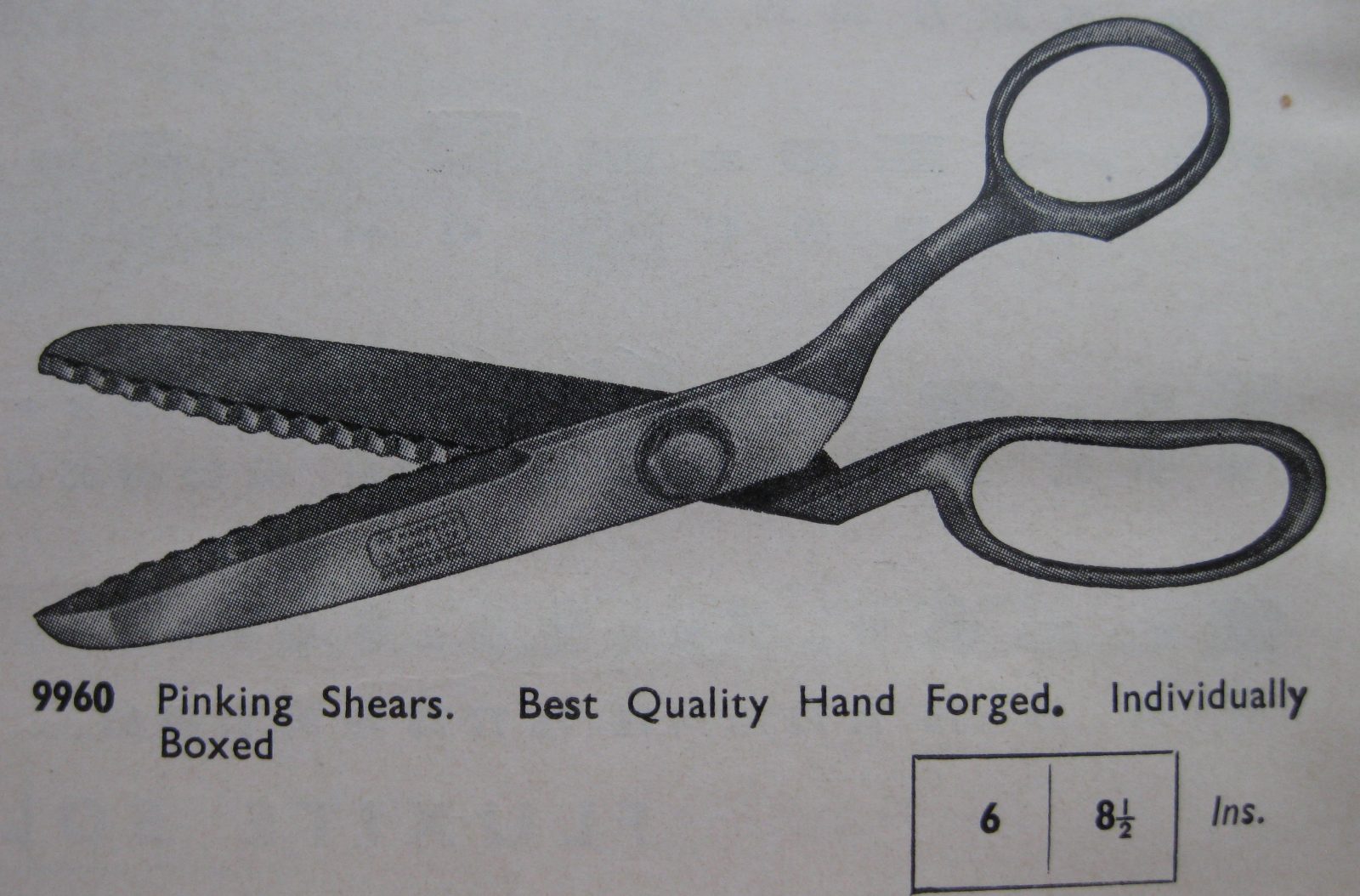
Pinking Shears
Below you will find a great set of ‘Pinking Shears‘, used by Tailors. The only reference I can find to this product is in the 1959 Main Catlogue as Item# 9960. However there is an Item# 9960 in the 1909 Catalogue that indicates ‘American-PatternTailors’ Shears‘, but these may not be pinking shears. [‘Pinking’ denotes the cutting of a saw tooth cut in cloth].