This is a plane that I cannot find in all of my extensive MARPLES catalogues!!
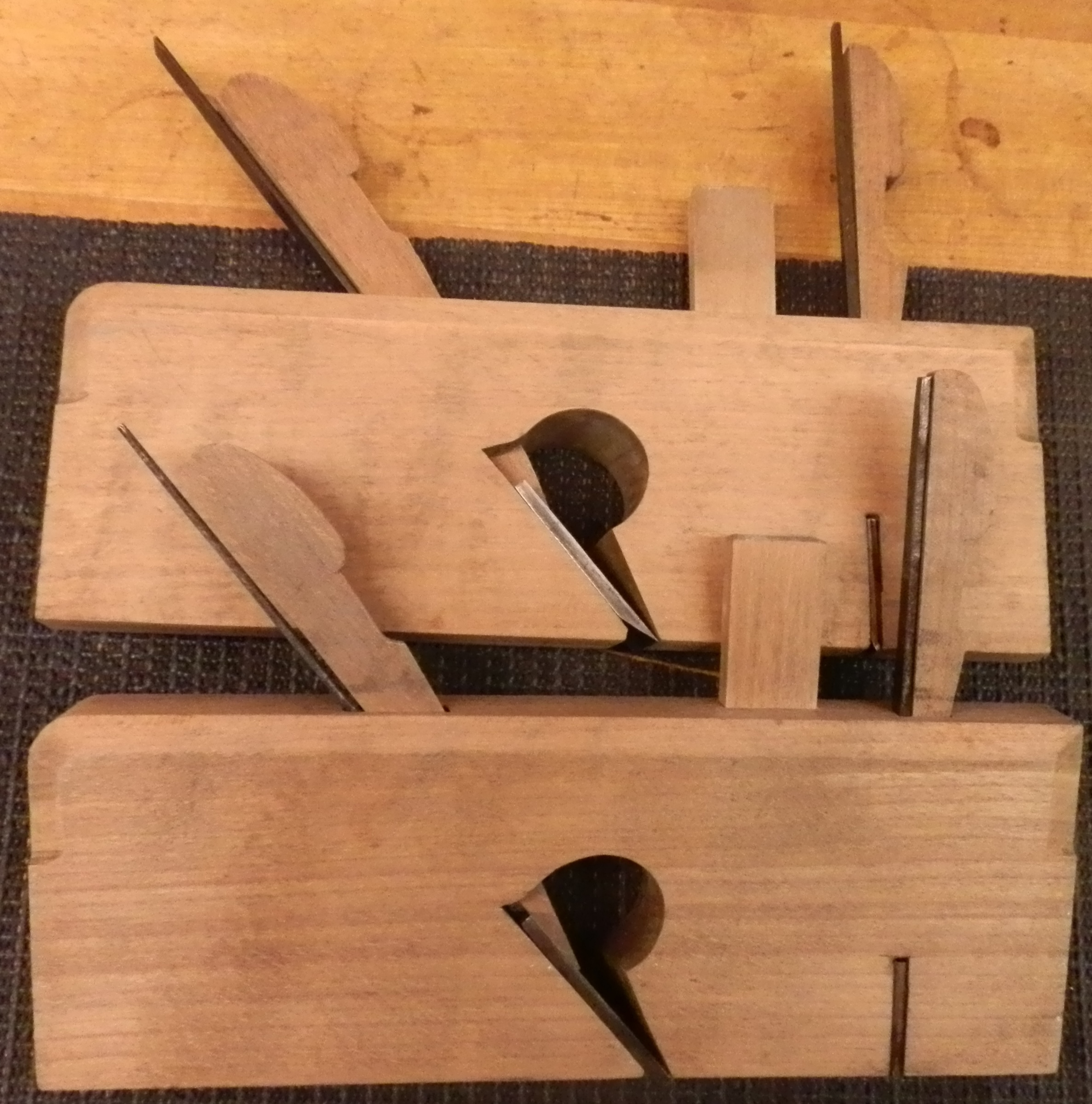
It was a tool that was designed to produce a spiral shaving , called a ‘Spill’ [as long in length as the wood from which it was worked] for helping to light fires or candles, before ‘matches’ were invented. The pictures below tell a thousand words:
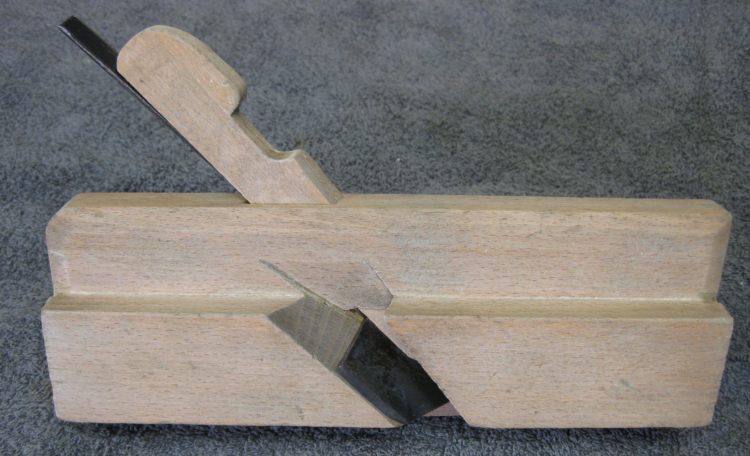


The plane was butted up to the side of the wood and the skew blade [set very fine] was used to produce a thin spiral shaving that could easily be lit [from another flame] and used to light further fires/Candles etc.
At this juncture I cannot surmise when the start and finish dates of production existed!! But there are no listings in 1861, 1873, 1888 or 1897.
So this study is far from complete and I will continue to search for further information.
William Marples & Sons produced Wooden mallets to strike a chisel or gouge going back to at least 1861 and probably even before that time. They therefore manufactured and/or offered for sale Wooden Carpenters/Joiners Mallets for at least 130 years. There were many item number changes during that time and many changes of ownership that resulted in even more Item number changes and changes in tools that were offered. [see the changes in the 1990’s]
We can start here with the pages drawn from the 1861 catalogue:
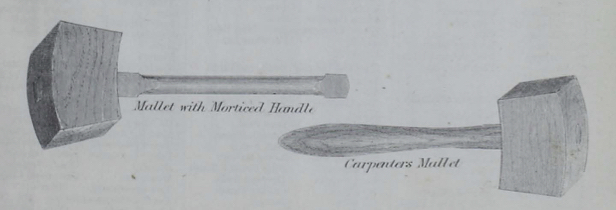
 Gentlemen’s Mallets were obviously smaller, but I cannot deduce the real useable difference between Joiners’ and Carpenters’ mallets. [size maybe?]
The 1873 Catalogue sees these pages. Note the sizes:


Here are the 1897 offerings:


You can therefore see that the size range has been increased with the addition of a 4.1/2″; 5.1/2” and 6.1/2” sizes to the Carpenters’ Best Quality range. All these Mallets had best quality British Beech heads and Ash tapered mortice handles, and this standard was held until the end of manufacture in 1991.
The 1909 catalogue shows these [with Item number changes]:


Here you can see that the range of sizes has again changed to reflect the time. A small 4″ size has been introduced and the larger 8″ size de-listed. Could this be a reflection of the degradation in strength of men generally!! The Round Hickory #7694 is a new addition as are the ‘framed’ Mallets #7690 and #7691. For the first time we can see that the Gent’s Mallet is not a through Mortice handle, but may well have been ‘fox-wedged’.
1921 sees the usual reduction in offerings because of the WW1, but still in the same sizes for Item#7685:

Here we move on to 1928 with again an Item# changes:
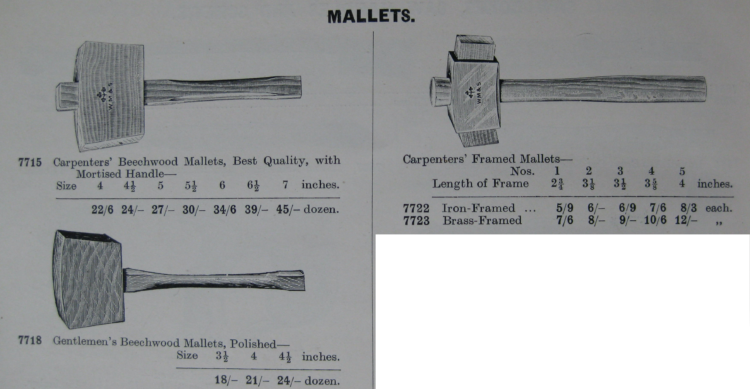
The 1938 Catalogue pages are here:

As you can see there are a couple of good additions to the range. The #7715L was a higher quality Carpenters’ Mallet having a Lignum Vitae head instead of Beechwood, and it just must have been the best ever offered. Also the ‘BB‘ range #7716 enters the market, being of lower quality and with therefore comparable lower prices.
Thanks to Mr. Hitler we have to jump to 1959 to see the next catalogued entries for these tools. No doubt they were for sale in between these dates but I have no literature to show you.

The 7 inch size has been deleted from being offered as a #7715 and all the other Mallets [see 1938] no longer exist!.
By 1965 even the 6.1/2″ size of #7715 has fallen by the wayside:

By 1971 we are now down to just 3 sizes of Item#M7715. 4″; 4.1/2″ and 5″
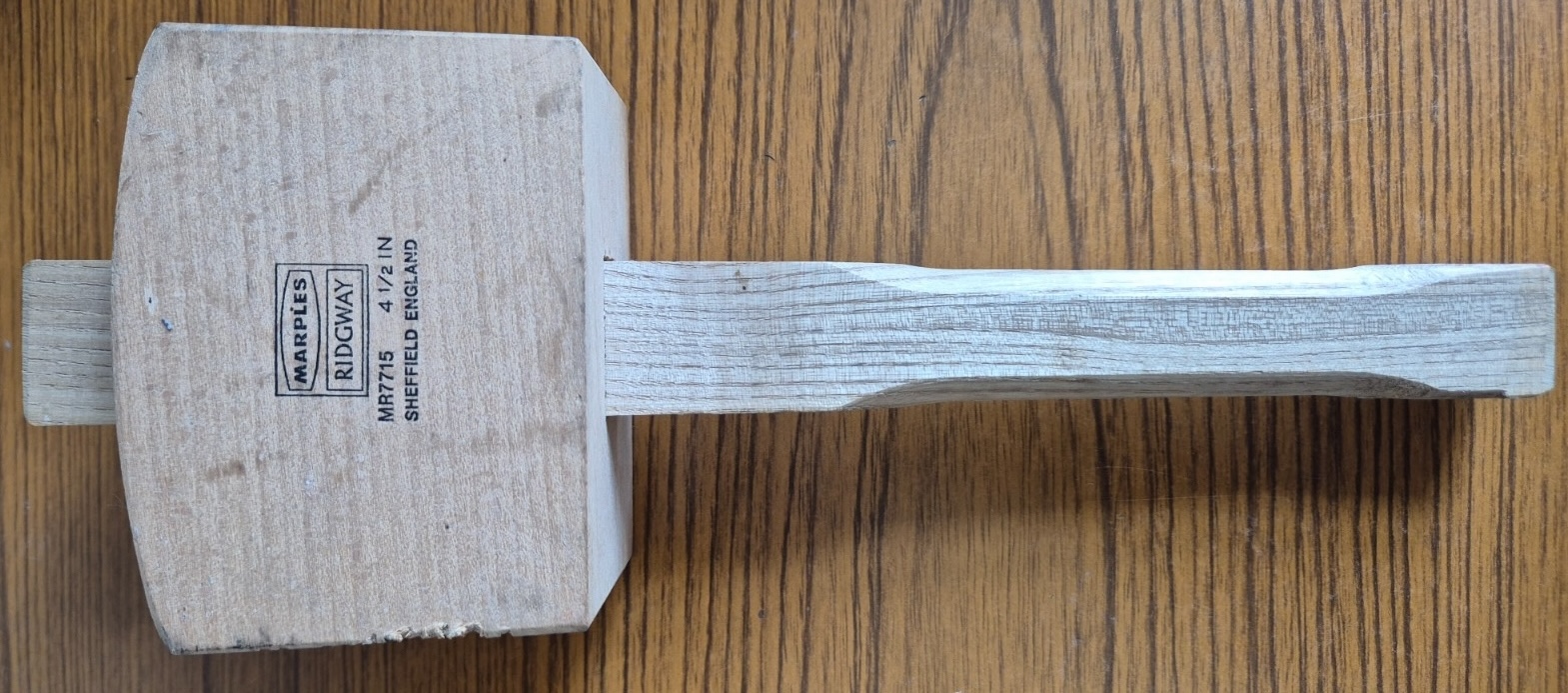
Nothing changed in these listings until Feb 1984 when only a 4.1/2″ is listed as MR7715. This is the 1980-1990s phase when multiple changes in ownership occurred. Below is a MARPLES RIDGWAY MR7715 from c.1984
The same listing is seen in May 1988 and beyond, but in October 1990 there are radical number changes:
MW 6 is the 4″ Joiners Mallet
MW 11 is the 4.1/2″
MW 12 is the 5″
MW 13 is the 6″ variety
Below is a rare MW 12….

But then in May 1991 only MR 7714 at 4″ and MR 7715 at 4.1/2″ are shown!!
If you are not totally confused by now, maybe you can explain all these silly number changes to me!
It looks as though the last listing of these Carpenters’ Beechwood Mallets can be found in the November 1991 Catalogue.
Here is a small gallery showing mostly the later Mallets [Most of them were used to pound into oblivion large Mortice chisels or large Gouges and so very few early examples can be found intact today]

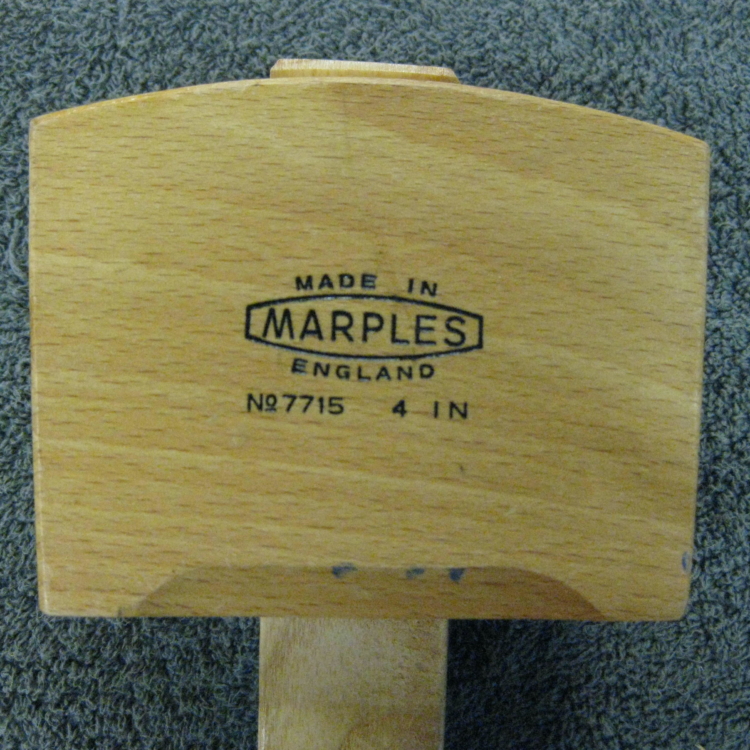


The example below numbered MR 7715 could either be from
Feb/84-Sept./90 or May/91 -Nov/91. See above notes.

A small mallet found in some later [c.2000] chisel sets is rarely found outside these [today] expensive sets. I am unsure whether it is marked ‘MARPLES‘ anywhere:

The next #7715 is from c.1940 with the older MARPLES mark and no hole drilled in the handle.

The following photos show a early #7715 with a different paper label applied to the head:


I have only included information here on the Braces that relate to Woodworking Tools. Many other Engineers’ and other braces may be found in the catalogues.
I can trace MARPLES involvement in the production of the Iron based braces back to the 1846 List and they were probably made slightly before that time since the Scotch Iron Brace shown there is an ‘Improved’ version! Only a Scotch Improved Iron Brace is mentioned at this time and this is the same tool as advertised below in the 1861 Catalogue.

The 1873 Catalogue has this entry:

The 1888 entries are a little confusing with the introduction of ‘American Pattern’ braces:
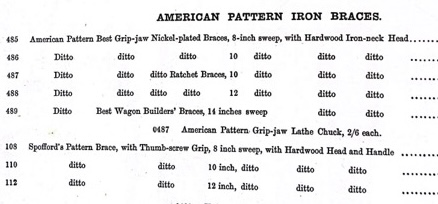
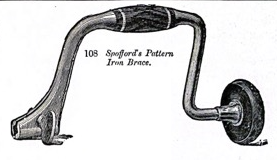
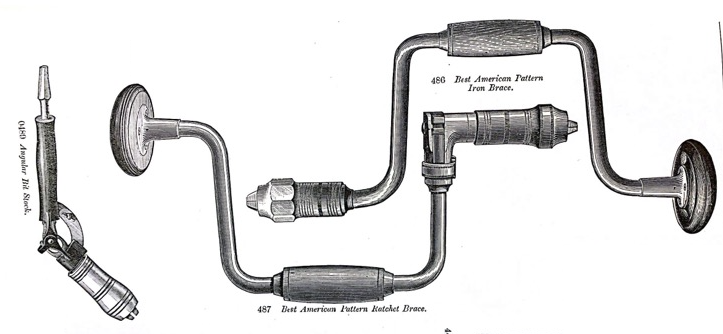
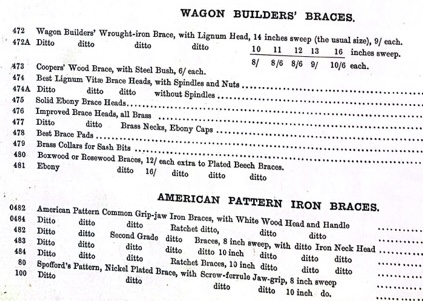
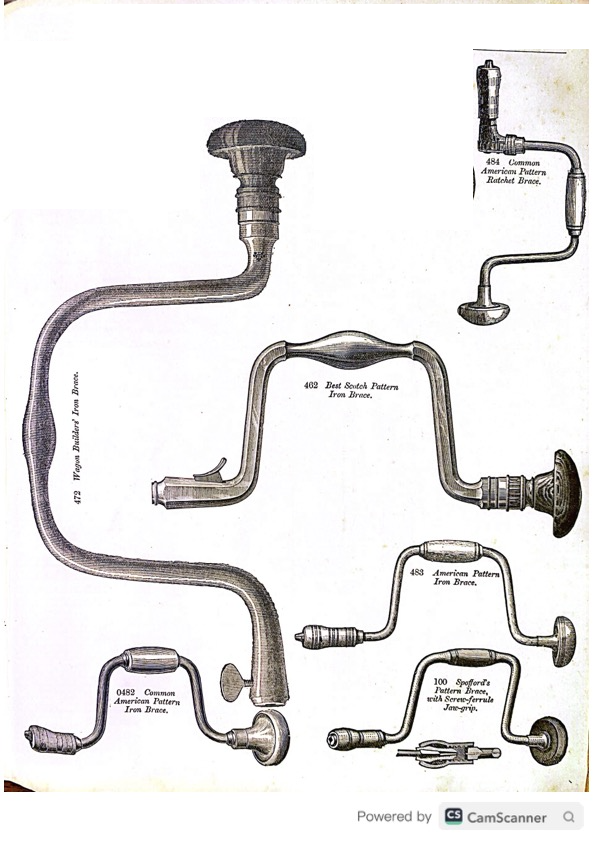
By 1897 products have drastically increased :

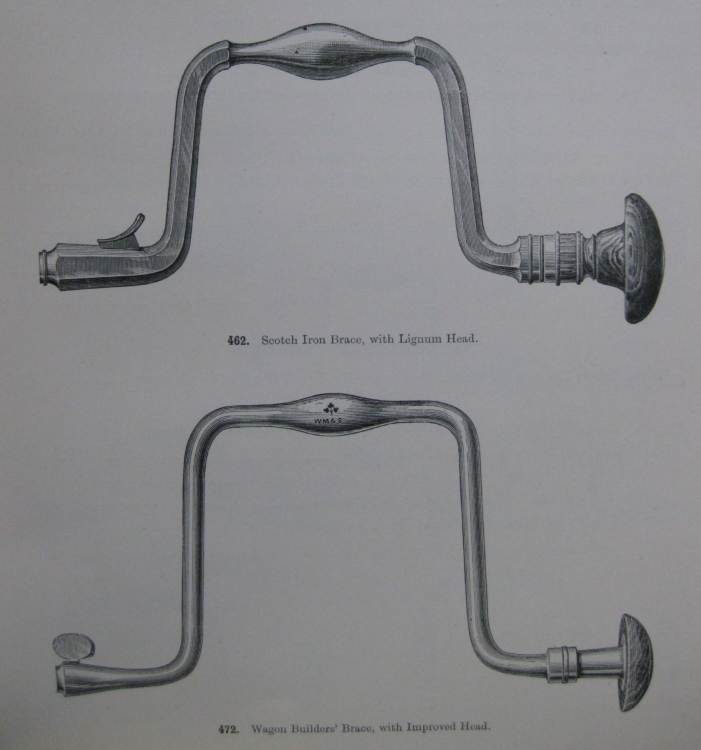


The 1909 Catalogue [below] has all the usual Item number changes to confuse us.


The 1921 Catalogue, shortly after WW1, shows the usual reduction in commodities [which rebounded by 1928] :


The 1928 Catalogue:


By 1938 we see this detail:


By 1959 things were completely different:


And by 1965 [below] the bottom of the barrel has been reached, since nobody then wanted to actually turn a handle to bore a hole, it had to be electric, hence the demise of the Brace and Bit. 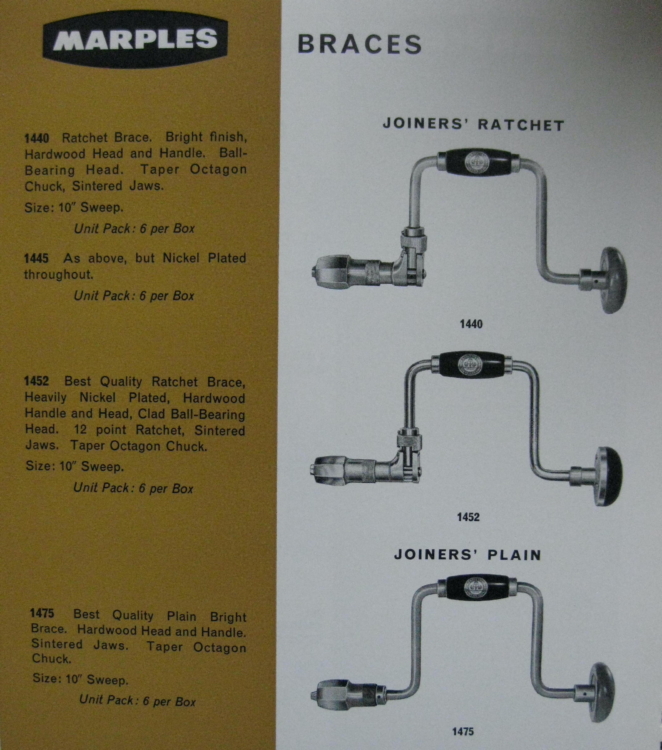
In the Price List of May 1966 here are the prices, followed by those of Nov 1969:
1440 28/3d 33/6d.
1445 34/- 40/-
1452 47/6d withdrawn
1475 19/6d 24/-
The last information I can find is in the Supplemental Catalogue of 1971 wherein is noted a #1440 10″ as being still available.
I hope to have some real examples up here soon, but I am still working on them. A Brace is the hardest tool to restore adequately and takes many hours of work on each one. Most are found in a very bad state of repair and though cheap to buy, cost much in hours of work, and then some of them simply cannot be restored!!
Here you will find a list of Brace Item numbers and the years that they were produced. Please note that I start this list at 1909 due only to the complexity of changed descriptions, changed item numbers and the fact that it is hardly likely that you will find any decent braces before 1909 because they all received a hard life!!
The dates given are only an estimate and are the dates found in the catalogues and price Lists. Therefore the real introductory date may be a few years before the date given and the real end of production date may be a couple of years after the date shown. This * means that these braces do NOT appear in the 1921 Catalogue, due to the fact that they are either Nickel Plated or discontinued.
1405 <1909
1406/7 <1909
1420 1909-April 1961
1421 1909-1938*
1424 1909-1938
1425 1909-1938*
1426 1909-1914?*
1427 1909-1914?*
1440 1909-1971
1440A 1938-Sept. 1955
1441 1909-1938*
1445 1909-June 1970
1446 1909- Nov. 1963*
1447 1909-1938
1447A 1938-?
1450 1909-1938
1451 1909-1928*
1452 1909-Nov. 1969
1455 1909-1938*
1460 1928-1938
1470 1909-1914?*
1474 1959-Nov. 1963
1475 1909-June 1970
1476 1909-1938*
1480 1909-1938
1481 1909-1938
1482 1928-1938
1490 1909-1921
1491 1909-Nov. 1963
1493 1909-1914?*
1494 1909-1914?*
1495 1909-1938
1495.1/2 1909-1938
I will be showcasing some MARPLES braces below in numerical sequence:
The Wagon Builders’ Brace:

This is one of the oldest Braces produced by MARPLES since 1873 when it was numbered #365 [Waggon Iron Brace]. No size is stated there. By 1897 the production increased to include #472 as the 14″ ‘usual size’ and #472A available in sizes 10,11,12,13,16 and 18 inch sweeps. By 1909 the name had changed forever to ‘Wagon Builders’ Brace’, was renumbered to #1420 and now was only available in 10,12,14 and 16 inch sweeps. The 1921 Catalogue shows the same details but in 1928 the 16 inch sweep was dropped from the line. In 1938 although the same sweeps [10,12 and 14 inches] are listed there had been a slight design change in that the bulbous steel centre handle had been changed to the now standard revolving wooden handle. Below is the 1928 Cat. entry followed by 1938, showing the different handles.


The 1959 Catalogue shows that only the 14″ sweep was available and by April 1961 the Price List shows ‘withdrawn’.
Below is a later example #1440

More examples will be coming Aug 2025……………….
Extension Bit Holders:
These long bit holders enabled the workman to drill a hole much longer than the length of the actual bit. It appears that they were first available in the 1909 Catalogue and were available as a holder with an Octagon Holding Cap [#1496 seen below] and as a cheaper item with a ‘Thumbscrew Socket’ [#1497]. Both these types, throughout their history, were only available 10″-24″. In the 1928 Catalogue #1496 is described as having a ‘Chuck’. Both were last listed in the December 1959 Price List.


In this section I will start by listing and describing the Carving Tools’ accessories and then move on to the Tools per se.
CARVER’S MALLET
The first Carver’s Mallet that I can find [below] is in the 1897 Catalogue, but I must assume that it was available before then, so I shall say c.1893. [They are not mentioned in the 1888 Catalogue].

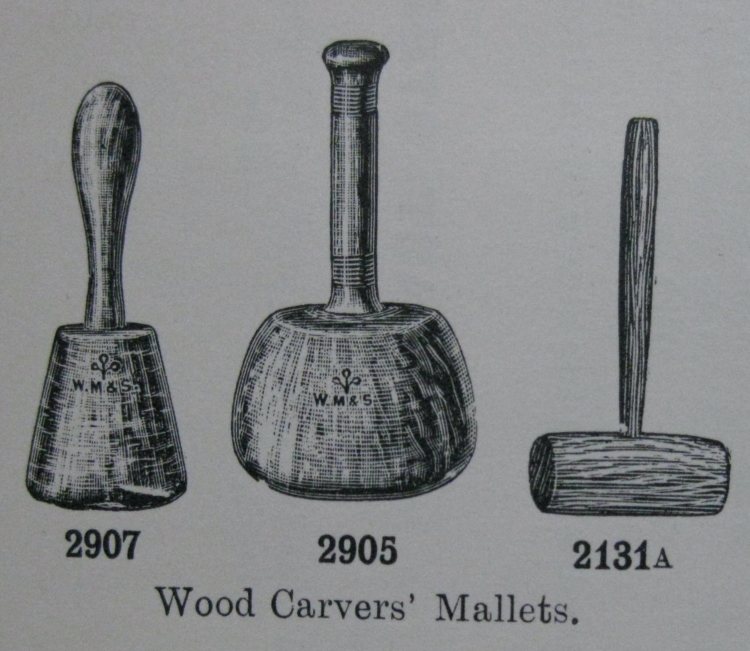
You can see that at that time there were many different styles and woods to be had.
The 1909 Catalogue shows different numbers, but #2131A Hickory has been deleted, although #2131B Hardwood has been replaced by #206 Boxwood with a slightly different shape:


1928 sees these changes: #201 Boxwood and #203 Boxwood are no longer available:

The 1938 Catalogue shows no changes from 1928.
By 1959 things have changed:

And by 1965:

Below is an example of #200 from c.1965 and one from an earlier period:


Then until 1977 there were no changes but in 1977 #200 seems to have been changed to #M204 and with a different profile. That is if we are to believe the accuracy of the images! This situation lasted until at least 1984.

In March 1986 we find that there are now 2 options, one being a #M205 Lignum Vitae head:

Both of these mallets were available up to 1992, but were not seen after 1994.
[There may have been a short time between Summer 1987 and Summer 1988 when only #M204 was available]
Below is a M205 with Lignum Vitae head:


And here is a M204 with a Beech head:

Below is a #206 Carvers Mallet:

Carving or Buhl Punches:
First introduced around 1895, these decorative punches were available into the 1959 Catalogue, but no further. In 1897 they were numbered #2130 but this changed to #246 in 1909 and this number existed until the end of production. They are about 3.1/2” long with a 1/4″ square section. No.14, [Anchor], is shown below:


Bench Holdfast & Clip:
The Bench Holdfast was introduced around 1885 as #2139, but this changed in 1909 to a different tool # 279 named a ‘Clip‘. This was a cheaper tool that did not standup to the passage of time in that the Holdfast [now numbered # 278] was re-introduced in the 1928 Catalogue. This tool endured into the 1959 Catalogue [#4688] where 2 different sizes may be found. The last listing I can find is November 1963. It is not listed in March 1964. M146 was much later…work needed here.


Below is an example of a very late MARPLES M146 Bench Fast:


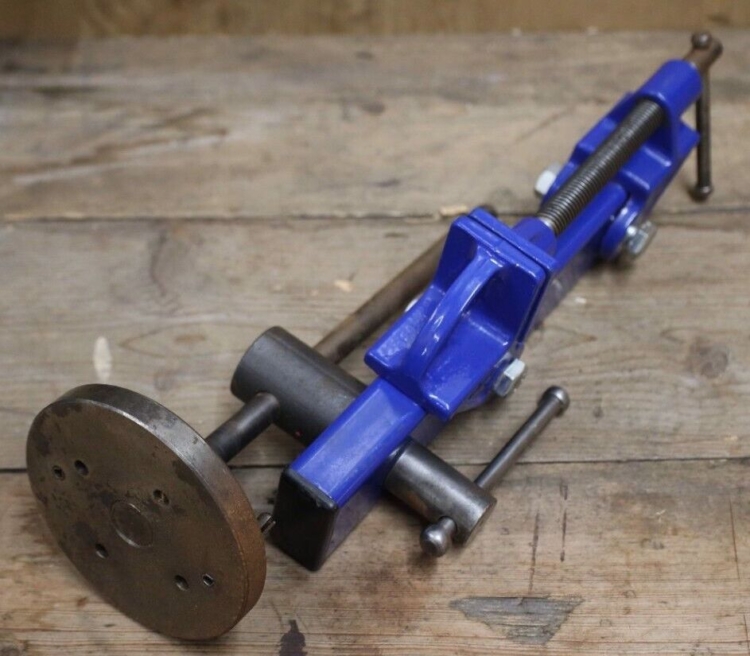
Wood Carvers Vice:
This was a new addition to the Carver’s tools in 1996 #RPCV130 and was very short lived as I cannot find it listed in 1998.


Carver’s Screw:
This long standing Carver’s helper was introduced in c.1895 as #1212. In 1909 it was available in a few different sizes and also as a Black finish [#277 ] and a Bright finish #276. It was only available as #276 in 1921. But reverted to #277 up to the end of manufacture in 1994, when it was only available in 1 size. Judging from the photo below of 2 sizes, it would appear that the length did not include the tapered nose portion


Wood Carver’s Router:
Once again this tool was introduced c.1895 as a Beech router #895 and as a Boxwood router #895A. In 1909 these numbers had been changed to #260 [Beech] and #261 [Boxwood]. But the Beech router only was available from c.1921 to the end of manufacture in the Summer of 1964

Here is the only example of this tool that I have ever found, so I must assume that this tool is quite rare. This one is from c.1960 but I am not sure that the wedge is original:

CARVING TOOLS:
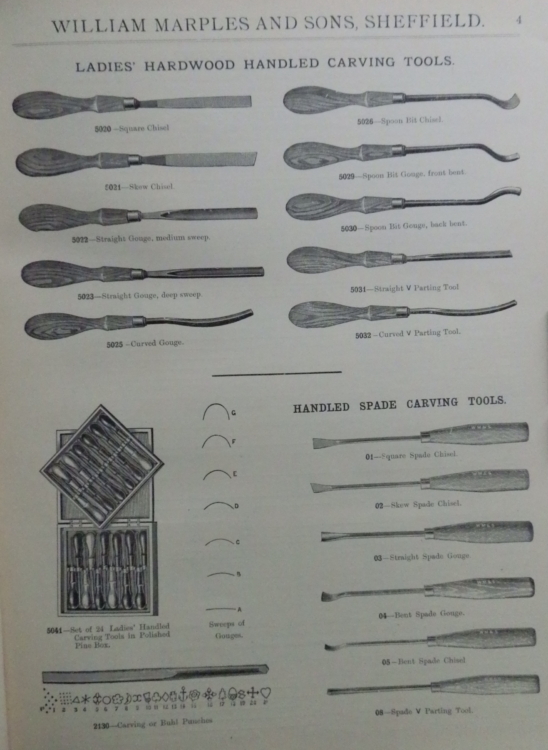
The first indication that MARPLES got into the manufacture of Carving Tools is when they are shown in the 1873 Catalogue. [Again you will note that the description page and the image page are both given the same number.] But noting the different scripts, the description page may be later.
These excerpts were gathered from the Hawley Museum copy.


You will note that at this time there was no #47 Veiner. Instead #11 small width was used.
The 1888 Catalogue entries are below:

Ladies Carving Tools had been introduced in Sets and individually.


Next listed here are the entries for 1897:
#47 Veiner is introduced as well as Buhl punches and Wood Carver’s Screw.




1909 Catalogue listings are below:


1921 listings:
The first page of this issue is ‘Sizes and Sweeps’ and is the same as in 1909


1928 Catalogue listings:
The first page of this issue is ‘Sizes and Sweeps’ and is the same as in 1909.


1938 Catalogue issues:
The first page of this issue is ‘Sizes and Sweeps’ and is the same as in 1909.


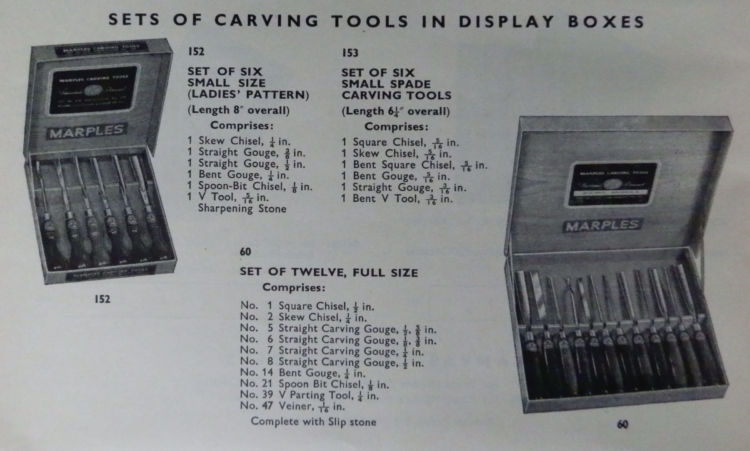
1959 is the next set of catalogue pages:

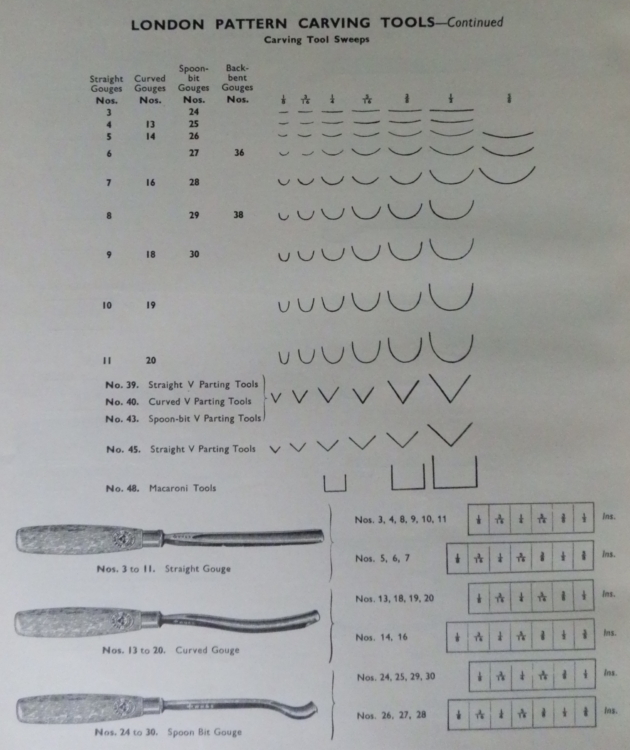


And then we come to the last of the MARPLES hard-backed Catalogues 1965:


The small paper back 1971 catalogue shows these:


1972 Catalogue:
Is the same as 1971 but quite a few styles and sizes show as being no longer supplied
3-11 3/16 & 5/16 not supplied
14,16 ” ” ” ” ”
20,22,23,27,29,36 All sizes no longer supplied
39 3/16 & 5/16 not supplied
40 1/8, 3/16 & 5/16 ” ”
The London Pattern Carving Tools adhered to a very old standard of sweeps and styles as shown in the 1909 Catalogue.

These tools first appear in the 1873 Catalogue in which every tool numbered 1-46 was manufactured. In the 1888 Catalogue tools #47 & #48 are added. In 1909 and 1921 number 47 was omitted and replaced with #11 as a substitute. But #47 reappears in 1928 and is resident until the 1959 Catalogue. No 49 does not appear in ANY catalogue, ever.
In the 1959 Catalogue the following tools do not appear as being available: #12;31;32;33;34;35;37;41;42;44;46 and #50
In 1965 these tools are shown as only being available in sets.
But in 1971 individual tools had been re-introduced, but each style was limited in widths avialable. It is beyond the scope of this study to list the individual widths of each style so I will merely show the Carving tool numbers then still available: 1,2,3,5-8, 11,14,16,20,27,29,36,39,40, 47.
In 1972 Numbers 20,27,29 and 36 have been dropped and #21 has been added to the line.
By November 1977 #40 is missing from the item list and the tools thus offered did not change until May 2000, when, under the ownership of the American Tool Co. RECORD, M18-3/8″ and M27- 3/4″ were added.
By January 2006 no London Pattern Carving tools were offered for sale.
[I am hoping to narrow this discontinuation down to a more accurate date.]
Dates of the Carving Tool sets being available:
#60 1971-1999
#60A 1977-1999
#60B 1984-1987
#60C 1984-1987
#150 1999-2000
#150A 1999-2000
#152 1971-1999
#152A 1996
#152B 1996
#152C 1996-1999
#153 1971-2000
#153A 1984-1999
#153B 1984-1999
#156 1996-1999
#260 1975-2000
#270 1982
During the RECORD TOOLS era c.1996 there was a set M152LE of Ash handled carving tools available that does not appear in any UK catalogue. I am suggesting that this was an Export Only item containing only 6 tools and that LE may stand for Light Export. I have only seen these sets in wooden boxes and as Bilingual…shown below:

Below are the 1988/9 sets:


Below are the ‘sets’ available in 1972:
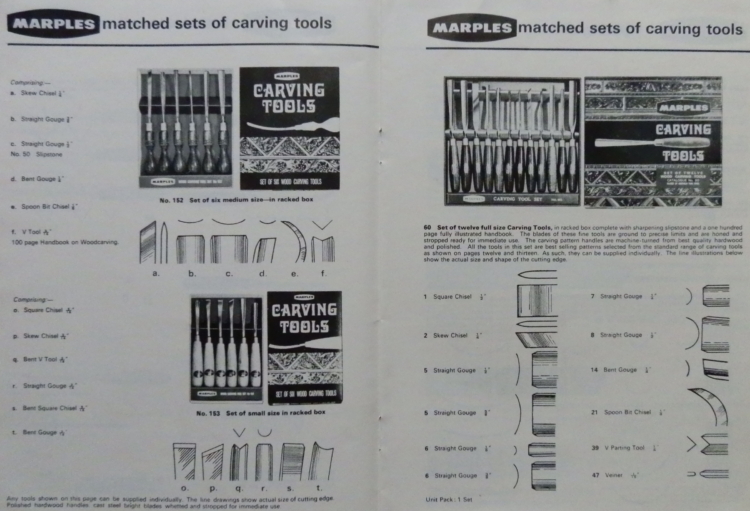
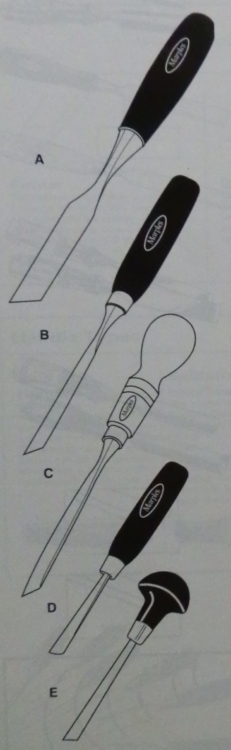
These show the handle descriptions and pictures:
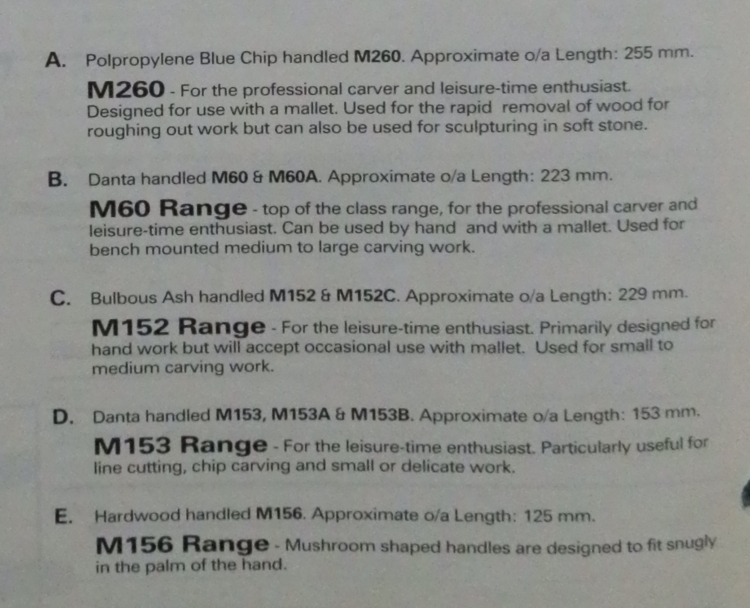
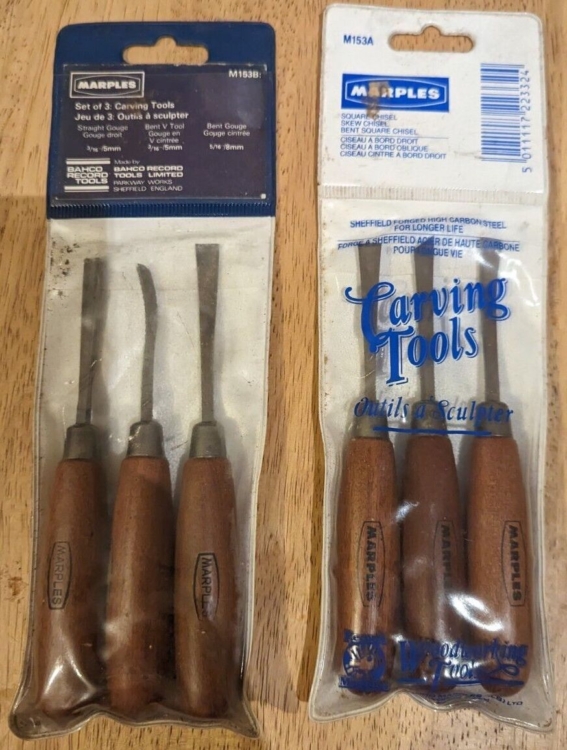
Above right are the 2 sets M153A and M153B, available 1984-1999.
Below is the 6 item set M60A c.1989

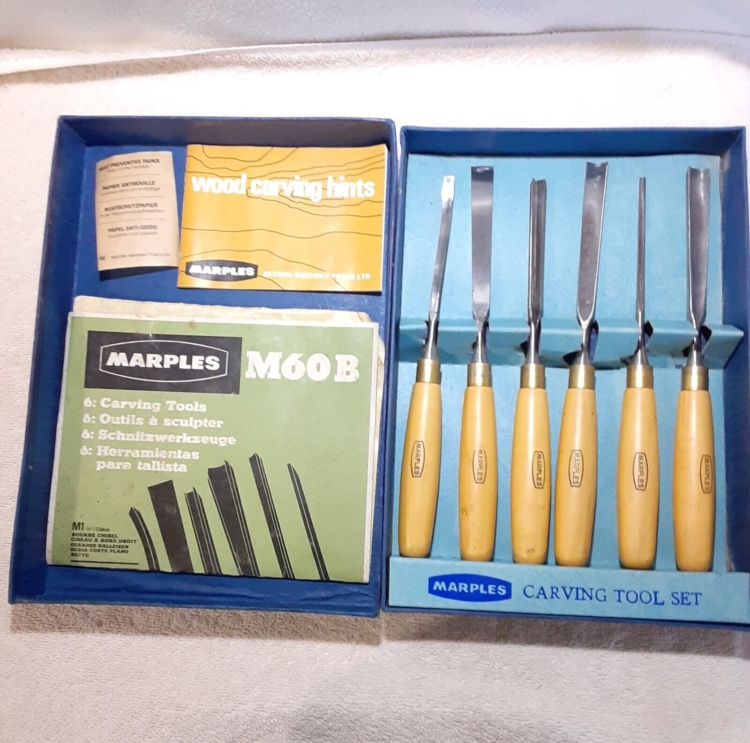
Below is set M60B available 1984-87.
Here below is a set of M156 [1996-99] having small mushroom shaped hardwood handles and used for fine detail work.

Below is a set of M260 Carving tools representing the last of its’ kind. Made by Record Tools Ltd in Sheffield under American Tool Co. Note the wooden handles [c.1999], not now blue polypropylene:


Below is a 12 set of M150 [available 1999-2000] Note the hexagonal handles.

LADIES CARVING TOOLS:
First introduced [and based upon the London Pattern ‘sweeps‘] in 1897 and having ‘Fancy Hardwood’ [Ebony;Rosewood and Boxwood] or Beech handles. They were described as having a ‘straw colour’ which was a treatment applied to the blades to render them more resistant to rust and gave them a straw colour.
The 1897 Item #s were: 5020-5033
The 1909 Catalogue shows a number change to L1-L46.
In 1921 only L1-L39 are listed, but in 1928 these Carving chisels were only sold in ‘sets’ of either 6,12,18 or 24 tools.
This continued through the 1938 Catalogue but they are not shown as being available in 1959. I suspect they they were dropped from the line c.1939, another casualty of Mr. Hilter.
Unshouldered Spade Carving Tools:
I am unsure as to why these tools were ever introduced, except that they may have been less expensive than the London Pattern Carving tools. This because they had no ‘shoulders’ to butt up against the handle at the ferrule.
But again they were introduced in the 1897 Catalogue [maybe before] having the item #s: 01;02;03;03.1/2;04;04.1/2;05;06;07;08
But again all these numbers changed in 1909 to:
S1-S11; S21-S32; S39; S43; and S52.
This continued the same through the 1921 Catalogue until in 1928 it is shown that they were only sold in ‘sets’ of 6,12,18 or 24 tools.
The 1938 Catalogue shows the same listings, but the 1959 Catalogue would indicate that these tools were no longer available, and probably since c.1940.

Below is shown a great variety of Spade tools:

Below is a set of six Spade Carving Tools in cardboard box.


Below is an old set of 12 Spade Carving Tools :

Chip Carving Tools:
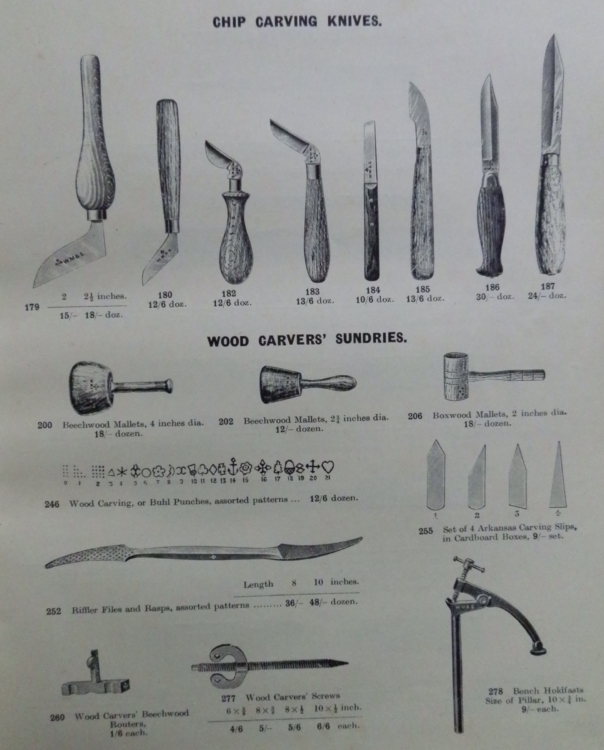
These are first shown in the MARPLES catalogue of 1897 as being ‘Wood Carving Knives‘ and other pages refer to them as being ‘Chip Carving Knives‘ .
They initially were only made in 4 styles numbered 906;907;908 and 909.
In the 1909 re-numbering system these became #182;183;185; and 187.
The 1909 listings show these numbers: 179-185;186A;187 & 188
By 1921 the following numbers had been dropped: 181;186A and 188. But #186 had been added.
By 1928 only these numbers were available: 182-187.
1938 saw the introduction of numbers 179 and 180.
Only in 1959 were all these numbers still featured except #187.
The Price List of November 1963 shows all are still listed except that #185 and 186 had been withdrawn. [Leaving #179;180;182;183 & 184 still in production]
By March 1964 all had been withdrawn from sale.

Below is a rare early Chip Carving Tool #183:

And here are a few of the later Chip Carving tools c.1990:
 Photo lost in transition to a ‘better’ provider!!
Below is a set of what may be ‘Wood Engravers’ Tools’, but to find out the details may take time:

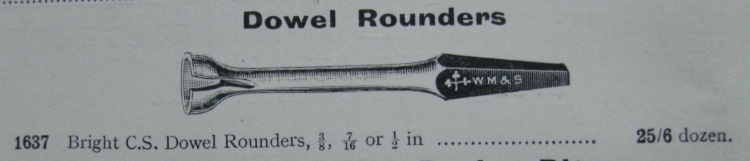
The first issue that I can find in the Catalogues to represent these tools is in 1909, but as always these tools may have been introduced a little earlier. The ‘Rounders’ were available in 3/8″; 7/16″; or 1/2″.


It can be seen that the Dowel Trimmer was to put a bevelled edge on the very end of the dowel, whereas the Dowel Rounder was used to put a rounded profile to the end of the dowel.
The 1928 Catalogue shows these pages:

By 1938 we have these pages:

The 1959 Catalogue shows that the Dowel Rounders have been de-listed:

The 1965 Catalogue shows this Dowel Sharpener as being much shorter:

The last mention of the #1636 Dowel Sharpener is to be found in the November 1969 Price list at 10/6d. By 1971 there is no listing of this tool.
In this section I will try to outline the tools that MARPLES manufactured that were associated with Picture Framing.
Below are the listings that I can find in the catalogues. There are no entries to show that the production of a picture frame was an issue that was beyond the capabilities of the average craftsman before 1888 but then we find this:


By 1897 the range has expanded a little:


1909 sees the inevitable change of numbering system:


Next is the 1921 Catalogue, truncated due to the past war:

The next large catalogue, 1928, is shown below:


We then jump to the next full sized catalogue of 1938:


After the war the next full catalogue is published 13 years later in 1959!!:


We then come to the 1965 Catalogue:


By the time that the slim 1971-2 catalogue came around:


The table below was constructed from all the information gleaned from the 1909 onwards catalogues. The information on these products prior to 1909 is available for you on the pages above.
It is curious that item #6826 in the 1921 Catalogue appears to have been swifly re-numbered to #6836 in the 1928 Catalogue. I do not know whether the initial insertion of 1921 was a numbering error or whether this is a true re-numbering.

Shamrock Mitre Planer:
This heavy duty double sided mitre planer #6798 is first seen in the 1909 Catalogue and was available into the 1928 Catalogue but not shown in 1938.
Marples must have bought out the Patent on ‘Hutchens Patent Mitre Shooter, [which was available before 1909] in order to continue production.
It had 2 opposing cutters which were actuated by a side lever as shown below:


Mitre Cutting Machine:
First seen in the 1897 Catalog as Item #2163 and in 1909 as Item #6800. This machine was overtaken by the ‘Imperial Mitre Cutting Machine, which was slightly bigger and therefore #6800 is not seen in the 1921 Catalogue:

M1; M2; M3 and M4 Mitre Block and Mitre Box:
In the September 1989 Price List we see that Marples Ridgway introduced 2 new Mitre Boxes and 2 new Mitre Blocks:

Here are pictures of a rare MW3 Mitre Box. [Note that it has a ‘Square Cut’ position…the 6820 did not:
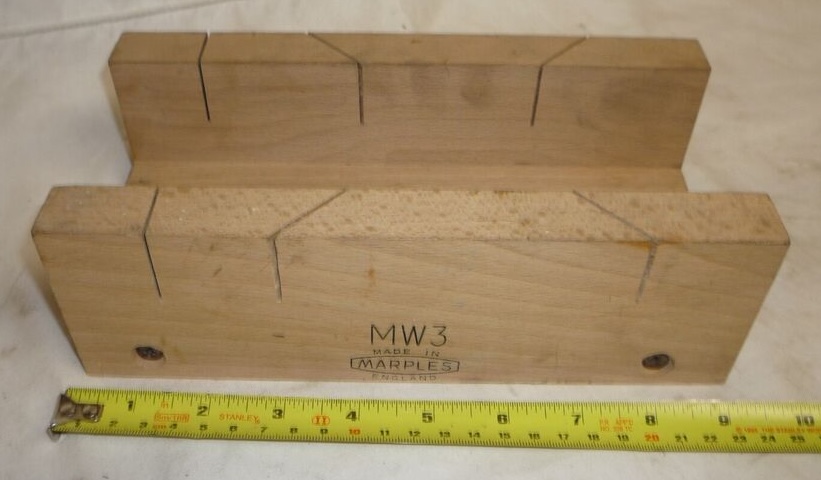
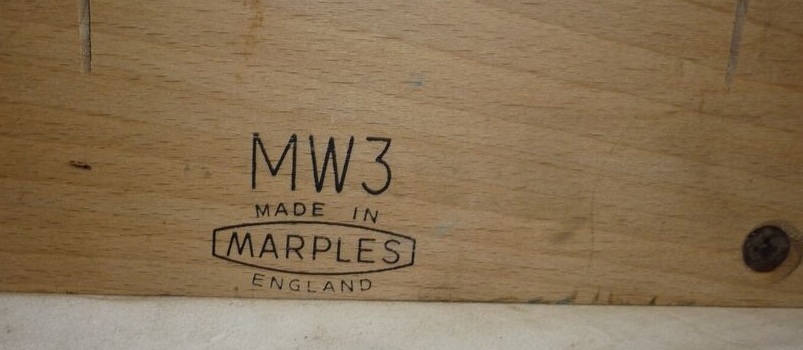
These were short lived in that by early 1991 they no longer appear for sale.
#6806 Marvel Mitre Cutter was the best Mitre Cutter jig that Marples produced. It had reversible jaws and was only made 1959-73.

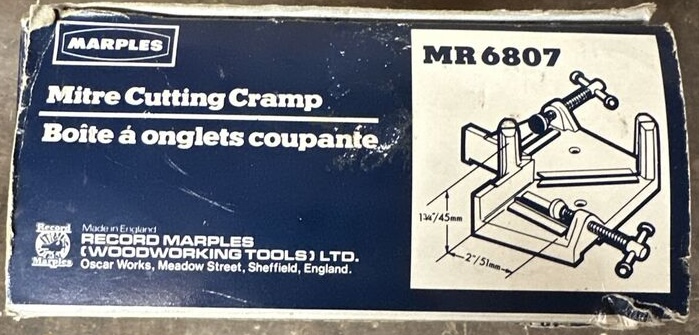
#6807 Mitre Cutting Clamp. was first produced by Marples Ridgway in Feb 1984. It was to replace the #6808 but with no saw guide adjusters and was basically a cheapened product. It was available until 1996


#6808 Junior Mitre Cutter. This aid was produced from 1959 to 1983:

#6809 Combination Square and Mitre Cutter:
Actually the number 6809 was originally ascribed to ‘Amateur Corner Cramps in 1909 but this tool was swiftly replaced by #6810 ‘Improved Corner Cramps’. The number 6809 was then taken up in 1965 by the ‘Combination Square and Mitre Cutter‘ as shown below and this tool was eventually de-listed in 1983.

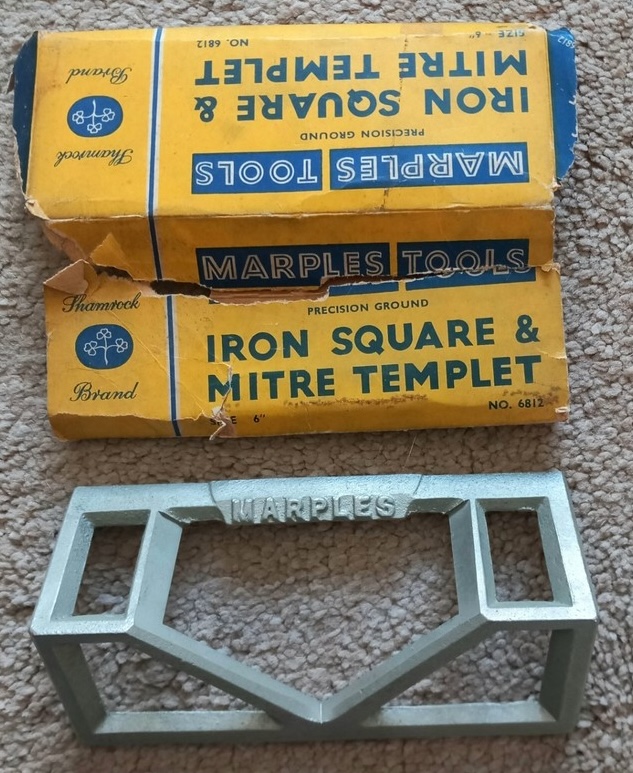
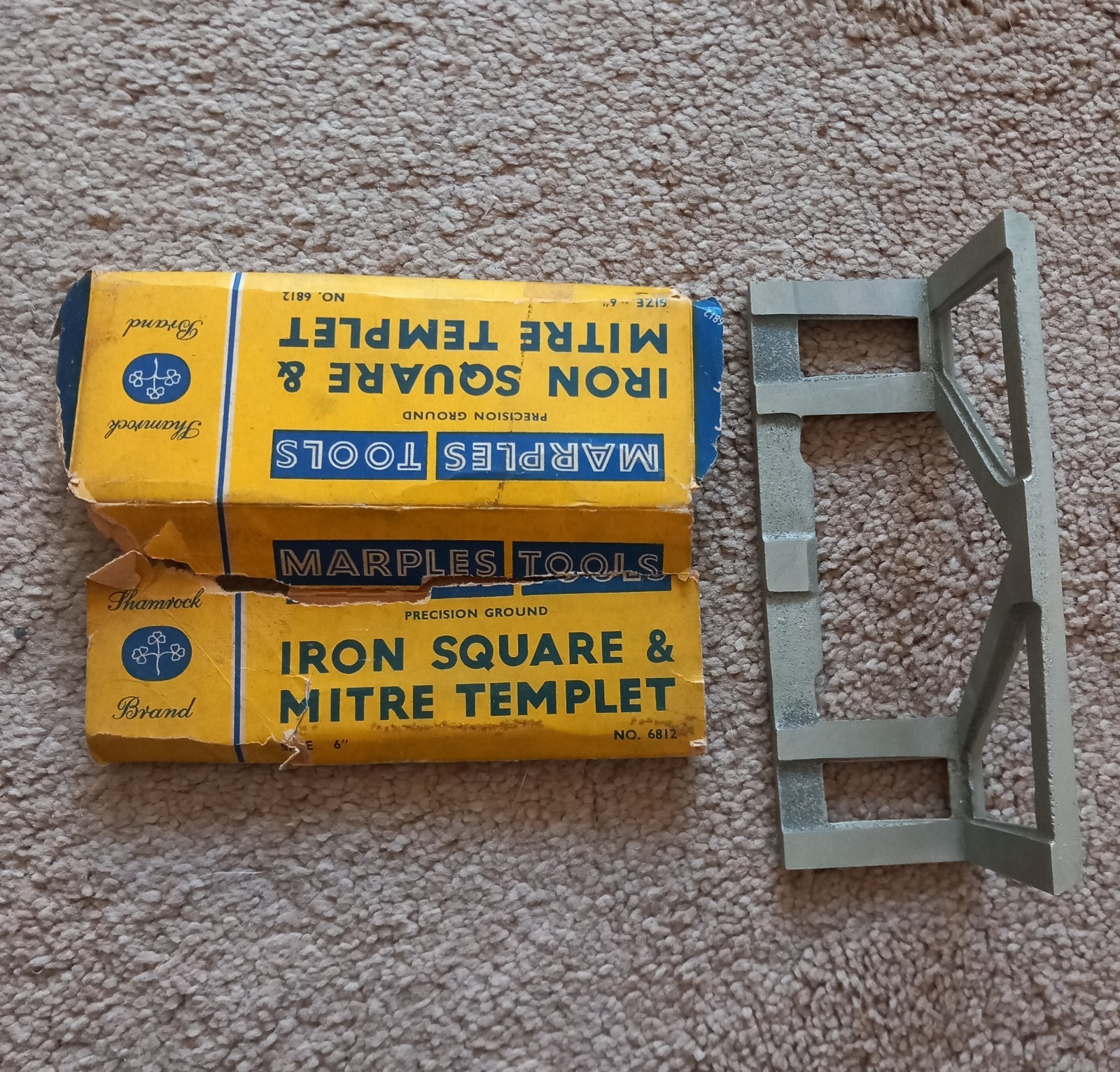
#6812 Iron Square and Mitre Templets
These were avaiable from c.1938 until August 1973.
6 inches long and Nickel Plated . Later models were shipped in boxes [ shame that a previous owner could not wait to get into this box !!…
#6814 Brass Mitre Templets are first to be found in 1897 {#2157G} in sizes 3.1/2″; 4.1/2″ and 6″.[Actually there was a Brass Mitre Templet shown in the 1888 catalogue, but of a more solid design than later] . Re-numbered #6814 in 1909, the line continued but after WWII the 3.1/2″ size was dropped, the tools being eventually dis-continued around November 1963. Shown below are 2 sizes of Templets.

#6815 Iron Mitre Templets, were only ever available in a 6″ size and between 1909 and August 1973. Nickel plated:

#6816 Mitre Blocks :
I can trace the exact same Mitre Block back to 1897 and forward to its’ possible demise in 1993. Unfortunately you will not find too many of these tools because they have been sawn into extinction by the owners NOT inserting a thin strip of wood on the base to prevent the oversawing of the manufactured slots. This is most prevalent in the Mitre Boxes….too many have been destroyed by not accurately adjusting the saw guides and NOT putting a strip of wood on the base portion.
You will see that there were a number of Item# changes with time, as well as a change in length. In 1897 they are listed as ‘Beech Mitre Blocks‘ #2150E and with 10″; 12″; and 16″ lengths.

In 1909 although the picture ‘number’ is wrong [8616] the text is correct with a new number of 6816 and this number endured until the product was discontinued [but see October 1990]. But it is still available in the 3 lengths as before.


As with many other tools, after WWI this product is not listed as being available, but it re-appears in 1928, but now only as 10″ and 12 “ lengths.

The Catalogue entries for 1938 and 1959 are the same, having the same item number and both 10 and 12 inch lengths. 1959 is shown here:
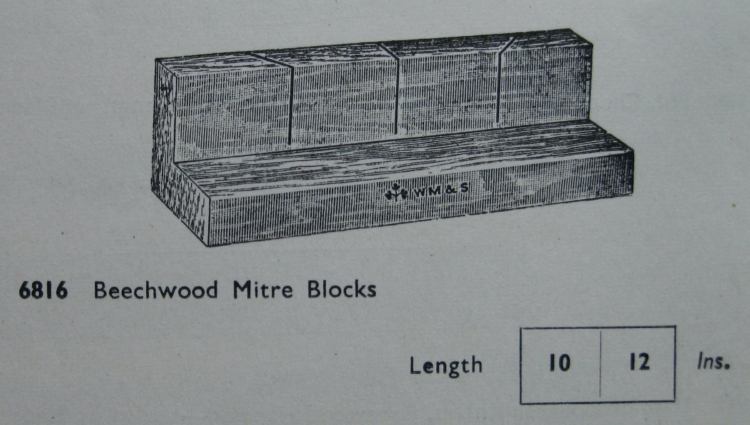
In 1965 the entry has been reduced to just a 10 inch size:

Catalogue #16 shows a similar entry of #6816 which persisted to September 1972 when the number was changed to M6816, still with only a 10 inch length being available. This state of affairs lasted until at least November 1980, but in the February 1984 list the number has been changed to MR6816 and the length is indicated as 10.1/2″ [Marples/Ridgway]. Curiously the listing of March 1986 states the length as being again 10″, but this must be an error as in August 1987 it is again listed as being 10.1/2″.
This persisted until the July 1989 listing which indicates that the number is now MW2 [10.1/2″]. There is an MW1 shown at 9″.


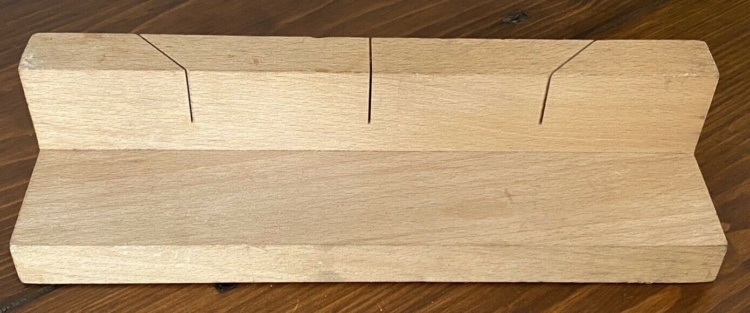
By May 1991 the number has reverted to MR6816 and this number lasted until the de-listing of this tool around 1992.
Below are shown 2 photos of a 6816 10″ c.1972


Below is a later version of 10 inch Mitre Block:

#6820 Beechwood Mitre Boxes were available 1909-1982 and they came in two sizes ‘To take Mouldings up to’ 3″x2″ and 4″x 2″. As of catalogue 1928 these were called No. 1 and No.2. These were the basic no nonsense box with no metal saw guides [#6821] and no provision for ‘Square cuts. See below:


#6821 Improved Mitre Box. Improved in that it was the same as #6820 but was fitted with metal saw guides. To saw ‘square’, one end was used having a projecting base piece… 1928 Catalogue image below:


As with #6820 there were 2 sizes [No.1 and No.2] which could hold mouldings 3×2 inches and 4×2 inches respectively. Below is the information leaflet that appeared in many of these Mitre Boxes.

I believe that when the firm was renamed Marples Ridgway the metal guides were replaced by plastic:

When Marples Ridgway introduced their cheap MW series [7/89] [see above] the MR6821 was dropped but re-appeared in May 1991. BUT although named MR6821 this iteration did not have any saw guides! [So in essence was a #6820!!] It also had no base extension to enable ‘Square’ cuts.

Around mid 1992 this Mitre Box was no longer offered for sale.
#6844 Mount Cutting Knife. These knives were only available 1928-1938


The following inserts were all found in a pristine 1928 Catalogue and must have been maintained by an individual who was a stickler for correctness. There are no pages listed under which to ‘stick’ the inserts, but direction must have been given at that time as to where to paste the new material. As far as I can deduce, most of the inserts are from c.1933. These inserts are exceedingly rare and I am very pleased to show them to you here on this site.
They are listed here according to the page numbers of Cat. 1928:
Page 18:

Page 46:

Page 50:

Page 52:

Page 54:

Page 58:

Page 60. These next 2 inserts were back to back:


Page 68:

Page 70:

Page 72:

Page 78. These next 3 inserts were to announce the introduction of the ‘M’ series of iron planes:


Page 84:

Page 122:

Page 124:

Page 150:

Page 164:

Page 206:

Page 217:

The first reference that I have about MARPLES producing Coachmakers’ Planes is in the 1897 Catalogue, although I am sure that they were introduced before then.
So in 1897 we see the following entries:
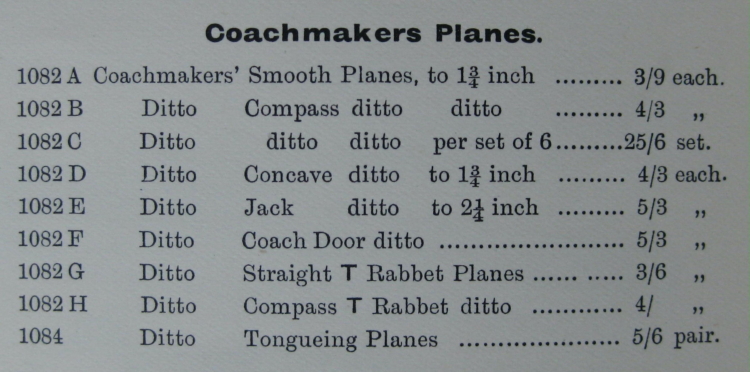

In 1909 the Item numbers have been changed and the listings follow here.
[Of note is that in 1921 the listings are exactly the same, including prices.]
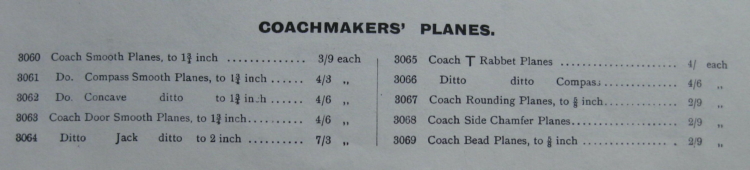

Jumping then to 1928 we find another item number change and that the Compass T Rabbet Plane and Coach T Rabbet Plane are both available up to 1.1/2″. Previously there is no maximum width stated for these planes, but since I have a 2″ Coach T Rabbet plane I will assume that, prior to 1928, these planes were available up to at least 2 inches..

These planes were not produced much after 1928 as there are no listings in the 1938 Catalogue, obviously due to Coachmaking being a declining industry.
The Coach T Rabbet Plane was so called ‘T‘ Rabbet because the body shape resembling an inverted ‘T‘. [Some references state that it was because of the shape of the cutting iron, but there are a few other planes that use this shape blade, so I reject this theory.]
The Coach Compass T Rabbet plane has a convex sole in order to work concave shapes and there was never a Compass T Rabbet Plane having a concave sole. The only concave sole in the Coachmakers’ line was the ‘Smooth Plane’ as shown as #2992 in the 1928 listings.
The Coach T Rabbet shown below has a sole that is 6.5/8″ long x 2″ wide. The whole plane is 3.3/16″ tall and the vertical body is 13/16″ thick. The cutter is 7.1/4″ long and 2″ wide at the cutting edge, with no maker’s mark. [which is common to the majority of MARPLES wooden plane blades.]


The following planes , shown L to R in the photo are:
#2992 Coach Concave Smooth Plane marked number ‘2‘
#2992 Coach Concave Smooth Plane marked number ‘4‘
#2991 Coach Compass Smooth Plane marked number ‘2‘
#2990 Coach Smooth Plane marked ‘1‘


Given that the curves were ‘numbered’ we must assume that various curvatures were produced and sold, but as yet I have no information to suggest what that range may have been. At least I can say that the number ‘2‘ concave and compass planes mate perfectly. Also that a number ‘1‘ is perfectly flat. All these planes [above] measure at a nominal 6.3/4” long, so this must serve as a marker to help to separate these planes from the full size planes.
Therefore, at this time, I must conclude that these Coachmakers’ planes were only available c.1890- c.1935?
‘Dado Grooving‘ or otherwise called ‘Trenching’ Planes are first noted in the 1888 MARPLES catalogue where they are listed under ‘Dado or Carcase Grooving Planes’. The name was changed by 1897 to ‘Dado Grooving or Trenching Planes’:

They were always only made up to 1 inch in cutter width with an accompanying double slitter blade to score the sides for easier cross grain work. The main blade was skewed. The lesser quality of the two sorts of plane had only a wooden depth stop whereas the ‘expensive’ model had a brass screw stop.
In 1909 there was an Item number change, and the planes retained these numbers and with the same image until no longer manufactured:


The 1921 catalogue entry shows the same:
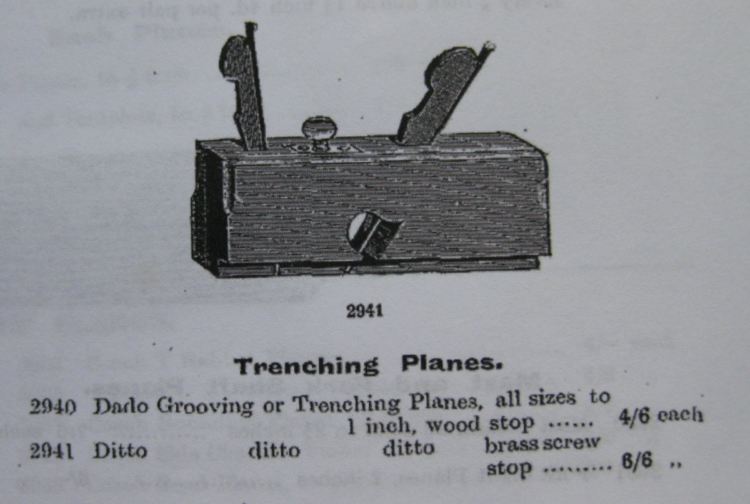
1928 [immediate below] and 1938 [ below] catalogue entries were identical, except for prices. You will note that they are now listed under ‘Dado Grooving Planes‘.


The 1959 listing is here:

The last listing that I can find is in November 1963, but by March 1964 they no longer appear to be offered for sale.
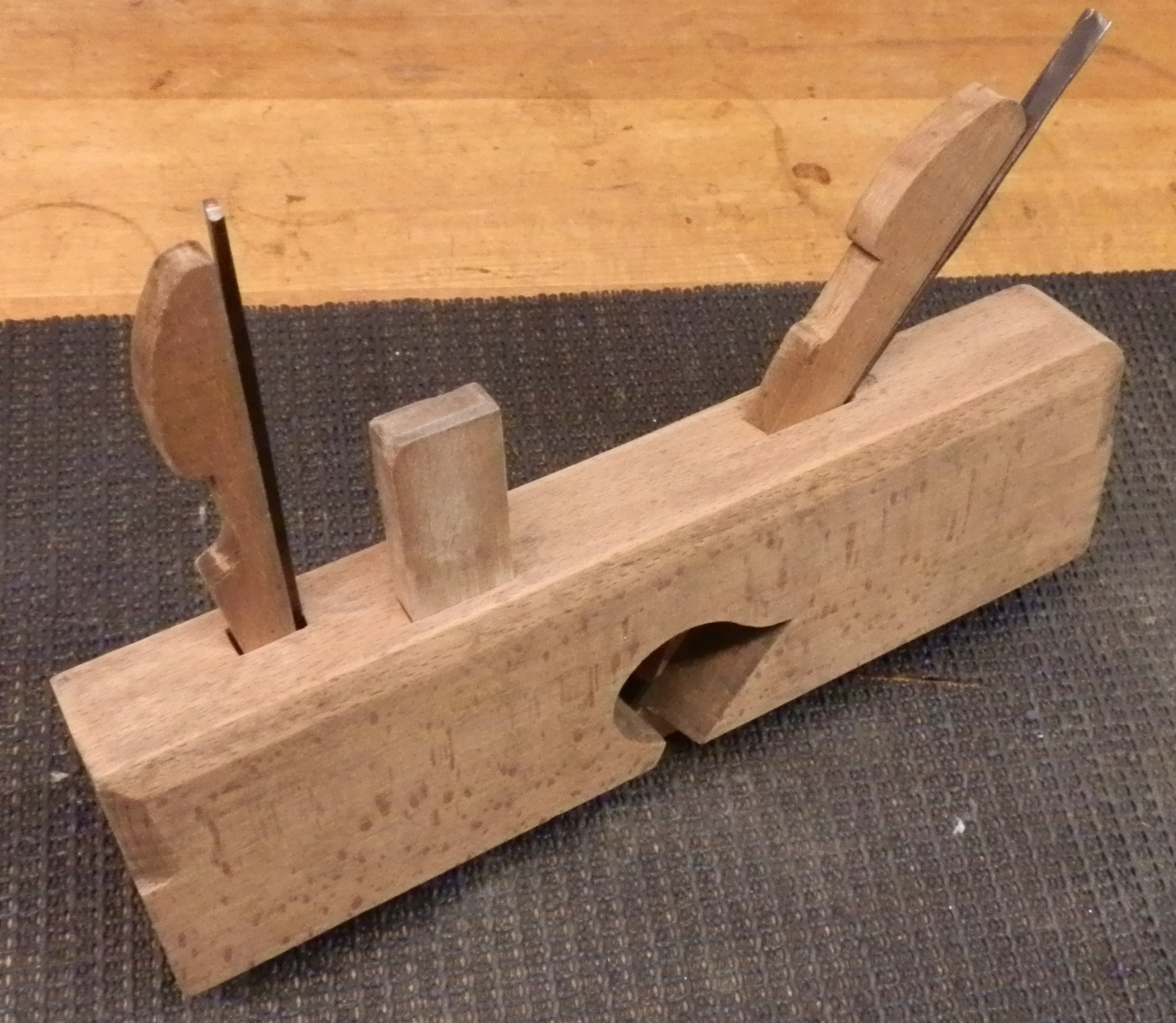
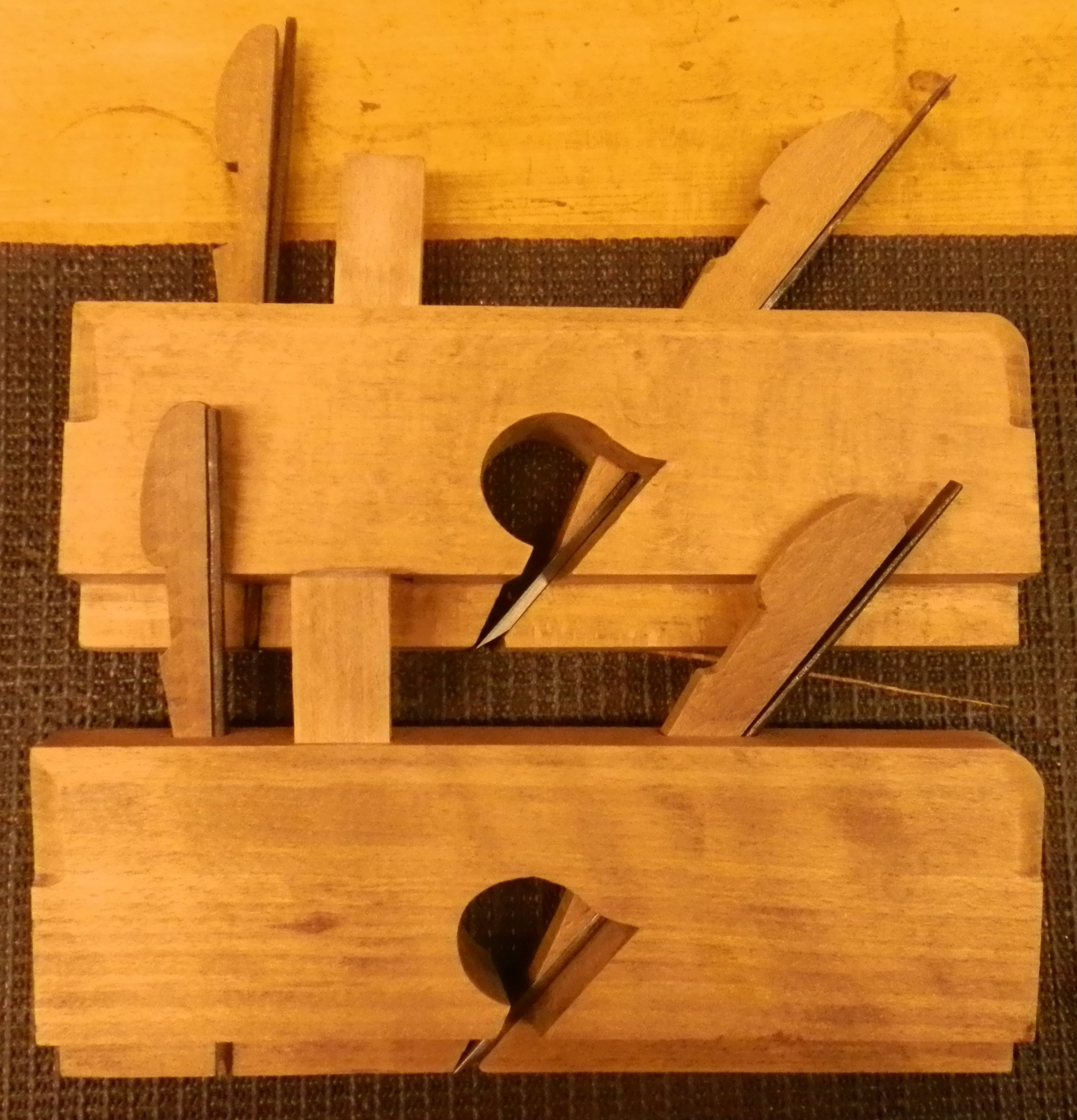
The photos below are of a 7/8″ Trenching plane #2941 with brass screw stop.
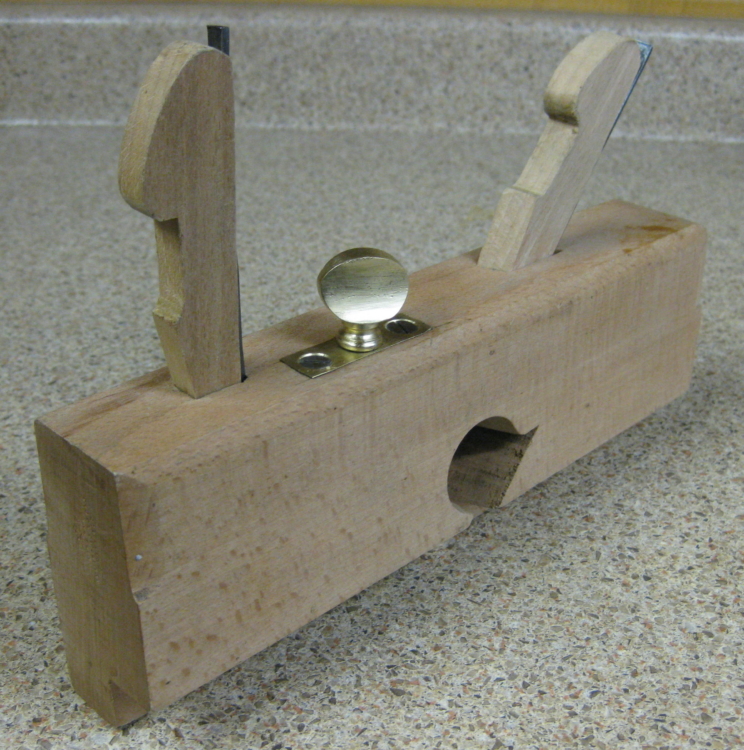
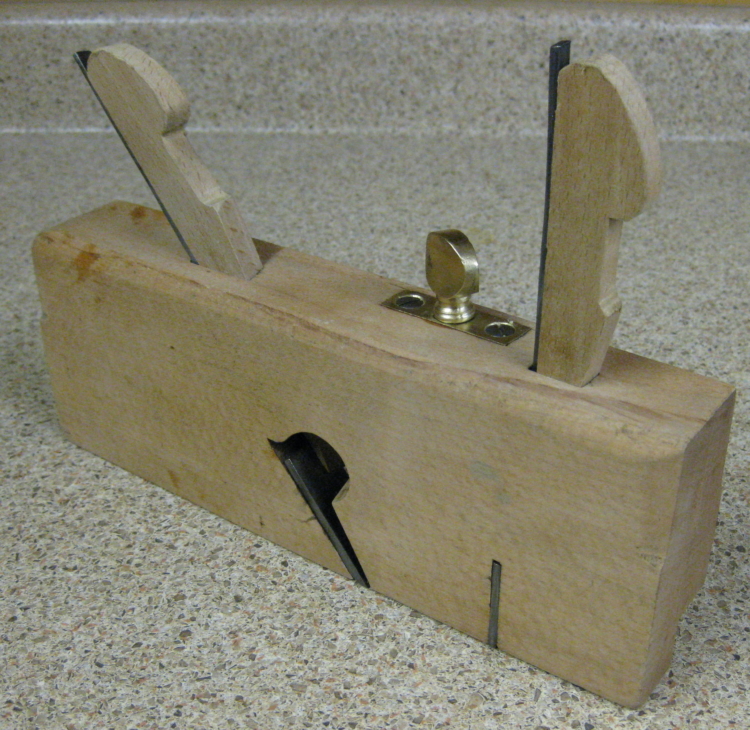
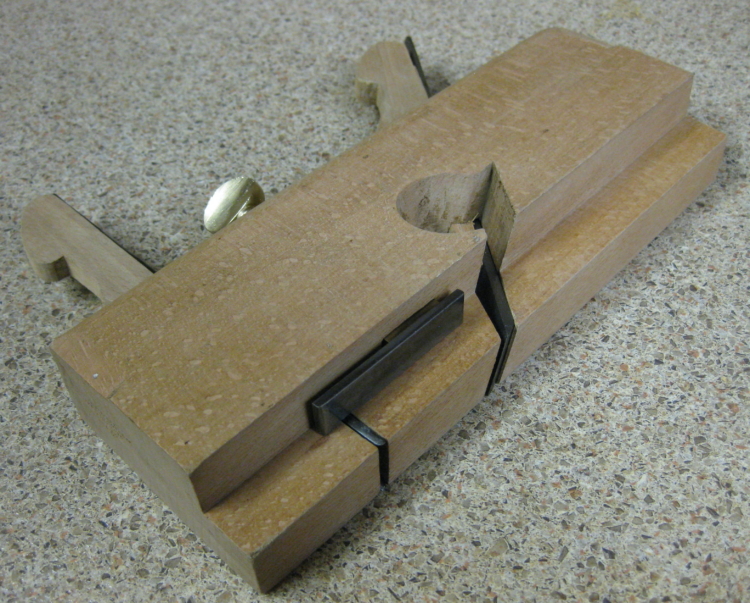
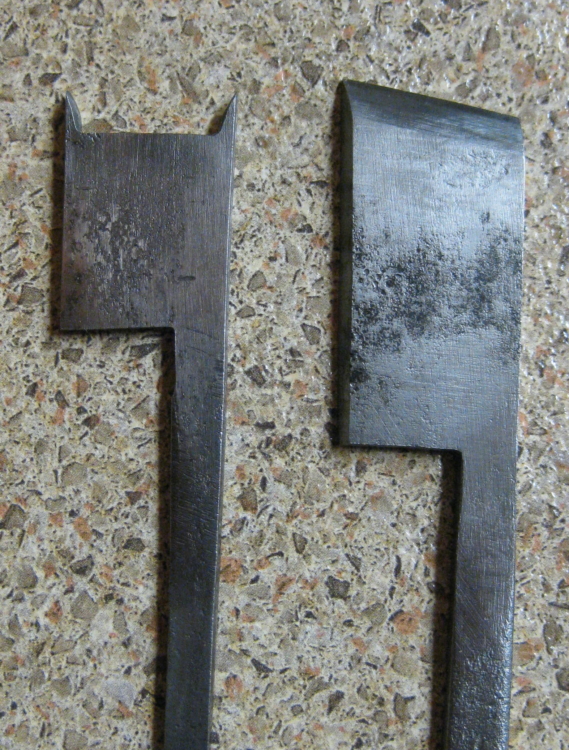

The Photos below are of a 1/2″ and 5/8″ planes with wooden Stops:
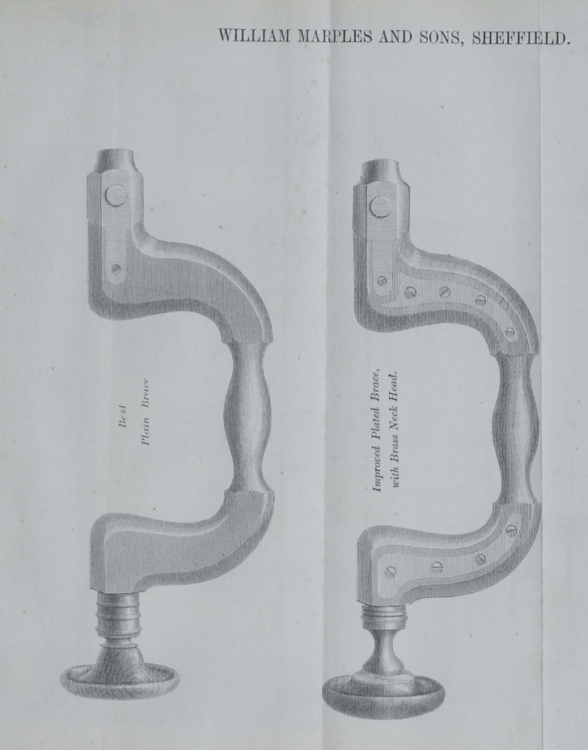
The earliest reference to MARPLES manufacturing Wooden Braces is to be found in the 1846 List wherein are listed ‘Best Braces‘ (9/- ea.) and ‘Improved Plated Braces‘. (13/- ea.) The latter being exactly the same as the ‘Best‘ but with the added strength of brass plates inlet and screwed to the sides of the arms [which were the Achilles Heel of these braces being made of short grain timber and easily fractured under stress.] The ‘Improved Plated Braces‘ could also be had with an Improved Brass Neck Head for 2/- extra and were also available in Ebony, Box or Rosewood at 12/- extra to the standard Plated Beech.
A giant step in technology and quality was the introduction of the ‘Ultimatum’ Brace, patented by MARPLES in 1849.
A superb analysis of the MARPLES Ultimatum Brace was published by Author and ‘Ultimatum’ Expert Reg Eaton, called ‘THE ULTIMATE BRACE‘. As such I will not attempt to give any details here, but will thoroughly recommend you to read that book. [ISBN 0 9514695 0 9]
In the 1861 catalogue we have this listing:


The 1868 Catalogue shows this:


I am sorry about the quality of the 2 above pictures, but they are copies of copies etc!!
Although not shown here the ‘Best’ and ‘Improved Plated’ braces were still manufactured.
BUT, what is new information is that the 1868 catalogue shows that an item numbering system was in place at that time, when previously I had thought that this started in c.1873!
The 1873 Catalogue shows this picture [I only have a picture of the text as the actual picture of the brace is missing from the Hawley Museum files].
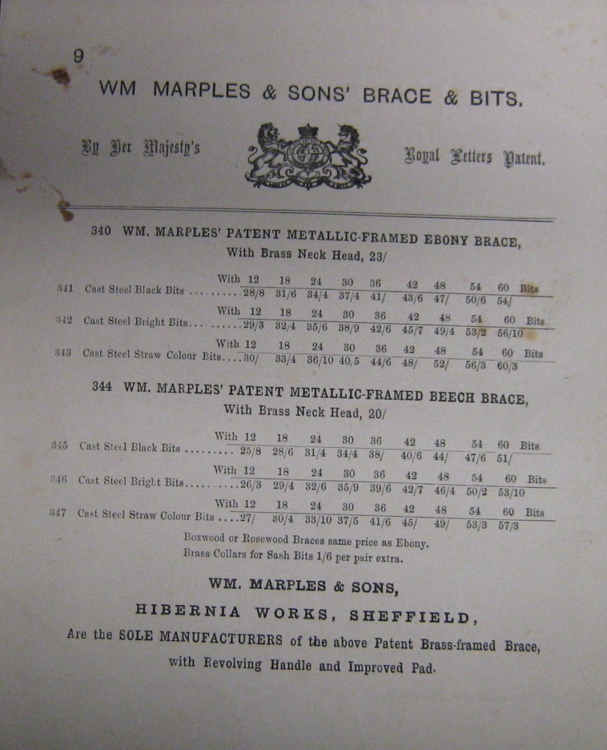
Although not shown here the ‘Best’ and ‘Improved Plated’ braces were still manufactured at this time.
The 1897 Catalogue shows that a wooden ‘Coopers’ Brace’ is manufactured [I do not know when this started] as well as the normal braces:


The above brace #458 is described as ‘with Brass Neck Head‘ added to #454
The 1909 Catalogue issues are noted below [note the Item number changes]:


I do not know for sure when the Wooden Braces were discontinued, but their demise was totally due to the emergence of the American Style steel brace and by 1921 there is nothing about the wooden braces to be seen!