The premier site for William Marples & Sons Tools.
Author: Roger Ball
M75 Plane Study
The M75 Plane, an utter copy of the STANLEY 75 plane, was introduced to the UK market at the onset of the ‘M‘ series of planes, in February 1933.
The picture below was used throughout the manufacture of this now rare plane…Feb/1933- c.6/1940.
This is from the February 1933 Catalogue.
This plane was manufactured in exactly the same format from 2/33 through c.1940. The last listing I have for this plane is in the May 1938 catalogue.
From 2/33 to 3/38 the spare cutter was listed at 9d each, but then on till 10/38 they sold for ..one shilling and one pence!
It should be noted that the much better bullnose plane, the M77, was introduced in August 1938, and this was a more adjustable Bullnose Plane. The M75 had an Adjustable mouth but this was very difficult to adjust and was very coarse in the adjustment. So it is no wonder that the old M75 was de-listed shortly thereafter
The price of the M75 was introduced at 2/3d . This continued until Sept 1936 when the plane price was increased to 2/6d. Consider this that the whole plane, including the cutter, was available for 2/6d. So the plane was worth 1/5d!
The body was always 4″ long [with the mouth totally closed] and 1″ wide. The rear edge was painted black, but the front edge was clean.
The lever screw was always 7/16″ wide, 3/32″ deep with a fine parallel knurl and nickel plated, and the Lever Cap was 2.1/4″ long and 5/8″ wide.
You will only ever find these planes with a Red Lever cap on a Black base.
The mouth adjusting slotted bolt was nickelled and the head was 3/8″ wide, 1/8″ deep and it was 7/8″ long
The new blade was 3.5″ long and had a useable length of 1″.
It is no wonder that the M75 was discontinued with the advent of the much superior M77. This latter plane although being much easier to adjust was much more expensive.!
Saws
Going through the old catalogues, it would appear that MARPLES made or were made for them, Turning Saws and Frames and Saw pads as early as 1846, if not earlier. But the earliest reference that we have is the 1846 ‘List of Prices’, an excerpt from which is shown here below.
The 1861 Catalogue shows us some more details:
The 1873 entries are shown below:
The 1897 Catalogue entries are shown here: But it should be noted that ‘Saws’ were now included in almost all of the higher priced ‘Tool Chests’ offered by MARPLES going back to 1861.
1909 Catalogue entries:
Item #8320-Pocket Pruning Saw [above] had scales of Rosewood in the 1909 Catalogue, whereas previously they were of Boxwood. [Item #394H]
The 1921 entries:
The 1928 Catalogue entries:
The 1938 Catalogue entries:
The 1959 Catalogue entries:
The 1965 Catalogue entries:
Below is the culmination of much work analysing the catalogues in order to produce a composite table depicting the MARPLES saws as listed against time. As I worked I eventually decided that I would only make a starting point at the 1897 Catalogue, as the previous item # changes were just too horrendous to work through. There were 3 different number changes with MARPLES Tools between 1873 and 1909 and these are very difficult to follow because Item descriptions also changed over time. I carried the study through using just the hard copy Catalogues. [1897, 1909, 1928, 1938, 1959 and 1965.] On each line where there is a number, this denotes a number change at that time. Of necessity I have had to truncate the descriptions given in the catalogues to the saws and their individual components, otherwise I would never have space in the table to include all of the Catalogue details. Therefore below is a list of the short forms used:
Below is a table to show the Types of saws sold, with a description and dates that they were available.
Below here is a large table showing the Saws sold by Item number, with a description and dates they were manufactured. You will find that as the saws were re-numbered I have noted the new number as RN#, or as ‘from’ a number previously given. This chart shows the Saw Item # against the years of production. But it must be understood that I have started the chart at the 1897 catalogue and continued it as far as I can given the catalogues that I have [< 1971]. There are many small catalogues that obviously cannot give information on all the products that MARPLES produced at that time, but give some good minor input. Also remember that the production dates shown are but evidence based catalogue entries and therefore the product may have been introduced/discontinued before/after these dates.
There were a lot of saws that were re-numbered between initial introduction [before 1897] and the first re-numbering date of 1909. The second re-numbering occurs in 1938. This can all be very confusing which is why I have tried to give you the composite chart below.
Below is an excerpt from the M2 Catalogue of August 1973:
Below is from the M1 Catalogue Feb 1968. Pad Saw #2421 was carried through until at least November 1977.
Above is from the New Products leaflet of Sept 1968. This shows that Coping Saw #2677 [absent from the 1965 Cat.] has had its’ number re-assigned in 1968 to the newly introduced Junior Hacksaw. The Dovetail Saw #2641 was a totally new number and I doubt that any maker of saws could have fitted a more ugly, more uncomfortable handle that also showed a disgusting nod to design. How could they have ever allowed this to be marketed?? Such was this age of austerity, and hopefully very few survive, so if you have one, please burn it!!
At this stage I am sure that MARPLES did not manufacture the saws in their own factory as they were made outside at other saw maker facilities and given the MARPLES mark. [Simon Barley informs us that they were in fact manufactured either by ‘Garlick‘ or ‘Francis Wood‘]
Below is where you will find additional info on the saws and as many photos of the different types as I can muster.
The very best book that could have been written on British Saws & Makers is by Simon Barley, and I have been given his permission to quote here from his book: British Saws & Saw Makers from c1660 SIMON BARLEY ISBN 978-1-909300-74-3 Published 2014 This information in his book represents a huge amount of time, effort and money and I am therefore much indebted to Simon for his allowing this publication.
” From his earliest days Marples sold saws, but it is not likely that the firm ever made their own. In 1825 the Beardshaw records show sales to him; the catalogues of 1878 show only Disston and Boynton makes (both American), and those of 1883 and 1892 only Disston’s. In the 1920’s Marples were one of the few firms to sell saws in the new stainless steel, although it is not known who they were made by. Later evidence is that their saws were made by Garlick and Francis Wood. “
I can only comment here that in 1825 Wm. Marples Jnr. was only 16 years old and was maybe merely purchasing saws for his own personal use. The earliest MARPLES catalogue reference to Stainless Steel saws is in September 1931, so it is possible that MARPLES was selling these saws before they were catalogue introduced.
Below are some marks found on MARPLES‘ saws, as shown in Simon’s book.
A mark that has recently been found is not shown in Simon’s book, because it is so rare. It simply states on the brass back: WILLIAM MARPLESLONDON This brass backed Tenon Saw was from an era when it was commercially productive to mark tools as having been produced in London, as Sheffield produced tools were still considered to be inferior. I suggest that this saw is c. 1865. Below is a photo of the brass back and a handle that may not be original [no blade as it was not recoverable] :
M110 Plane Study
The MARPLES M110 plane really started in 1933, when the ‘M‘ line was introduced, but this plane transitioned from one named No. 3107 that had been manufactured since c.1925 [at least if not by MARPLES it was factored in by them]. The earliest recorded date that I can find for item No. 3107 is in the MARPLES Centenary Edition Catalogue of 1928. But I believe that this plane [as well as the smaller No. 3105 Block Plane (M102)] may well have been manufactured and offered for sale since c.1925. There is no indication in the 1928 catalogue that this [or the 3105] was being introduced as a NewTool.
In the 1928 catalogue the 3107 is shown at a price of 40/- dozen (an Ironmongers Cost Price, since at that time these catalogues were geared to the trade only.) The picture below is of the 1928 catalogue listing.
Please note that the front knob is most unusual and therefore different to all other 110 block planes, of all makes. It is however exactly the same as shown on the box label and catalogue print. However the Pressure Cap adjusting ‘wheel’ is more ‘coarse’ than shown in either illustration.
I am not able to exactly date the manufacture of the plane that is shown above but it is likely that the first 3107 planes had Black Caps (similar to #3105 [M102]). The length of the 3107 is stated as being 7.1/2″ in June 1930 but changed to 7″ in the Feb 1933 cat. [or maybe it was changed in the Sept/32 catalogue] Therefore my 7″plane shown here is from 9/32 or later.
Also my earliest example [shown] has the MARPLES logo and wording raised cast on the base in front of the knob, whereas the box label/catalogue picture shows no markings.
The February 1933(2/33) soft cover catalogue introduces a ‘New” line of ‘M‘ planes which included the M110. This advert stated that the M110 was 7″ long and had a blade width of 1.5/8″.
The No. 3107 Block Plane in whatever form, persisted up to the 9/35 catalogue and was therefore a brief competitor to the M110 because it was priced 6 pence less than the M110 which sold for 3/6d.
{A similar situation existed with the M102 block plane and its’ rival the No 3105 [for which you may wish to visit the M102 page]}. The 3107 was available for about 10 years 1925-1935 and it might appear that the only reason MARPLES continued this internal competition was to use up back stock of the old 3107 until that stock was depleted. There just seems to be no other plausible reason.
What follows will be my present attempt to put an order to the issues of the M110 style Block Plane according to date sequence. Under these Type headings I will list any perceptible changes that I have found to be different from the previous Type. I will try to categorise the study according to the major notable physical differences which would occur in : Paint; Body; Lever cap;Cutting Iron and Markings; Wheel; Knob; Box and Labels.
Again, I have difficulty in differentiating the blade markings as MARPLES seemed to have had quite similar blade stampings on their planes that spanned some 20 years. So faith should not be placed on these blade markings to identify a plane Type/Date. Remember that the blade is the first item to be ‘swopped’.
Type 1:
Like the M102 (3105) the first type of M110 block plane was introduced named #3107 around 1925 when it was priced at 3/4d. This price was maintained until at least March 1932 catalogue. The Feb 1933 cat. shows the 3107 priced lower at 3 shillings and this price was maintained into the Sept/35 cat. which is the last listing of the 3107.
Paint: The base was always advertised as being Black japanned and the very first 3107 was probably supplied with a Black japanned Cap. My early example has a Red Cap. The Black paint is found all over the plane body except the slope to the mouth and the top of the blade supports.
Body: As discussed above the body changed from an initial offering of 7.1/2″in 1925? to 7″ after 9/32? The sides were left as they came from the casting process and were not machined flat. My pristine plane shows that a wavy line of Shellac was applied to the machined bottom surface as a rust preventative. I also believe that the first 3107s did not have any raised casting letters or symbols, but by 9/32? it did [my example].
Cap: The first caps were probably Black but changed to Red by at least 9/32? No paint was used in the groove for the cross piece[below left] or on the lower back of the cap below the cutout. Note the very early water transfer.
Cutting Iron: The blade was supplied slightly thicker than subsequent issues but still measured 1.5/8″wide and 4.1/2″long when new. Only the bottom half of each side was cleaned from the original casting and the BM1 marking is feint.
Wheel: The japaned black cast iron wheel is 1.5/8″wide (across the largest diameter) and is 1/4″thick at the perimeter. The finger grooves [castellations] may have been finer in the earlier issues, according to the box/catalogue illustration. See photo above under ‘Cap’.
Knob: A very different Red-Mahogany coloured hardwood front knob was issued, which was awkward to use because it had no top indentation in which to register the index finger. The knob was screwed onto a cast threaded post arising from the base and it was 1.1/2″high with a convex top.
Box and Labels: Initially the end of box label [left below] would have read 7.1/2″ but I doubt that the label would have changed significantly in any other aspect. The box lid label is also shown below.
Type 2:
The Paint and Body are the same as Type 1, but the Cap is Red all over except for the lower half of the underside. The Cap received the same early water transfer as Type 1.
Blade: Has BM2 markings and is cleaned bright on both sides.
Wheel: The wheel is what sets this Type aside from all others because it is made from solid cast brass and painted black and has the same dimensions as previously.
Knob: Is now 1.3/8″high and made from mahogany with a dark finish, but remains screwed onto a threaded post cast on the base. Rather than having a convex top as per Type 1, it has the more normal slightly concave indentation on the top.
Box and Labels: Unknown at present.
Type 2a:
This has the old style water transfer on the cap, the same as Types 1&2.
The 7″ body now has the cast in ‘valleys’ as described under Type 3 but the Mahogany front knob is now attached via a hanger bolt as per Type 3.
The wheel is again cast iron and with 12 ‘points’.
[the 1.5/8″ cutter may have either BM1 or BM2 markings]
[Front and Back edges to the body may be painted].
All other details are as Type 2.
Type 3:
This Type existed until at least 2/33 and at a price of 3 shillings.
Paint: Is the same as Type 1/2 and is still japanned black on the sides.
Body: One notable difference between this and Types 1&2 is that this issue still has cast in ‘valleys’ at each side of the sloping mouth as per Type 2a.
Cap: Is painted a Red/Orange colour over all surfaces and has a circular Water Transfer applied to the palm rest as shown. NOTE: this is the ‘MARPLES‘ only transfer, not the ‘Wm. MARPLES and Sons‘ transfer.
Blade: Exactly the same dimensions as before with a bright clean surface all over . The BM3 blade as shown has letters 1mm high.
Wheel: Is as per Type 1, cast iron and japanned Black, but may be now thinner at only 5/32″ thick at the perimeter.
Knob: Is again attached via a ‘Hanger Bolt’, which is itself screwed into the base. The top part of this bolt is a standard Wood Screw thread to hold the Hardwood Knob which is painted Black and 1.13/32″ high.
Box and Labels:
The end label still shows that it is a #3107 plane, but has now been modified to read: ‘MARPLES BLOCK PLANE’.
The Box Top label is now the familiar coloured label, shown below.
Type 4:
This is the first issue labelled simply as M110 and was probably in production from Feb 1933 and priced at 3/6d.
Paint: Is still Black japanned, but the sides of the plane are now machined clean during production.
Body: The mouth slope still remains clean as does the crossbar and the ‘V’ grooves at the sides of the mouth are still present. However the base casting still has no letters to indicate that this is indeed an M110 plane.
Cap: Is painted RED all over, except that of the top leading edge and the lower half of the underside.
Blade: Has BM3 stamp.
Wheel: Has the same Black paint as previously but now again has a 1/4″ thickness at the perifery.
Knob: Has now assumed a brown finish over the hardwood base and at 1.5/16″high is still secured by a hanger bolt.
Box and Label: For the first time these show that this is actually an M110 Block Plane and presumably is now manufactured directly under MARPLES supervision, which is probably why there appear to be modifications made to the plane.
Type 5:
Paint : Is the same as before
Body: The same as before
Cap: Is now painted RED all over, back and front.
Blade: Still the same BM3 markings.
Wheel: Has now been reduced to 3/16″thick at the perifery, but is still painted Black.
Knob: Is still held by a hanger bolt and is probably hardwood [Rosewood is most unlikely although the finish has a Red/Brown tone] and is 1.13/32″ high.
Box and Labels: Presently unknown.
Type 6:
This Type shows a real difference to all the previous planes. I think that the colour changes occurred towards the end of WWII, approx 1944.
Paint: The Body is now painted RED [although the cross-bar and slope to the mouth remain cleaned] and the Cap is painted BLACK. This is a total reversal of the previous Paint scheme and is also found on the Bench Planes.
Body: As above, the body is now painted Red but the sides are still machined clean and the body is now marked with raised letters WM. MARPLES & SONS and M 110 in front of the knob and SHEFFIELD behind the knob. NOTE HERE: The words SHEFFIELD behind the knob and the word ENGLAND behind the blade supports are both 1.1/2″ across.
There is now no V shaped groove [valley] at either side of the mouth slope. and the cross-bar may be clean.
Cap: The Cap is painted BLACK all over.
Blade: This all bright blade may either be found to have the BM3 or BM4 blade stamp.
Wheel: Same as before.
Knob: A Hanger bolt still retains this dark mahogany coloured hard wood? knob which is approx 1.5″ high.
Type 7:
Paint: The Body is still painted Red all over [except the slope down to the mouth and the top bearing surface of the blade supports ] and the sides of the plane are still machined clear.
Body: Totally as before but now the word ‘SHEFFIELD‘ that is cast behind the knob is reduced to 1.1/4″across and the word ‘ENGLAND‘ behind the blade supports is now only 1.5/16″across. This is therefore a totally different base casting to that of the Type 6 plane.
The photo below shows the body castings of Type 7 on the left and Type 6 on the right and it is easy to see the differences in the sizes of the words indicated above.
The Black cap has a small MARPLES SHEFFIELD ENG. water transfer applied.
Cap: Is still painted Black all over.
Blade: This is probably BM3, but maybe otherwise [see Type 8]. As cautioned before, we cannot rely on blade stampings to date any plane, as these stamps are very hard to date and blades can be switched.
Knob: This knob now appears somewhat shapeless with a minimal waist. It was probably made from Mahogany and varnished a medium Brown but still secured via a hanger bolt.
Type 8 :
This type is exactly like Type 7 but the front Mahogany knob is held in place by an oval head machine screw that is countersunk into the top of the knob and screws into the base. A similar situation occurred with the M120 c.1945. { the blade marking is the same as shown}. Maybe this is of a similar date but it is not known for how long this modification existed before the hanger bolt method was re-instituted in Type 9.
Type 9:
Paint: The base is RED all over including the mouth slope, top of blade supports and the cross-bar.
Body: Has the same castings as a Type 8, but may show a small parallel valley at each side of the mouth slope beside the side vertical walls. The outer sides are still machined bright and clean.
Cap: Is still Black all over
Blade: May have BM3 stamp or as per Type 8, and is bright all over.
I have recently [10/17] purchased an MIB plane which is a Type 9in mostrespects and is priced at 12/3d. This price puts the plane around 1953/54. The mouth and cross piece are as original and painted, along with the front and back edges. It has a BM3 blade, but the front knob looks to be of Mahogany and is grain-painted to look like Rosewood with a good shapely profile at 1.7/16″ high.
The Black cap has a small MARPLES SHEFFIELD ENG. water transfer applied. I do not know whether this plane was produced at the beginning or the end of Type 9.
Wheel: Type 9 like the Type 8 has more grooves on the perimeter of the wheel and the nose has been increased in length. Note below: Type7 on the left and Type 9 on the right.
Knob: As seen here and made of Mahogany, but may have received a thick coat of light coloured clear varnish and still retained via a hanger bolt.
Box and Labels:
In all other respects the top label is exactly the same as previous issues except that this Type label seems to have the words…. ‘Manufactured By‘ missing. The end label now has a bar of RED at the top.
Type 10:
In 1962 half of the MARPLES company was sold to C&J Hampton Ltd (Record), and half to the company of William Ridgeway & Sons Ltd. I believe that RECORD continued to manufacture the M110 under the MARPLES banner until around 1970 or at least until the MARPLES Company was moved to Dronfield [just outside Sheffield] in Derbyshire c.1971/2.
When RECORD took over the manufacture of this plane it became almost identical with the RECORD 0110. It was named MA110 and was priced at 17/9d in Nov/.69.
Paint: The Body and Cap are now painted a BLUE all over, except the mouth slope, the now nickel-plated cross bar ; the sides and the front & back ends.
Body: Measures exactly 7″ long and the base is cast much thicker than before, which gives the plane more weight. The mouth slope has been cast having less of a bearing area for the blade, as shown below. V- shaped valleys can be seen each side of the mouth next to the side walls.
The casting shows MARPLES infront of the knob and the new designation MA110 behind the knob. At the heel is cast MADE IN ENGLAND.
Cap: Is painted the same Blue all over and can be seen to now not have the previous ‘windows’ cast on the underside. It is a somewhat rough heavy casting and is an example of the degradation in hand tool quality which occurred World Wide around this time. The palm rest shows a quite plain yellow transfer.
Blade: Machined clean all over and marked with the BM5 stamp.
Wheel: RECORD supplied their regular Block Plane wheel to the Type 10MARPLES MA110. It is a solid Alloy casting on a threaded steel post, with Multiple fine straight knurlings as a finger grip around the perifery.
Knob: A Dark varnished Beech knob is secured by a hanger bolt, as before.
MA43 Plane Study
The MA43, or as it appears in the Price Lists MA.43, probably was first available around March 1965.
When C&J Hampton took over MARPLES in 1962 they must have looked hard at the duplication of tools that MARPLES were then producing and those that RECORD then produced. They must have decided that it was ludicrous to produce identical lines, but concluded that MARPLES had a large ‘fan’ base. They therefore decided to continue production of ‘MARPLES‘ tools and to then gradually fade this mark out in favour of their RECORD line.
Around this time the old M40Single Arm Grooving plane was eventually replaced by an updated MA43 plane, which echoed the lines of the RECORD 043 in that it had 2 fence arms and a ‘bridged’ fence.
Although the MARPLES M40 is still shown in the mini-catalogue P61 of 3/64, the then current price list of 3/64 does NOT list this plane as being available and this 3/64 Price List also does not list the MA43 as then being available.
The only Price List /Catalogue listings that I can currently find for the MA43 are as follows:
1st April 1965 36/- (referring to that item on p.24 of Cat.15) MA43
1st Nov 1969 38/- (referring to that item on p.24 of Cat.15) MA43
The 1971 mini-Catalogue and Supplementary Catalogue of 1971 (month not stated) does not show the MA43, nor any other ‘M‘ planes.
It may be deduced that the MA43 was possibly available from March 1965- January 1970 and during this time it was not changed at all, since RECORD were not renowned for changing specifications once one was working fine!.
The Description in Catalogue #15 (1965) is that the ‘Plated all over‘ MA43 Plough Plane was supplied with 3 cutters…1/8″ 3/16″ 1/4″ marked ‘MARPLES‘, all except the 1/4″cutter which was marked as ‘MARPLES‘ and in addition ‘MADE IN ENGLAND‘. The 3/16″blade was supplied ‘in the plane’ with the other 2 being supplied in a blue plastic pouch.
[The M40 was described as a ‘Grooving Plane’ but with the same cutter sizes as the MA43] In addition is the fact that the M40 could cut grooves 1/2″ deep up to 3″ from the edge [of the work], whereas the MA43 could cut grooves up to 1/2″ deep up to 4″ from the edge.
They also advertised additional cutters of 4mm and 6mm as being available for the MA43.
Note: Above photo shows the depth fence inserted incorrectly, the longer flat should be towards the rear of the plane.
Body:
Is totally Nickel plated and the high areas are polished. It is 5.5″ long and marked ‘MADE IN ENGLAND ” on the skate at the RHS rear.
Lever Cap and Screw: Are also totally nickel plated. The screw always had a 1/2″ diameter head and the thread length was 11/16″. This was longer than the body screws. The Lever Cap from heel to toe is 1.5/8″ long.
Body Screws: [Fence and depth adjustable screws] The Finer and earlier screws had a 7/16″ diameter with a thread length of c.7/16″. The later and more coarse knurled screws seem to have slightly more a diameter at 15/32″. But we have to acknowledge that these screws are so easily interchanged that it it is hard to come up with a hard and fast rule. Rods: Are 7mm (1/4″) diameter and 134mm long, including the rounded ends.
Blades: The 3/16″ blade was attached to the plane and the other 2 are contained in a small blue plastic wallet.
Screws: At some time, [and I presume this occurred around 1965], the 3 fixing screws on the body were changed from having a fine knurling to a head having more coarse knurling. The depth of the knurled head was around 1/4″.
Box and Labels:
It was only labelled on the end of the box, that end which was also used to open the box.
[ 5.3/4″long; 2.5/16″across and 2.7/16″ tall]
M44 Plane Study
The M44 Iron Plough Plane is first shown in the ‘New Line’ ‘M‘ plane introduction of the September 1935 mini catalogue. Here it is just listed [with no image] as ‘Plough Plane, 8.1/2ins. long, with 8 cutters 1/8 in. to 9/16 in. … 17/6 each‘
The surface finish is not stated, but this information is first to be found in the September 1936 mini catalogue wherein it is listed as ‘Rustless Plated‘.
The first listing that I can find stating that this plane was ‘Nickel Plated’ is in the 1954 Export catalogue., and thereafter Nickel Plating remained until the plane was discontinued by RECORD around late 1969.
From the 1st November 1951 price list of planes it would appear that this M44 was produced throughout the war and would then have been ‘RustlessPlated‘ to conserve Nickel for the war effort. Like those similar planes produced around this time by RECORD the plating was based upon ‘Cadmium‘ and had a dull grey colour finish. The 1959 large catalogue tells us that the cutters were supplied in a plastic wallet, but Types 1and 2 planes had the cutters housed in a Red cardboard sleeve with matching top.
Here [above] is the first illustration from the March 1936 mini catalogue.
Here are some prices gleaned from catalogues, these can help identify the age of a plane, if it is boxed and if it was price marked!
Around 1963 the plane was renamed MA44, as it was now produced by C&J Hampton [RECORD], since they tookover the MARPLES firm in late 1962. The MA44 [Type 4 here] was produced until at least late 1969.
Type 1:
This type may be structurally distinguishable from later types in that this first issue has no small width cutter retaining screw housed into the base. It was ‘Cadmium’ plated [Rustless plated], and this finish was available as such between September 1935 and c.1954. I also note that the rods do not have the circular indentation at one end and that they also had the early circular MARPLES transfer on the rear handle.
Below is a good example of this Type 1, compare it closely to the Type 2 shown below that:
Type 2:
Apparently RECORD tools #044 added the ‘cutter cramping screw’ in 1949 and I will assume that MARPLES followed suit at this time.
Therefore Type 2 represents the issues from c.1949- 1954, being still Cadmium Plated and it seems the ‘Diamond’ motif on the thumbscrews was added at this time.
Either in Type 1 or Type 2 I have found a small variation in that the cast in letters/numbers on the body are highlighted in Red. Presently I do not know whether this was how the very first M44s Types 1&2 were issued or whether the Red was added towards the end of Type 2. But I tend towards the first option. A similar situation is seen on the M40 planes with Rustless Plating. See the M44 below:
Type 3:
Body: 8.1/4″long and Nickel plated throughout and polished on the top of the handle and top of the main frame. On the top of the handle is placed a circular MARPLES water transfer [MARPLES only, not W. MARPLES & Sons]
Depth Fence: 2.9/16″long and 1/2″wide Nickel plated, and very often missing!! This fence appears to be the same issue as is found on the M40, MA43, and M50.
Blades [Cutters]: 8 cutters were supplied, 7 in a Red plastic wallet and 1 to be found installed on the plane. [1/8″;3/16″;1/4″;5/16″;3/8″;7/16″;1/2″;9/16″.]
The markings [BM 11] seem to be found on only the 4 largest cutters due to space limitations.
Rods: 2 sizes of rods were supplied to handle the different width tasks asked of the plane. The rods were supplied in a manila envelope, as shown. I have yet to find out the purpose of the circular indentation at one end of each rod. Short Rod 3.1/4″long, Long Rod 7.1/4″long and both of 3/8″diameter.
Lever Cap and Screw:
The Lever Cap was always painted RED [except Type 4] and had a plated adjusting screw. The smaller cutters were secured by a lateral grooved screw applying pressure against the main body. [see below] [Not present in Type 1]
Fence and screws:
The fence was 7.1/8″long and all nickel plated. The screws still had the ‘diamond’ insert knurled pattern.[shown below]
Instruction Leaflet:
This 2 sided leaflet is sized 8.7/8″ x 11″ and therefore the scans below can be copied and reproduced for your benefit.
Box and Labels:
The M44 box was substantially made and therefore many have survived to this day. The end label and top of lid label are shown here.
MA44:
This could be called the Type 4 of M44 plane and was produced by C&J Hampton from late 1962 , [after the takeover of MARPLES by RECORD] until late 1969 and then was de-listed.
I do not expect that this plane would have materially differed from Type 3 in any large way, but the photo below shows that the base casting marks had a rounded aspect to the name MARPLES and the number MA44. Also I note that the Lever cap is no longer painted red but is nickel plated. The fence rods also do not have the circular indentation at one end. The major difference is that there is now a Depth of cut adjuster that engages with slots milled in the backs of the cutters. And the tightening screws for the arms in the fence and the depth stop are all now knurled round headed bolts.
The only other exception was in the box design, and this followed the Blue and Yellow labels of that time that was typical then of RECORD. As shown below:
Metal Routers
The very first pictures of the M71 and M71.1/2 metal routers first appeared in the March 1936 mini catalogue, [as shown below] but were heralded initially, although not then shown, in the December 1934 mini catalogue wherein they appear as ‘ Also Routers, Scrapers, Spokeshaves etc.‘
The March 1936 mini catalogue describes them as being of ‘Best Grey Iron Castings, Handles & Knobs of ‘Selected Rosewood’ with all adjustments ‘Smooth and Precise’.
Each were sold with 1/4″; 1/2″; and a smoothing [V] blade. The M71 had an ‘Open throat’ and included an Adjustable Depth Gauge as did the M71.1/2 which had a ‘Closed Throat’ and each with a totally flat base . The initial planes were probably Cadmium plated [Type 1]. I can find no information that these Router planes were ever issued with a fence [to enable grooves to be cut parallel to an edge straight or curved] on the base as were the’RECORD Tools’ equivalents.
Here are the prices asked over time:
DateM71 M71.1/2
March 1936 15/- 12/- and these prices were stable <March 1940 and beyond.
In the 1949 Price List these items are not shown as being available, so they must have been de-listed during the war. But an Addendum dated November1951 to this 1949 Price list indicates that they are ‘now in production’. I cannot find any listing for the M71.1/2 after this date, and must therefore infer that it was dropped from production c.1952.
Similarly the M71 seems to have been dropped from production c.1963. I have information of an M71 [Red paint] being priced at 32/- [c.1946?]
Date M71 M71.1/2
November 1951 38/- 35/6d
January 1955 36/- not listed
December 1959 39/- —
April 1961 39/- —
April 1962 42/6d —
March 1964 not listed —
Type 1:
I have a good example that shows a price of 17/6d and a date of 2/42. It is therefore possible that these planes were initially issued with a Cadmium finish until c.1942, then changed to a Black finish and then to a Red finish around 1944
Type 2:
I have only found 1 picture that shows this rare Type which had a Black painted base . The base casting looks exactly like the picture shown in 1936, with the MARPLES wording readable from the front. The blade clamping ring and associated Thumbscrew were probably Nickelplated, but I see that the handles are NOT of Rosewood! Therefore pre-war?
Type 3:
The next type that I have found shows the more usually seen RED base and this may be from 1944 onwards. It is possible that they may still have been available then with Rosewood [old stock] handles, but these are more probably Beechwood with a stain and varnish.
Type 4:
This must be the issue with stained and dark varnished Beechwood handles. The MARPLES transfer is still seen on the Left hand side, as seen from a users point of view. But I really do not think that the ‘water transfer applicator people’ really cared on which side the transfer was placed!!!
Above is an M71 and below are M71.1/2 examples:
And here is a strange one that I cannot fit into this study. It is a M71.1/2 plane that has the word MARPLES cast on the base in the reverse position….readable only from the back and with no surface paint or other!
….#71.1/2Type 1 ??
Here below is another example [with no water transfer] again with the reverse name on the base!
Could these be early examples of the 71.1/2 Router plane??
So, obviously this study is not complete and I will add to it as information is found. 4/25
Squares and Bevels
Soon after William Marples Jnr. started his own business in 1830, Squares and ‘Bevils’ (as they were then known) must have been among the first tools that he started producing.
Although the c.1846 Broadsheet [see Catalogues section] may not have been the first literature advertising his wares, these two products were listed on it. Of note is that at this time no Product Identification Number was in use.
Shown listed from c.1846 [but with no illustrations] are:
Plated Squares from 3″-30″ [affixed with 3 Diamond shaped ‘rivets’]
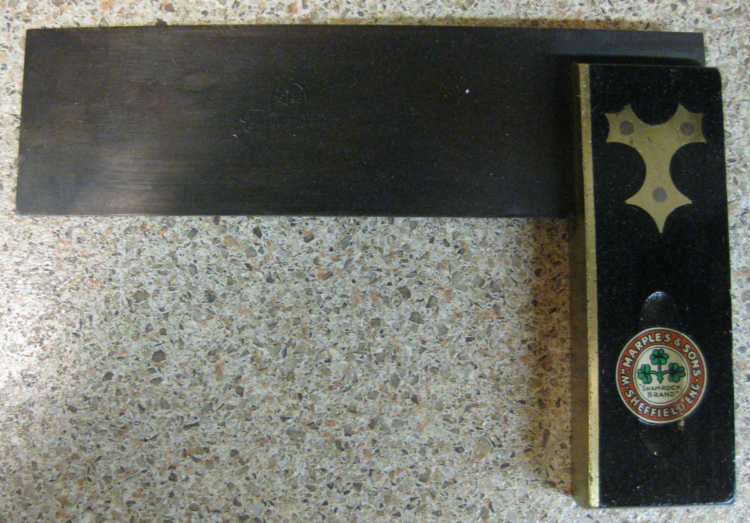
Best ” ” ” “-” [affixed with a large almost triangular shaped brass insert and 3 steel rivets]
(‘Plated’ means that the inside edge of the handle had a brass plate.)
Best Plated Squares with Levels 9″-30″
Best T Drawing Squares 9″-30″ [Probably the kind of square used in a Draughtsmans’ Office on a Drawing Board]
London Pattern Bricklayers’ Squares
Brass Stocked Sash Squares 2.1/2″ [ A small brass ‘handled’ square presumably used in the layout of sash joints?]
Plated T Bevils 7.1/2″- 15″ [These were the forerunner of the Sliding Bevil/Sliding T Bevil, in that there was no slot in the steel arm]
Best Plated T Bevils 7.1/2-15″
Best Improved Sliding Bevils 7.1/2″-15″
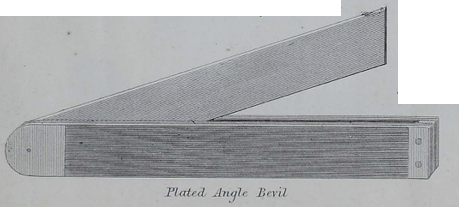
Plated Angle Bevils 7.1/2-15″
Best Plated Angle Bevils 7.1/2″-15″
Those Bevils above were available with either Thumb Screws or Wing Screws at extra cost, as opposed to the regular flat slot headed bolt.
Best London Pattern Bricklayers’Bevils {I can find no image of this tool even in later catalogues}
The 1861 catalogue pages are shown here:
You will see that ‘Best Improved Brass sliding bevils’ come in sizes: 7.1/2; 9; 10.1/2; 12; and 15 inch sizes…but no picture is shown. Prior to 1862 the stamped imprint on the top of one side of the brass frame would be this:
After that time the imprint had the added ‘& Sons‘ stamped. We can therefore assume that this ‘Bevil’ was introduced to the line in the 1850‘s
The imprint on both reads: 5REGD EF 3835, This mark also appears on
Squares of that time:
So I think it must have been a Registered number covering the Brass enclosed Ebony stock.
In the 1873 catalogue this Bevil is described as a ‘Brass framed sliding TBevil ‘ with an associated item number of 427. But the brass frame has beenchanged to incorporate a ‘rib’ at the half way point. To make the frame more stable? The sizes were exactly as above in 1862. The 1888 Cat. lists a ‘Best Improved Brass-frame Sliding Bevel [#575] in sizes 7.1/2; 9; 10.1/2; and 12″. I cannot find this Bevil listed in 1897, so it may have persisted until c.1890.
Now compare these images and documentation with the 1873 Catalogue shown below. There are subtle differences in structure.
Below is a very rare London Pattern Bricklayers’ Square #416. Apparently they were made all in Brass, probably because with all the water involved in Brick Laying, steel squares would not last very long! This ‘style’ shown below is from 1873 onwards…but does not appear in 1888.
The first appearance of this square is shown in 1861 and with having a slightly different end profile to the later issues:
Below is an example of a #414 Best Plated Square with Fancy Shield. I see that this example has brass screws attaching the plate to the stock, this is not shown in the c.1873 Catalogue so maybe only the larger Squares were re-inforced this way.
The smaller #414 shown below is marked as ‘PATENT‘ on the shield, so maybe by 1873 the Patent had expired but was retained so as to scare off any copycats!
Below is a photo of #427 Brass Framed Sliding T Bevil, although I note that is has a square end to the slide and therefore is perhaps an earlier model?
Most Squares and Bevils of this era would have been infilled with Ebony or Rosewood. [See above for more details on this ‘Bevil’.]
Here below is a Canada-pattern bevil showing what I have been informed is a Howard’s 1867 Patent locking screw. I see this bevil first in 1888 as #574 with no mentioned wood species but available as 8″; 10′ and 12″. In 1897 it is called ‘Common’ Canadian Pattern [#549R presumably not Rosewood] and ‘Best’ [#574 Rosewood]. In 1909 ‘Common’ is noted as #2236 and ‘Best’ is #2235. This bevil does not appear in Catalogues after 1909.
Below is a 3″ Engineers’ Steel Square Item #418 c.1880. These Squares were not ‘rule’ marked until c.1890 when they were numbered #560. These markings however seem to be ‘upside down’ to the usual format, reason unknown! In 1909 the number of the ‘rule’ marked squares was again changed to #5132 and this number persisted until the demise of the item c.1938
The next section is from the 1897 catalogue:
#562 Coachmakers’Iron Stock Squares 6″-10″ #576 Coachmakers’Iron Stock T Bevels 14″ #576S Coachmakers’Iron Stock Spider Mortice Bevels
[There are no images shown for these items]
Below is shown a 6 inch Iron-Stocked Combination Square # 554C:
The blade is imprinted:
Below is an Ebony Combination Square possibly #554B. It does not conform to the illustration in the 1897 catalogue but resembles the fittings of a Canada Square [#558]. I estimate this example to be c.1890 since it does not appear in the 1873 Catalogue.
Engineers’ Steel Squares #559 were available [#418 in the 1873 Catalogue] 3″-18″, as were the ‘Engineers’ Steel Squares, Rule-marked #560.
Item #560A Steel T Square was 6″-18″.[see below]
#1675 Tailors’ Boxwood Folding Squares 18″- 30″… No Image.
Listed under Glaziers’, Painters’, and Paperhangers’ Tools are the following, but again there are no images. #1685T Squares, Rule Marked 18″- 48″. #1686 Laths, 1.1/2″wide, Rule Marked 24″- 48″.
Next are the 1909 Catalogue listings:
You will see that there is now a re-numbered system since the 1897 numbers, perhaps to absorb the vast increase in the number of products available. There are too many differences between these years to list them all here, so I urge you to explore those newly listed items and discover those that were de-listed.
#4248 Masons’ Galvanized Steel Shiftstocks or Bevels 7.1/2″, 9″, 12″. #4249 Ditto Solid Brass
These are still listed in 1909 and are shown as per the 1897 catalogue.
It is highly likely that all the wooden measuring implements carrying the MARPLES name were made for MARPLES by SMALLWOOD or RABONE.
The next image is from the 1921 Catalogue pages. These are the only Carpenter’s Squares listed because after the Great War all items were drastically reduced in availability.
The next images are from the 1928 Catalogue:
The image above here is from the ‘Coachmakers’ and Wheelwrights’ Tools’ section.
The next images are from the 1938 catalogue:
The next images are from the 1959 catalogue:
Here you will see a drastic reduction in items available since 1938.
The following pages are from the 1965 Catalogue No. 15:
The image below is from the New Products Leaflet of September 1968. This Combination Try and Mitre Square #2205 was only available from 1968 to 1971, being then renumbered as #2222 . This item was itself short lived as it was replaced by a Die Cast #2222 in 1973 which initially had a spirit level, but this was phased out before 1977. Photos below show both styles.
Next are photos of a M2222 with the plastic inbuilt spirit level c.1973:
Below is a photo of the Die Cast M2222 without the level. New information suggests that there was a Silver MARPLES sticker in the area of the truncated SeOval area. [Below]
Below is a photo of a carded new #M2222 which was a re-numbered #2205. The photo below that is of a #2222 but which [looking at the brass locking nut] seems to be closer to the number change from #2205.
What follows is a synopsis of all the Bevels and Squares issued by MARPLES since 1909 trying to link in the Item number with the dates of product availability. The catalogues above will tell you of tools issued before1909. This research may be altered with new evidence, but I have scoured all the catalogues and bracketed the dates for you. All you have to do is identify your tool from the above catalogue information and look it up in the list below. This will tell you the dates of availability so that you may know roughly the age of your Square or Bevel. The list will be in numerical order, however I have noted that early on [c.1900 to 1938?] MARPLES produced the same tools but were noted as ‘SPECIALS‘, with a suffix of ‘A‘. [For e.g. 2200A] . I do not really know what these items were, but presumably they may have been special orders for specific Companies and were impressed with that Company’s name. The dates given below are accurate plus or minus a couple of years generally. Where no end date is stated [e.g. 1993<] it must be assumed that the tool existed in production until taken over by IRWIN in c.2007
I will publish here some photos from my files and personal collection, as a picture is worth a thousand words.
In my estimation this Square, #2204, is the very best ever made as it cannot go out of Square. It was called various things throughout its ‘history but’ Shockproof ‘ describes it best. When first introduced around 1928, and up until 1938+, it had 5 rivets with 2 at the top and 2 at the bottom. It may have gone out of production because it is not listed in the 1959 Catalogue, but it was re-introduced in 1962 with a Hardwood stock and with only 4 rivets. The word ‘Shockproof‘ was introduced in 1962 on the stock initially separated from the other wording, but later was moved up so that the wording was all together [see photo below]. Also at this time a small label was affixed to the blade, as shown on the right. The 1909 Catalogue lists a different product with the #2204 coding, namely Rosewood Squares with incorporated Spirit Levels in the stock brass face. When these Squares were dropped from the line, the number became available and the ‘Solid-Blade’ square appears in c.1928 [below]
Above as shown in 1928 and 1938 catalogues.
The photo below is of the first ‘Shockproof’ square with 5 rivets. It was not marked on the stock, only on the blade. This is a rare example.
The photo [below] shows an original ‘Shockproof’ Square, but not labelled as such. NOTE: the thick 1/4″ dovetailed brass plate. [The brass face plate was originally ‘dovetailed’ into the wooden stock and this may have been the situation until the ‘Shockproof’ wording was removed upwards to join the other wording [hard to explain!!!] See below.
The photo [Below] shows the ‘Shockproof‘ Squares. The TWO lower Squares are 6″, but the lowest Square shows that the ‘Shockproof ‘ name was imprinted lower than later examples. The first ‘Shockproof‘ Squares were not marked as such, as shown above. The plate was joined to the wooden stock by accurate Dovetail jointing [No screws]. Later on the brass plate was changed to have a ‘Phillips Screw‘ fastening and a thinner plate. This changed around the same time as the word ‘Shockproof‘ being moved from below the middle rivet to join with the words stamped above. [see the 2 lower images on the right.]
Note that the brass plate decreased from 1/4″ to 1/8″ in thickness when screws were then used.
These Shockproof Squares were sold in cardboard boxes:
But [above] you may note that the advertising boys got into the act as the handle and blade markings have been reversed to accomodate a better format picture.
The photo above shows a very early 14.1/2″ Square by W. MARPLES JUNR This was the very first mark that Marples adopted, despite what other sites may say.
The ‘R‘ in Junior [see below] may have been in raised script with a line underneath. At this time, there were no numbers ascribed to the various tools, but later catalogues would list this Square as #407 [Available in 1873 from 3″ to 30″.]
These Squares below are very early Squares with a PATENT mark of Reg 3835. The stock was of Ebony with a total Brass plate all around. In the 1873 Catalogue they are listed as Item #412 ‘Best Double Plated Squares’, and were available in 3″-30″ .
This MARPLES Square [below] has an iron stock with HIBERNIA in raised letters and is #2207 [no measurements on the blade] and this existed from 1909 to 1920. There was also an identical #2208 Square which had inch measures stamped on the blade.
Below is an Iron Square that I cannot find in my Catalogues, but it may be a late #2207, without the Trefoil and ‘HIBERNIA‘ marks.
Below is another 6 inch square that I am unable to identify. It does not have any Rule markings on the blade, but the head seems to be of Aluminium. I think this item must be post war [1950<].
Below is a Rosewood Try and Mitre Square #2205, listed 1909 to 1932.
These Ebony with Shield Squares #2202 [below] are listed as being available from 1902 to 1973 [when hardwood was started] but I very much doubt that Ebony was really used much after c.1939!
Below is a very rare 3″#2202 Square with 2 other sizes. All have the same stamped mark on the blade which dates them to c.1932. The later squares [c.1930< ?] had thumb grooves machined into the handles.
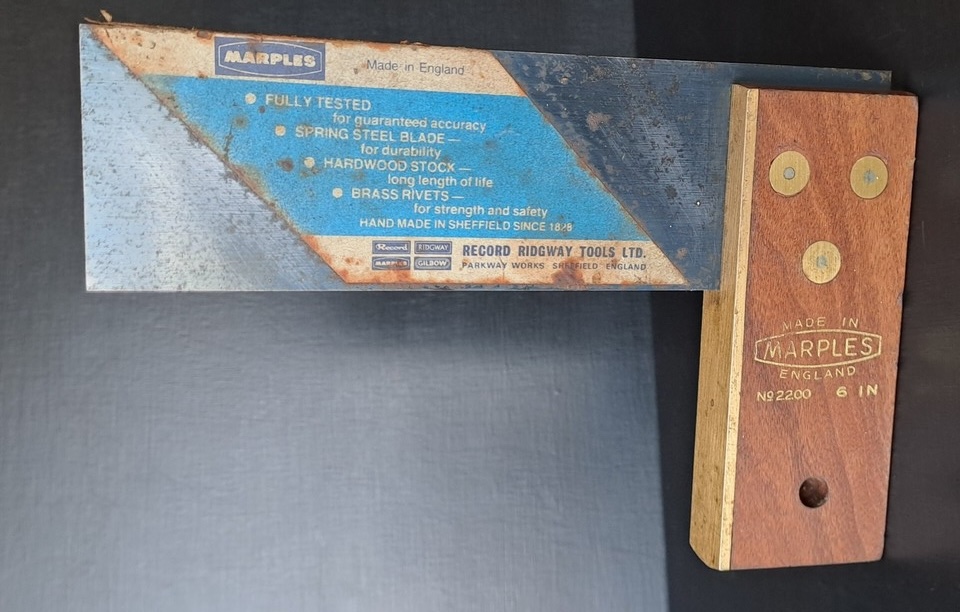
These Rosewood Squares #2200 were issued from 1909 to 1960 [after which ‘Hardwood’ was used], but to be replaced again by a cheap Rosewood in 1993.
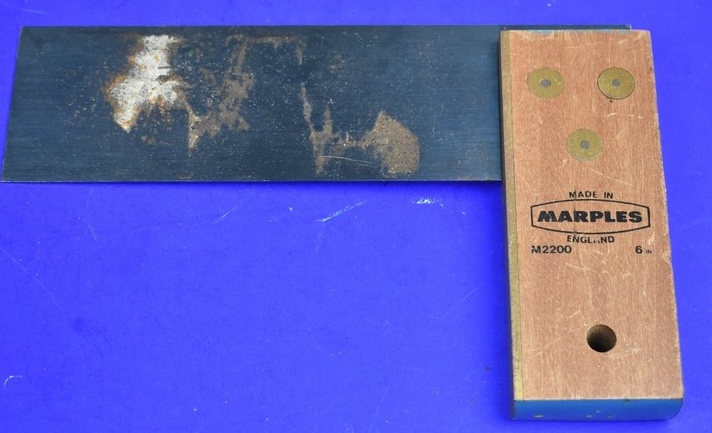
These photos below show the transition from the #2200 earlier Rosewood variety with Diamond Plate rivets and Slot screws having a blade width of 2″ and finger slot, to a later Hardwood edition having Phillips screws and circular plate rivets and a blade width of 2.1/4″. [6″examples shown]
The above M2200 square is from when they had received a ‘Hardwood’ handle. Note the manufacturer drilled ‘hang hole’ and the fact that the brass face does not have any screws or dovetail fitting. I am not sure what keeps it there! Also see photo below showing that the MARPLES mark was not stamped in but is a gold surface applied motif ‘Record Ridgway Tools Ltd‘. c.1965, and this changed later on the ‘Record Marples ‘Squares to a Black motif .
The ‘Gold’ Square above in the earlier…look at the script! The Black motif is shown below:
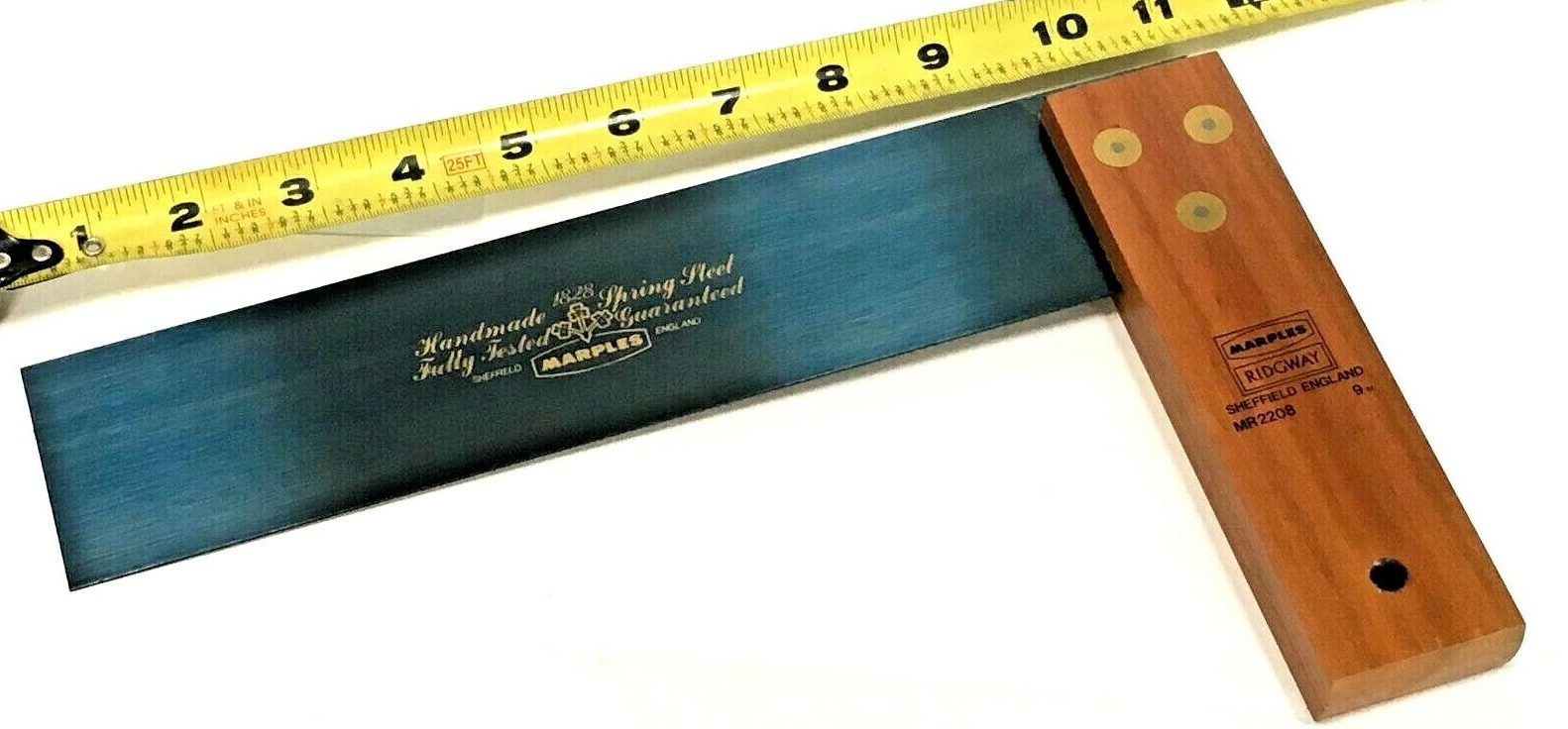
The Rosewood Square #2208 [below] was first available in 1938 and was replaced by Hardwood in 1959 and was available as such until 1999.
Below is the MARPLES RIDGWAY MR2208 Square, Note that there is no Brass face strip to the stock:
Below is another later MR2208 9 inch square with hanghole:
Below is a later MR6829 Square:
Below is an Ebony Mitre Square with Shield #2212.
Best Ebony. Available 1909-1936.
Item #2210 [below] Rosewood Diamond-plated Mitre Squares were available 1909 -c.1960, when Rosewood was replaced by Hardwood. But this was again replaced by a cheaper Rosewood in c.1963-1969.
Below is a M2210Record Ridgway [Mid 1980s] in original packaging:
Here below is a very late Marples-Ridgwayc.1993 Mitre Square MR2210. It shows a cheap 3-pinned Rosewood, manufacturer drilled hang hole in the handle and no brass protective end strips on the handle.
An even later example shows no brass strips at all!!
Shown below here is a small all steel 4″ square that may be a #5131 from the 1909 Catalogue. But it does not fit the picture exactly, because it has a concave aspect to the underside of the handle. It is marked, [as shown,] 1915 with the War Dept. arrow emblem. It may be a ‘SPECIAL‘ produced just for the British War Dept in the First World War.
Below are photos of a 7 inch 5132 with inch markings. Probably later than the square above because it has a parallel stock with no indentation.
The 6” square MR2208 below is a late Marples Ridgway offering, showing no brass face on the stock:
Below you will see 2 good photos to show the 9″ later MARPLES RIDGWAY Square MR2208. The drilled hole in the stock is original.
After 1991 a 6″ Square in Hardwood was available having a drilled hole in the Stock, no brass face plate to the stock and numbered MR 6829:
I cannot specifically find the 4.1/2″ Rosewood ‘Best‘ Square [shown below] in any of the catalogues that I possess. Note that it is ‘Rule Marked‘ in old style numbers on both sides. I estimate it should be c.1880-90.
The 18″ Square below is a ‘Plated Square’ with 3 diamond shaped rivets from c.1860 marked on the stock: W. MARPLES JUNR
SHEFFIELD
Picture missing………………
This Combination Square and Bevel is not to be found in any MARPLES catalogue or list prior to 1862. The mark on the handle definitely indicates that it was made by William Marples Junior and around 1840-50. A similar looking tool can be seen in the Preston Catalogue of 1909 item #1488 named as a Horizontal Square.[below] and it was known in the trades as a Coach Maker’s Square. It performed as a square and when adjusted and placed on one section of the Gun Metal handle it delineated a 45 degree angle on the edge of a board [hard to describe!] By loosening the handle this angle could be adjusted as desired. [Photos courtesy of Ben Bama]. Doubt that you will ever see one! The makers’ mark is exactly the same as one at the top of this page, which denotes prior to 1862.
BEVELS:
Presently I can find no listing on this [below] double Brass plated Ebony infilled Bevil, it is not even shown in the 1861 catalogue. I have a similar item [below]in my collection now.
It seems to be marked: W.MARPLES SHEFFIELD and on the under arc is marked: REGD EF and then under that 3335? Further investigation on Patent Marks is in Order.
This ‘Bevil’ [below] is listed as Item #427 in the 1873 Catalogue . ‘Best Improved Brass Frame Sliding T Bevil’. Available from 7.1/2″- 15″.
Below is the most famous bevel in the MARPLES lineup, [‘Joiners’ Bevel’] since it endured for so many years. 1909-1973 #2220 in Rosewood and #2221 in Ebony. (1959 Cat. shows only Rosewood) 7.1/2-15″ but reduced over time. ‘Hardwood’ was started around 1960-64.
But only 7.1/2 and 9″ are offered in 1965.
This #2220 ‘Rosewood Sliding Bevel, Best’ [below] is from c.1932 and shows a rare Water transfer:
MARPLES Item #2226 Hardwood Sliding Bevel, Brass Plated, with special Brass Lever Locking Nut for quick action adjustment. Available in 1959 as 7.1/2-12″. Was available 1938-1999 . But ‘Hardwood’ replaced ‘Rosewood’ in 1969 but again it reverted to ‘Rosewood’ in 1993.
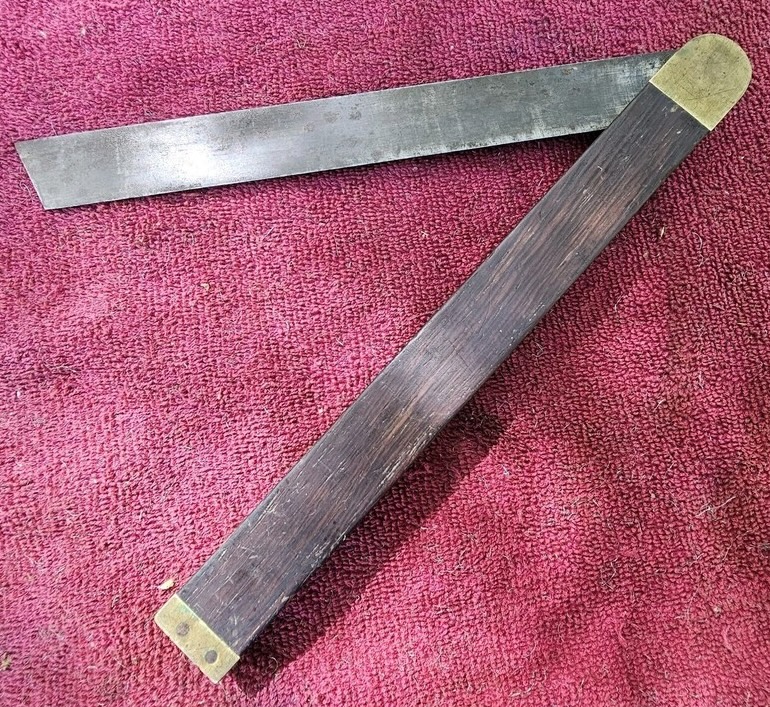
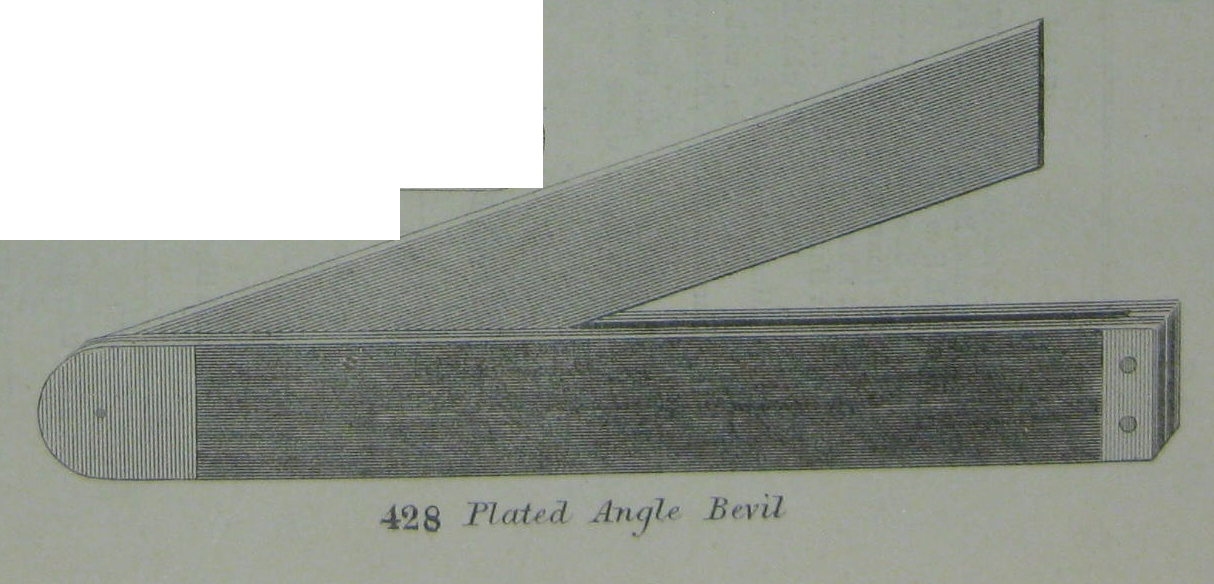
The Bevil below is a 7.1/2″ ‘Angle Bevil’. Hinged at one end [as opposed to a ‘Best T Bevil’ ] There are subtle differences between an Angle Bevil, a T Bevil which swivels around a central point and a Sliding Bevil which can move along a central axis and is the most advanced Bevil. The Angle Bevil is described in the 1846 list [7.1/2″; 9″; 10.1/2″ and 12 “] and illustrated in the 1861 Catalogue:
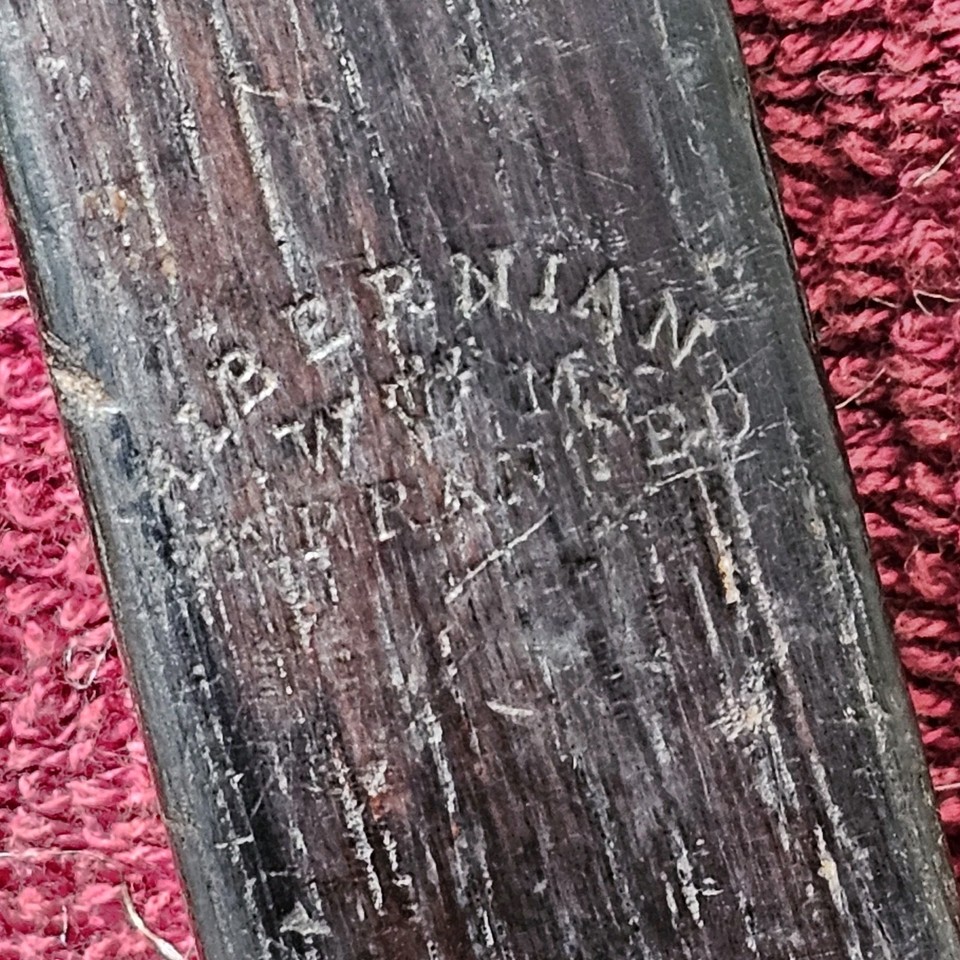
It is Item#428 [above] in 1873 when it was still available up to 12″ in length. In 1888 it is item #571[rivetted] or #572[Best..with screw] ] and is not listed in 1897. The example here below shows a rare mark {‘HIBERNIAN’ referring to the WORKS from 1837-1859 when the WORKS moved to Westfield Terrace and was then called HIBERNIA WORKS.}. The middle line is ‘W Crown M’ with no ‘& SONS’.
BOAT BUILDERS’ BEVELS:
I will treat these tools as a separate section because they are so different to woodworkers’ bevels. First named ‘Bevils’ in 1846. At this time there were various lengths available 8 inches; 10 inches and 12 inches:
Then in 1861: Up to this time although the length is 12 inches there are still no inch scale markings.
1873: At this time there are various woods available for this bevel and there are inch scale markings:
1888:
1897:
1909:
1921:
1928:
Below is a #2241 which seems to have been available in Rosewood in 1873 [#433] in 1888 [#580], in 1897 [#580] and in Catalogues 1909;1921 and #1928 as item #2241. It does not appear in the 1938 Catalogue.
Chisels
CHISELS
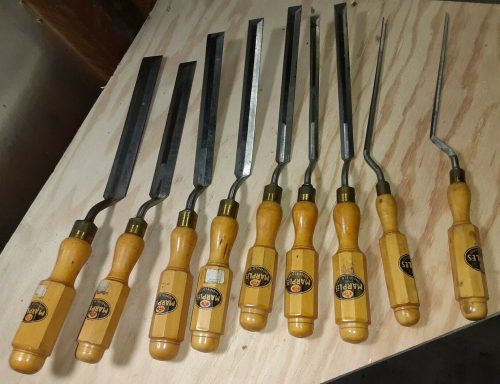
This section has been my on my mind for a long time, because I have collected and restored MARPLES chisels (gouges) for many years. It is also a very difficult subject to address, since there were so many chisels/gouges produced by MARPLES, but all had very slightly different handles. To list ALL of these chisels may be difficult, so stick with this site as nobody else is able or even willing to try to do this!!
The first question on your mind is…..’When did MARPLES start making Chisels/Gouges ‘ ?
And this started my catalogue research, so I hope that you will join me and enjoy the path that we can briefly explore in this field, since these tools shaped Great Britain1840-1900? [and even beyond these dates]
Very early chisels, like any older tools, are extremely rare to find, let alone to own and photograph. At least we know that chisels marked HIBERNIA [the word of which was used before being patented in 1875] and with theTrefoil are from 1875 onwards. But to find no marks, or at least to find the marks HIBERNIA and with a single Shamrock is very hard to date.[Possibly pre-1875?]
The earliest ‘catalogue’ [more a double sided product issue/broadsheet] of c.1846 makes no mention of any chisels/Gouges being for sale (see the catalogue section), but recent information indicates that MARPLES started to have these very important basic tools for the ‘Woodworking trade’ made for them around 1860 when it was considered a viable financial proposition. Remember, William was not a man to take risks on a venture that could not be profitable because by all accounts he was an astute businessman and at this time he would have been competing against the likes of James CAM and other fine edge tool makers who were by then well established in these lines.
The 1862 catalogue [2 pages shown below] does indeed show and list Cast Steel Firmer Chisels [not made on site], but not bevelled edged chisels [see later]. At this time they were sold ranging from 1/16″ to 3″ wide, and were also offered ‘handled’. [although the shape of handle is not specified] Ditto here for the Gouges(<2.5″). Strong Firmer Chisels and Gouges are shown, as well as ‘Sets of chisels and gouges’. CAST STEEL Coach Makers Chisels and long thin Paring chisels are shown as well as CAST STEEL Millright’s Chisels and Gouges. From that time onwards the list offered of chisels gets ever larger and more complex.
The 1873 [below] catalogue lists ‘Bevelled Edge’ chisels both in Firmer and Paring style but again with the option of being supplied handled or not. But there are still no details as to what shape/style of handle could be supplied. I can therefore conclude that the move to a ‘Bevelled Edge ‘ manufactured chisel started around 1870, but this is a hard date to positively establish.
Prior to this time you may well find many firmer chisels that have been owner modified by grinding a small ‘bevel’ back from each side of the cutting edge. It is probably that these workmen may have suggested to the manufacturers that ‘Bevelled Edge chisels’ may be good practical items to produce.
The next text which I have available is the 1897 catalogue, and here are shown about 10 pages of bench chisels and gouges that could be supplied with/without Round Ash / Beech / Boxwood Handles; Boxwood Carving Pattern Handles; London Pattern Octagon Boxwood Handles or Taper Handles. Taper Octagon Boxwood Handles (see below [7555] were only offered for a short period of time). There are simply just too many varieties and combinations of chisels and gouges to show them all here.
Below, is a page from the 1903 Catalogue which shows the choice of chisel handles that were available at that time. The Common Octagon Chisel Handle in Boxwood [7540] is a new addition, but again only lasted for a few years. Please study this picture well, as many are never seen today and they may have existed for only a brief period in time. Obviously this would have been due to either the design being uncomfortable to use or maybe just too expensive to produce and therefore to buy. The chisel handle styles I cannot find readily today are: 7536 – Plain Octagon, Hooped; 7540-Common Octagon; 7555– Taper |Octagon; 7515 Taper Round; 7530– Kensington Pattern and 7535– Plain Octagon Chisel Handle.
Personally, I have never seen the 7530–Kensington Pattern Chisel Handle but it looks to be a very comfortable handle.
By 1909 there are 21 pages devoted to chisels and gouges. Page 8 shows the styles of handles then available and curiously lists a blade that I have never seen..#330…Round Back Cabinet Firmer Chisel.and therefore it must have been very short lived. Naturally these chisels and gouges were also available in ‘Paring‘ style and also available as a cranked variety of ‘Paring‘. The shear volume of different tools, each engineered for different trades, is utterly overwhelming and you can only really grasp this fact by looking through the actual catalogues. What I can present here is but a very thin slice of pertinent information.
By 1928 there are 16 pages, but they are now organised to be more easily read and understood. Mostly everything seems to have been available either handled [with many different types of wood handles.] or without handles.
There are:
Firmer Chisels; Bevel Edge Firmer Chisels; Strong Firmer Chisels; Firmer Gouges; Firmer Gouges In-Cannel; Sash or Scribing Gouges; Long Thin Paring Chisels; Bevel Edge Long Thin Paring Chisels; Long Thin Paring Gouges; Round Neck Registered Chisels; Round Neck Registered Gouges; Millwrights’ Chisels; Coachmakers’ Chisels; Coachmakers’ Bevel-Edge Chisels; Wagon Builders’ Chisels; Mortise Chisels; Sash Mortise Chisels; Lock Mortise Chisels; Machine Mortise Chisels; Socket Chisels; Socket Gouges; Solid-Steel-Blade Socket Chisels; Bright Socket Firmer Chisels; Strong Socket Firmer Chisels; Bright Socket Firmer Gouges; Wheelers’ Bruzzes; Butt Chisels; Sash Pocket Chisels; Roller Coverers’ Chisels; Floor Cutting Chisels and Drawer Lock Chisels.
Only the 1928first 2 pages of Common Chisels and Gouges are shown below:
The 1938 Catalogue [below] shows 15 pages devoted to chisels and gouges. There are some additions to the line and some deletions [too numerous to mention here] but in essence the listings follow the 1928 catalogue, only with some price increases. The only ‘Round’ neck chisels and gouges are the ‘Registered’ pattern Mortice, the London Pattern Sash Mortise Chisels and the Tanged Butt Chisels. All the rest, except for the Socket style, are ‘Square’ necked. All the handles are made of either Ash, Beech or Boxwood with no Plastic yet in evidence. This situation was in effect until at least the March 1940 pocket catalogue.
The next catalogue that I have [below] is just post-war 1954 and this shows that a ‘Splitproof’ Amber Plastic handle had been introduced, and was also offered on the Round neck B/E Butt chisel. [This handle was all Amber, not the later Red/Orange.] At this age you will see that the ‘Round’ neck B/E chisel has arrived, but the ‘Square’ neck Firmer chisel is still available…if we can believe the Cat. images to be correct. Yet, in the same cat. there is shown a Chisel Display Stand that depicts B/E Firmer chisels with Square necks! I therefore suggest that the Round Neck Chisel/Gouge was probably the only variety produced after c.1952/3 and that the Square neck [Drop Hammer forged?] had been replaced by the Drop Forged Round Neck because of lower production costs. [But see later for a MARPLES contradiction]
Below you will see the amended page, dated March 1957, showing all Round Neck chisels. {Compared with the square necked chisels of pre 1953 }
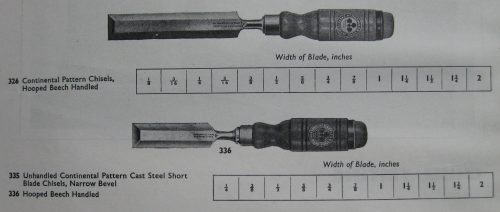
Here [below] is the ‘Continental’ pattern wood handle [#326] that had been introduced into the line. [1954] along with the shorter Butt ‘Continental’ [#336] They were described as having a ‘Narrow Bevel’.
But in the 10/79 E3 Catalogue [below] they are no longer called ‘Continental’, just ‘Hooped Beechwood’ and are now numbered #M371 So #326 turned into #371? Very Confusing!.
By 1954 the ‘Round’ [Amber] Splitproof handled B/E Butt chisels [#876] had made an entrance although the page below is dated Sept 1958.
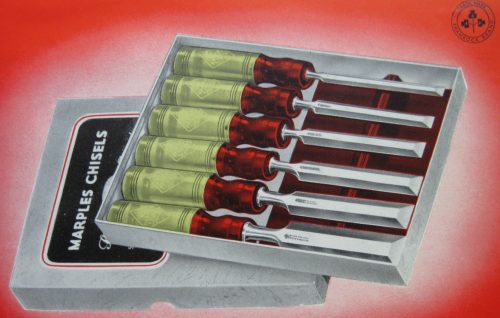
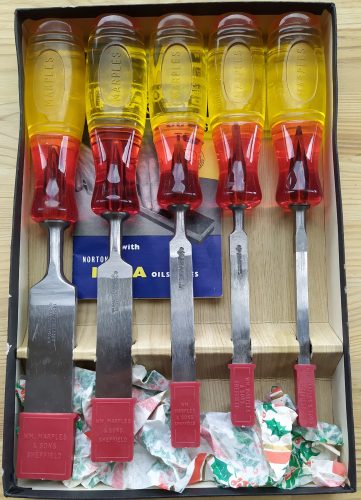
Also shown is the Red/Yellow Oval “Splitproof Handle” chisels in sets of 5 Firmer [#313] and 5 B/E Firmer [#373]
Below is a set of Splitproof Butt chisels, Item #876 withRound handles. Item #876 endured 1954-1958 and then the Item # was changed to #386 in 1959 and these were themselves eventually discontinued in 1969. The chisels below may be from c.1958. These chisels should not be confused with the heavier more robust OVAL handled #373 The box that they came in is also shown below.
But here below is a picture from the 1959MARPLES Catalogue, showing a different handle marking on the #876. It was probably an older picture but still used in 1959. The other image here is of 3 of those chisels to show the mark better. The older #876 had a Red colour to the plastic close to the blade.
Below is the illustration of Item#386 in the 1959 Cat. and these chisels had an all amber plastic handle.
It would appear that the Splitproof Butt chisels with round handles came in 4 different coats…earliest to latest.
a] A Diamond shape impression on an amber handle with a red neck
b] A white Oval applied coating to an amber handle with red neck
c] A MARPLES impression mark on an amber handle with a red neck
d] A MARPLES impression mark on an amber handle with no red neck.
Below is a great set of M371/S4. Late 1970s?
In the March 1957 Pocket Cat. these 2 adverts [below] appear advising that MARPLES chisels are good to the last inch as they have been “Hardened and Tempered from edge to trademark.” And this was also advertized on the chisel boxes of that era.
In the 1959 Cat. there are advertised sets of chisels contained in ‘ colourful’ P.V.C Wallets:
The picture below shows set 377/W5 but the handles have an impression later than that shown in the Catalogue. I am unsure as to how long these plastic wallets were available, but a guestimate is 1956-1965?
The following is taken from a September 1961 catalogue issued by MARPLES for USA consumption. So, up to this date MARPLES were stating that ALL gouges and chisels are ‘hand-forged.'[see below]
BUT hand-forged can include the handling of red hot steel into a drop hammer, as opposed to the automatic systems employed later, [wherein no ‘hand’ is actually employed]. ‘Hand-Forged’ could then be legally used, but it is stretching the use of the English Language somewhat!
I also note that ‘Good to the last inch’ or ‘edge to trademark’ has been sacrificed for a larger description that the ‘entire length of the tool can be honed’.
At this time (9/61) the Paring Gouges and Paring Chisels are shown as having Square necks. [Could these have been old ‘cuts’?]
In 1968 the ‘BLUE CHIP‘ handled B/E Firmer chisels #444 and gouges had been introduced, followed in 1971 by the #333 Blue Chip Firmer chisel. It is shown here that ‘In co-operation with the European Tool Committee, Marples Wood Chisels are marked in inches and millimetres’.
‘Metrication‘ was introduced across many walks of life in Britain on 15 Feb1971, and the image below is from 1971.
The Oval ‘Splitproof’ Handles [#373] were in full swing as well as the smaller Harlequin Handled B/E chisel [#388] as found here [below], which was introduced in 1968.
Below is a photo of some HARLEQUIN chisels #388 [shown are 2 x 1/2″ sizes with different coloured handles, which proves that the handle colour did not indicate chisel width.] It is not presently known whether the Harlequins were provided with all the same colour edge guards.
And below [and above advert] you will see a Mint example of ‘Compact’ chisel #382 which was introduced at the same time as the ‘Harlequin’ [9/68]. This chisel may be much more rare than the ‘Harlequin’ because it had a wooden handle and as these chisels were low cost and aimed at the Amateur market, they would have been prone to the abuse afforded such items, [housed in a damp shed at the bottom of the UK garden, used to open paint cans and used as a substitute screwdriver! etc.] and therefore to find one in mint condition [below] is rare. And add to that the fact that they were only offered 1968-69.
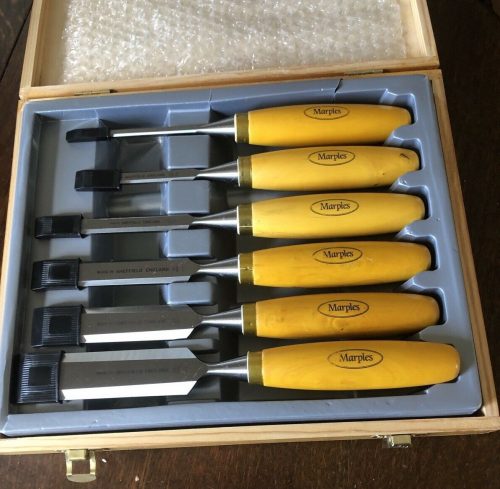
A beautiful set [below] of 6 B/E Oval Split-proof Handled chisels. 373/S6
The photo above is from the RECORD RIDGWAY MARPLES Woodcrafting Tools Catalogue dated October 1979.
Above is the introduction page of the 1993 Wm. Marples Chisels/Gouges catalogue.
Below here is a set of Leather tipped B/E firmer chisels in a plastic pouch that I seem not to be able to yet identify! They must be from the 1960s<? and had applied sticky MARPLES labels on the handles, all of which are now missing .
What follows is the table form of the chisels and gouges that MARPLES made, starting with the 1909 Catalogue and progressing as far as 1998. The catalogue dates are across the top. There are some assumptions that I have had to make, the most important being that should an item appear in [for e.g.] the 1928 catalogue and in the 1938 catalogue, but nowhere in between [in the pocket catalogues], I have concluded that the item was indeed available in between but did not appear in the Pocket Catalogues due to space limitations and popularity of the item.
Errors in table:
a] M555 Green handle chisel should read as being available 1991-98.
A Gallery of some of the more common MARPLES chisels that can be found today:
Round Ash Firmer [#310] 1909-1994 or B/E Firmer [#370] 1909-1986.
This chisel endured as the backbone of MARPLES chisel production and was probably around prior to 1909. You will find them from good quality early chisels to the later less exciting offerings…see below.
Some chisels you may find have a steel ferrule [see example below] and these may come from the latter parts of WWII. I have ONE example that is fitted with an Aluminium ferrule. [And that is the way that it is spelt in Britain!]
Photos above are of #310 Firmer Chisels, but are of very different years and quality. All are Ash handled.
The 2 photos below are of #370 Ash handled B/E chisels from around 1986, showing short non-brass ferrules, tapered necks and the same size handles throughout the range.
The #370 Chisels shown below are higher quality and obviously from an earlier time:
Carver Boxwood Firmer [#317] 1909-1994 or B/E Firmer [#377] 1909-1998
Found quite often today on a famous Auction site, these chisels can be had once again in various quality states according to the year of production.
The very best were the square necked chisel, probably <1952. These would have had a small round MARPLES water transfer applied close down to the brass ferrule. But around this time we can find these square necked chisels having a ‘Green Shamrock‘ transfer [See the section on Marks] similar to the red ones shown below. I have found this Green transfer on both these ‘Square neck’ and ‘Round neck’ chisels. To me this indicates a date c.1952/3 since I have deduced that the Round neck chisels phased out Square neck around that time. Below is a fine set showing a Round neck and a ‘Red’ Shamrock transfer in the middle of the handle.
Below you will see the degradation that this fine chisel suffered over time, showing here disgusting ferrules, ‘tapered’ necks, all the same sized handles and no Makers mark on the blade]
The tapered neck appeared on these chisels around 1985.
Below here is a photo of some late [c.1995] B/E Boxwood handled [#377] chisels. Note the short brass ferrules, a white plastic ‘washer’ and the same size handle for each chisel.
BUT… you may find [ shown below] some MARPLES Boxwood Carver handled B/E chisels with a full brass ferrule [i.e. before they truncated the ferrule to a brass plated steel..c.1990?] which literally have no MARPLES identification on either the handle or the blade. See below. Presently I cannot explain why this should have occurred. Definitely MARPLES.
The above chisels also show a change in blade design in that previously the bevelled edges were of equal size along the length of the blade, whereas at some time [to be determined c.1980?] the design changed to give a splayed look to the central portion. I have seen this on chisels with a SEOVAL Boxwood Carver style handle and etched blade; on a SEOVAL handle with no blade marking and on chisels [as above] with no markings at all. Below is a comparison of the 2 designs…
This design was carried through to other styles at different times and may have been used only on the larger sizes of chisels. For instance I have catalogue pictures showing Blue Chip chisels as having this played out design around 1971! It is presently not possible to collate and report on when all these chisels started to have this new blade design, the information simply is not available.
Also noted is the fact that these ‘splayed out’ [and maybe others] design of #377 chisels can be found with 2 different electro-etched marks. The earlier mark has the word ‘Sheffield‘ and also is a narrower necked chisel displaying a finer designed shoulder [top in pictures]:
At the moment I do not know whether these different etchings occurred in other chisels.
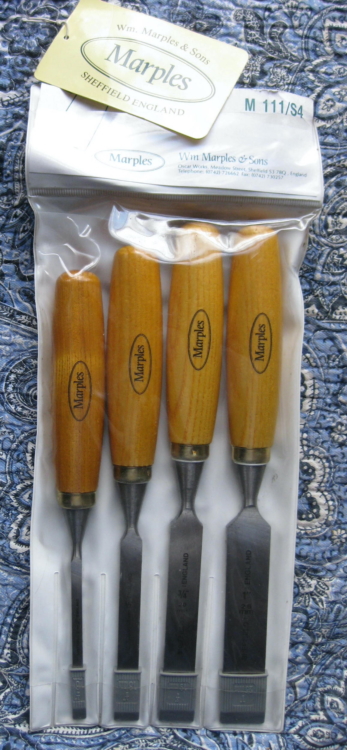
Ash Carver Handled Firmer chisel #M111
This style of chisel was introduced in 1986 [Marples/Ridgway MR111] and was available 1986-7 in these sizes: 1/4″; 3/8″; 1/2″; 5/8″; 3/4″; 1″; 1.1/4″. It was dropped from the line in 1988-90 and was available again 1991-4 as M111 but only as 1/4″; 1/2″; 3/4″; 1″. See 1986 excerpt below:
The M 111/S4 set below shows a short brass coloured pressed steel ferrule and same sized handles for each chisel c.1994.
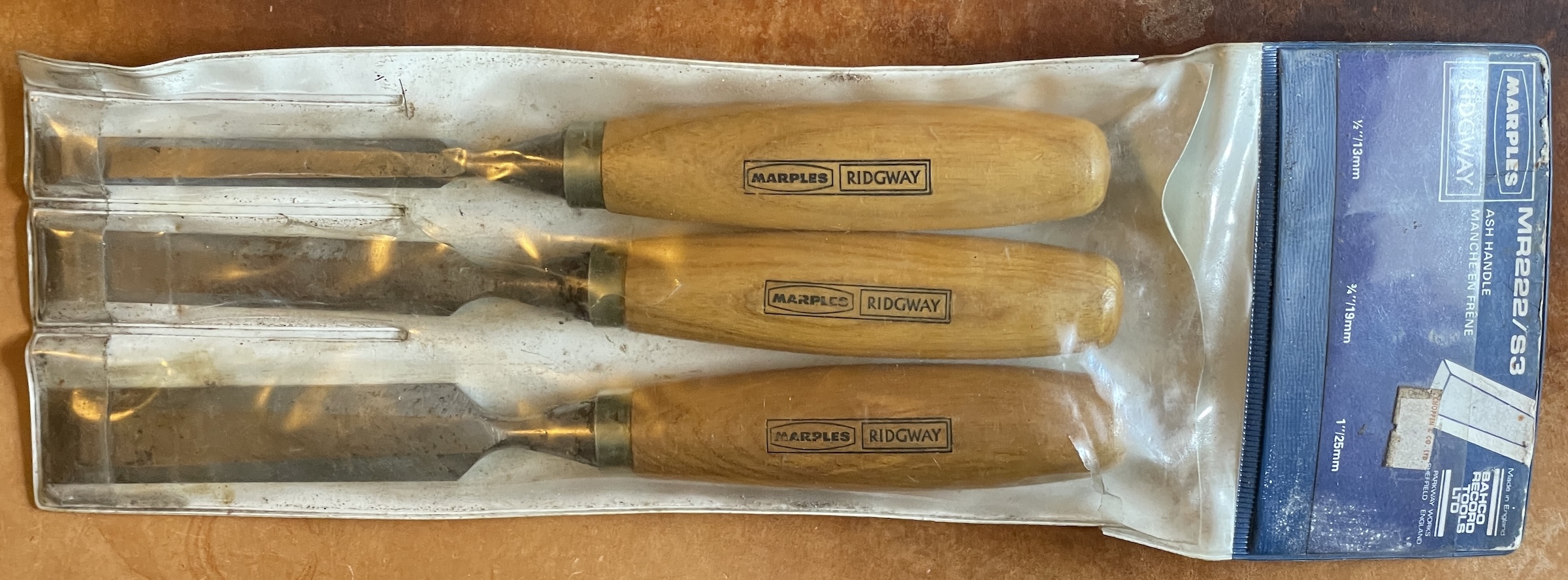
Marples/Ridgway MR222 earlier 1986/7 chisels looked like this:
Below is set MR222/S3
Blue Ribbon #M555 Blue Handle B/E Firmer chisel
This was introduced in as an Amateur household chisel and therefore less expensive chisel in c.1986 and until 1991. Only produced as 1/4″; 1/2″; 3/4″ and 1″. Also called ‘Hobby 1’. Available individually or as a boxed Set. M555 was changed to a Green Polypropylene handle in Mid 1991.
‘Blue Chip’ Polypropylene handled Firmer [#333] 1971-1998 or B/E Firmer [#444] 1968-2006+
A much abused chisel because of the bad advertising that propelled this item to fame. [In essence, it is OK to whack it with a hammer!]
This is why you will find them usually very soiled and scuffed due to the fact that this ideology appealed to the ‘whack it and get the job done’ tradesman, who would then consign the poor creature to its’ storage space with an errant toss.
Of note here is that the 1/8″ B/E #M444 was introduced into the line in September 1978
They always had a ‘tapered’ neck and are now still manufactured by Irwin-Marples but you must be careful to only purchase those made in Sheffield, and this is hit or miss. The very first Irwin-Marples still had ‘MADE IN SHEFFIELD‘ electro etched onto the top of the blade. and the B/E were still produced in Sheffield until 2008. Very soon after that, the whole system was transferred either to Italy or more probably CHINA.
The earlier chisels made by MARPLES have the electro-etching shown below on the blade and the SEOVAL {semi-oval} MARPLES mark in the handle.
Chisels made by RECORD RIDGWAY TOOLS LTD. looked like this below and with Blue Edge protectors.
Initially chisels made by Record-Marples Woodworking Tools Ltd had SHEFFIELDENGLAND etched on the blade and the seovalMARPLES Mark on the handle. Or may have the OvalMARPLES on the handle with SHEFFIELDENGLAND etched on the blade. Grey chisel end protectors. All as shown below.
But of course I have now bought a Blue Chip chisel that has a handle marking that I can only try to slot into the dating order. The blade marks are as shown immediately above except the mm. size is inline with the wording. My example is too feint to photograph.
It also has a Grey plastic edge keeper. As you can see the mark on the handle is a surface application, not pressed into the handle.
The Later Marples [Made by RECORD] Firmer and B/E Firmer chisels seem to have MADEIN SHEFFIELD ENGLAND or HAND FORGED SHEFFIELD ENGLAND etched on the blade, and the Oval ‘Marples’ emblem was on the handle and may also be etched on the blade,[Later] (as seen below).
These Later chisels may also have the ‘Man in Safety Goggles‘ emblem impressed into the top of the handle.
A quite late example [below] c.2007 has an open toed black plastic edge keeper, a silver surface appliedMARPLES name on the handle and an impressed ‘Man with Safety Goggles‘ at the top of the handle. The font is exactly the same as the chisel above here.
OR MAYBE:
Can you now see how utterly confusing these takeovers have on dating etc.?!
This chisel [below] has definitely an older style marking, but is contained in a later style plastic wallet.
I very late ‘set’ of chisels with an included Mallet is shown below:
Green Polypropylene handled Chisels and gouges:
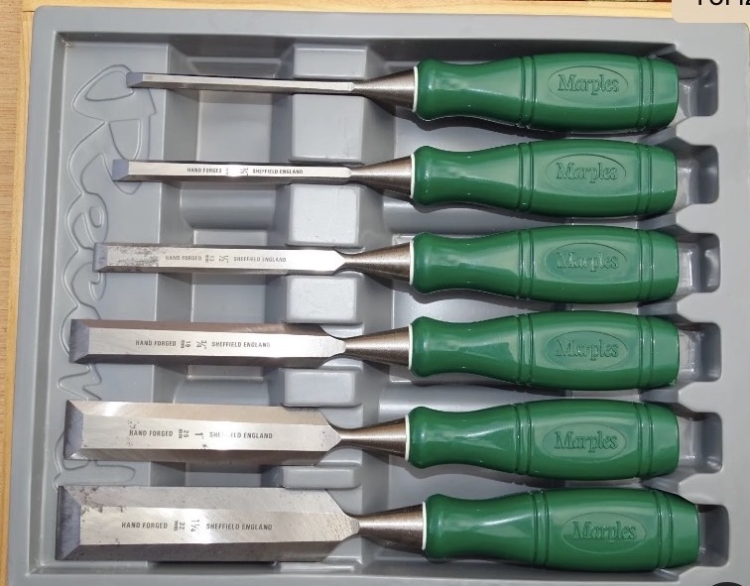
Below is set M555/S4:
The above B/E chisels were Item #555 and were introduced [along with the other Green handled chisels/gouges] in November 1991 and were madein sizes 1/4; 1/2; 3/4; 1; 1.1/4; and 1.1/2″. They were available individually and in sets of 4 or sets of 6 {M555/S6}. But in 1996 the set of 6 was changed to then include 1/4; 3/8; 1/2; 3/4; 1; and 1.1/4″. All the chisels were still available individually, including the 1.1/2″ size, but the 3/8″ size remained only available in the set. Today this may be the rarest of these chisels to locate. Therefore M555 was available November 1991 until 1998. I should be noted that up to Nov 1991 M555 had a blue handle and was called ‘Blue Ribbon’. See above info on Blue Ribbon.
In 1998 they are Item M555 with a Green handle, but M555 has a Black handle in 1999. The plain Firmer chisels #666 were only made in 1991 to 1994 as 1/4; 1/2; 3/4 and 1″
Outcannel Gouge #415 was available until 1998 but as M415 in 1999. It was made as 1/4; 3/8; 1/2; 5/8; 3/4; and 1″.
Incannel Gouge #435 was available until 1998 but as M435 in 1999, and in the same sizes as the Outcannel.
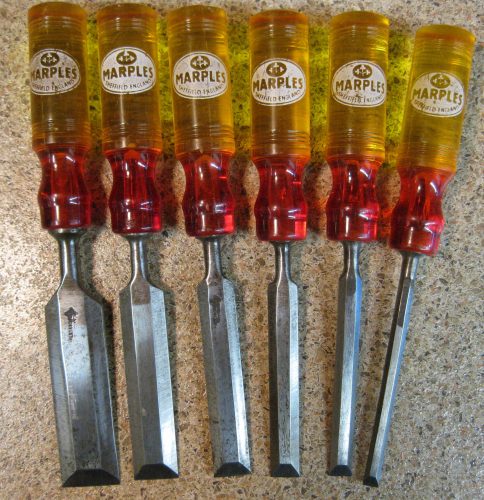
‘Splitproof’ Firmer [313] 1954-1998 or B/E Firmer [373] 1954-2006+
This is the famous Red/Yellow plastic [Cellulose acetate butyrate] handled chisel that we all love to own, except that all points noted above on the ‘Blue-Chip‘ apply here. Some of these offerings, that you may find on the internet, look like they have been rolled in a Cement mixer! I believe that Irwin manufactured the B/E chisels in Sheffield after their takeover of RECORD in 1998 until at least 2008, and these were marked on the blade ‘MADE IN SHEFFIELD ENGLAND‘, but soon after, the manufacture was exported away to cheaper manufacturing countries. Be aware that the Irwin Marples Chinese offerings may have but a light electro-etching of their name on the blade which can be easily rubbed out to make the chisel appear like a real MARPLES. [The handle is still simply marked MARPLES inside an Oval.]
Neither these or the Blue Chip chisels were intended to be ‘Fine Woodwork’ chisels. They are every day ‘user’ chisels intended for the Trades or home use because they have little ‘feel’ or balance. The 1965 Catalogue indicates [below] that there were 4 different sized handles for these Splitproof chisels [numbered on the handles 1-4], but for how long this may have been in operation is not presently known.
You also can see below that with every change of ‘Ownership’ the packaging also had to be changed. Most confusing! By 1982 the ‘tapered’ neck had also been introduced into this line.
THE BEST [above photo] ….had the earlier round neck. Below are images of a beautiful set of #313Firmer Chisels c.1968:
I have noted that the handle could have the following impressions in the plastic:
A) ‘Record Marples‘ on both sides and had Electro etchedSHEFFIELDENGLAND on the top of the blade, with a Tapered neck.
B) ‘MARPLES‘ on one side and the Oval Marples [‘WM. MARPLES & SONS‘ and SHEFFIELD. ENG with Trefoil’ ] on the reverse side showed a ‘Bahco RecordTools Ltd‘. [Tapered neck] or RECORD RIDGEWAY Tools Ltd. [round neck] C) ‘Marples‘ on both sides indicates a tool made by Record Hand Tools and Electro etchedHAND FORGED SHEFFIELD ENGLAND on the top of the blade with a Tapered neck.[bottom photo]
The page below (October 1979) shows the ‘tapered’ neck of the BlueChip chisels as well as the Round Neck of the Splitproof chisels.
So basically if you have a MARPLESSplitproof handled chisel in your possession with a Round Neck, you have an original MARPLES tool, no questions asked. These are the best of the Splitproof ever made. As the Catalogue picture [see below] shows, the Hefty Oval handle allows a large striking surface
And this is what a Late Canadian M373 issue looked like:
This following item is rarely seen. It is an M373 set by Irwin-Marples c.2003 [Made in England] that is in a plastic box and with an Oilstone!
Item # M373/S5+OS
Below is shown one of the last ‘MADE INSHEFFIELD ENGLAND ‘ M373 chisel sets. Made by IRWIN, it is housed in a garrish wooden box and the chisel tips are protected by open-toed black ribbed protectors.
IMPORTANT TO NOTE:
The #373 Splitproof handled chisel was available in the UK 1954-2008. This was a standard length B/E Firmer chisel. However in 1962 a ‘Continental‘ Style B/E almost paring chisel was introduced as Item #327 and I believe was renumbered around 1964/5 to Item #323. I had always thought that the ‘Continental’ style name was applied to chisels [such as #326] because of the pattern of Beech handle having a top steel thin hoop [see 1965 Catalogue picture]. Apparently this may not be so, as the Item #327 [later #323] was introduced and with an Oval “Splitproof” handle and still listed on page 10 of the 1965 Cat. as ‘Continental’. These longer chisels do not show up too often in the UK, as they were produced for ‘Export Only’ [WHY?] and may therefore be rare to find in UK , and I can find no listing in any of my catalogues of a ‘Splitproof’ handled Paring chisel.
[A recent study by a MARPLES Splitproof handle expert [Alan Niven] suggests that these chisels were wholly produced for the British Military.]
Some ‘MODERN’ Chisels… the ones that you will mostly find today.
After around 2008Irwin Marples moved chisel production to China and produced chisels that look nice only.
The set below with RED handles is named as M555R, [R for Red?] clearly made by RECORD MARPLES probably 1996/7 but only very briefly as it is said that only ever 500 sets of 6 were ever made and that many were returned to MARPLES for destruction. [WHY?]
The #555 number was used for so many chisel types in the 80s and 90s , but these ‘edge protectors’ shown here were phased out around 2002 in favour of unmarked Black plastic guards and then unmarked Black plastic guards with an open-toe on the top surface.
The set above is numbered M500 S6 and was made by Record Marples probably c.2002. Note the word ‘Record‘ in the flimsy plastic tray. [You will always find the tray cracked/split]. This set was boxed, as above and you can see that storage has produced a ‘bloom’ on the rubber handles.
They were also issued to the Tradesman as a ‘PROTOUCH‘ chisel having a polypropylene? scabbard to be attached to the belt:
Around 2006 the same chisels were issued with Steel Caps as Item#MS500 and were still marked as being made in Sheffield. The M500 chisel was short lived as it does not appear in the 2006IRWIN Marples catalogue, probably replaced by the Steel Capped variety.
This chisel [below] is marked Irwin-Marples and was produced outside of Sheffield around 2008<.Look at and learn the blade markings, they will never indicate ‘Made in Sheffield‘, because they were not.
The M500B [‘B‘ for Blue?] had Blue polypropylene handle inserts, whereas M500 chisels had Ivory polypropylene handle inserts] The ProTouch set shown [below] is marked MADE IN SHEFFIELD ENGLAND and came in widths up to 2″. Another set [MS500B] is essentially the same but with a Steel cap on the handle. They both had Impact-Resistant polypropylene core handles. The edge protectors indicate this set was made around 2004, as up to 2002 the protectors were of the fully enclosed variety as shown belowon the 2″ MS500B and dated ‘2002‘.
This photo [below] is to show you that from at least 2008 MARPLES chisels were made in CHINA. [“to MARPLES product specifications”]
The MS500B chisel which was ‘Made in Sheffield’ [if so marked] until c.2008 Also see immediately above.
‘Made in China to Marples product specifications’ indicated on the left above.
Below are extracts from the IRWIN Tools 2006 Catalogue indicating Madein England:
Above are examples of M750, Splitproof Pro Bevel Edge Chisels with SoftGripHandle. The name on the handles is ‘Marples‘ but the 2006 catalogue above shows the name as ‘IRWIN Marples‘, so these chisels may be c.2004
Below is a boxed set of Irwin Marples c.2010 MS750, a chisel that replaced the M750 because it had a steel cap.
Here below is where I will try to show as a variety of the unusual chisels that were offered by MARPLES over the years:
In the 1861/2 and 1873 Catalogues is listed [but not shown] a #115Cast SteelMillrights’ chisel available 1/4″- 3″wide. [Although it is not numbered in 1861.]
But in the 1897 Catalogue it is available as # 115 1/8″-2.1/2″ wide and is then named ‘Cast Steel Registered Chisel‘ with ‘two Bright Iron Ferrules‘. By the 1909 Catalogue the number has been changed to #600 and still showed the same sizes and each still having TWO steel ferrules, but the neck looks thicker. It is not shown or listed in the 1921 Catalogue, having being discontinued in favour of other similar chisels,or the WW1, but this chisel was the only one having a short thick neck and a square Bolster. [Most other chisels had either a round Bolster or an 8 sided hand-forged Bolster.]
This image below is from the 1897 Catalogue.
This same slightly different image [neck looks thicker] below is from the 1909 Catalogue.
The image below, is of a 2″ #115c.1890.
The chisel below is a #133 Cast Steel Socket Mortice chisel c. 1873
In 1986 MARPLES decided that they would draw enthusiasts back to the fold by introducing a throwback chisel. This was the #777 Rosewood handled B/E chisel. [ 1/8″-1.1/2″]
Note the truncated brass ferrules, MARPLES would thereby have saved at least 5p each ferrule over installing a real good old length one! They lasted until c. May1991.
Above is from the Record Marples Price List of 1st. March 1986.
The above images are of the M777/S5.
An M777/S6 set was introduced in 1988 with the 1.1/4″ chisel included.
MARPLES Chisel Points to consider:
I have observed that the older chisels c.1900 tended to have longer brass ferrules than were later used and were more accurately fitted to the wood handle such that they did not require a punched indentation in the brass to hold the ferrule in place.
The older chisels did not indicate ENGLAND only that they were made in SHEFFIELD. which was deemed, at that time, to be quite adequate. I believe that Legislation was introduced around 1900 that required that all tools manufactured or sold in the UK had to have the country of Origin impressed on the tool.
I have found that many later [after 1980?] boxwood handled chisels tend to have split ferrules and I can only surmise that this may have something do with over drying the boxwood, as the boxwood must have expanded with moisture after manufacture.
Just when the chisel neck was changed from a square profile to a round is hard to discern but I estimate that this might have been around 1952-4. The round neck was then changed to a tapered one around 1985. [but gradually phased in on different models].
The plastic edge guards may indicate whether the chisels are real Marples . The earlier guards were totally rectangular in section and were marked ‘Wm.Marples & Sons Sheffield‘ on one side. They came in many different colours: Light blue; Pink/grey; Salmon; Translucent; Red; Black; Creamy green; Sky blue; Translucent red + others. The later versions were sloped down to the cutting edge and marked ‘marples england‘ on one side and the sides were ribbed. These guards seem to be Blue until c.1993 and then Grey thereafter until c.2002. A Black plastic open toed variety was then used until at least c.2008, and when Irwin took over, a totally different [generic] guard was used.
The pictures below show the Chisel Edge Guards that were for sale around 1965:
Ferrules were gradually cheapened by making them shorter and then not even from brass..see below ….these #222 Carver Ash handled B/E Firmers were made 1986-1994. They all have the same size handles for the many different widths, shortened non-brass [light brass coloured steel] ferrules and no makers mark inscribed on the blade.
This Rare Blue Chip Set [above], with included Mallet, probably dates around 2004 but I do not understand the quote ‘Since 1898‘!!
And then we arrive in the bottom basement section where anything goes to sell a tool. This must surely be the lowest level to which a MARPLES name was attached in order to sell a tool. ‘For the Professional Woodworker’, are you kidding me!!?? But then again the owner of the company, at this time, was ‘American Tool Co.’ so what can you expect?
Manufacturing for Tool Merchants?
Below is the first instance that I have found whereby it is obvious that MARPLES did indeed manufacture tools for specific Tool Merchants and placed the Merchant’s name on the tool at the factory. In this case the Common Octagon Boxwood handled B/E chisel was made for Louis Henry TURTLE of Croydon and has the MARPLEStrefoil impressed alongside Turtle‘s name. [TURTLE was a Saw maker, Cutler and Tool Merchant [info from Simon Barley] This chisel would be from around the year 1900.
X4 Plane
The X4 plane makes its’ first appearance around mid 1954 in an article [below] about its’ designer and the development of the plane. It was in production until 1965, when low sales volume dictated its’ demise.
I am unsure as to why MARPLES would have introduced this plane, but it was possibly designed to capture some of the market of the infill planes, (which had such a good name with craftsmen, but were very expensive) because it had everything that an infill plane had: weight; total adjustment; feel and a solid construction made to last generations.
You would appreciate this last statement if you had ever had an X4 in your hands and had studied its’ construction closely. It is for the following reasons that today it commands a premium price. Unfortunately many of these planes have fallen into the wrong hands and have been treated badly due to either plain ignorance of its’ qualities or just simply not caring for the tool. Or then again, maybe just ‘plane’ ignorance! [Sorry about that, I could not resist it.]
Surprisingly, in a 1962 pamphlet, MARPLES shows the X4 and states “It is not recommended for the ‘do-it-yourselfer’,” I surmise that truthful advertising was then still the norm!
It was a heavy and solid plane, just what a number 4 type plane needs. The combined frog and rear closed handle were anchored well to the base. Mouth adjustment was changed by loosening 2 bolts on the top of the plane base just forward of the mouth that held an adjustable mouth plate, and then securing them into the desired mouth width. The base casting was very ‘substantial’ and provides the iron with a 9/16″ support for a chatter less experience. It had a Lever cap which gave the user a good grip when the plane had to be used on a shooting board. The front Knob was quite large and gave a better grip on the plane than smaller normal sized knobs. The wood used was good British Beech coated with a semi-gloss black enamel paint and the base was coated in a ‘black stoving enamel’. All metal fittings were were either Nickel (early) or Chrome (later) plated.
PLEASE NOTE: The sideways adjusting lever originally fitted only had a circular curvature to the top where it was to be finger/thumb adjusted. Later examples had a rounded Red plastic insert pushed into each side of that curvature to make the adjustment less painful. You will find many examples where one or both of these inserts are missing. Re-productions may be made, with a little skill, from those thick red plastic coat-hangers that can be found anywhere today.
Note also that the cap-iron always had a rounded top edge and this is also echoed in the design of the blade. Any other configuration is not original.
Below is the page from the 1959 Catalogue that announces the X4 as being a new plane, but this was only a relative statement [ note: no red inserts are shown in the lateral lever]
Prices for this plane are as follows:
October 1960 65/-
Early 1961 63/- [ I do not know why!]
September 1961- October 1964 90/-
Some photos are shown below.
Below you will find a rare article reprinted from DESIGN August 1954 in which the X4 plane, the designer and the design progress to final copy are discussed.
Above here is a good photo to show the 2 plastic RED inserts [One from each side] that were added for comfort to the lateral lever later on with this plane. At least one is usually found missing as they had but a friction fitting inside the lateral lever top curl.
The front knob is unusually large, but very comfortable in controlling this plane.
Here [above] you can see the TWO slotted flat head bolts that have to be loosened in order to adjust the mouth width plate [Immediate above]
A good photo to show the Nickel plated depth Adjusting Wheel and the angle at which it was placed.
Above you will find 2 box end labels. The top one is what I believe is the First type and then followed below by the Second type which was after the Plane had its’ Registered Design issued in 1955.
The Cutter supplied to the X4 was always the same, as was the cap iron. Any plane that you see, will not be ‘original’ without these specifications as shown below.
You can note here [above right] that the Blade is chamfered on the edges on the same side as the cutting edge. This is the only correct blade for this plane as is the Oval top edge to the un-marked Cap Iron.
M50 Plane Study
The M50 ‘Improved Combination Plane ‘ was only available from March1936 until March 1940 [or soon thereafter] according to the catalogues in my possession. The only description given in those catalogues is that the plane was ‘Rustless Plated and was supplied with 17 cutters. The first listing in March 1936 does not even give a picture of the plane and only in the September 1936 catalogue are we actually shown a picture of the plane (shown below)
The only hard-backed catalogue that the M50 appeared in was the 1938 catalogue, and there we are given a little more information…as seen below. Here you will see that the plane main castings are of STEEL and that it is described as ‘practically unbreakable’. Unfortunately I do not have, and therefore cannot show you, the ‘instruction card’ for setting up the plane.
Throughout all the catalogues listing this plane the price is shown as 30/- [30 shillings] and always as ‘Rustless Plated‘. At this time of War most tools were plated with a Cadmium based metal product that had a rather dull grey finish. But my example of this plane indicates that the rear of the handle and the top of the handle down to the leading edge were polished. This plane was available for such a short period of time but there appears to be 2 Types. Type 1 has the raised casting of MARPLES on the front left of the main body, as per illustration. But sometime before discontinuation the addition of M50 raised casting before MARPLES is seen:
Given the advantages of this plane over its’ lesser brother, the M44, it is surprising that this plane was dropped from production whereas the M44 endured until 1970.
So what follows is a description of the plane according to the different parts:
Body: The Steel body is 8.3/4″ long and shows that the blade was depth adjustable by a screw feed mechanism that engaged slots in the sides of the cutters. [see picture above].
Sliding section: this effectively holds the cutter and has the depth control screw feed mechanism that engages the slot on the side of the cutters. There is a ‘fixing screw’ at the back of the section to stabilise this part.[see above right and below.] The whole section slides on the 2 rods and is secured to the body by an attached threaded rod and tightened on the RHS of the body by a nickel plated brass wingnut.
Blades: 16 of the cutters came housed in 2 cardboard sleeves that had full covers and the Tongueing Cutter came in a brown envelope along with the Shaving deflector. The 1/8″and 3/16″ grooving cutters were held in place by a special holding screw [supplied in a brown paper envelope.]. All the cutters have no markings.
Depth of cut Fence: Was secured on the RHS of the body by a nickel-plated brass thumbturn bolt. This fence appears to be exactly the same as was furnished with the M40, MA43 and the M44. Approx. 2.1/2″long and 1/2″wide.
Long fence: Adjustable along the 2 Rods, this 7.1/2″ long fence [above] does not have a hand hold as is provided on the M44.
Match beading stop: supplied in a separate brown envelope.
Rods: only 1 set of 2 long rods was provided on the M50 (cf. long and short rods of the M44) and these rods are screwed into the body and tightened via the hole at the outer end of the rod (see above (using a suitably sized bar ). This is a much more secure method of assembly than is shown on the M44, where the rods are only held in holes of the body casting and clamped there by a flat head slot bolt.
The rods are 6.3/4″long and have a 3/8″diameter.
Thumbturn screws: All these screws on the M50 appear to be nickel plated and polished and have plain faces with no longer a central ‘diamond shape’ pattern.
Box and Labels: The box lid is 7.7/8″wide; 4.1/2″deep and 9.1/4″long.


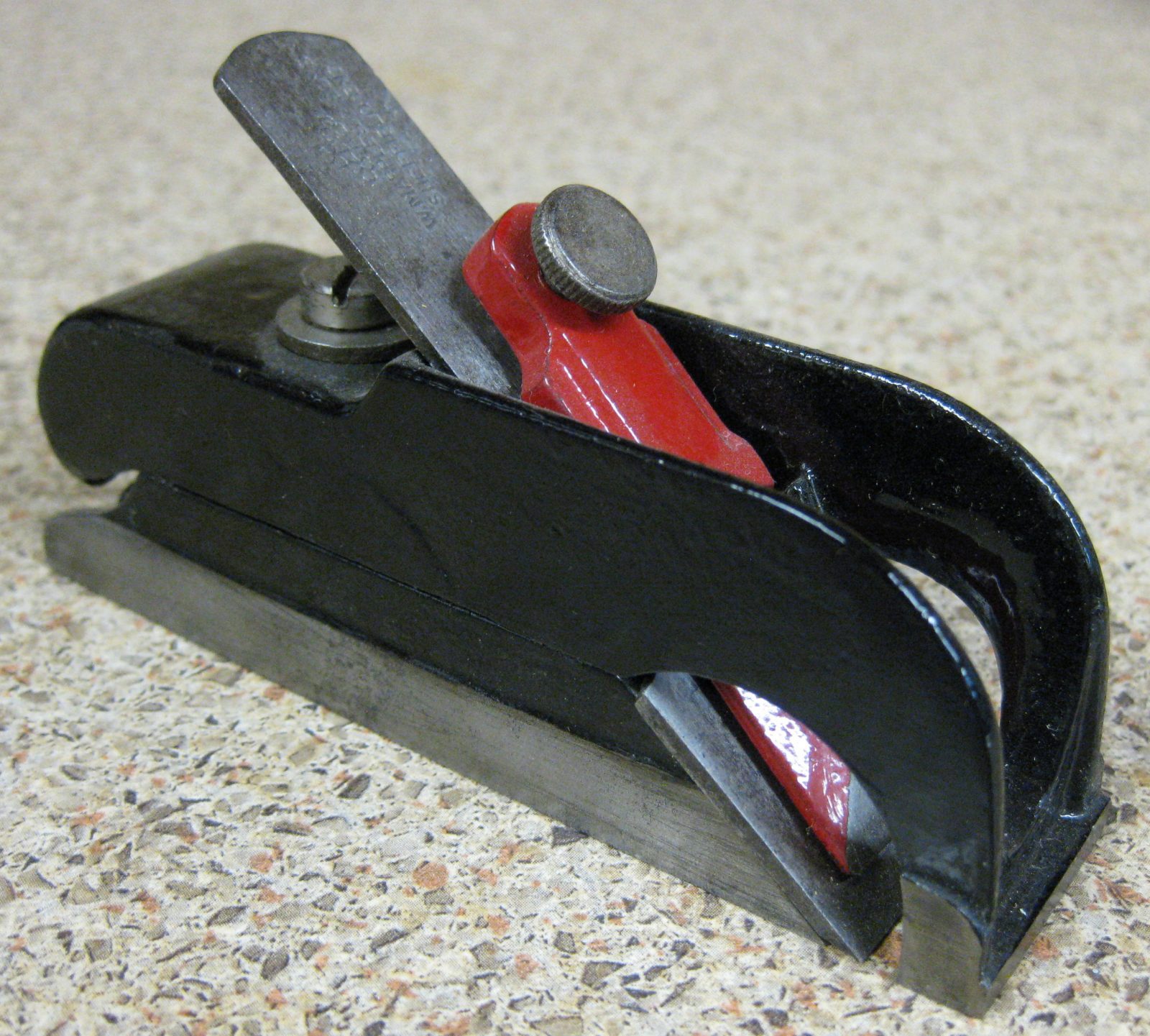


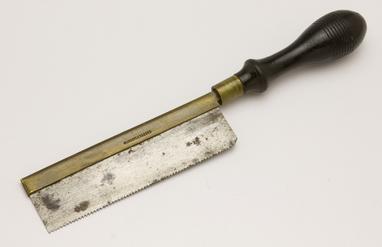


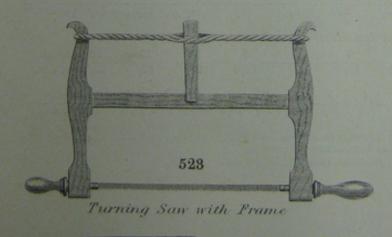
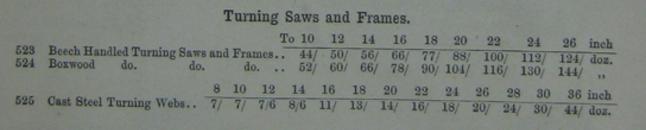
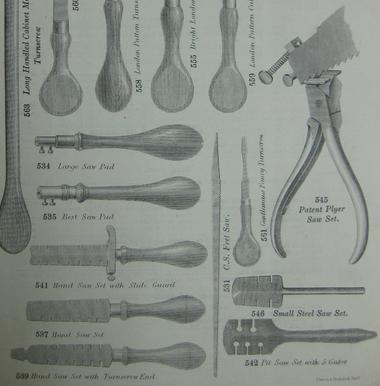
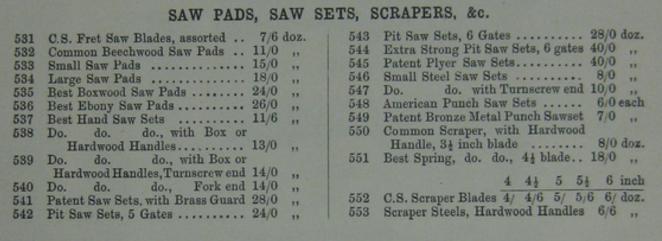

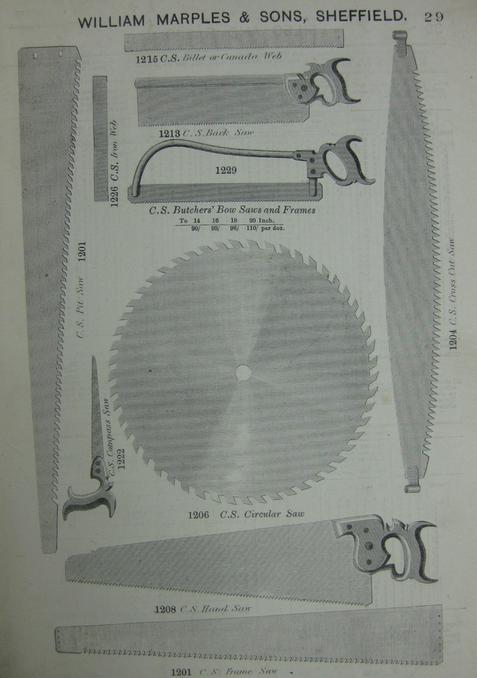

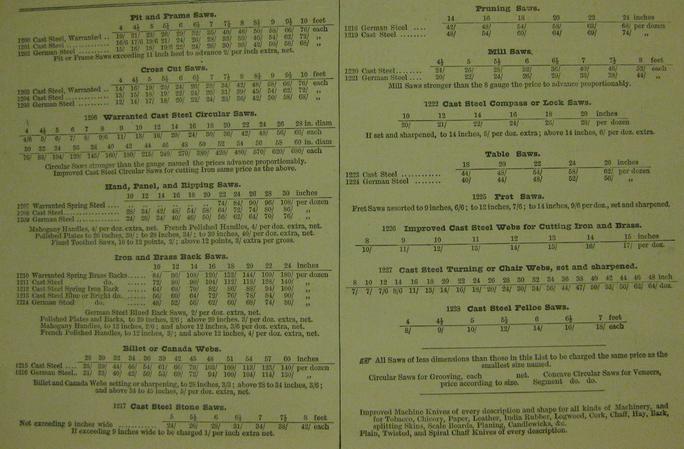
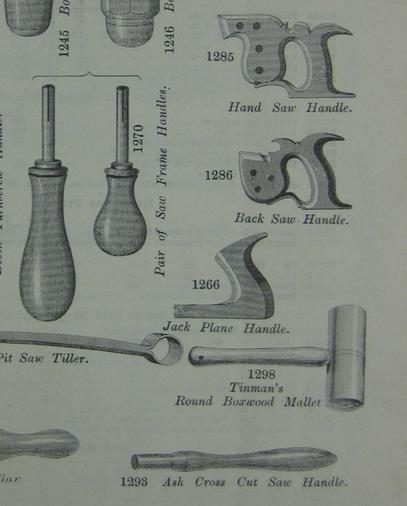
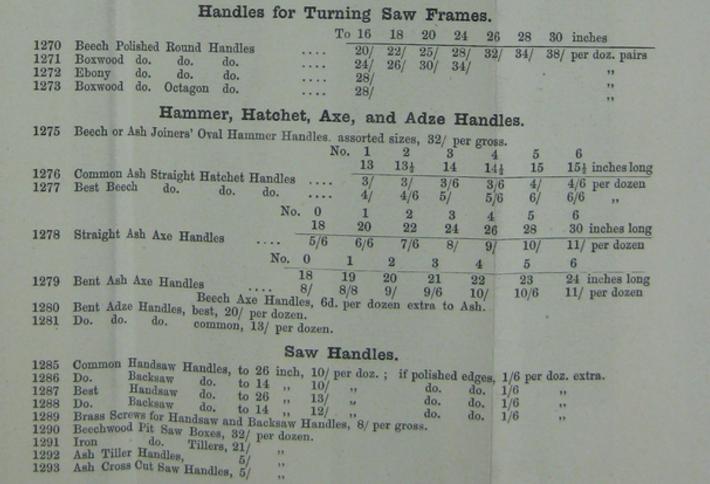

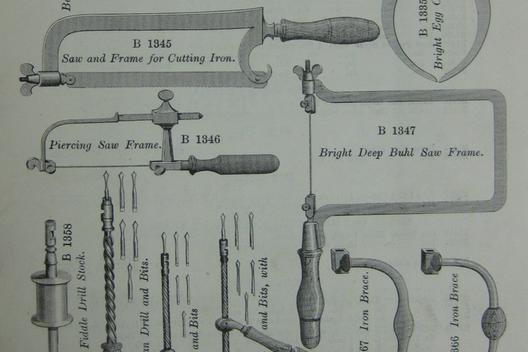


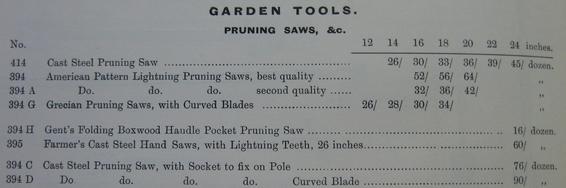
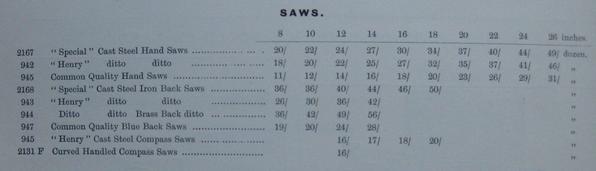

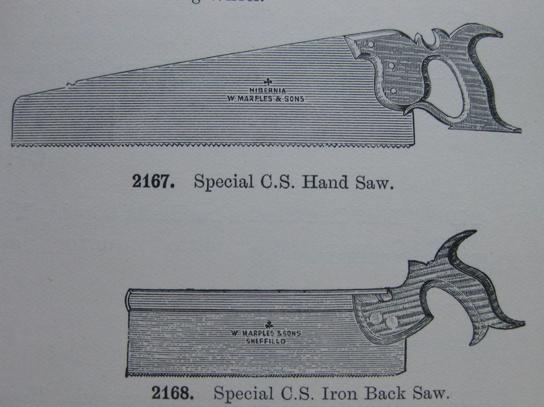

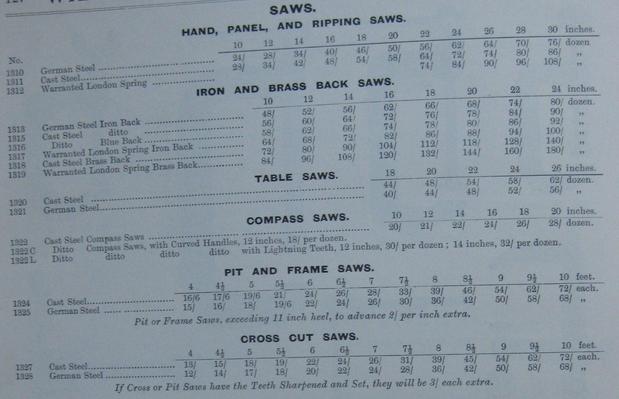
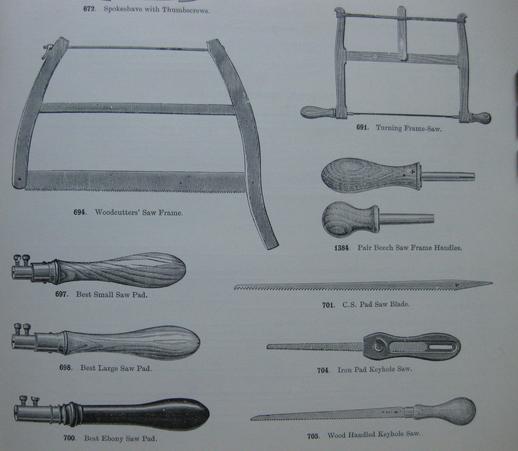


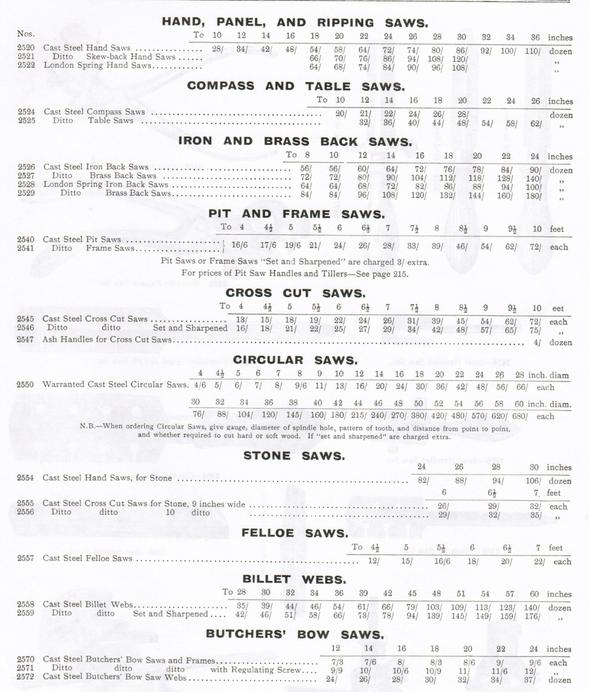

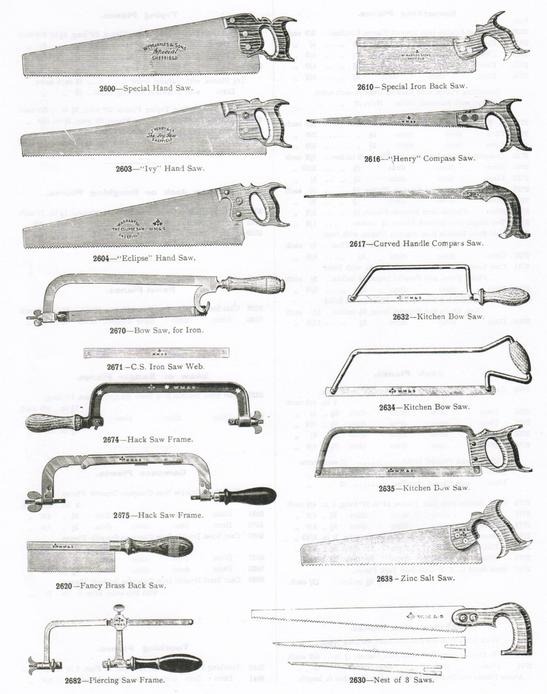



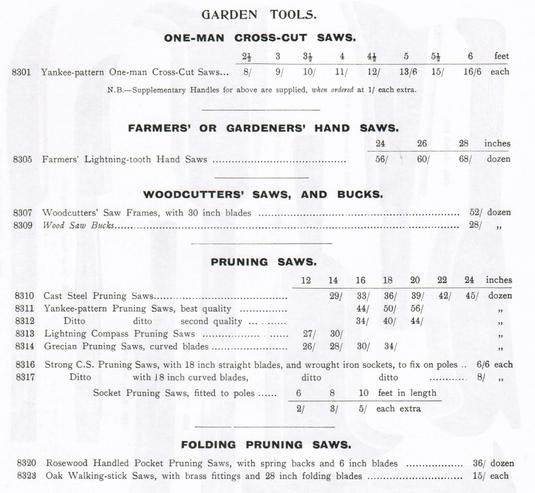


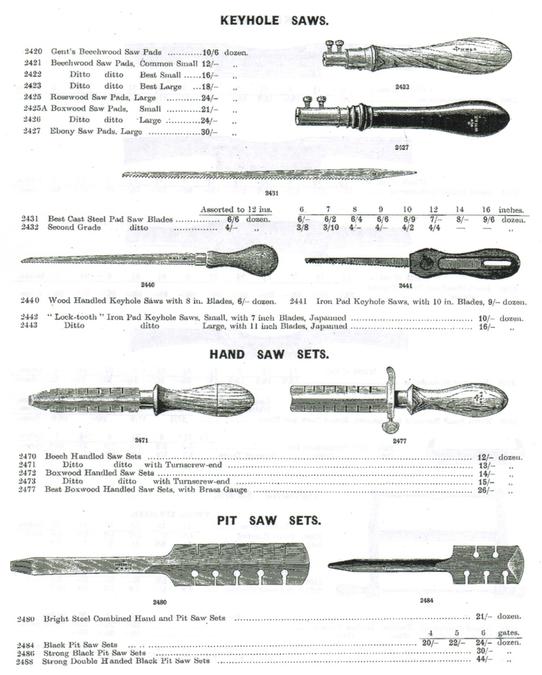
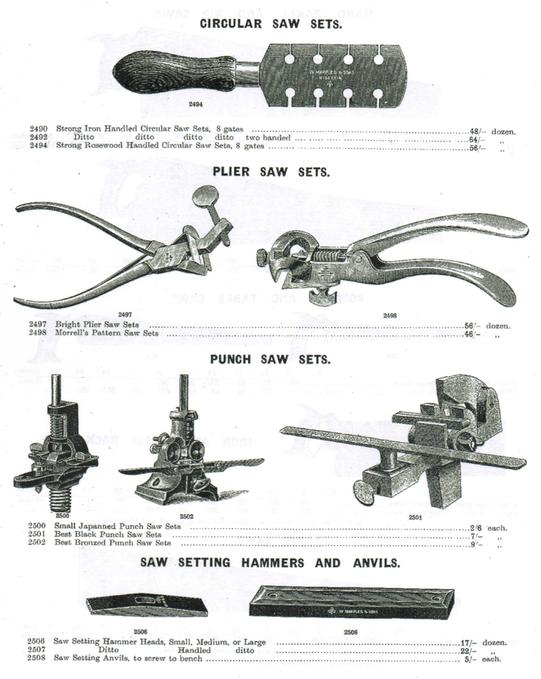


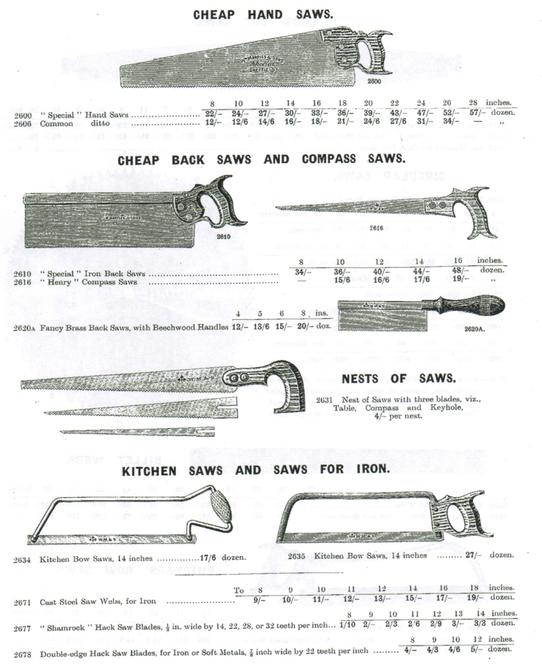
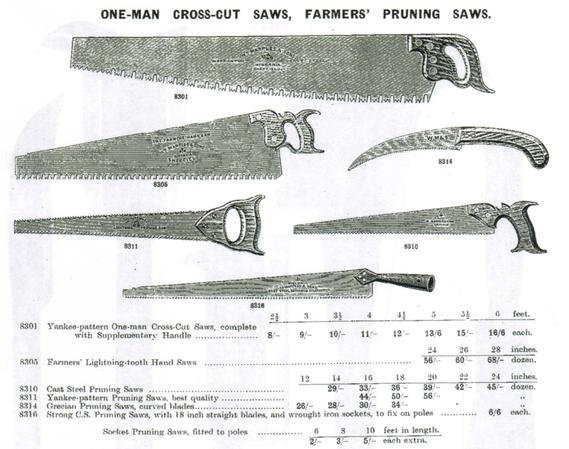


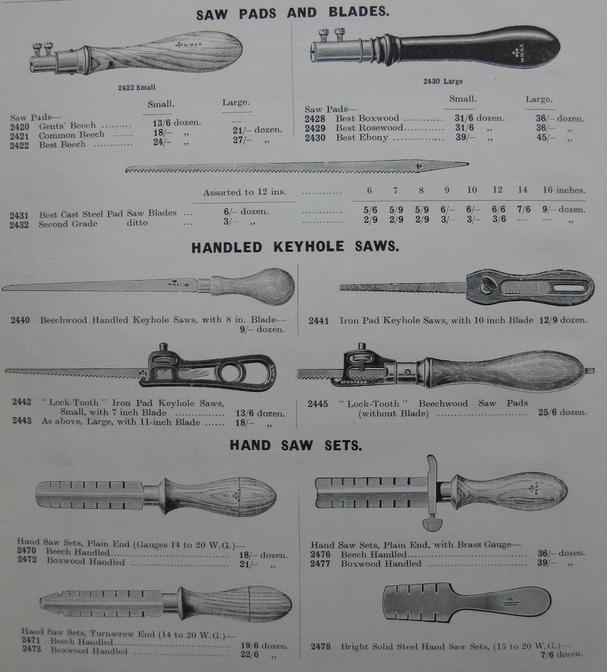

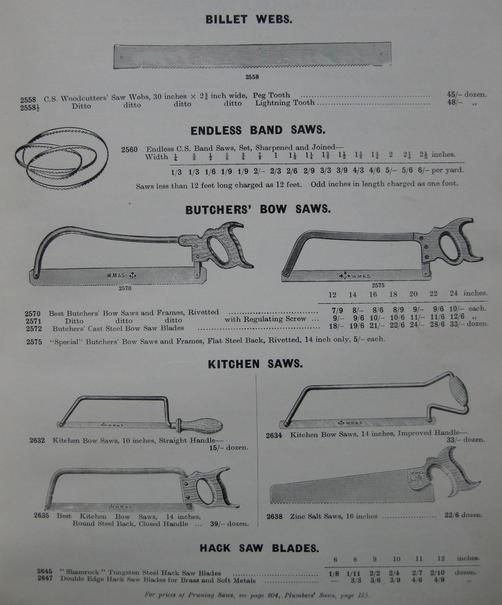
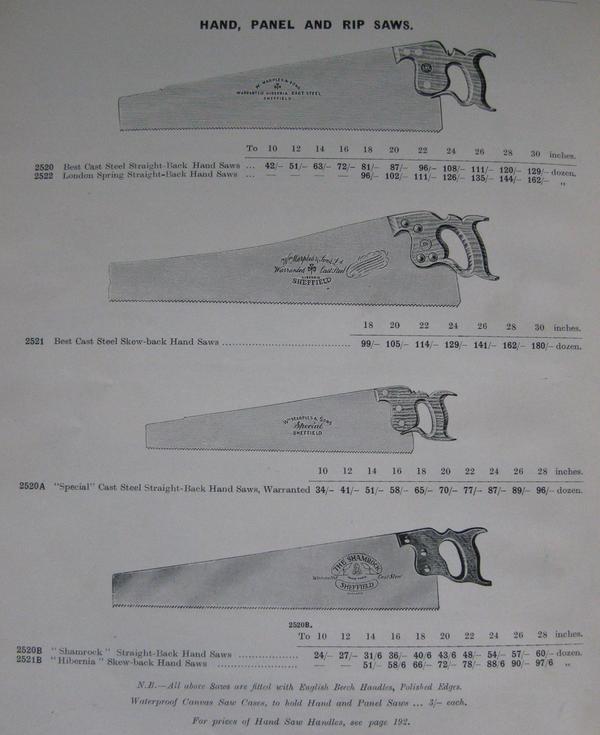


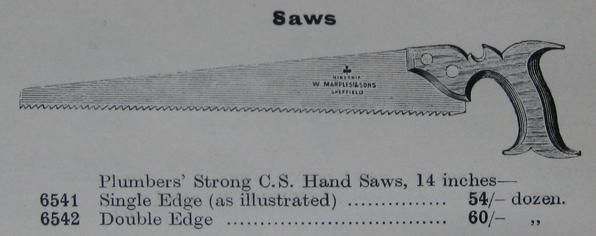

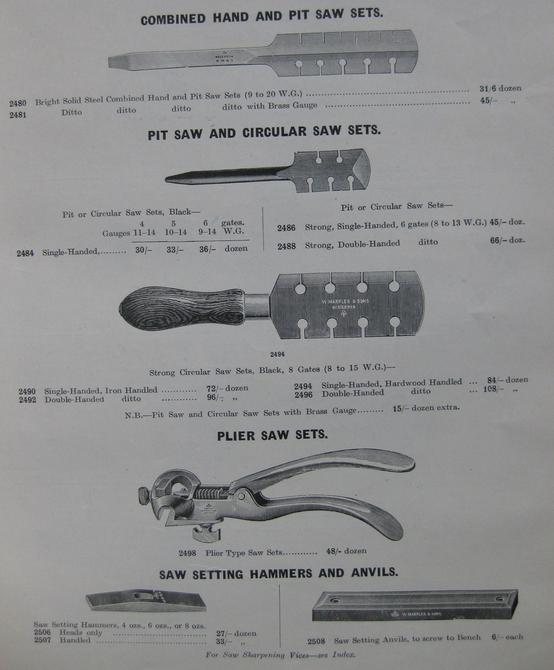

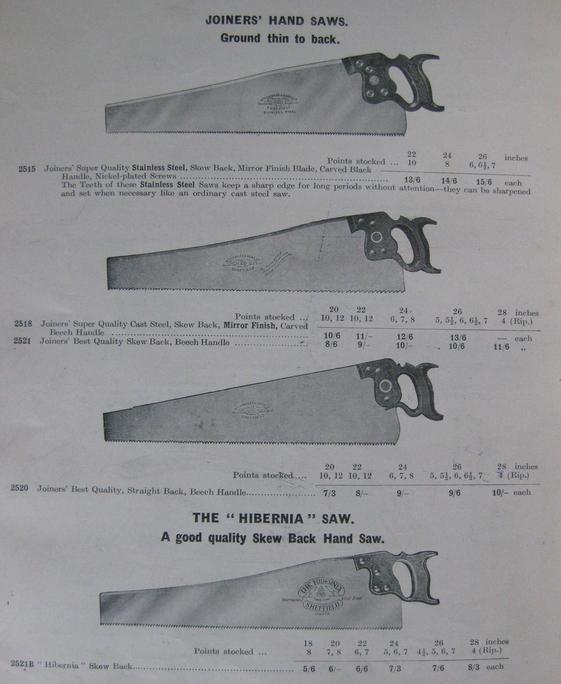


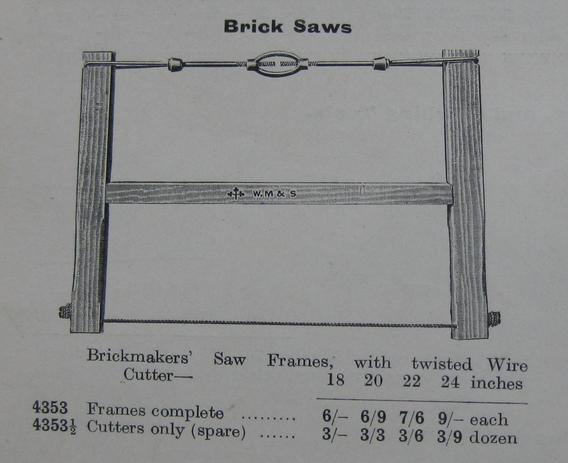


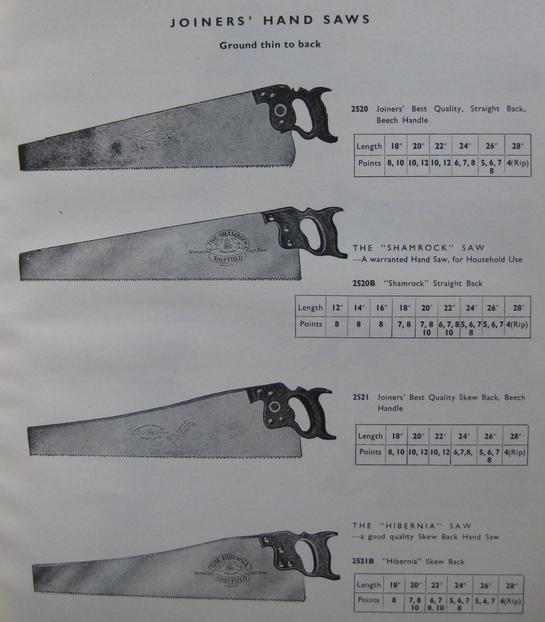
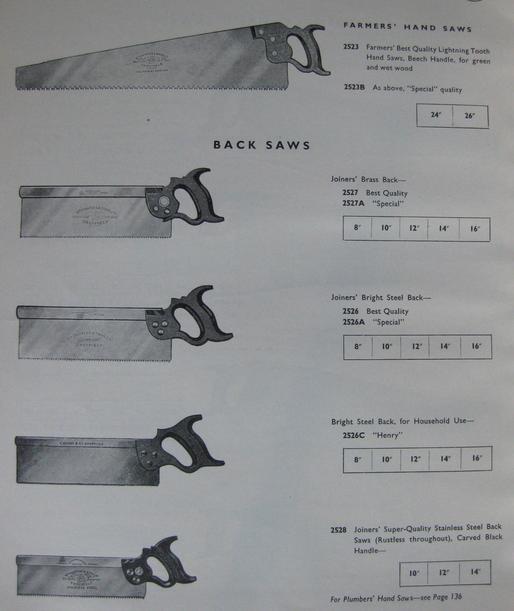


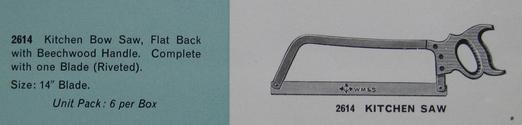
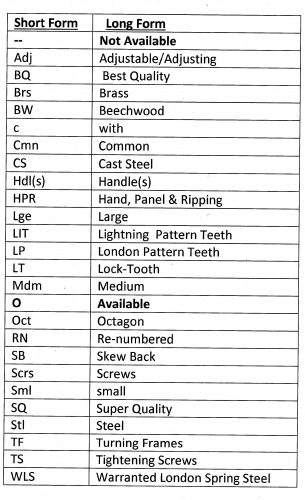
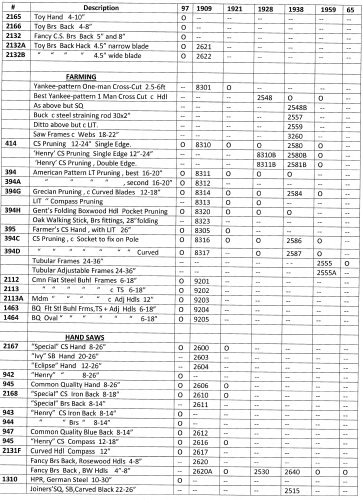

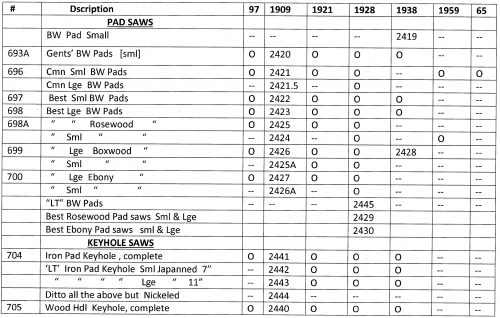
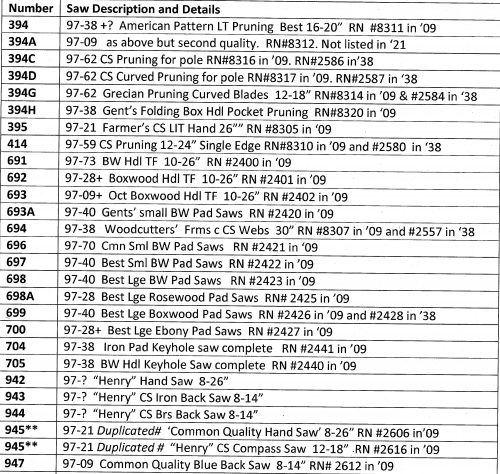
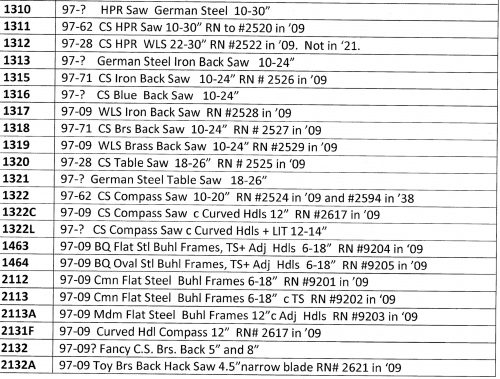
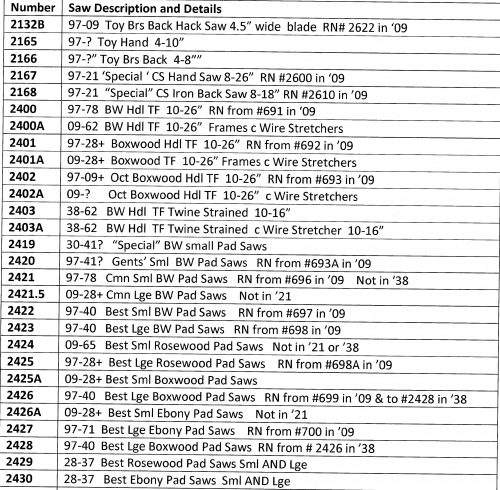
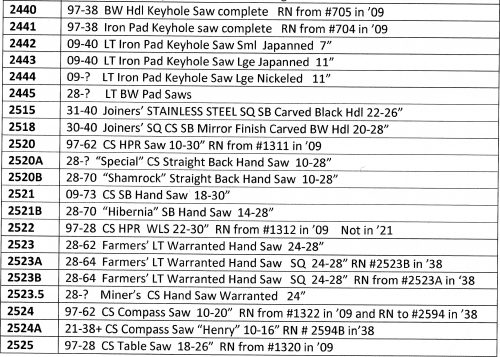


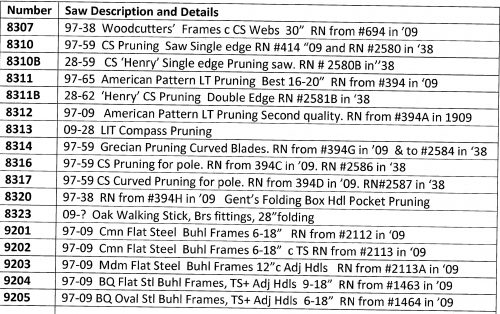
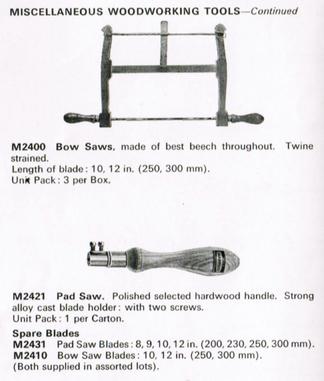

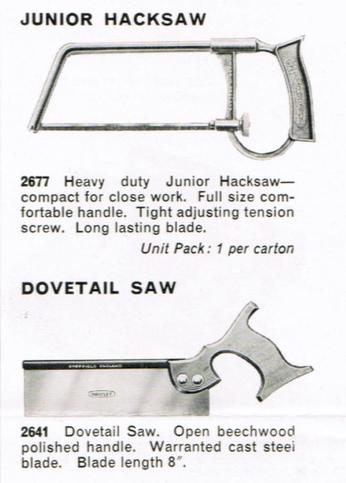

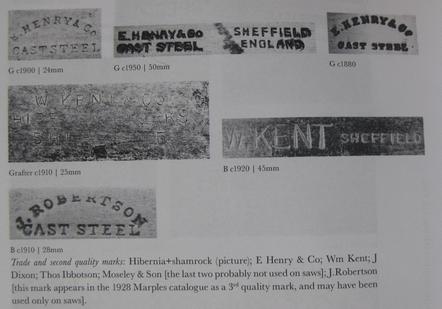
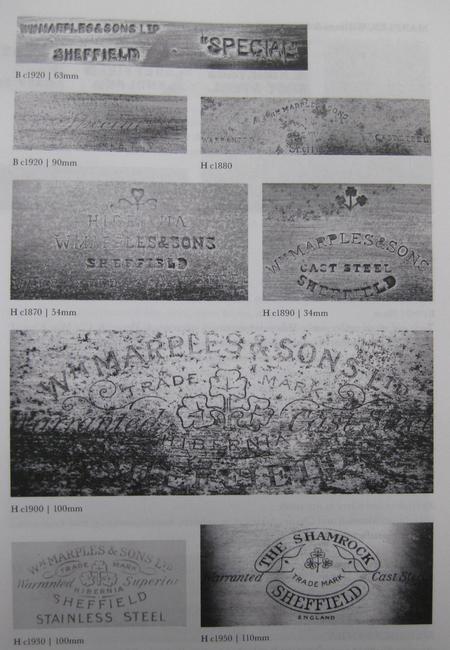
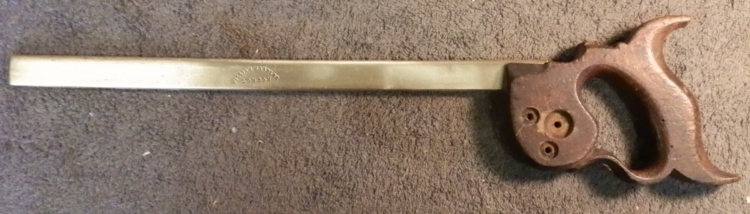


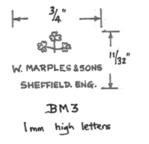


 Above as shown in 1928 and 1938 catalogues.