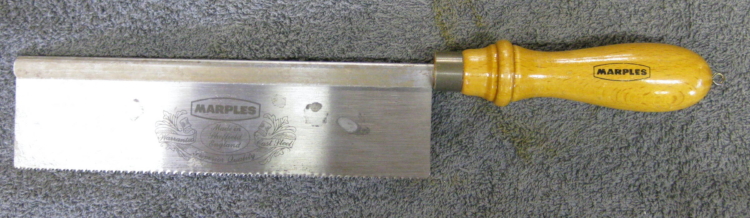
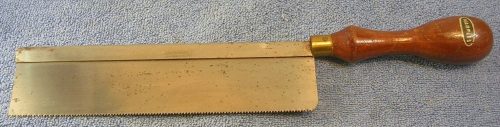
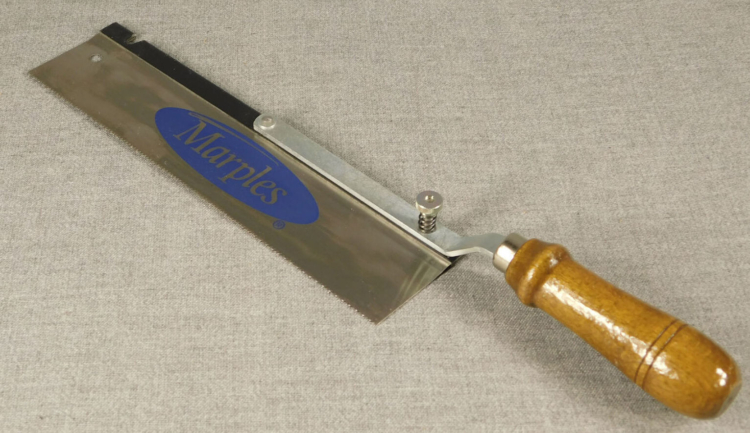
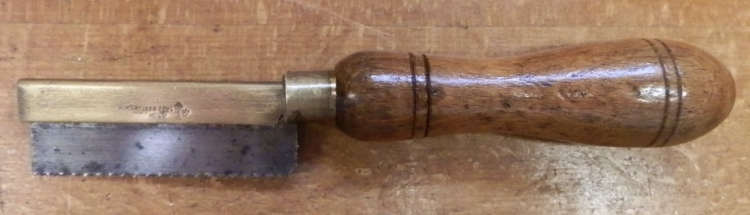
The premier site for William Marples & Sons Tools.
Author: Roger Ball
Mortice Chisels
MORTICE CHISELS:
I really should address this important section to deal with the chisels that shaped our country, and many more, namely the much abused Mortise Chisel. This style of chisel is rarely used today, outside teaching schools, having been supplanted by Drill press style Morticing Machines or other wood joints that rely on modern adhesives. So I will expand this section based upon history. Even in 1861 the following MortiCe Chisels were listed in the MARPLES catalogue: Common Mortice Chisels. 1/8″ – 1″ Best Joiners’ and Cabinet Mortice Chisels. 1/8″ – 1″ Cast Steel ditto ditto 1/8″ – 1″ Improved Sash Mortice Chisels, all steel. 3/8″ – 5/8″ Socket ditto ditto ditto 1/4″ – 1″ Cast Steel Socket ditto ditto 1/8″ – 1″ Lock ditto ditto 1/2″ – 5/8″ Improved Lock ditto Tang or Socket. 1/2″ – 5/8″
By 1897 the following entries are made in that catalogue, and the name has been changed to MortiSe:
Below you will find a table that shows the Mortise chisels that were produced from 1909 onwards arranged according to item number. You will see that sometime between 1909 and by the 1928 Catalogue many styles were discontinued, leaving a bare minimum to soldier on. The backbones of these survivors were certainly #601, #706, #736, #737 Immediately below is the 1909 page showing the handled blades.
The #730 Sash Mortice blade [Beech handled #731 or Boxwood handled #732 from the 1909 Catalogue.]
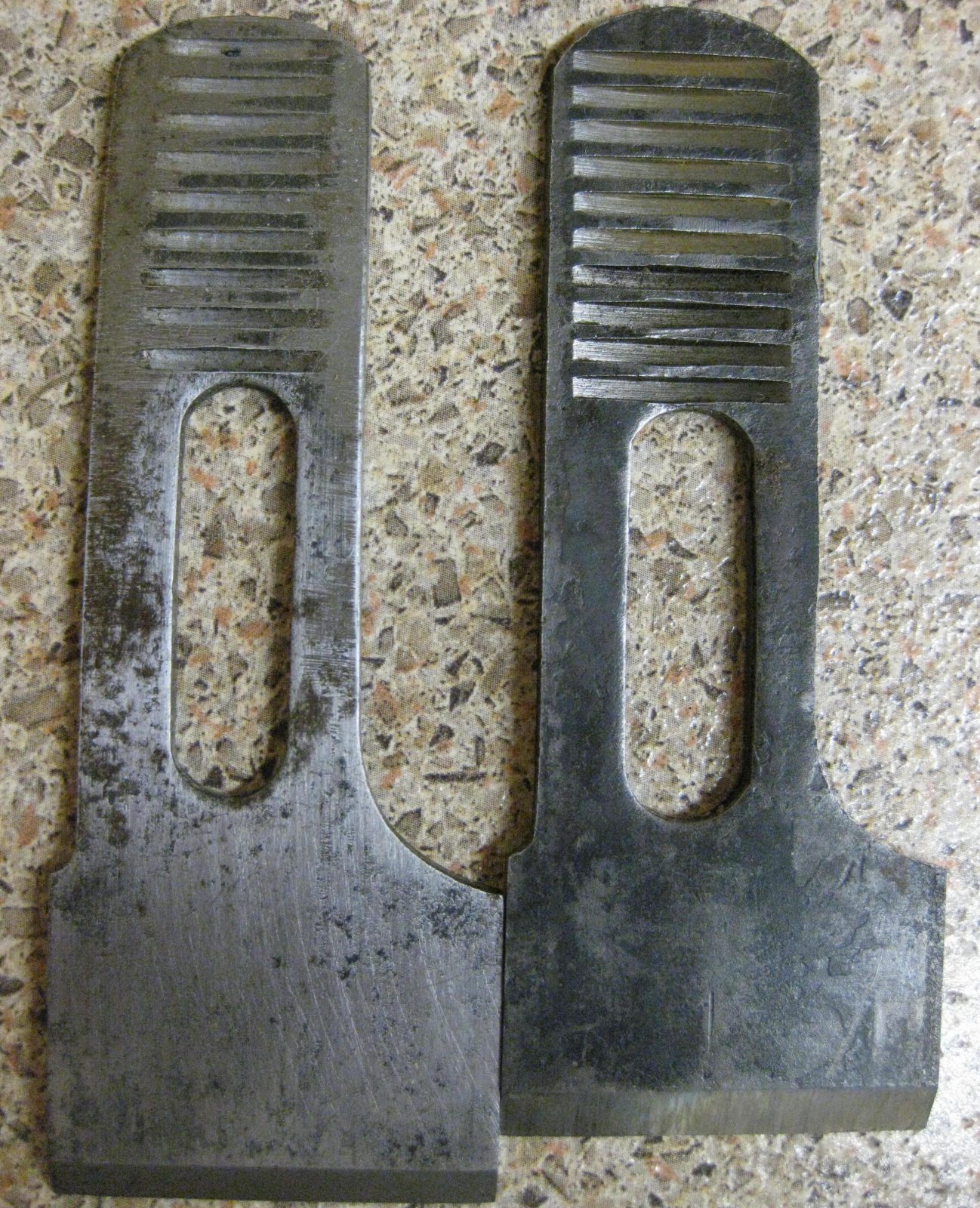
Note the differences in the necks of #730 Sash Mortise Chisel [#731/#732 handled] and the London-Pattern Sash Mortise Chisel [#736/#737 handled]. The older style of Sash Mortice Chisel was phased out after 1909 and before 1921 in favour of the London Pattern Sash Mortice Chisel. Below is the real survivor, the Iron Hooped Registered Round Neck Mortise Chisel #601 here with a c.1980s example.
Below you will see a great example of the #706 ‘Best Mortise Chisel,Oval BeechHandled‘.
Throughout this treatise please note the variation in spelling: ‘Mortise’ and ‘Mortice’. Which do you think is ‘correct’?
Above is a fine example of a #737 London Pattern Sash Mortise Chisel.
Above is a set of recent #773 Splitproof Sash Mortice Chisels, spelt with a C again!! Note here that the handles are rotated 90 degrees for ease of Morticing[Mortising?], differentiating these from Regular Firmer Chisels, where the names on the handle are in line with the top/bottom chisel surfaces. Just a small point that is missed by many. Available 1986-2000 and maybe a couple of years beyond.
The one below is going to need some investigation, because it is a wooden handled Sash Mortice Chisel with a steel ring supporting the striking end of the handle, BUT it is numbered M773! As far as I can tell this chisel may have been introduced around 1982 and was switched to a Splitproof handle in 1986, as shown above.
But to add to this mystery is the following chisel. Same handle construction and packaging, but this one is labelled as M603Mortice Chisel. On the back of the packaging is indicated that it was made in Holland! [ And also that it was made in UK.] If only a date had been stamped! So it looks as though M603 and M773 are identical but perhaps the numbers were changed at a specific date?
Both of the above ‘Made in Holland’ chisels have a solid steel striking cap.
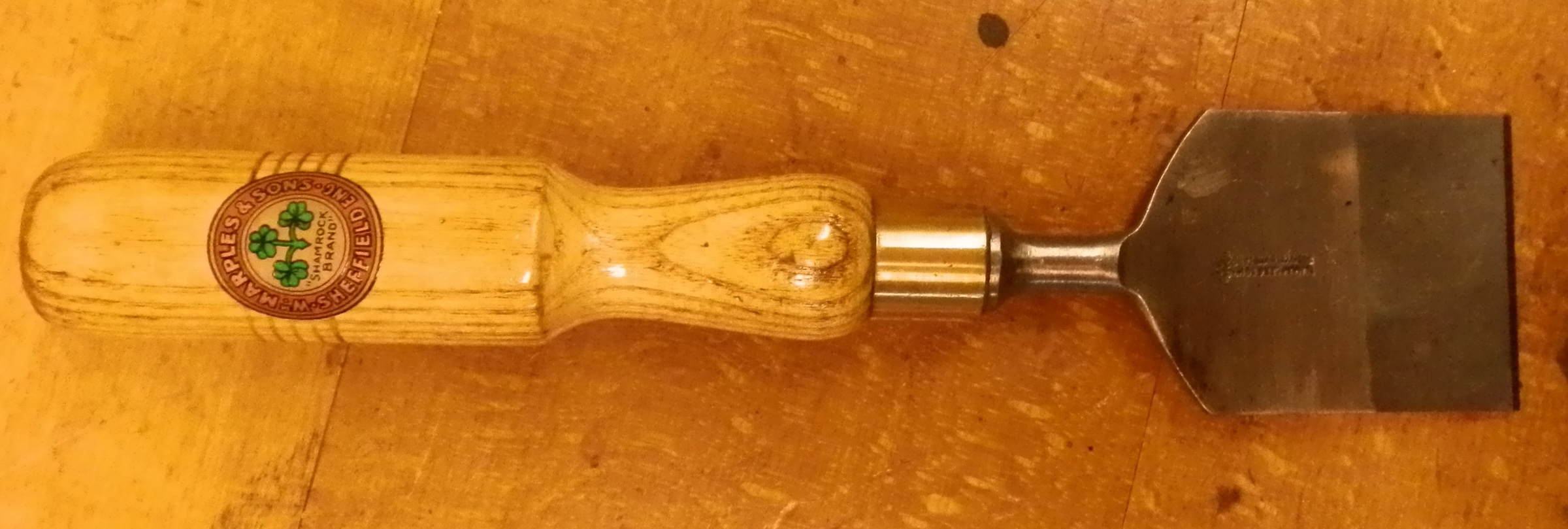
Below is an example of C.S. Registered Chisel, Handled, as listed in the 1897 Catalogue #115 and the 1909 Catalogue as #600. This example seems to be missing the leather washer that should be between the bolster and the steel ferrule. Discontinued before 1921.
Note the Square neck.
The following photos are of Item#600 showing a complete set of those tools and with the leather washers. These seem to be the for-runners of the Registered Mortice chisel, with which we are more familiar today.
Note the very thick steel top ferrule.
Sash Pocket Chisels
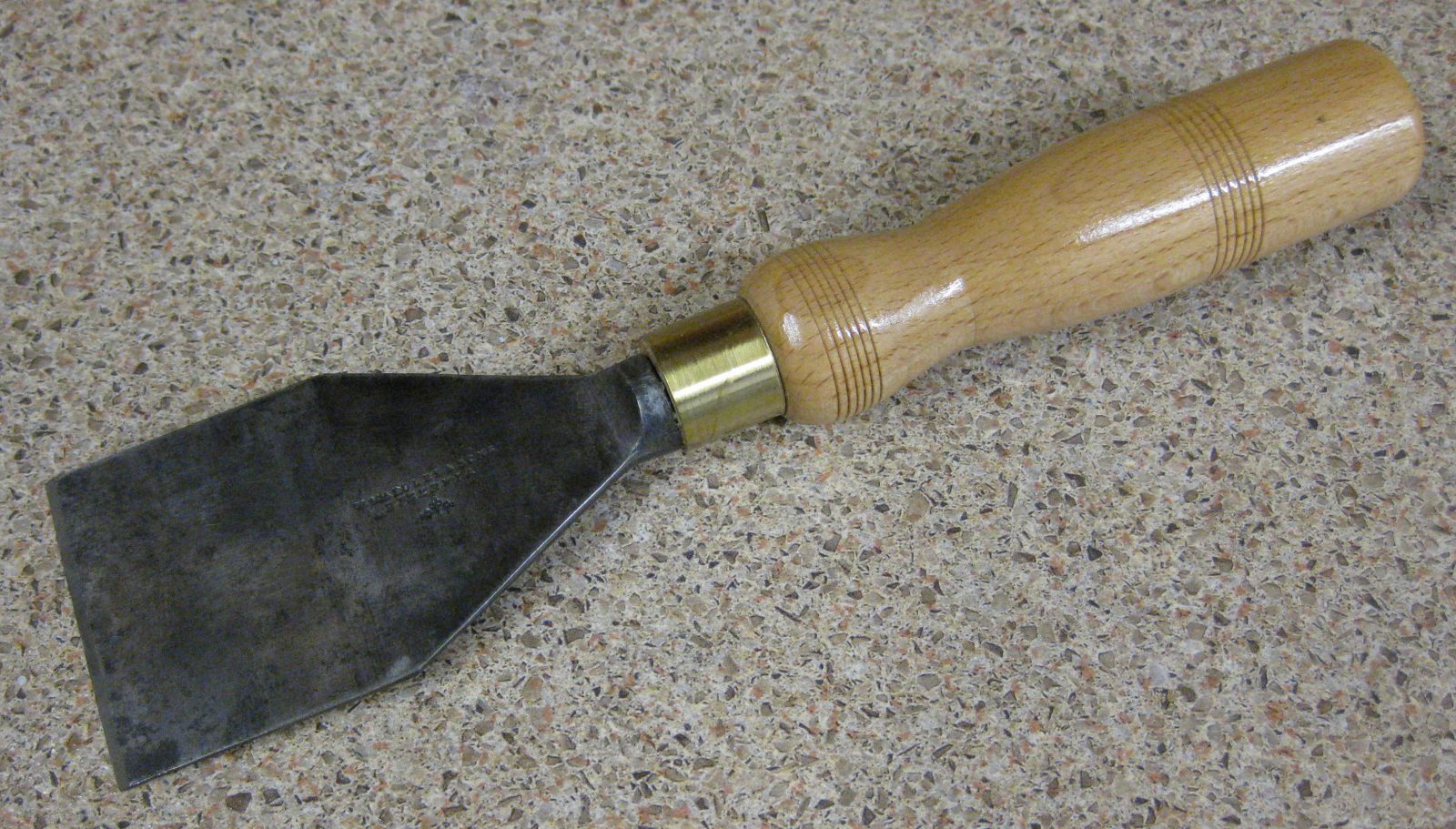
A great Sash Pocket Chisel
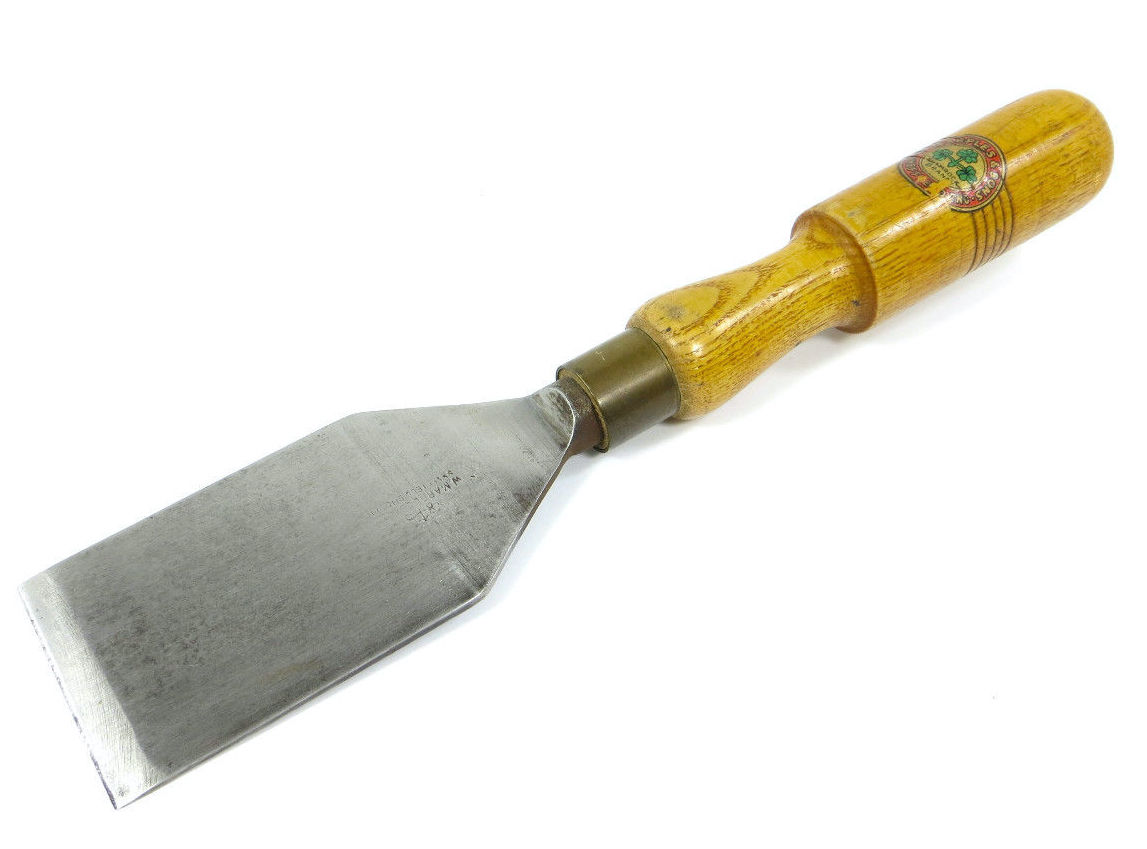
These are specialised chisels designed to cut the ‘pocket piece’ in the side of the frame of a Sash sliding window. The pocket piece is a removeable wooden ‘window’ to enable access into the space at each side of sash windows in which run the sash cords to raise/lower the window. These cords, over time, wear out and need to be replaced. Without this ‘pocket’ to access the cord and ‘weights’, that would not be possible.
Do not confuse these with Sash Mortice Chisels, which have nothing to do with Sash windows but are themselves merely lighter duty Mortice Chisels.
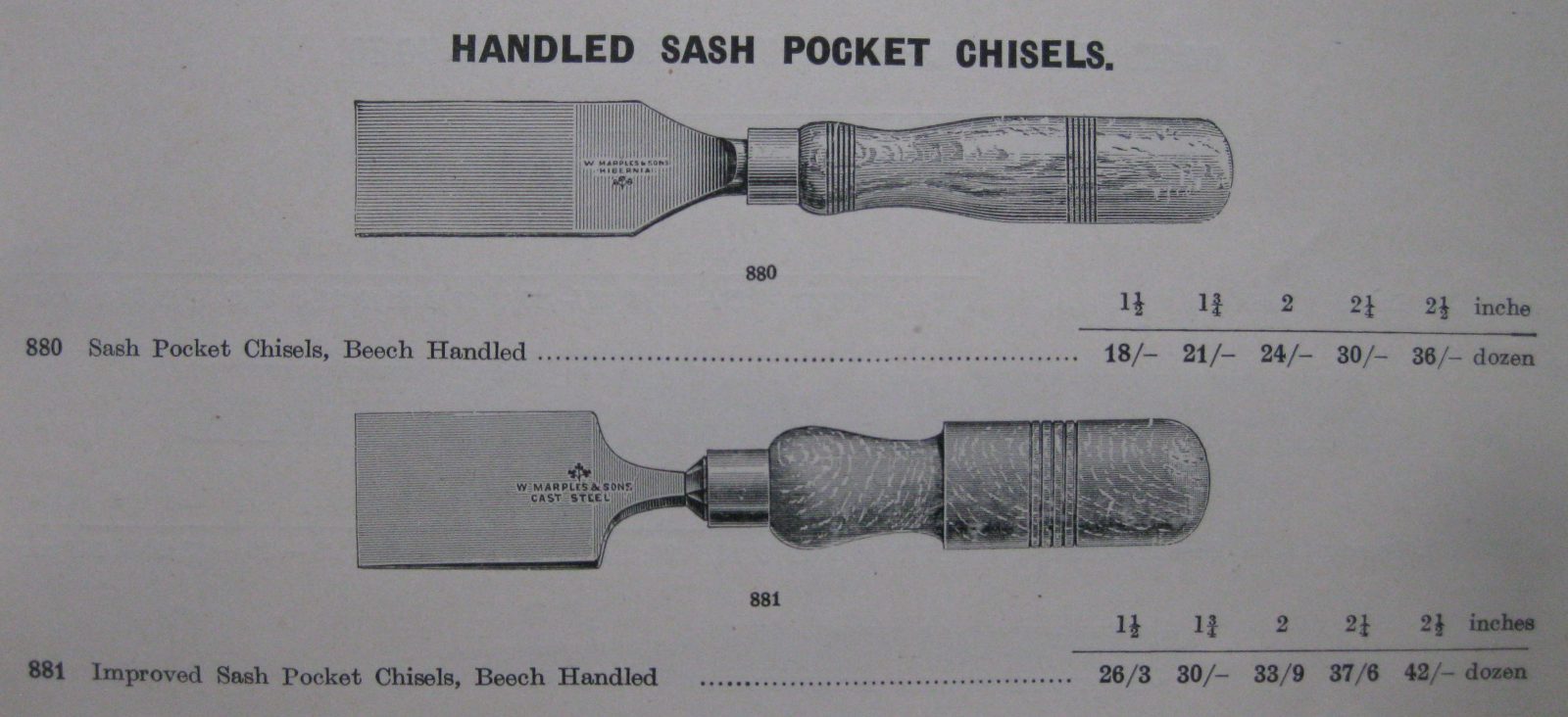
As shown in the 1938 Catalogue.
The first reference that I can find to the availability of Sash Chisels is in the 1897 Catalogue, but they may have been available before then. They seem always to have been offered for sale ‘Handled’. In 1897 the variety of wood handle is not stated, but would probably have been Beech. Listed there is Item# 1980 Sash Pocket Chisel [SPC] in widths of 1.1/2-2.1/2″. Item#1980A is the Improved Sash Pocket Chisel [ISPC] in the same widths.
The 1909 Catalogue shows an item# change; SPC becomes #880 and ISPC becomes #881. Both with Beech handles and the same widths available as before.
The 1921 Catalogue shows a reduced output [as found in most of the MARPLES line] in that only #881 is listed, in Beech and the same widths as before.
By 1928 both lines have been listed [#880 and #881] and in the same Beech handles and the same widths. The 1938 Catalogue shows exactly the same details.
The 1959 Catalogue only lists the Improved Sash Pocket Chisel [#881] and in the 2″ size with an Ash handle.
The last listing I can find is in the March 1962 Price List as a 2″ width at 13/6d.
Sash Pocket chisels should only be sharpened on one side, like a normal chisel. This is important in this guise because it is required that the chisel maintain its’ line and not deviate, as may be possible if it were sharpened on 2 sides. You may often find these chisels wrongly sharpened. Of the 2 styles of chisel here, the Improved variety is less commonly found. At this stage [4/20] I am unsure that the handle style denotes either a Common SMC or an ISMC, as I have both handle styles with SMC blades. Therefore I must now assume that at some time, MARPLES interchanged the handle styles, and it is therefore only the metal forging which dictates the style.
Here above are 2 that have the Improved Sash Pocket handle on a Common Sash Pocket blade. Below is an Improved Sash Pocket Chisel with ‘correct’ handle and blade, but sharpened on both sides!
M78 Plane Study
Known as the ‘M78 Duplex Rabbet and Filister Plane‘ it was first listed in the 12/34 [December 1934] Pocket Catalogue and appears to have been in continuous production until c.1964. At that time MARPLES was under the control of C&J Hampton [RECORD] and so in the 1965 Catalogue the M78single arm plane was replaced by the MA.78Rabbet and Filisterdouble armplane having a removable wooden front knob attached at the front blade position. This front knob was no innovation by RECORD as they stole the idea from the WODEN W78, who in turn inherited the concept from WSTOOL’sA78 [see my site wstoolsbirmingham.com] who first introduced the front handle. The MA.78 was produced 1965-1969 and thereafter, through various Company name changes until it was designated #778 in October 1979. At this time it was purely a RECORD plane and was a MARPLES in name only. Even this RECORD #778 was only listed until 1990 and was then not listed in 1991. I do not consider the MA.78 a true MARPLES plane.
The catalogue text below is as it appeared in pocket catalogues of 12/34; 4/35 and 9/35 and it was only in the 3/36 Pocket Catalogue that we get a picture of the tool, and the spelling is changed to ‘Fillister‘. It is interesting to note that there was only the one picture of the M78 shown from 3/36 through 1964 and this had been perpetuated after the war even though the base casting and lengths were changed! Austere times indeed! After WWII the name was changed to an ‘Iron Rabbet Plane‘ and then changed again in the 1959 Main catalogue to ‘Iron Rabbet and FillisterPlane‘.
This is the only picture of the M78 shown in all of the catalogues.
Here are some prices of the M78: 12/34-3/36 10/6d 9/36-3/40 11/3d 12/49 24/3d 11/51-1955 28/6d 9/55 31/6d 12/59-8/61 34/6d 9/61-4/62 36/- 3/64 39/6d 4/65 MA78 45/- 11/69 MA78 50/- 3/86 Record/Marples 778 £36.43
By the time that the 1965 MARPLES Catalogue was issued the MARPLES Company had to march to the tune of their masters, C&J Hampton Ltd. So the single armM78 was then replaced by the [admittedly much improved] double armMA.78. I do not know why MARPLES clung tenaceously to the single arm plane when the Double Arm design had been around since c.1945 [WS A78]
1965 Catalogue listing.
To date I think that I can identify 5 different Types of M78, but it is difficult to assign specific colours to the base, fence, depth gauge and Lever Cap of the different Types because these items are all interchangeable, and to know that an example is ‘all correct’ is hard to judge.
Type 1: Although advertised as being 8.1/2″ long, they were in fact 8.5/8″long, nose to end of sole under the handle. The base colour is Black and the Lever Cap is Red. [But may have been Black!] The Depth Adjusting Lever was not painted, remaining as uncoated plain steel. The Black painted fence is 5.9/16″ long and always remained so. The Nickel plated bolt through the Lever Cap is 1″ total length with a fine parallel vertical knurling. The Lever Cap remains unpainted underneath and on the extreme lower ground side edges. The stampings on the 5/64″ thick blade are sideways and are 3/4″ wide. The blade has 9 notches underneath for adjustment using the 2 pronged Depth Adjustment Lever. The large Thumbturn screw that secures the side Depth Gauge remained always with no central ‘diamond’ motif, had a ‘shoulder’ and an accompanying washer. The Thumbturn screw that secures the fence to the nickelled arm is larger than on later planes and has no ‘diamond’ central motif. [see later]
The sideways stamp is 3/4″ long.Lever Cap Screw is 1″ long and with fine vertical knurling.Thumbscrew sides are smooth
Type 2: The only difference that I can find is that the Depth Adjustment Lever is now painted the same colour as the base [Black] and the Lever Cap lower edges are now painted. [As with other MARPLES planes the conversion to a RED base may have occurred around 1944.]
Type 3: This variety has a Black Lever Cap on a Red base, the latter of which is still 8.5/8″ long. The shoulders of the blade support casting are square. The Lever Cap again has the sides totally painted, and the Bolt that holds the Lever Cap now has a more coarse knurling. The Depth Adjustment Lever is painted Red. The Thumbscrew to hold the fence now shows a central Diamond pattern on both sides and is smaller than before. [This is typical of MARPLES planes post War.] Blade markings are shown below. and are 9/16″ and the blade is 3/32″ thick and has 9 or 10 notches underneath to engage the Depth Adjuster Lever.
Thumbturn Screw showing central Diamond MotifLever Cap bolt shows a more coarse vertical knurling
9 Notches on the left and 10 notches on the right..not definitive of the Type.
This is the casting on the right hand side of all M78 planes up to Type 4. Then see that of Type 5 below.
Type 4:
This is a VERY rare plane. It still has a Black Lever Cap [unpainted underneath] Red base with Red fence and Depth gauge. It still has square shoulders to the blade support castings and a ‘diamond’ motif to the small Fence thumbscrew.[Not the thumbscrew to the depth gauge]. The blade has 10 notches underneath to engage the Depth Adjuster Lever [which is still painted]. Some Type 4 planes may have the round water transfer on the top of the handle, but on mine this is found just forward of the handle underneath the rear blade support [see below]. But what sets this plane in a different realm is the fact that the MARPLES SHEFFIELD ENGLAND raised casting on the body has been ground away [or maybe some other words were ground off] and a Brass plate installed over it by rivets [see below].
Note the elegant brass name plate, why this was done is a mystery! BUT that mystery may now be solved [2024]. ‘Turner Naylor & Co Ltd ‘ was a company that was owned by MARPLES since 1909 and they in turn were the owners of the ‘I. SORBY’ mark and produced those tools at their Northern Tool Works property in Sheffield. The I.SORBY tools [and catalogues] were identical to the MARPLES tools and as such they produced an I78 plane. In 1963Turner Naylor & Co. Ltd. disappeared and the remnant castings of I78 [same as MARPLES M78] were left unfinished. But those castings had the words ‘I. SORBY‘ in raised letters in that box on the right hand side of the plane body. MARPLES, who owned and sold Turner Naylor must have decided to use those castings by grinding off the raised casting letters and installing a brass plate over that area. It is not known how many of these old I.SORBY castings were doctored, but there cannot have been too many as I have only come across two in the last 10+ years. { extra info: one of my examples shows that the red paint to cover the ground off casting was applied around the brass plate after the latter had been installed!} See below where you can see that the applied paint has flowed onto the brass….or could this be an owner paint job? I detect a slight difference in red between the new paint and the original above and why would MARPLES not paint the ground off casting before applying the brass plate?
But it looks as though the actual stamp has a ‘House Roof’ on the top! This has now been seen on 2 planes. Unique to Type 4?
Type 5:
The Red body length now is really 8.1/4″ long. [actually 8.3/16″] The blade marking has changed and may be of either 2 as shown below. The Lever Cap bolt has been shortened 7/8″ long but is still Nickel plated. The 3/32″ thick blade has 10 notches on the back to engage the Depth adjustment lever . The MARPLES SHEFFIELD ENGLAND casting on the side of the plane is very different than before…..image below. The Box has the same old picture on the end label which still indicates that the plane is 8.1/2″ long, and’Filister’ is still spelled with only one ‘L‘. MARPLES therefore only used the one end box label print throughout the years of production of the M78.
Note the Rounded corners to the outline above.Compare this to the image above.
Below is a picture of a Record Marples 778 Box.
Below I note some differences between the pre-warBlack M78 and the PostwarRed M78…presently not ascribed to any one type, merely generalisations. More work to be done here.
Square top to blade support.Rounded corner to blade support.Thicker top supportThinner Top edge.Narrower top HornWider Top HornStronger handle supportThinner handle support.Note the thickened nose base.Shows a much thinner nose base.
MARPLES MA.78
By the time that the 1965 MARPLES Catalogue was issued the MARPLES Company had to march to the tune of their masters, C&J Hampton Ltd. So the single armM78 was then replaced by the [admittedly much improved] double armMA.78. I do not know why MARPLES clung tenaceously to the single arm plane when the Double Arm design had been around since c.1945 [WS A78]
As previously mentioned the MA.78 was a double arm Duplex Plane produced under the control of C&J Hampton, but in direct competition to their RECORD778. The MARPLES MA.78 had a painted Black Hardwood front Knob, a Water Transfer which lacked any artistic quality, and was identification stamped on the lower Right hand side of the body.
Nevertheless, a great functioning Plane.Not pretty, basically austere. ‘Hampton‘ did not want to spend a lot of money on a different casting when they could use virtually the same casting as their RECORD 778.The marking on the top of the MA.78 Plane blade.So let us not spend a lot of money on a new Transfer when we know that the MARPLES line is going to be canned anyway!!
Lock Mortice Chisels
The first reference to the manufacture [selling] of Lock Mortice Chisels (LMC) is found in the early 1861 Catalogue wherein the [Common] LMC [CLMC] is listed as being available in sizes 1/2″ ; 9/16″; and 5/8″. At this time they were only offered without handles. Also is listed an Improved LMC [ILMC], again with no handle and again in the same widths. The CLMC was a lighter-duty socketed chisel, whereas the ILMC was more heavy duty. It is probable that these chisels were manufactured forMARPLES, as the firm had no facilities, at that time, for such manufacturing.
Improved Lock Mortice Chisel
By the year 1873 [the next catalogue available] the chisels had been assigned numbers. The CLMC being named #134 and the ILMC as #135. All widths available being unchanged from before.
By 1897 the numbers had been changed, but the option of buying with handles had been added. I will only list hereon the ‘handled’ numbers. The CLMC had become Item#134B and the ILMC became #135A
1909 Catalogue extract.
In 1909 there appear to be number changes..again. And also introduced is a lighter chisel named ‘London-Pattern‘. [This may have appeared prior to 1909, but I have no catalogues to show that.] This chisel was a tanged chisel, not socketed. CLMC Item #134B became #743 and ILMC Item #135A became #746. The new London Pattern LMC [LPLMC] in Boxwood was called #740 and available in Beech was #739.
1921 only sees Items 739; 740 and 746 as listed. The first two as available in 1/2″;9/16″ and 5/8″. And the ILMC #746 in Beech available in an expanded variety: 3/8″;7/16″;1/2″;9/16″ and 5/8″.
1928 lists the same chisels as in 1921. Although #746 is shown as being now available with an Ash handle.
1938 lists exactly the same as 1928
By 1959 there are only listed #739 and #740. And by 1965 there are no Lock Mortice Chisels listed at all. I must guess that plunge routers or other tools took over?
Gouges
Eventually I will get to writing this separate section, but presently the information is intertwined with the CHISEL section! So much work to do here!
I will put photos here and explain later…OK?
What a great set of Firmer Gouges. 1920’s?Everything that you always wanted in a Firmer Gouge.
Other Saws
BOW SAWS [TURNING SAWS]:
Details on this type of saw can also be found in the year by year catalogues under ‘SAWS‘.
These saws were always called ‘Turning Saws‘ in all MARPLES catalogues up to 1965, when the term ‘Bow Saws‘ was first shown.
The 1846 List shows these ‘Turning Saws’ as being available in a Beech wood frame in 1o”-20″sizes and as being quite fancy in their design. They had Boxwood handles and Brass Collars. The front handle was introduced as being quite rounded and the rear handle as being elongated Round. This handle shape [if we are to believe the catalogue pictures] endured up to 1965+. As was usual at this early time [1846], no numbers were associated with the saw.
The saws are now listed with item #523 and #524….the latter having Boxwood handles. At this time the name ‘Bow Saw‘ was reserved for an Iron Framed ‘Lancashire Style’ hacksaw Item # B1345 for cutting metal.
1897 Listings:
By 1897 the numbers had changed from #523 to #691; #524 to #692 and #693 being a London Pattern Octagonal Boxwood handle variety.in sizes 10″-22″ [The listing states ‘sizes up to 10″ but those sizes are not stated]. The Bow Saw for cutting metal was re-numbered to #1460.
1909 Listings:
At this time the Wire stretched Turning Saw is first seen. #691 became #2400 , #2400A was the wire stretched variety. #692 became #2401 , #2401A was the wire stretched variety. #693 became #2402 and #2402A was the wire stretched variety.
1921 Listings:
By 1921 the listing of both #2402 and #2402A had been removed. [These were the London Pattern Octagon Boxwood handled variety]
1928 Listings:
Only now is the term ‘Turning and Bow Saws‘ listed. Listed are #2400; #2400A; #2401 and # 2401A
1938 Listings:
Listed are #2400; #2400A; #2403 and #2403A The listings of #2403 and #2403A are noted as now being made of just ‘Beech’, not of ‘Best Beech’, [i.e a lesser quality and price] . Item #2401 [Boxwood handle] is no longer available.
1959 Listings:
Listed are Items #2400; #2400A; #2303 and #2403A . The picture [below] still shows a totally round and short front handle and this was certainly in effect in 1952 as I have a WD↑ 1952 marked example. Item #2400 and #2400A [Best Beech] are shown as being available in 8″-24″ lengths. Item #2403 and #2403A are shown as being available in 8″-16″ lengths.
Below is a 2400A 12″ size:
1965 Listings:
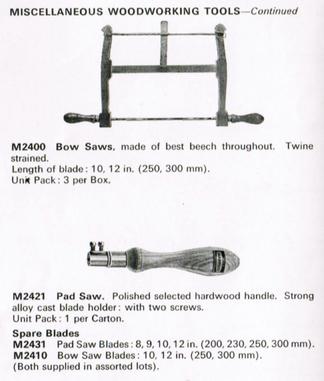
By 1965 the only listing is for #2400 ‘Best Beech throughout‘ and only available in 10″ and 12″ sizes. They are now only called ‘BOW SAWS‘ and no wire stretcher option was available, only ‘twine strained’. The picture also still shows the front handle as being totally rounded, not elongated rounded.
1973 Listings:
The M2400 ‘Best Beech’ twine strained is the only offering in 10″ and 12″ sizes. The picture now shows both handles as being elongated round.
Price changes over time: Best Beech 12″ size frame.
This would be the first issue noted in the 1844 price sheet and shown as being quite fancy in the 1861 catalogue. The same cut is shown in 1873, but is now first numbered 523. It is doubtful that you will ever come across an example of this early form. The front handle is only slightly shorter than the rear handle.
Type 2:
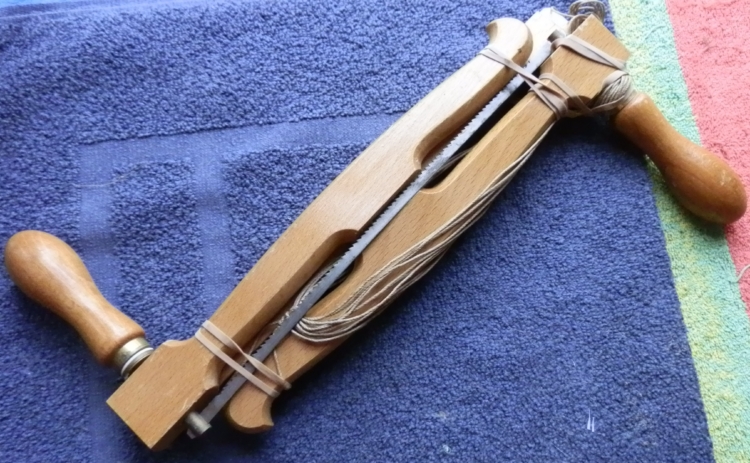
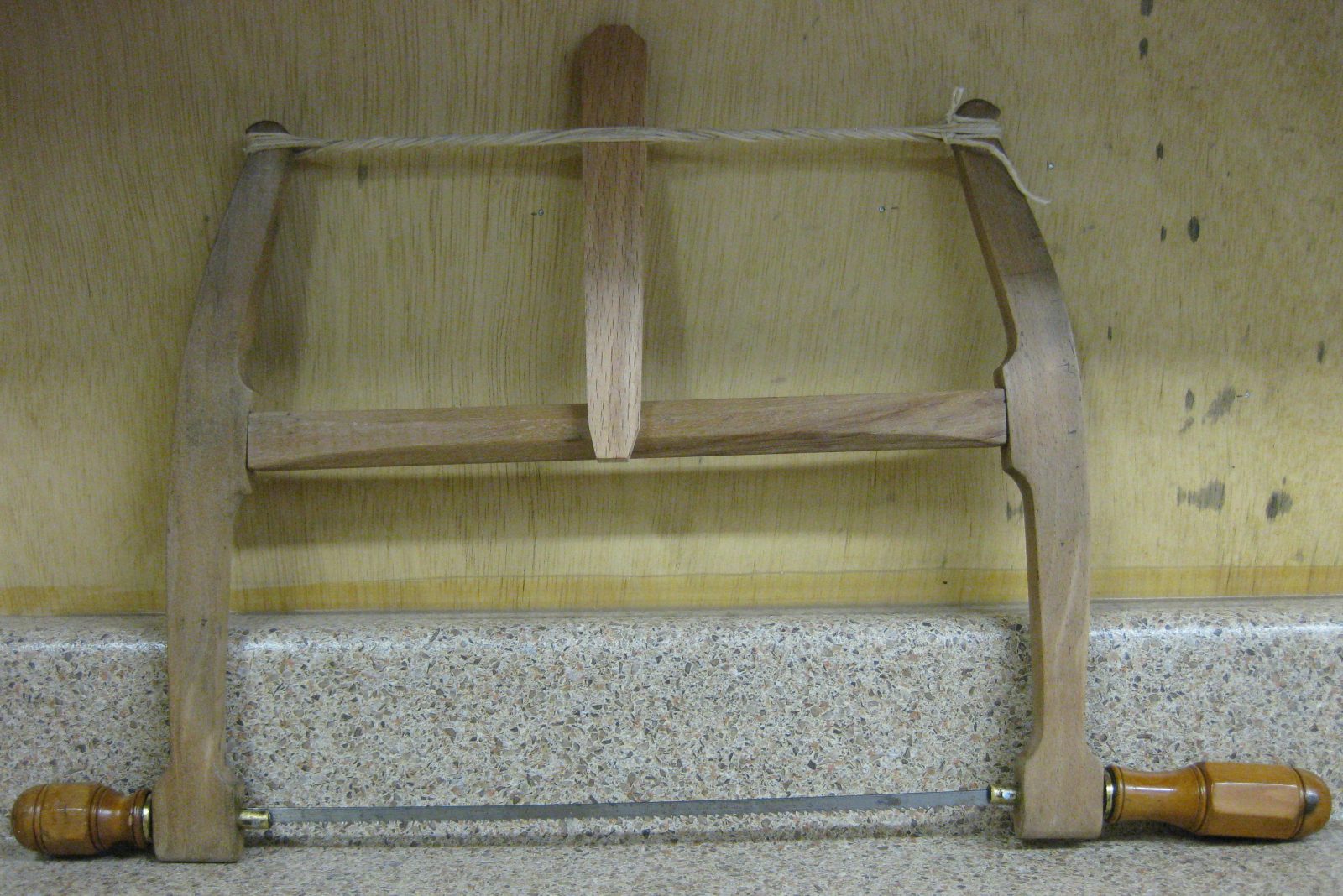
This is the shape and figure generally seen and it has a small rounded front handle pinned through to the front brass blade holder. The rear pinned handle is an elongated round handle. The handles do not, at this stage, have brass rings separating them from the frame. The impressed mark is to be found at both ends of the middle Beechwood stretcher on the side frames. The short Beechwood tightening arm, through the twine, may be straight sided as shown. It is not a good idea to drill a hang hole in the frame at the point of maximum stress , as you will see here!
Type 3:
This saw differs from Type 2 in that the handles are not ‘pinned’ in place, but are only joined to the brass blade holders via a brass dowel portion of that casting. You can now see that part of that casting contains a round brass plate that forms a contact point between handle and frame. The frame is again marked on both ends of the middle Beechwood stretcher, with a different MARPLES mark. The short Beechwood tightening arm may be slightly tapered as shown.
Type 4:
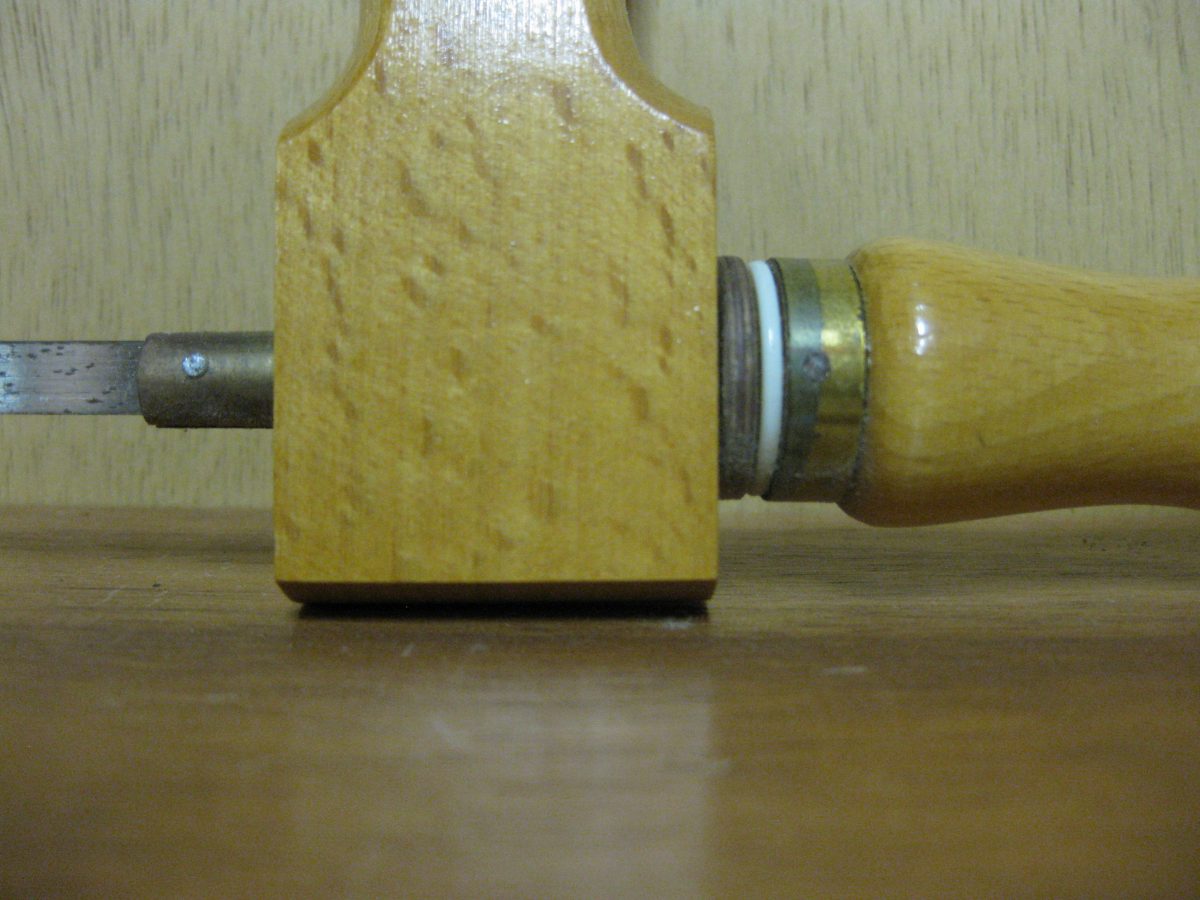
This is the last style manufactured and it has a white nylon washer in each handle assembly as shown. The middle stretcher shows the only MARPLES mark in Black .
The handle has a Brass ring collar, pinned to the handle. Then comes the Nylon washer and lastly another Brass round freely rotating collar. The photo below shows how these saws were purchased, cleverly disassembled,without removing the blade, to fit in a box!
Below is a #2400A showing the thick ‘wire’ in place of the usual twine.
What a Treasure Trove!!
Below is a 10″ London Pattern Boxwood Handled Turning saw. These appeared around the 1890s in sizes less than10″and up to 22″ as Item #693 and changed to #2402 in 1909. They are not listed in 1921.
The middle stretcher may have been sculpted by a previous owner. Below is an 8″ example of #2402:
Below is a copy of the ‘New Products Leaflet’ of 9/68 showing the re-numbered M2400
It appears that Bow saws [ #M2400?] were available until at least 1987.
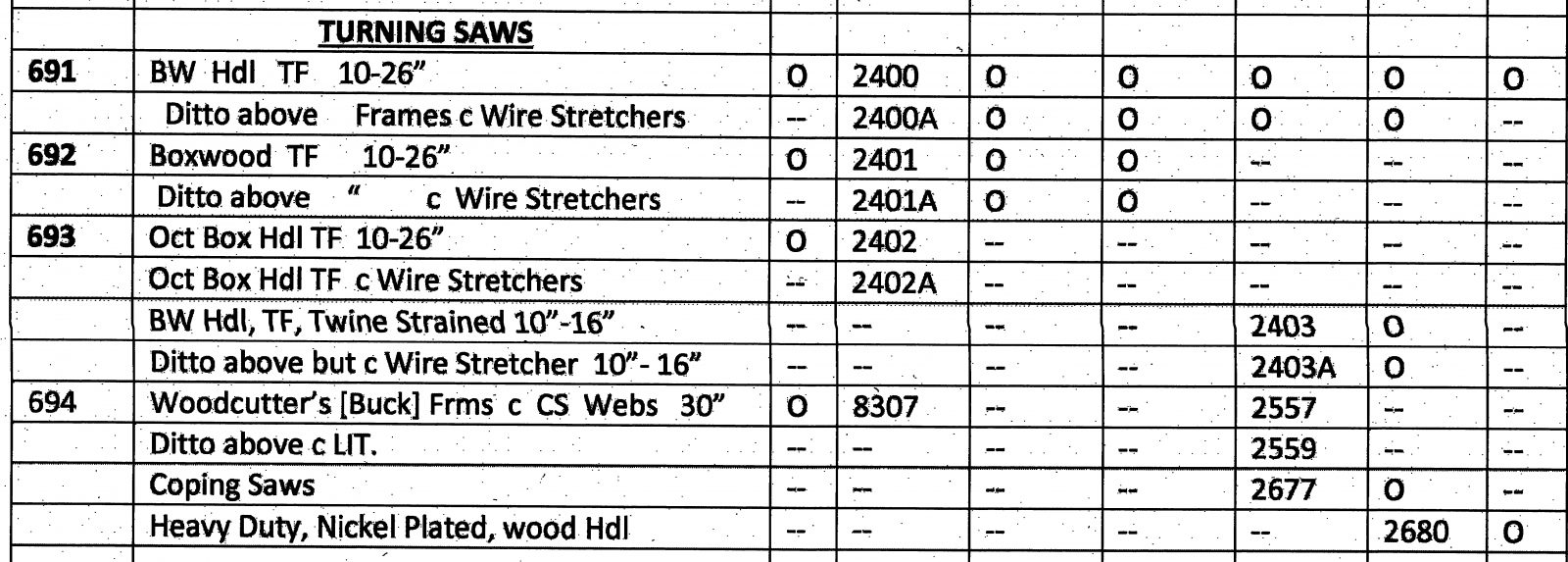
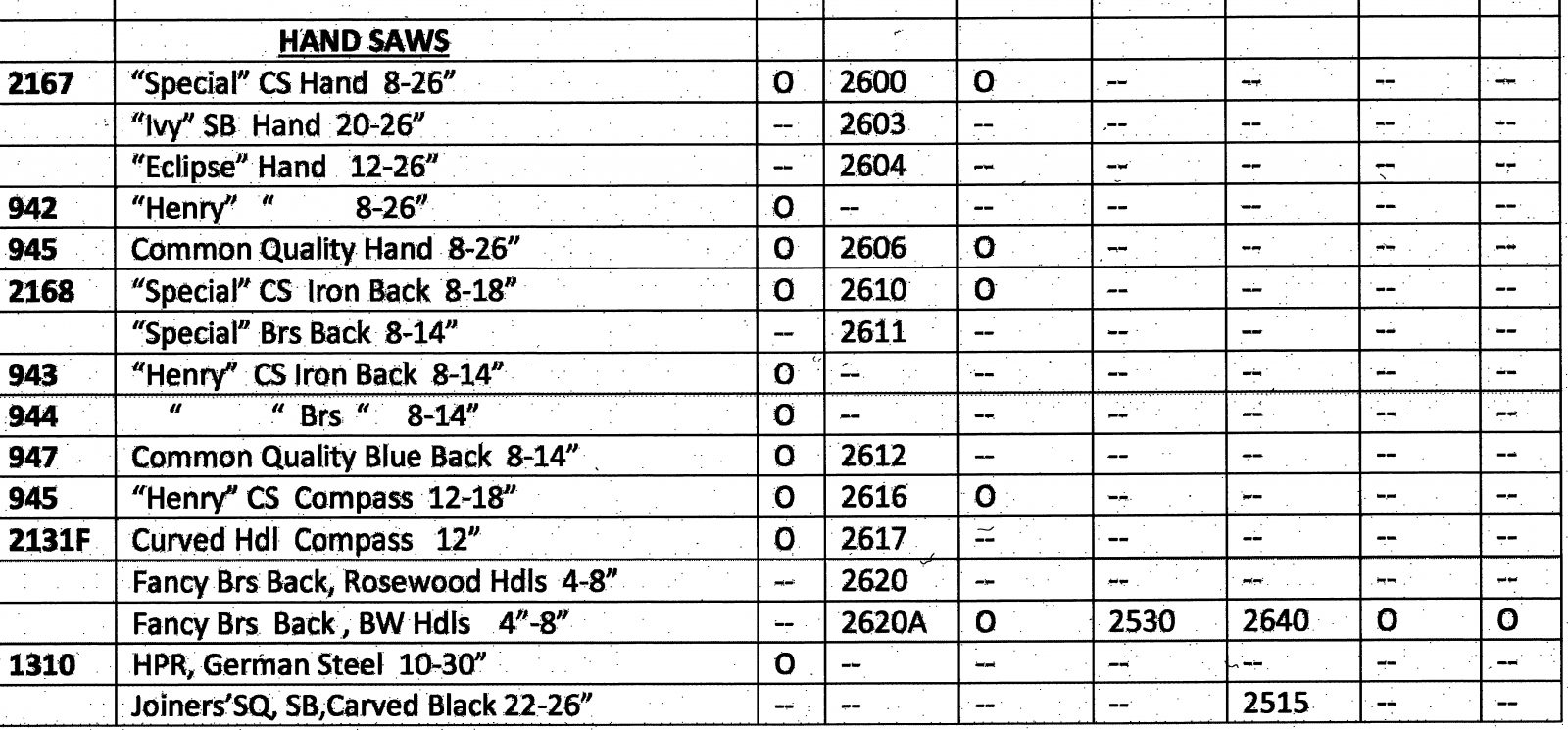
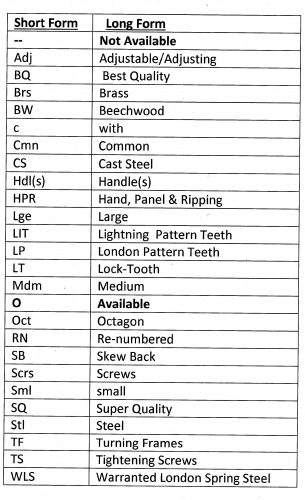
There were many Item# changes and length changes to Compass saws over the years as can be seen in the chart above. [0 = available; — = not available]
Length changes are here: 1897: #1322 10-20″ 1909: ‘Henry’ #2616 10-18″ Curved handle #2617 12″ 1928: ‘Henry’ #2524A 10-16″ and ‘Best’ #2524 10-20″ 1938: Both ‘Best’ and ‘Henry’ were 10-16″ 1959: ‘Best’ #2594 was in 10-16″
Below is the listing of 1938:
Below is a photo of an 18″#2524 c.1928
As you can see, a Compass saw blade was included with the ‘Nest of Interchangeable Saws‘. However, you will usually find only the Table saw blade attached to the handle as this was the most popular and the other blades were ‘lost’. The blades were inserted by loosening the 2 handle bolts and slipping in the saw blade, which had a slot cut as shown below:
These ‘Nest of Saws’ were available starting c.1909 and were produced up to c.1970. In 1909 they were numbered as #2630 Best Quality with #2631 being Medium Quality. There was a number change in 1928 with only best quality being available as #2525.1/2 . In 1938 the best quality is #2595 with a Cheaper quality to be had in #2595C, and this was echoed in 1959. But in 1965 only #2595 was available and nothing is shown in the 1971 Catalogue. In the 1965 Catalogue below it is noted that the edges only of the handle are polished.
Below is the 1928 Catalogue entry for #2440 Beechwood handled Keyhole saw with a saw from that era:
The 2 saws shown below are a bit of a mystery to me. They do not have pictures in any Catalogue, but I believe may be Amateur or Children’s saws. The larger one at 8 inches is the older and displays a more refined detailed handle than the younger 6 inch example. Any information on these saws would be gladly accepted!!
OLYMPUS DIGITAL CAMERA
Pad Saws
PAD SAWS:
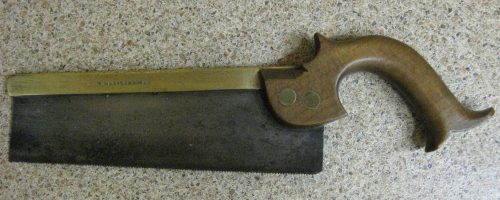
It is amazing to see just how many different types of Brass ‘Ferrules’ were designed and used on the MARPLESPad Saws over time. Below are some examples, but dating them is very difficult.
It can be noted here that the early Pad Saws had a strip of steel inserted and held in the mouth by 2 small ‘Ferrule’ holding screws. This strip was so placed to be between the actual blade and the 2 blade securing screws. I have yet to determine when this strip was omitted from the formula, but the later saws do not have it and the saw blade is directly held by the 2 securing screws which could lead to saw blade damage, which could be significant at the narrower/shorter end of the blade.
See below for additional information.
Below is from the M1 Catalogue Feb 1968. Pad Saw #2421 was available in the 1965 Cat. and carried through until at least November 1982.
Above is from Aug 1973.
Around 1985 the number 2421 was changed to #2430 and this Pad Saw was produced until c.1991. I can find no Pad Saws listed after that date. Example of #2430 is below.
This next example of M2430 was produced at ‘Oscar Works‘ under the RECORDMARPLES name.
GALLERY:
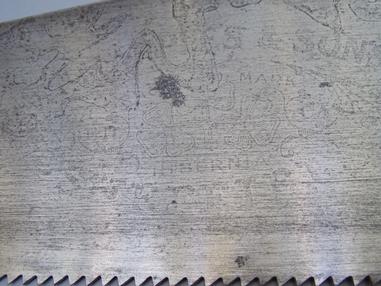
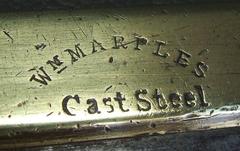
I think that the Pad Saw above is the earliest Pad saw mark I have seen…. merely a script of W.Marples. With a Boxwood handle it has a length from Brass to handle end of 8.1/2″ Either #698/99 [#2425/6 after 1909].
Above are 2 photos showing W. MARPLES & SONS SHEFFIELD Boxwood. 8.5/8″ Either #698/99 [#2425/6 after 1909].
Above is a rare Ebony Handled Padsaw with no discernible makers mark 8.3/8″ [but it is almost certainly by MARPLES] #700, RN#2427 in 1909. 1897-1928. Below is a rare Rosewood Pad Saw numbered 698A in 1897 but changed to #2425 in 1909. This saw is stamped W. MARPLES & SONS SHEFFIELD. . It is probable that Rosewood was available from about 1890 onwards but the last listing was in c.1928 .
The above 2 photos are of anotherW. MARPLES & SONS SHEFFIELD Boxwood 8.3/4″ Either #698/99 [#2425/6 after 1909].
[Above 2 photos] W. MARPLES & SONS HIBERNIATriple Shamrock Boxwood 8.3/8″ Either #698/99 [#2425/6 after 1909].
[Above 2 photos] W. MARPLES & SONS HIBERNIA Triple Shamrock Boxwood 8.7/8″ Either #698/99 [#2425/6 after 1909].
[Above ] W. MARPLES & SONS SHEFFIELD Triple Shamrock in a rectangle mark on the Brass ‘Ferrule’. Beech 7.1/4” #2421. c.1940-50?
[Above 2 photos] Wm. Marples & Sons Ltd. Sheffield England in raised lettering on a Gold painted cast pot metal ‘ferrule’. Beech 7.3/8″ #2421. ‘RED’ MARPLES Shamrock transfer denotes early 1970’s?
[Above 2 photos] Wm. Marples & Sons Ltd. Sheffield England in raised lettering on Hammered Gold painted pot metal cast ‘ferrule’ Ash 7.5/8″#2421. ‘Seoval’ mark denotes c.1980’s? The M2421 below is from c.1973 and of RECORD RIDGWAY Tools Ltd.<
The above estimations of both number and availability are only rudimentary at best because the documentation to support good estimations is just not available now. Much of this documentation was destroyed by ‘Philistines’ during the destruction/demolition of the Factory and even the great Ken Hawley was not given the chance to rescue all the documents that were available then before they bulldozed 200 years of History into the dust.. Therefore, today, we can only guestimate the facts, but it will be forever true that the youth of any age will only regret their decisions too late in their life to realise the implications of their youthful desire to ‘start afresh’.
Panel Saws
RIP, CROSSCUT and PANEL SAWS:
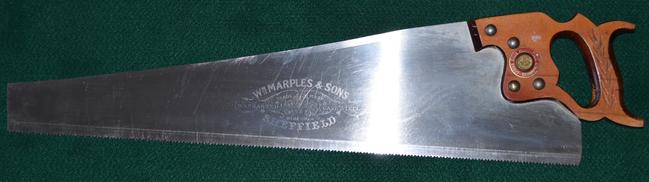
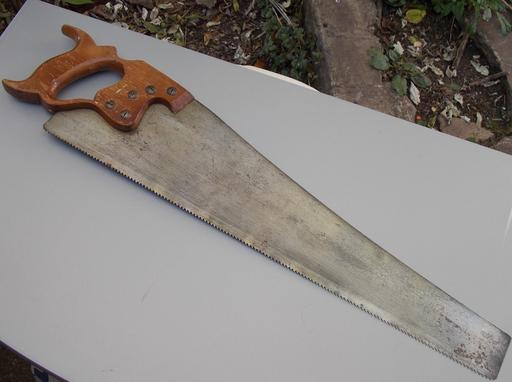
Below is the chart of Item# v. date 1897; 1909; 1921; 1928; 1938; 1959; 1965
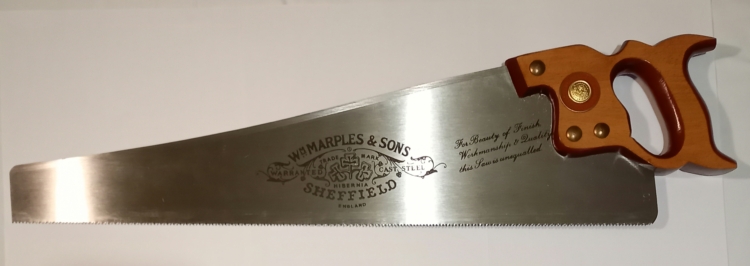
Above is a really beautiful later saw [no Lamb’s tongue, 2-tone handle and Wheatsheaf design.(only on one side!)] Probably c.1968.#2521 Joiner’s Handsaw, best quality. Swaged Skew Back, Beech two-toned Handle polished all over. Available in 22″, 24″, and 26″blade lengths.
Below is another #2521, but again a later saw with no Lamb’s tongue, but not with a 2-toned handle.
Below is a 4 screw panel saw, swaged skew back with 2 tone beech handle which I believe may be a later than 1965 #2521. I cannot find any other description that would fit this saw.
Obviously this example [2 photos above] is an extremely late saw [c.1975<] Profit could be the only motive for distributing a ‘saw’ such as this. The saw below is certainly from around 2004 and displays an even worse handle to the one above!
Below is a MARPLES-RIDGWAY MRT 26-6 crosscut saw c.1985:
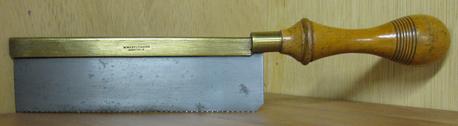
The Beechwood handled ‘Fancy Brass Back’ saws [also called Gents’ Saws] were available 1909-c.1971 and numbered 2620A, 2530 and 2640 according to date [see Master List above]. 4″-8″.
The Fancy Back or Gent’s Saw above is towards the 1971 date. A short brass ferrule and thick handle varnish. The older saws had a longer brass Ferrule and fancier turning.
The Rosewood ‘Fancy Brass Back’ saws [above] were available for a short time 1909-c.1914? They do not show in the 1921 catalogue and probably were dropped shortly after the beginning of WW1.4″-8″#2620. Again, note the long brass Ferrule.
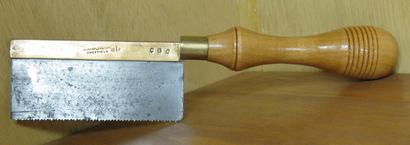
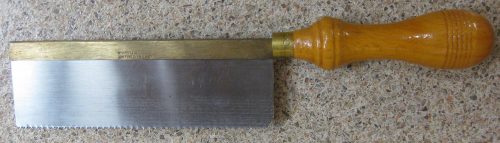
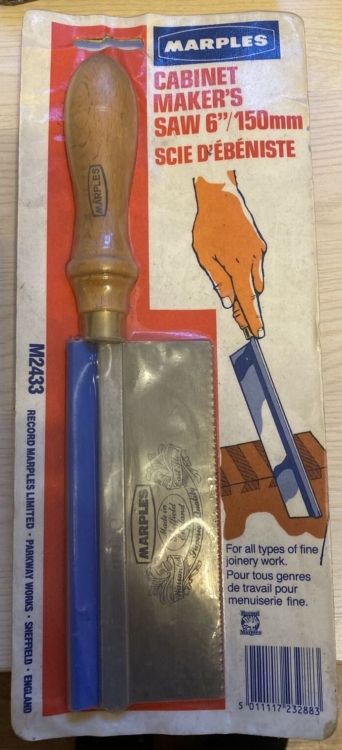
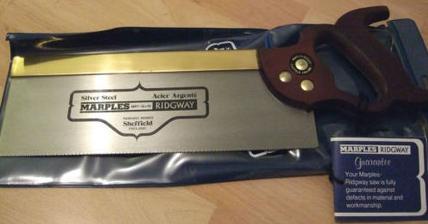
MARPLES also issued a 6″ [M2433] and 8″ [M2434] Steel backed ‘Cabinet Maker’s Saw’ between 1985 & 2000. But from c.1994 only the 6″ was listed
The next 2 photos may show that 6″ Steel backed saw #M2433 c.1994
The M2434 below is obviously later:
And a still later edition is shown below:
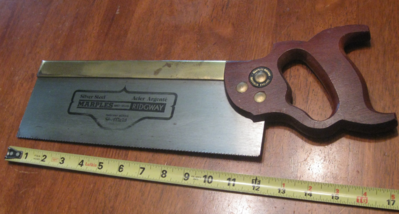
From approximately 2006 to 2008 [and maybe also after manufacturing was exported out of UK] Irwin-MARPLES produced a ‘Dovetail Saw withreversible handle 250mm‘. Numbered T13-250 .
Below is a later Fancy Back Saw with the eliptical double-line surround. I have yet to search for it, but guess it may be c.2002.
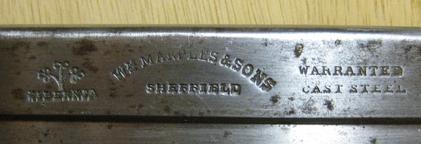
Here is one that I can find listed nowhere. I think it was called an ‘Inlay‘ Saw and it has a 2.1/2″ long blade, very fine. The handle looks to be a later issue, but the mark on the brass back shows only ‘Sheffield‘ with no ‘England‘ impression. A bit of a mystery this far.
BACK SAWS:
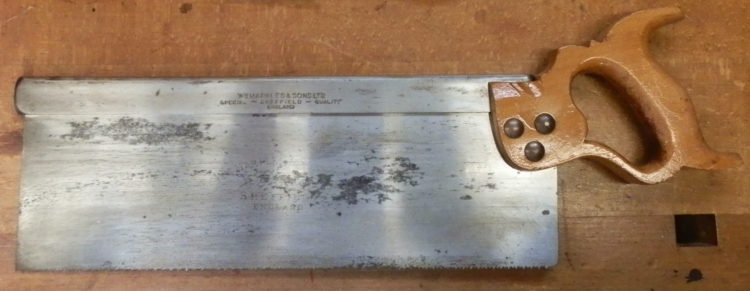
Above: Two examples of #2527 Joiner’s Brass Back Best Quality.
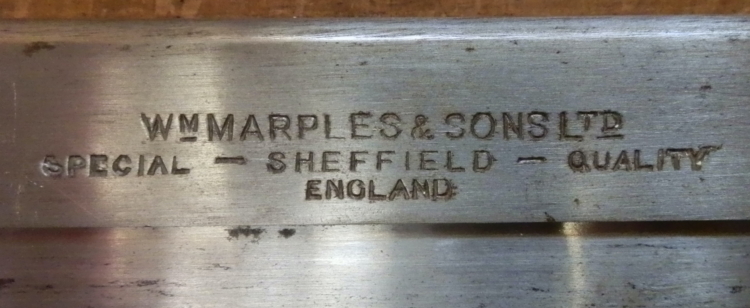
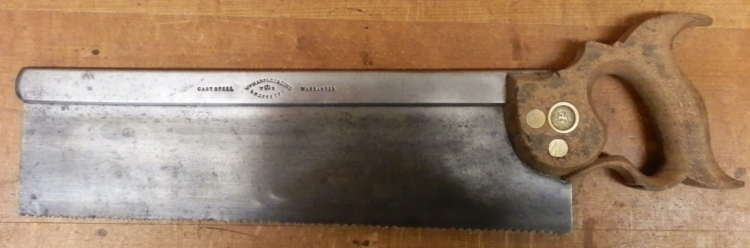
The Brass back saws above and below show a gradual degradation in the letters of the stamp, starting with the ‘D‘ in SHEFFIELD and progressing to the ‘L‘ in SHEFFIELD then to ‘L‘ in LTD, the ‘L‘ in QUALITY and the ‘N‘ in ENG. These degradations can also be found in the Steel backed saws. I am unable to find reference anywhere to these ‘Late’ Open Handled Back saws and so believe that ALL the saws here are #2527A [Joiner’s Brass Back “Special” quality.] The smaller saws may have always been Open Handled in this line and you should note that they all have Steel fixing bolts.
Above: Joiner’s Bright Steel Back #2526.
Above: The 1909 Catalogue shows #2610 Special Iron Back Saw with an Open Handle.
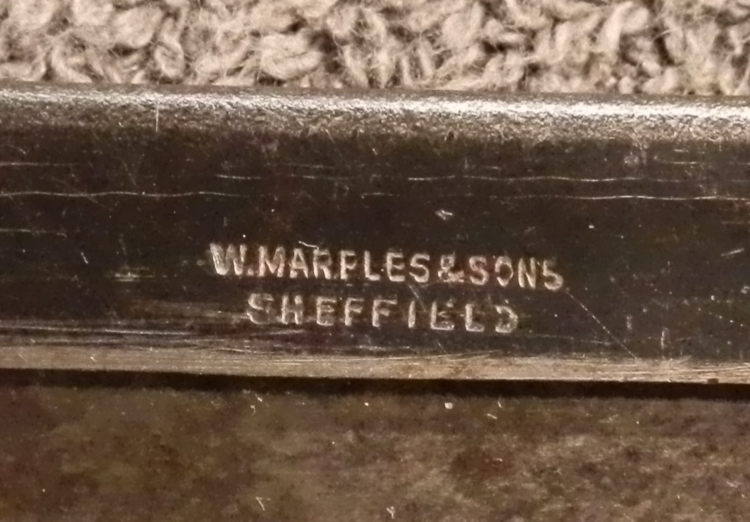
Judging by the Font and Style [above] I would think that this is a very early saw, perhaps c.1860 [no ‘& SONS‘]
Later examples of #2527 shown above with a Two-Tone Polished Beech handle, and below with a Mahogany handle.. These later handles show a lack of design and little thought as to comfort.
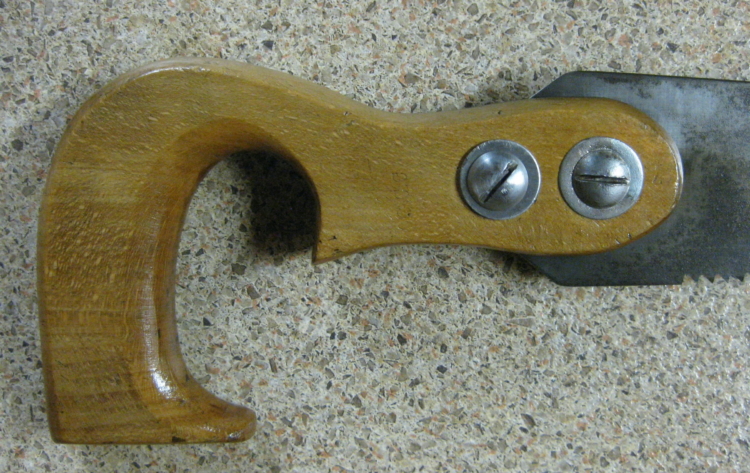
Below is a Brass back saw with a distinctive curved handle, but I am unable to find it in the Catalogues that I possess.
Below is a later #2526A Steel Back closed handle.
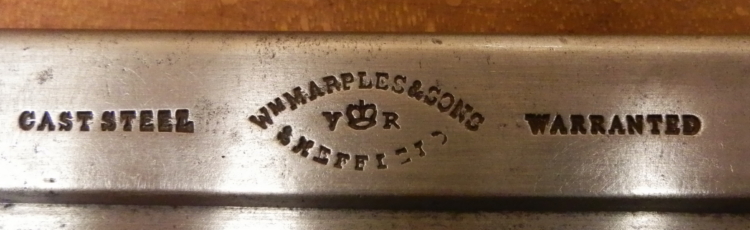
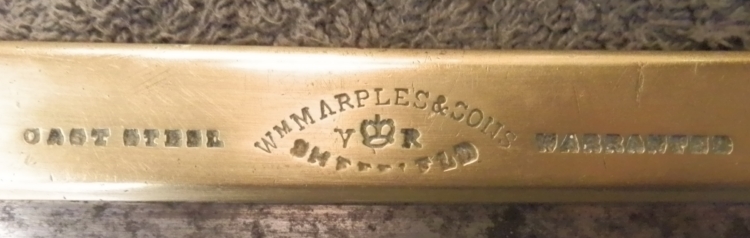
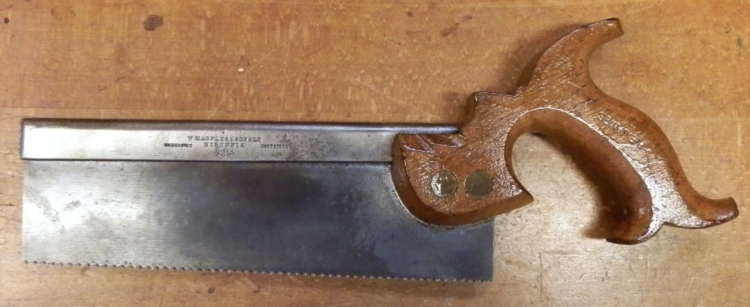
Below is what I believe to be a #1315 Back Saw with a unique ‘VR’ mark and because there is no ‘Ltd‘ it must be <1897.
Below is another mystery saw that is Open handled Beech, brass backed and having the rarely seen ‘VR‘ mark . c.1895?
Below is a #2526 from c.1900
M120 Plane Study
The MARPLESM120 was very similar to all other number 120 planes from other manufacturers as it had a screw feed blade adjustment but no lateral blade adjustment. The M120 had no predecessor in the MARPLES line, unlike the M102 and M110. It started life when other ‘M‘ planes were introduced by MARPLES around February 1933 when it was priced at 5/6d. This price was maintained, in a stable economy, until at least March 1940. Sometime shortly after this date it was omitted from production only to re-appear around November 1951 at a price of 15/-. In 1965, under the then ownership of C&J Hampton, it appears with a ‘Record‘ style Lever Cap, Alloy wheel and continued in this guise until at least November 1969 when it was priced at 23/3d. It was dropped from production shortly after and C&J Hampton then only manufactured their RECORD 0120 Block Plane.
The following M120 Type Study should be very close to the M110 Study on this site.
Type 1:
Like the 110 series of Block Planes, I have to assume here that the first Type of 120 plane, which was introduced in Feb 1933, may well not have had any cast number marks on the base, so the following is drawn from inference that the 120 would be similarly produced.
Paint: Black base with machined smooth sides.
Body: The Cross-bar is not painted and the mouth slope is similarly clean. There may be ‘V’ valleys at the sides of the mouth on each side.
Cap: Is painted RED except for the upper leading front edge slope and underneath from the leading edge to approximately the hole in the Cap.
Blade: At this stage I can only make a guess as to the possible stamp that would have been used on this blade, and that it may have been BM3 and it would certainly have had 10 milled out arc slots on the underside to mate with the Depth Adjusting mechanism.
Wheel: The wheel would be Black all over with Large castellations, as shown below.
Knob: Probably fixed with the now standard ‘hanger bolt’ and made of dark stained hardwood, or at this age more probably full real Rosewood.
Depth Adjuster: This was engineered exactly the same as the standard Stanley 120 mechanism, and this really needed no improvement. At this time I feel that the adjuster would have been nickel plated.
Box and Labels: The colourful top label would have included the words ‘Manufactured By‘ and the end box label would have had the Red line at the top of the label.
Type 2:
Paint: The Base is still painted Black and with clean machined flat sides.
Cap: Is painted RED all over, no exceptions.
Blade: Probably the same as Type 1 in having BM3 markings.
Wheel: Is 3/16″ thick at the perifery and painted Black.
Knob: Is 1.13/32″ high and again secured to the base by a hanger bolt. It may be either dark Hardwood or Rosewood, but it is difficult to tell.
Box and Labels: May well be the same as the Type 1.
Type 3:
Paint: Type 3 has the reverse colour profile, the base is Red and the Cap is Black. I believe that this would date this Type from about 1944 onwards. But as you can see in the ‘History” section the M120 was dropped from the Marples Plane line around this time and was re-introduced in 1951. Thus Type 3 is either the last Type issued prior to being dropped in c.1945, or the first to be re-issued again in 1951. But based upon my observation that the casting seems to be ‘cleaner’ than the next Type 4, I would suggest this Type 3 is approx 1944. There is a total lack of brochures or any other information on Marples Tools between 1940 and 1950. So the base is painted Red, the sides machined clean and square, and the front and rear ends are clean. The cross-piece is Red.
Body: The base is about 2″x 7.1/16″ but the actual length will vary according to the person who finished it. The mouth slope is cleaned of paint and has grooves each side. The mating surfaces of the blade support and sliding adjustment sled are similarly clean. ‘WM MARPLES & SONS’ and ‘SHEFFIELD’ are cast in raised letters in front of and behind the Knob and M 120 are cast either side of the knob. The cross-piece is inserted from the user’s Left and is screwed into the Right hand side piece. The Rear edge has a cast raised ‘half cone’ and the marks ‘ENGLAND’ and the Triple Shamrock appear just forward of it.
Cap: Is painted Black all over, all except for the lower half of the underneath towards the leading edge. [As shown in the example below]
Blade: The blade has markings [below] and these are 11.5mm wide and 4.5mm high with the blade having 10 milled slots on the underside for adjustment.
Wheel: Is painted Black, and still measures 3/16″at the perifery but now has a longer nose. [but this may have been at the finisher’s discretion]
Knob: Is now quite stubby at 1.7/16″tall, made of dark hardwood and finished with a yellow varnish. It is attached to the base with a 1.1/4″oval headed machine screw which is countersunk into the top of the knob. This is a different attachment method from that of the ‘Hanger Bolt’.
Depth Adjuster: Is Nickel Plated.
Box and Labels. The end label has the ‘Red Line’ at the top and the top label does not have the ‘Manufactured By’ line. The Type 3 box lid does not have the ‘thumb’ cutouts on the long sides.
Type 4:
This is the first M120 plane that was re-introduced around 1951.
Paint: The base is painted RED all over, this includes the cross bar and the back and front ends. However the sides remain machined clean as before.
Body: The body in this post war edition appears cast slightly rougher than pre-war Type 3, and it has no grooves at each side of the painted mouth slope. The cross piece is now inserted from the RIGHT and is therefore screwed into the Left cheek. Half a cone is still cast on the base at the middle of the rear end.
Cap: Is painted Black all over.
Blade: The blade still has 10 milled slots on the underside to engage the blade depth adjustment mechanism. But it now has the following stamped in markings.
Wheel: The wheel again is a rougher casting than pre-war but still painted Black. The nose may be stubby and ground off [finisher’s discretion].
Knob: The knob now shows a more shapely form at 1.1/2″ tall than is shown in Type 3. and is manufactured from a dark hardwood [mahogany?], finished with a clear varnish and affixed to the base by a hanger bolt.
Box and Labels: There are a few subtle differences between the top lid coloured label used on the Type 3 and that label used on the Type 4. Type 3 is shown below on the left and Type 4 on the right.
Type 5:
Paint: This Type is painted RED all over except the machined clean sides. The sloping mouth is probably painted Red too.
Body: This body casting is totally different to the Type 4 casting. The painted cross rail is inserted from the right but is only a wedged fit and therefore not screwed into the left cheek . It can therefore cannot be extracted. The front raised cast lettering has now changed to read ‘MARPLES’ and ‘SHEFFIELD’ with a wider font than previously. Also the M120 letters have been spread wider away from the knob. The Major change is that there is no longer a half cone cast at the rear of the plane and that the plane body now only measures 6.3/4″long.
Cap : Is painted Black all over with the usual round water transfer applied to the palm rest.
Blade: The blade can now be identified as now having 11 machined slots for the blade depth adjustment and shows a BM3 marking.
Wheel: Is still painted Black and has a long nose.
Knob: Now appears to be ‘stubby’ like Type 3 at 1.1/2″tall. A thin light varnish has been applied over a dark hardwood and the knob is fixed to the body again with a hanger bolt.
Depth adjuster: This metal now seems to be not plated with anything.
Box and Labels: Are probably as the same as before.
Type 6:
This is what I shall call a Type 6 and it was put out under the ownership of RECORD tools (C.&J. Hampton Ltd) after this conglomerate purchased the tool making section of MARPLES in 1962. The plane is now named MA.120.
Paint: Naturally RECORD tools put their own colours onto the MARPLES brand at this time, which is why this Type is painted BLUE all over, except the mouth being clean as shown here:
Body: The body has now increased to a length of 7.1/16″. The cross piece is inserted and screwed in from the right and is now Nickel Plated. The top of the rails are painted BLUE and the outside cheeks are machined square and clean. On the front of the plane is cast ‘MARPLES’ in front of the knob and MA 120 is cast behind the knob. ‘MADE IN ENGLAND‘ is now cast behind the depth adjustment Knob and there is now again no rear half-cone.
Cap: Is obviously now painted BLUE all over and does not have any ‘windows’ on the underside. The Palm rest now has a very plain MARPLES yellow transfer.
Blade: The blade now seems to have been reduced in width to 1.5/8″ wide, but still retains the 11 machined adjuster slots on the underside. However it now carries the Record/MARPLES stamped in mark.
Wheel: Under RECORD control the wheel was automatically changed to the standard RECORD alloy wheel with a steel threaded central insert.
Knob: The knob is reduced to just 1.1/4″ high and is secured by a shorter hanger bolt than was used previously. There is a thick dark varnish applied over a probably hardwood knob.
Depth Adjuster: Now does not appear to be plated.
Box and Label: The internal box has been modified by the inclusion of a curved piece of cardboard intended to control the movement of the plane within the box, and therefore to reduce damage of the plane during transit. The label on the end of the top is similarly as austere as the new label on the Palm rest. It would appear that artistic merit was totally out of favour in the ‘design’ studio at RECORD.