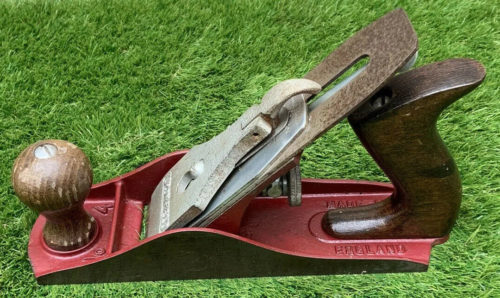
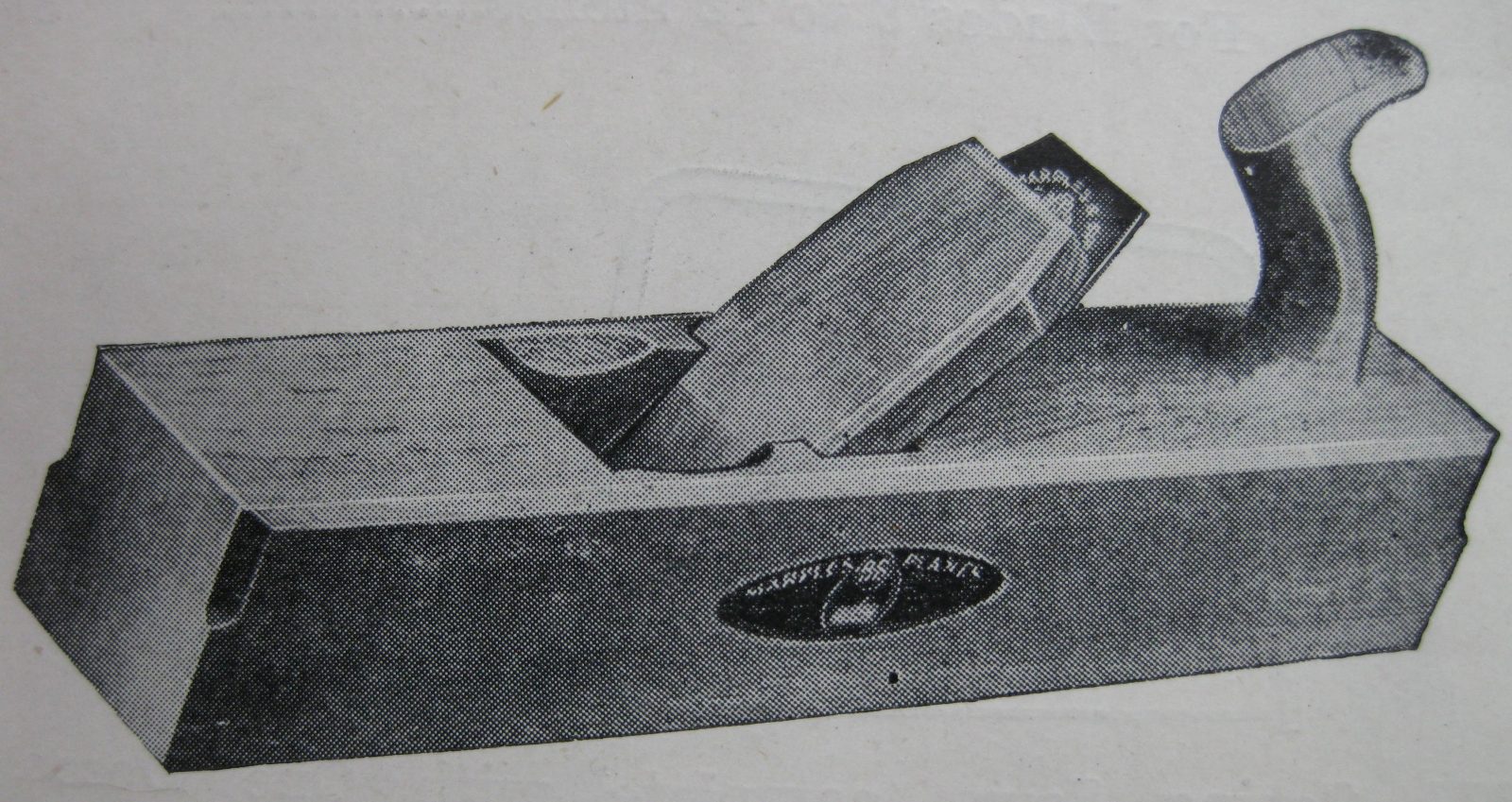
The premier site for William Marples & Sons Tools.
Author: Roger Ball
Centre V Planes
These were a very short lived Moulding plane that made either an external ‘V’ shape or an internal ‘V’ shape. Why you would want to use this plane is beyond me. Maybe a precursor to wood panelling installation?
I first see them in the 1909 catalogue listed as Centre V #3011 and Reverse V #3011.1/2. By 1921 only the #3011 is listed and neither are shown in 1928.
I have never seen one , but I do have a 3011 made by another maker.
Sash Planes
These planes were obviously manufactured to shape the design in the windows of that era. They are first seen in the 1862 Cat. where are listed: Lamb’s Tongue Sash; Ovolo Sash and Astragal & Hollow Sash. No images shown. By 1873 the planes have been numbered: #858 Astragal & Hollow; #861 Lamb’s Tongue; #883 Gothic [new addition] and #890 Oveloe. The numbers were changed again[!] in 1897: #1057 Rustic Sash [new addition]; #1058 Oval Sash; #1062 Gothic Oval; #1063 Lamb’s Tongue Sash and #1065 Astragal and Hollow Sash. By 1909 we have again another re-numbered system and these planes are now: #3041 Ovaloe Sash; #3044 Rustic Sash; #3045 Gothic Sash; #3046 Lamb’s Tongue Sash and #3047 Astragal and Hollow Sash.
In 1921 only the #3041 was available as was the case in 1928. But by 1938 all of the Shamrock Sash Planes had been de-listed. It should be said here that from 1897 -1909 there were listed planes as above but described as being ‘to Stick and Rabbet, with 2 Irons’. These double-iron planes were ideal for window sash, cutting both the filleted Ovolo [or other shape] and accompanying rabbet. Below is the excerpt from the MARPLES 1909 Catalogue.
Above you will see that Brass-end Templets were available for all the different Sash shapes. Below is one of the Templets.
Other Beechwood Planes
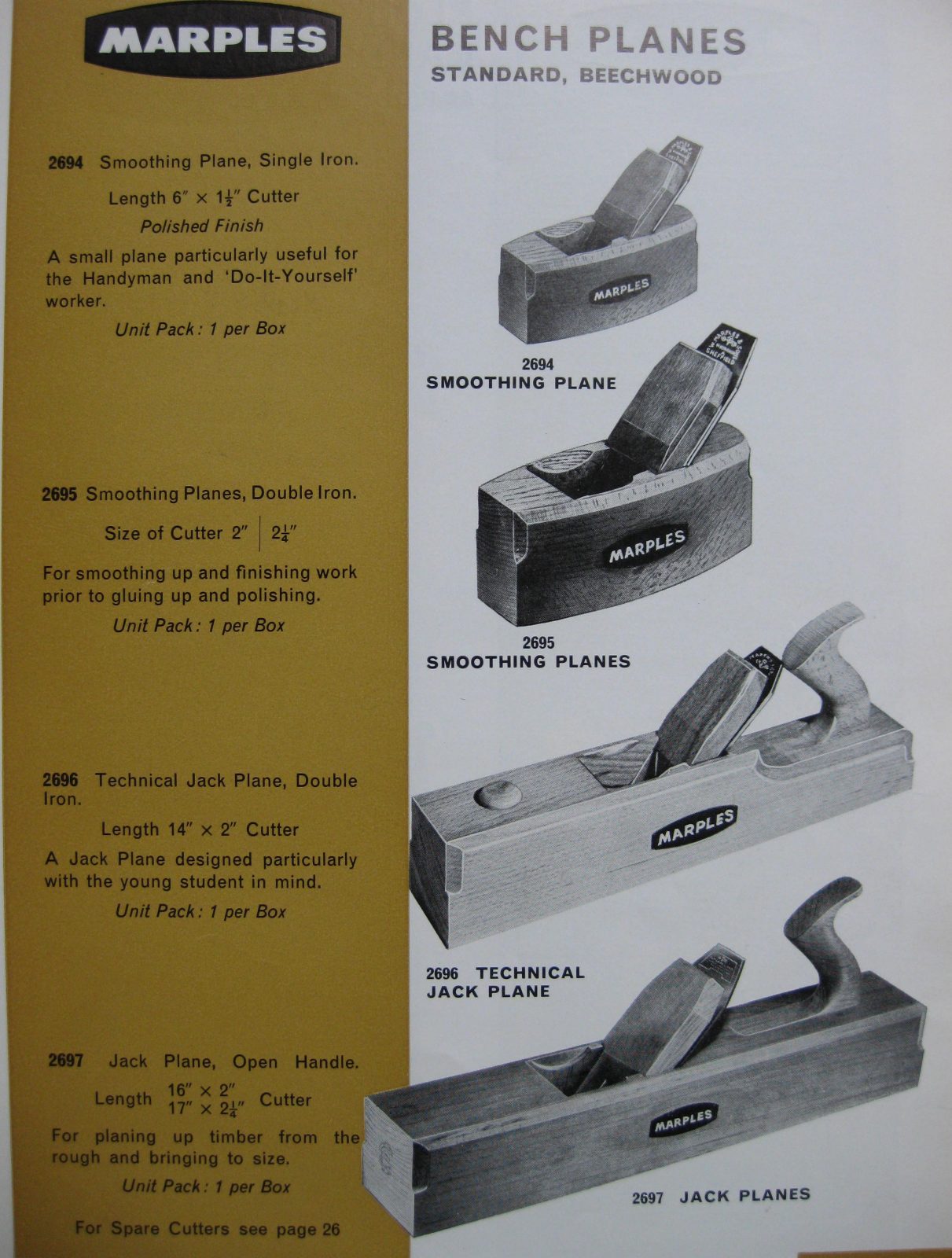
The ‘BB’ Series of Wooden Planes [see that section]produced by MARPLES was introduced as machine made tools to take over from the hand made ‘Shamrock Brand‘ planes, because there was a declining number of craftsmen who could produce those planes by hand. Around March 1964 or shortly thereafter the whole BB line of planes was discontinued. The MARPLES Tools Catalogue No.15 was issued in early 1965 and BB planes are not shown. However, in their place is a newly introduced line of Wooden planes under the Headings of BENCH PLANES, Standard, Beechwood and SPECIAL PURPOSE Planes, Beechwood.
These planes were hand made, unlike the BB planes, but finding examples today is difficult because they were not manufactured for very long. They were all available in the May 1966 Price List, but all except #2696 and #2697 are shown as withdrawn in the November 1969 Price List. [Where they are described as being ‘Price on Application’]. I can only guess that these planes were the leftover hand made planes that were in stock when RECORD took control of MARPLESc.1964? and they were re-numbered and issued for as long as it took to sell them all.
I can find few of the newer Price Lists to gather any more details. The older Price Lists seem to be more available due to the fact that in those days [before 1965?] it was not a ‘throw away’ society!!
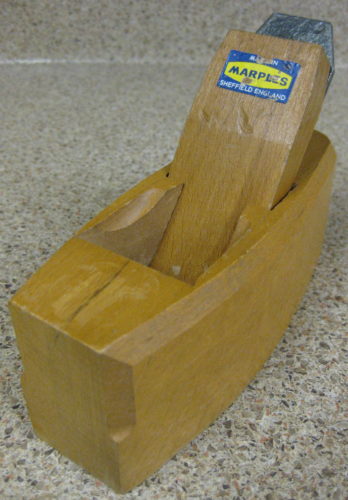
I do have a good example of the Toy Plane #2694 which has an unmarked blade of 1.1/2″ wide. It is one of the few planes that MARPLES issued as ‘polished’…I do not know why! Note the applied MARPLES sticky transfer on the wedge. c.1968? But from this one example I must deduce that this line of planes was stamped on the toe end with the same MARPLES stamp as was used on the ‘Shamrock’ hand made planes, and this supports my theory above.
The photo below shows 2 labels for the 2696 Technical Jack Plane. The one above is a label produced specifically for the 2696 and is the later of the two. The one below is a generic label that was used on the Shamrock planes made until ‘RECORD‘ took over the company and is obviously being used to use up old label stock.
So how do you tell the difference between machine made planes and the earlier hand made ‘Shamrock’ brand planes?? Except for the ‘Toy’ plane this is easy. In the mouth area of the base there is a slot cut to accomodate the nut head that secures the blade to the cap iron. In a machine made tool this slot has a rounded ‘routed out’ lower end, whereas with the hand made plane this slot terminates in a squared off end, produced by a hand chisel.
Below is a photo of a #2697 Jack Plane showing the hand cut slot in the base, and proving that these planes were indeed hand made until discontinued. The imprint on the toe shows there was no difference between this planes and the #2760 ‘Shamrock Brand’ plane.
Bench Planes (Wooden)
WOODEN BENCH PLANES
This section includes Smoothing Planes, Jack Planes, Technical Jack Planes, Trying Planes, German Jack or Roughing Planes, Skew or Badger Planes and Mitre Shuteing Planes.
There is no mention of any plane sold by MARPLES that can be found in the 1846 Broadsheet, but in the 1862 Catalogue we find the following bench planes listed, but with no Item numbers.
The 1873 Catalogue shows the same planes as being offered but now they are given an Item number:
We see this in 1897:
And in 1909:
From the 1928 Catalogue:
This catalogue states that the planes were also available in the celebrated ‘John Moseley & Son‘ make. But both the Marples branded and ‘John Moseley & Son’ branded planes were exactly the same, only with different name stamps, because they were all produced on the same benches by the same craftsmen.
The 1938 issue states the price in line with the plane number:
By 1959 we see these pages:
The last ‘Shamrock‘ [hand made] planes were produced by a single workman, Mr Albert Bock [below], around 1964-6, and after that time only the BB Wooden planes and a brief issue of ‘other wooden planes‘ were offered . [see those sections available from the Main menu] . Both of these planes were certainly not up to the same standard as the ‘Shamrock‘ brand.
Beginning at 1909, I have constructed the table below to help to give you a reference as to what planes were issued and when they may have been de-listed. I only started at 1909 because of the amount of work needed to go back even further, and there are many other types of wooden planes that I must report on that demand my attention. The table below here explains the necessary short forms need to interpret the main table because there is simply not enough space in a table format to write out the full description of a plane AND get in the ‘years’ information .
An interesting fact:
I have just found that MARPLES , and maybe other manufacturers named what we today call a CAP IRON as a ‘TOP IRON’. As shown below…..
SMOOTHING PLANES:
These very basic bench planes were available from MARPLES since 1862 and were always made by craftsmen from John Moseley and Son. More details can be found in the pages shown above as there were planes with steel soles etc. , but I will limit my discussion here to those pure Beechwood ‘Shamrock‘ Smoothing Planes that were sold from 1897 to 1963
The ‘Toy Plane’ [#2728] at 6″ long and having a 1.1/8″ wide thick unmarked single blade, is first seen in 1909, but is not mentioned in 1921 or after that time. { It did reappear in the ‘BB‘ series of planes and then continued in the 1965 Beechwood Bench planes.} It does have a 1.1/2″ wide blade like the BB series. The wedge is the same as the BB Toy plane, so I cannot tell when this plane was made!! It has the common MARPLES stamp on the toe, but I believe it was still made in the era of Hamptons owning MARPLES c.1990 It is therefore not a true ‘Shamrock‘ hand made plane. It would appear that Hamptons used the old stampings on their new issues of wooden planes introduced in c.1965. after the demise of the ‘BB‘ series. {see the section named ‘Other Wooden Planes‘ in the index.]
The usual Smoothing planes were first seen in 1861/2 and had blades of 2.1/8″; 2.1/4″; 2.3/8″ and 2.1/2″ and by 1873 a 2″ size had been added. 1897 sees the same line-up, as did 1909 but then the numbers were all changed [see table above],+ an option of having Boxwood Striking nubs was offered and, at extra cost, the blade could be a Parallel Iron as opposed to the regular Tapered Iron. In 1928 the planes could be had with the John Moseley & Son imprint and in 1959 the sizes offered were changed to 1.3/4″; 2″; 2.1/8″and 2.1/4″. All four sizes seem to have been withdrawn around 1963. Generally the bases and wedges were pencil numbered [in arabic numerals] so as to keep the 2 matched pieces together, as that was how they were individually produced. The blades were generally all tapered, and these had a solid cast steel lower insert welded into the blade to act as the superior cutting edge. You can see this insert on the edge of the blade and/or as a line on the inferior side of the blade. Generally this insert seems to be resistant to rust.
The stamped mark on the front of the planes seems to be consistent throughout production, but Hiberniamay have been omitted after the War.
The long MARPLES water transfers may have been applied on the left hand side of these planes from about 1905 [not confirmed as yet], but the later planes [after 1950?] also had a round transfer on the wedge and the longer one applied to the side of the body.
.
Probably after 1962 the planes had a MARPLES mark impressed onto the top of the toe section of the planes.[below][readable from the back] although these planes did not have an impressed mark on the Cap Iron. But around 1960, or before, the cap iron had a 1″ wide stamped motif as shown below right.
A later observation shows that planes after this above issue had a more comprehensive impressed mark on the top surface of the toe but did NOT have any mark on the cap iron. Circa 1963<.
The box labels of all the MARPLES planes seem to follow a common design, but I do not [yet] know when these labels were started or ended.
The different width blades commanded a different length of base, such that the 2.1/8″ blade had a 8″ wooden base and the 2″ blade had a 7.5/8″ wooden base length.
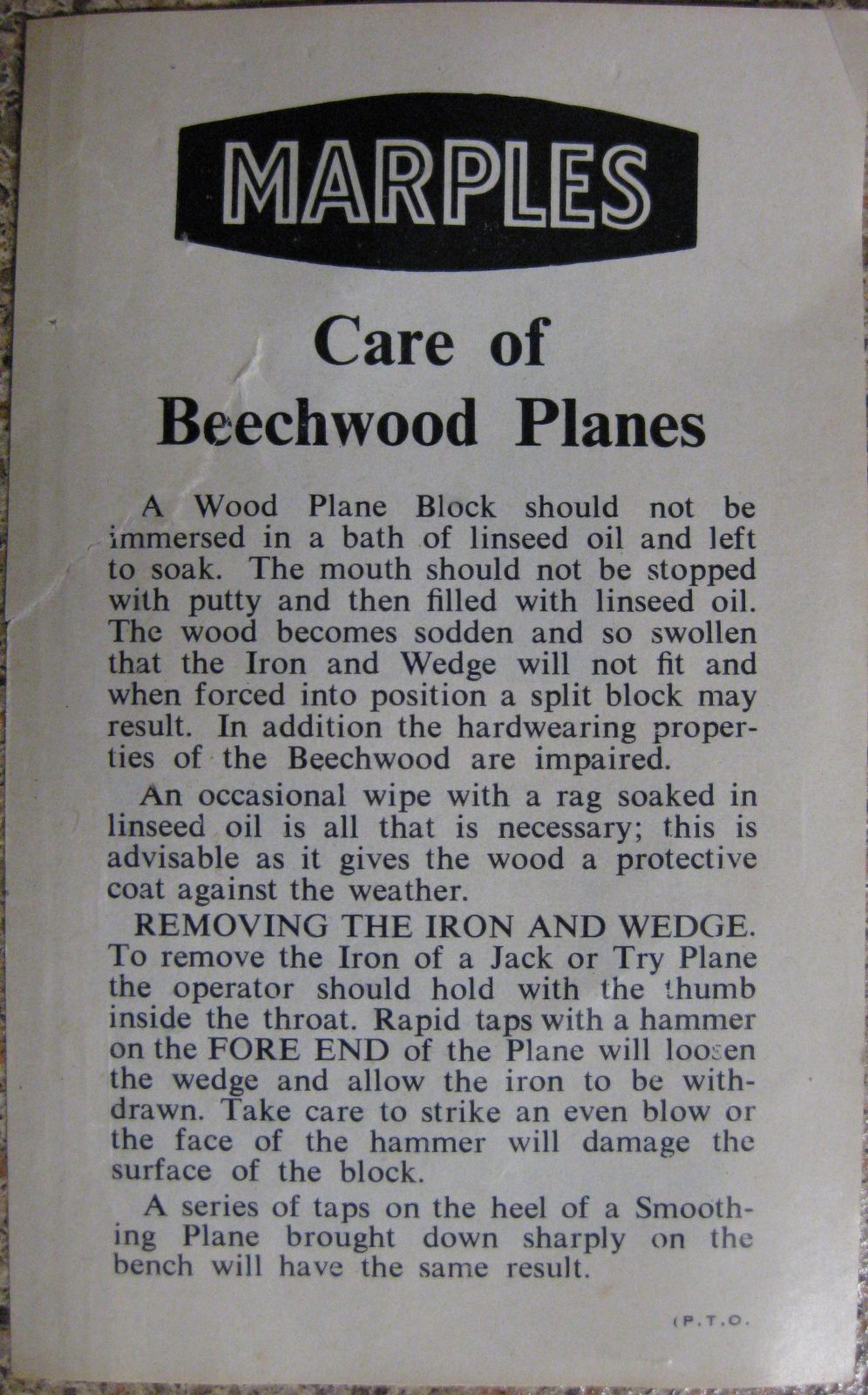
The Wooden MARPLES planes had an insert in the box describing how to treat/not treat MARPLES planes, it probably was included until c.1963, but I cannot say when this practise was started:
The mark on the toe [above] looks similar to the c.1960 Cap Iron marking.
Smoothing Plane #2741:
This plane was introduced in 1862, although not numbered. Strangely I cannot find an 1873 listing but it does reappear in 1888 as #967 with a ‘Solid Iron Face’ and a 2.1/4″ cutter. In other words the bottom face was completely clad with Iron/Steel. It is listed in 1897 as #956, again with a 2.1/4″ cutter. In 1909 it is listed as having ‘steel plated soles and Parallel Irons of 2.1/8″ This was the situation until 1938 after which this heavy plane fades away. Below is a 2.1/4″ example:
JACK PLANES:
Sometimes known as ‘FORE PLANES‘.
Most of the points mentioned under SMOOTHING PLANES would apply to these larger planes. The Jack Plane was a staple from day one and was available in 1862 with blade widths of 2″ ; 2.1/8″ and 2.1/4″. In 1873 the plane is listed as being available in 14″-17″ lengths [not specified] and in blade widths of 2″;2.1/8″; 2.1/4″; 2.3/8″and 2.1/2″. Also the first 3 widths were available as single-iron or double-iron. By 1897 only double-iron planes were offered, but you have to look at the 1897 extracts above to see the variety of Jack Planes on sale at that time. But in 1897 a Jack Plane variety was first offered ‘with sunk handles’..at extra cost. [This became later known as a ‘Technical Jack Plane’]. 1909 shows the same sizes offered [#2760;2761;2762;2763;2764 ] with Parallel irons being extra, Boxwood striking nubs being extra and Closed handles being extra. Again there were other varieties of planes available, but too numerous to mention here. See the catalogue photos above. 1921, 1928and 1938 Catalogues show exactly the same offerings and extras as before. But there is less variety of planes available at this time. [One I have never seen is the #2785 Steel-faced C.C. Double Iron Jack Plane 17″ long with a 2.1/4″ blade]. And then came WWII. The Black hole of information. The 1959 Catalogue shows some changes, which may have come into force before then. The #2760 Cast steel Double Iron Jack Planes had an Open Handle and #2770 Planes had a Closed Handle. The 2″ width blade is now [+ maybe before 1959] only available in the 16″ size and the 2.1/8″; 2.1/4″ and 2.1/2″ are all only as 17″long and the 2.3/8″ size is no more. There is no mention of these planes in the No.15 1965 Catalogue but they are shown in the April1964 ‘Price List to Catalogue 1959′. These planes were therefore delisted or withdrawn around late 1964.
Below are some good photos of Jack Planes:
Plane#1 This plane is totally mint and is in the original box. It has a 2″ wide blade and is 16″ long.[c.1955<] I note here that the front MARPLES mark has the word HIBERNIA in it, so that shows that HIBERNIA was still in use at that time. The blade is stamped with an ‘M‘ mark; ‘Sheffield’ and ‘England’. [see below] The wedge and side of the plane have the correct water transfers, and the top of the toe has the 1.1/4″ circular MARPLES impression [that can only be read from the back of the plane] The cap iron has the oval stamped mark and the toe has a 1.1/2″ wide impression as shown below. 2IN is stamped into the heel.
Plane#2. My Second Plane shows some differences:
It is 2.1/4″ wide blade, and 17″ long. It has no water transfers. The different toe imprint is 1.1/2″ wide:
HIBERNIA is shown on the blade, but no mention here of ‘Sheffield‘ or of ‘England‘. Therefore C.1890? Which explains it having no transfers, since these were introduced, I think, around 1905. There is a letter mark here of ‘L‘. Heel marking of 2.1/4 but no ‘IN‘ seen. Is the exclusion of the INches mark any indicator of the age of the plane?. But again I have to research as to when the blades had a stamp that included a Letter, and what did this Letter denote… A year number or a position number on the ‘tree’ of the casting?
Below is a fine example of a Closed handle Jack Plane:
TECHNICAL JACK PLANES:
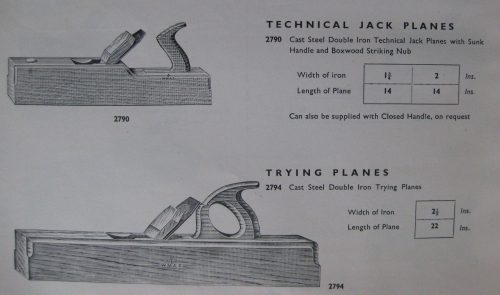
These essential bench planes are also named ‘Razee’ planes as they are cut down in height towards the rear of the plane, thus putting the user’s hand closer to the work surface and getting more thrust. [The word comes from the razee ship conversion wherein the upper decks are ‘razed’ ( lowered) to make the ship lighter and faster]. They are first seen in the 1897 catalogue wherein they are described only as ‘with sunken handles’ at 1 shilling extra. At that times they could be had in 14-17″ lengths and with blade widths of: 2″; 2.1/8″; 2.1/4″; 2.3/8″; and 2.1/2″. Boxwood striking nubs towards the toe could be purchased for 3d extra. In 1909 they are officially named as Technical Jack Planes but now only available as #2790 1.3/4″ and #2791 2″ in either 14″or 15″ long only. Boxwood nubs have now become standard.
There were no changes to these configurations up to and including the 1938 Catalogue.
In 1959 [ and probably introduced before then] only#2790 was shown and available in 1.3/4″ and 2″ blade widths with a length of 14″ , priced 45/-. For the first time a closed handle plane was offered at 47/-. The last Price List inclusion is April 1962, and therefore I assume these planes were not offered after c.1963.
It would appear that the older planes had a toe stamping of 1″ across and were also stamped on the Wedge as being Wm.Marples & Sons, Sheffield. To and from dates unknown. When the move to the larger 1.1/2″ wide toe stamp is also unknown, but the side transfer was introduced first and then both transfers later. Later still these transfers were totally dropped, probably just before 1963, when I have a plane [shown below] that is totally polished and with a linseed oiled sole. This plane has a flattened Boxwood button, a cap iron marking; no blade letter stamp; and with a Polished Cap iron and Blade/Cap Iron screw!! At this juncture I am unsure as to whether this plane was ‘owner’ modified!!.
There is a maker’s mark on it of ‘Albert Bock’.
The next interesting Technical Jack plane is an edition from around 1960? which has no Cap Iron mark, no letter stamp on the blade, both water transfers and a 1.1/2″ wide toe stamp. It is mint in the box and is therefore ‘correct’. It is a 2″ and 14″ plane and again made by Albert Bock.
But here [above] is a perfect example as to how to tell a handmade plane from a machine made plane. The slot to accommodate the Cap-Iron/Blade screw of a Shamrock plane ends as a square chiselled slot, whereas that of a machine made plane ends in the rounded end of a ‘routered’ slot.[shown right above]
Below is a great Closed Handle Technical Jack Plane:
TRYING PLANES:
These larger Bench planes were used in the final trueing up of an edge or of a flat surface because they traversed the slight hollows produced by the smaller Jack planes. They were only ever available with a closed handle, which is a stronger handle than an open handle and was needed because of the weight of these planes.
In 1862 they appear as being available as 22″ and 24″ and this range had increased to include 26″; 28″ and 30″ by 1873. The 1897 catalogue lists the same sizes but now states the blade widths to be 2.1/2″.
The 1909 catalogue shows that by then the 30″ size had been dropped from production, but that now Parallel Irons and Boxwood Striking Nubs could be had at extra cost. [like 3d!] The planes were numbered 2794-2797. The 1928 and 1938 Catalogues show no changes from 1909. But after the war in 1959 only Item# 2794 was available as 22” long with a 2.1/2″ iron, but with no Boxwood Nub being offered.
I have noted some small differences that may destinguish older planes from more recent examples. The older style has a smaller hand opening in the handle and the top horn is more pointed. [on left below]:
Older Style has the Cap Iron marked ‘Warranted Steel’ [left below]as opposed to the newer oval mark.
Older planes are 3.5/16″ wide, newer are 3.1/8″ wide. Older have a 15/16″ wide toe stamp [below left] whereas the newer planes have the 1.1/2″ wide toe stamp. Older planes may not have the blade size marked on the heel, although the newer ones had a stamp, but without any ‘inch‘ designation..
Here is a #2794 at 22″ with a 2.1/2″ cutter:
Recently I acquired a Trying plane that I suggest was among the last produced c.1964 and it has various differences from before as well as having no MARPLES impression on the Cap iron.
It has noMARPLES impressed mark stamped into the toe. It does have a printed MARPLES mark on the face above the toe, but this is printed in a metallic blue colour. But of note is that the chamfer vertically applied to the 2 leading edges is ommitted! See below:
Same Label
I do not know whether these above differences were applied across the whole range of MARPLES Wooden Bench planes.
GERMAN JACK or ROUGHING PLANES :
These are first seen in my 1897 Catalogue, although they may have been itroduced earlier than that, but definitely after 1873. There were 3 sizes with Single German Steel blades… as shown below in the 1897 Cat:
The same sizes were offered in 1909 but the numbers had been changed to 2820;2821 and 2822. The 1921 Cat. was exactly the same, but by 1928 the Name had been changed to ‘Roughing or Scrub Planes’ because they were not made from German Steel any more [I wonder why!?] and the numbers were changed again to 2850; 2851 and 2852. Same sizes but now with Cast Steel blades. Around 1929 the #2850 [1.1/4″ x 10″] was dropped from the line. The 2 sizes left [2851 and 2852]were carried on until they were no longer shown in the March 1937 Mini Catalogue. These planes are quite rare to find, let alone in good condition, because of the work to which they were subjected.
SKEW or BADGER PLANES:
These planes are listed [not shown] in the 1862 Catalogue , but seemingly are missed from the 1873 and 1897 Catalogues. I do not know why they were omitted. They do appear again in the 1909 Catalogue as shown below:
At this time the 17″ long plane with a 2.1/4″ Double Iron blade was number #2827 but the #2828 was ‘Box-edged’. This availability continued until 1938. My next reference is the 1959 Catalogue in which is listed only the #2527. The latest Price listing I have is in April 1962 at a price of 90/- [90 shillings], so I assume the plane was not available after c.1963, which ties in with the fact that skilled craftsmen were simply not available or needed around that time.
My example below is, however, only 16 inches long, 3.1/16″ wide, 3″ tall and with the standard 2.1/4″ wide cutter. []The flat nose boxwood striking area is not original.]
I cannot find when this plane would have been cut down to 16 inches but I suspect later in the issues.[c. 1960/1]
MITRE SHUTEING PLANES:
These planes are listed in 1862 Cat. as ‘Mitre plane common’ and as ‘Mitre plane best with box front’. There are no pictures to show us what they meant by this. It is curious, as in the case of the Badger planes, that these Shuteing planes are not listed in either the 1873 or the 1897 Catalogues! They re-appear as Items #2985-2991 in the 1909 Catalogue.
But note here that #2988 is shown as being 22″ long with a 3″ single iron. [see later under 1959 Cat.] By the 1921 Catalogue only the #2985;2986 and 2987 are listed. The year 1928 shows the same information…
In 1938 the same scenario is shown, but by 1959 only a #2988 is listed, but this is not the #2988 of 1909 as it is truncated to a 17″ long plane having a 2.1/4″ single iron skew mouth.
These planes are last listed in the Price List of April 1962 and therefore were probably discontinued around 1963, due to the lack of skilled craftsmen able to produce these planes and/or because of the lack of demand for this type of plane.
M10 & M10 1/2 Plane Study
Both of these planes are first to be seen in the December 1934 Pocket Catalogue and both were withdrawn by April 1962.
The clip above is from the March 1936 Pocket Catalogue, as any previous mentions were by description only. Throughout the manufacture of both planes, only the M10 is pictured and the same cut was used throughout that period.
As can be seen the M10 was 13″ long and the M 10.1/2 was 9″ long, therefore about the same sizes as the M5 and M4 sizes. But the blade width was always 2.1/8″ wide which went from outside to outside of the plane. Although not mentioned anywhere these planes where manufactured from Malleable Iron, as were all other manufacturers’ equivalents. It is easy to see why this should be so, because any accidental drop of this design plane in Cast Iron would immediately fracture the side of the casting above the side aperture. These planes would have both followed the same changes in construction and colour as the general Bench planes, and this would apply to the appearance of the plane number behind the front knob around 1937 and the introduction of the Ogee frog around 1938. But, as with the other Bench planes, there is always the possibility that these planes would have been put together at the factory from parts available at that time and painted with the colours of the day and this would have been done when there was a new call for stock from stockists in the provinces and thus it is hard to pin down the manufacture date with any certainty. Because on those planes not commonly used there would be a backlog of stock available from a previous casting run and these older castings could be called into service at a date far later than when they were actually cast.
The above M10.1/2 is a perfect example. It is painted with a Red frog on a Red base, which generally did not occur until c.1944< But the frog is pre-Ogee, in other words before 1938! The solid brass depth adjusting nut is associated with the 1944 era as are the handles of dark Rosewood coloured varnished Beech.
The above M10.1/2 has a Black non-Ogee frog [ c.1937]. A Red base which, up till now, has been ascribed to 1944<. But, this base does NOT show the M 10.1/2 casting numbers each side of the knob [ie c.1937] . The handles are grain-painted Beech and the Brass Depth adjusting wheel is concaved with coarse parallel knurling [Post War]. So it looks as though they grabbed a c.1937 base and a pre-finished Black non-ogee frog and married them together with post war handles. Can you now see how very difficult it is to realistically ascribe a reasonable date to the manufacturing of MARPLES planes!!??
The M10 above ‘Red on Red’ shows a number behind the front knob and therefore c.1937<. It has a non-Ogee frog and what looks to be a Rosewood handle but a Beech knob. The Lever Cap looks too good to be nickel plated and may therefore be Chrome plated. Was this plane changed from the original to present in this condition? Who knows.
But I have noted that most of these Malleable Iron planes seem to present in a rough casting condition. This roughcasting seems to have not been addressed by judicious grinding or sanding and therefore this may be a class effect.
The plane shown below is a Black non-ogee frog on a Black base with full Rosewwod handles, these are very rare to find today in this condition.
Socket Chisels
SOCKET CHISELS
These may be the best chisels available, but they have one detraction, and that is the difference in humidity between Summer and Winter makes these chisels either loose on the handle or tight on the handle. It is difficult to come to a steady state.
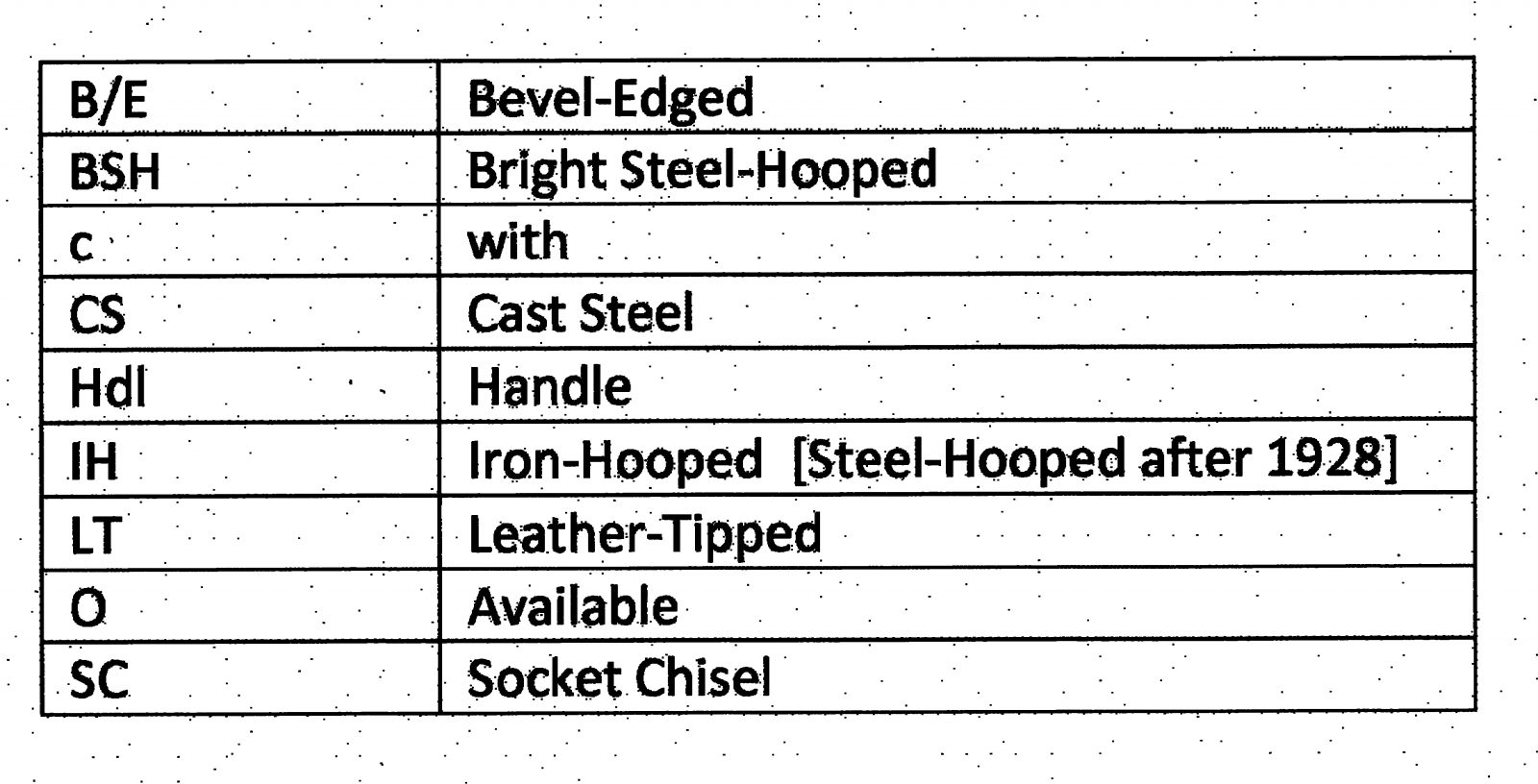
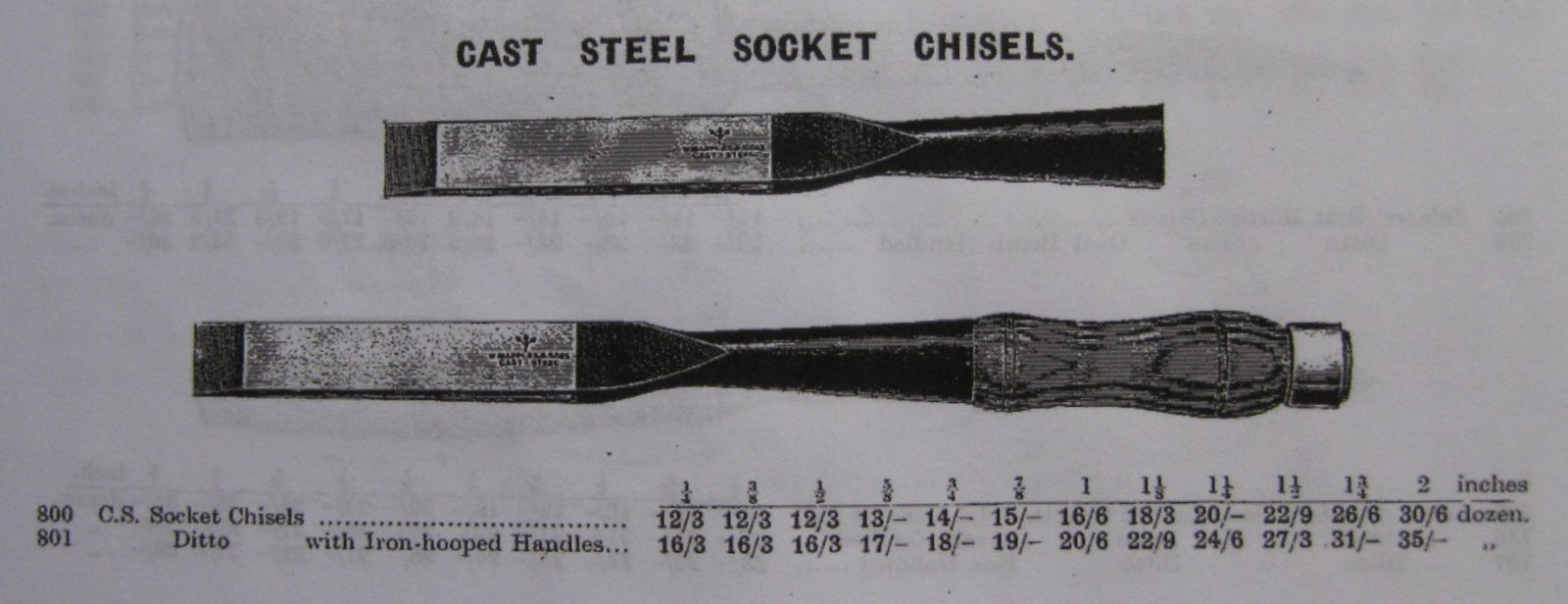
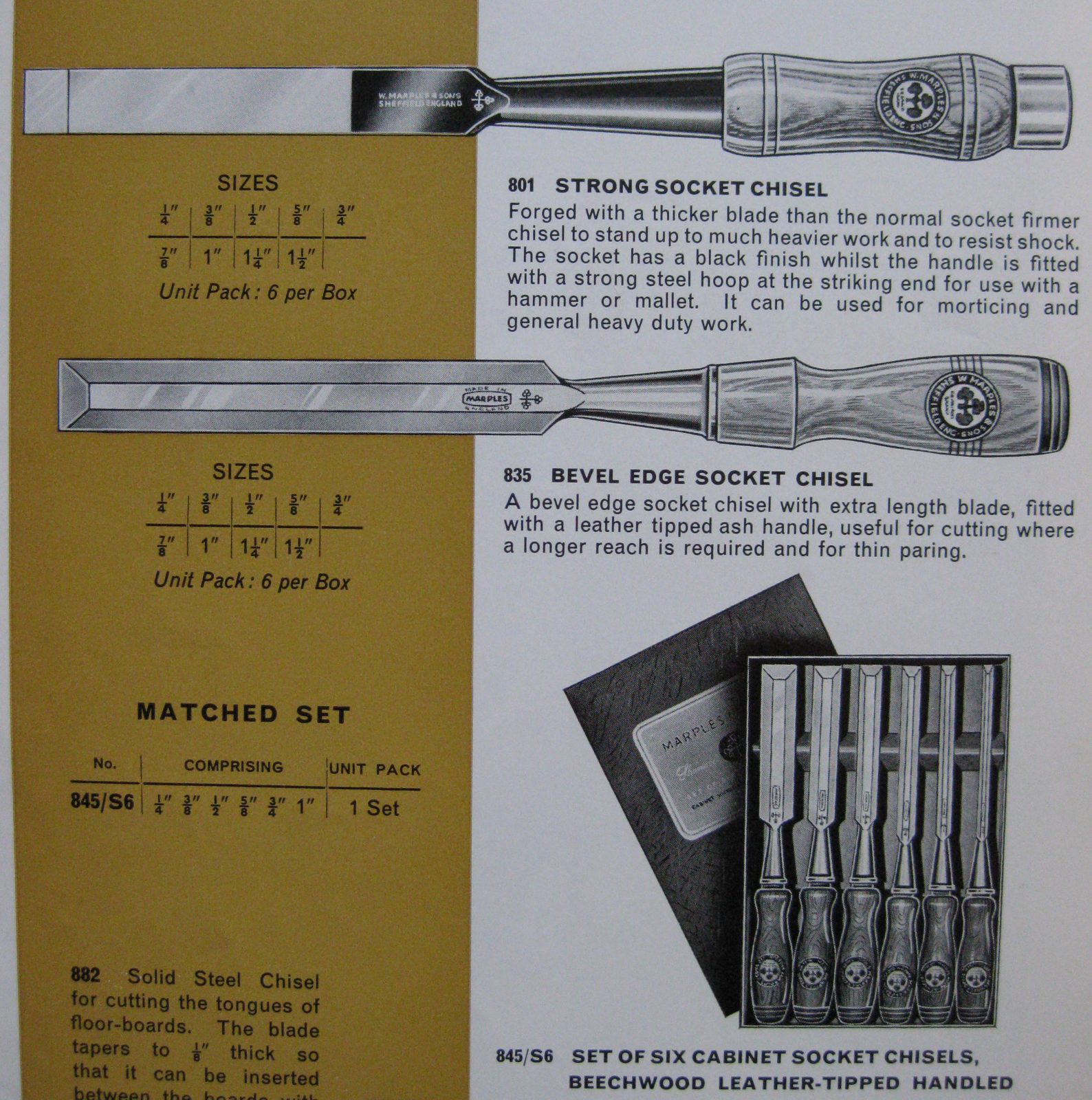
Wm.MARPLES were certainly not the first manufacturers to have these items for sale, but they do appear in the 1861 Catalogue, wherein are listed a Cast Steel Socket Mortice Chisel; a Cast Steel Socket Chisel and a Socket Stalking Chisel. [The latter of which I have yet to know of a specific use]. The 1873 Catalogue lists, for the first time, chisels by an Item number. The chart below has been compiled from catalogues of 1873 – 1959. The 1965 Catalogue only lists #801 Strong Socket Chisel, #835 Bevel Edge Socket Chisel and a set of 4 #845 B/E Socket Cabinet Chisel with a Leather Tipped Beech handle. By 1971 , no Socket chisels are listed.
The 1862 Cat. page is below: [1873 Cat. page is the same cut]
The 1897 Cat. Page is below:
The next 2 images are from the 1909 Cat.:
The next 2 images are from 1921:
The next 4 images are from 1928:
The next 4 images are from 1938:
The 1959 Cat. shows the next 2 images:
The last entry for Socket Chisels is found in 1965:
A Gallery of Socket Chisels:
The boxed example below is a set of 6 of #845..B/E Socket Cabinet Chisels, Beech handled with Leather Tip. Presently I cannot locate the No. 2032 shown on the label!
Item #801 , below, is a great set of Cast Steel Chisels, Black Socket, Steel Hooped, Ash handled.
Below are shown No.834 B/E Socket Firmer, Ash handled and No.835 B/E Socket Firmer, Ash handled with Leather Tip. The larger chisel [also a #835] is a later example having no markings on the blade.
Again, an almost complete set of #845.
Research & Development Plane
Just a normal M4?But look a little closer…..
A few months ago I bid [in a well known on-line Auction House] what I thought was an M3 plane. Looking at the photos supplied it was obvious that the rear handle did not have a screw through the front of the toe and into the base [classic early M3 characteristics]. No dimensions were supplied ( Sounds familiar, sometimes getting important info from a seller is like getting blood from a stone!). I won the Auction, but on receiving the item, I was in for a shock. The plane was an M4 size, but on disassembly the real facts were disclosed. This plane was like no other MARPLES that I had ever seen. And, yes it was definitely a MARPLES with the Triple Shamrock cast into the base behind the Frog. The dimensions are very similar to an M4 and the main differences are in the Frog assembly and the base mating surfaces of the Frog. The whole arrangement is reminiscent of the Stanley Bedrock plane, in that the frog has a totally flat bottom, divided by a sunken area and the base has a matching configuration. The only securing feature of Frog to base is the two Frog screws, which enter the base at an angle [cf vertically in most other planes] this being due to the fact that the Frog assembly sits on the base at an angle. There is no Frog Adjusting screw assembly. The Base and Frog are both ‘painted’ Black, which is Petrol dissolvable and the ‘Y‘ Lever is Cast, with the Frog being ‘painted’ after it was totally assembled which means that the Lateral Lever rivet and ‘Y‘ lever rod ends are overpainted. On the Base both front and rear ends are clean, with no paint. The Lever Cap is stock from that era and was originally Nickel Plated, but no more. The Cap Iron has the ‘Grinding Angle’ guide configuration. The Blade is Standard at 2″ wide with an early Trefoil ‘W.Marples& Sons, Sheffield, Eng.‘ impression. The screw that holds the Cap Iron to the blade has a wide shoulder and the Lateral Level disc rotates. The Frog rivet that secures the Lateral Lever has no strengthening ring cast into the Frog on the underside. The blade holding screw and Frog screws look to be uncoated steel. The Brass Depth Adjusting wheel has 3 fine knurling lines. The mouth of the base is 1/4″ wide and the base at the front of the mouth is quite thick at 3/16″ and quite long from the cross-piece at 1/2″. The wood is BEECH, [which varies from this era, as the normal wood around this time would be Rosewood] and the rear handle retains its’ MARPLES Water Transfer on the top. So I think that this plane emanated from the R&D Dept of MARPLES around 1936 and was mostly put together from parts then available on the line, all except the handles, the Base and Frog main components.
Frog bottom showing 2 bands of flat casting in line.The Frog front end comes to an almost chisel point.Apart from the bottom profile the Frog looks quite ‘normal’.Flat frog base showing no Adjustment apparatusTrefoil and base area, showing the Nub that fits into the handle.Frog Mating surface on Base and Throat area.The 2 slopes that you see are on the same level.Trefoil just behind the Frog area, no Frog adjustment provided for.Cap Iron screw showing a wide bevel.Rear handle showing indent to fit over base protrusion [Nub]. No screw.Beech handle with Mahogany/Rosewood stain and varnish and showing MARPLES Decal.Showing like a standard M3 handle.Well defined 3 row knurled brass Depth Adjuster Ring
Scrapers (Handled)
These wood scrapers encompassed 4 varieties. The M79 Box Scraper was used to scrape stencil marks or paper labels off the sides of packing cases [when items were shipped in square wooden boxes, such as Apples etc.]. The M80 Woodworkers’ Cabinet scraper was used to put a fine finish on a quality article. The Scrapers numbered #1890 [Double blade pattern and #1893Single blade pattern] were inexpensive general scrapers unsuitable for fine work.
M80 Cabinet Scraper:
The M80 Cabinet Scraper was made from Cast Iron and had raised handles, a reversible 2.3/4″ blade and was 11″ long. It is first listed in the March 1936 Pocket Catalogue and is last shown in the March 1940 Pocket Catalogue and always for sale at 4/6d. I can find no reference to indicate that this item was continued after the War and therefore these are always to be found with a Black painted base, if you can even find one!
This is the only image used in the catalogues.
Box Scraper M70:
The M70 was designed to remove the paper labels that were affixed to the sides of wooden crates that were generally used to transport fruit and vegetables. [So the idea of re-cycling of articles was in evidence way before the 1990s!] The tool is first seen in the March 1936 Pocket catalogue.
It was continued until March 1964, but does not appear in the Catalogue #15 of 1965. It was introduced at 4/- each and went to 15/6d each by 1964. I do not know whether it was continued in production throughout the War years, but it is listed in March 1940 and November 1951. We must suppose that pre-war issues were painted Black and post-war (1945<) issues were painted Red. The 2 examples that I have are both pre-war and show different blade markings according to age. The older issue has a larger thumb turn-screw than the later example, which displays the central ‘Diamond’ pattern. {see below}
2 Pre-War Box scrapers..different years….later is above.The earlier issue is on the left.The later blade marking [rounded corners] along with the ‘Diamond’ pattern Thumb-screw.The earlier blade mark [square corners] with the larger Thumb-screw.The slightly convex bottom base.The blade support ‘wings’. The scraper below is, I think, the earliest issue having a black base, red cap and painted handle with transfer:
#1890 and 1893 Scrapers:
Both of these general scrapers were introduced in March 1937 and were last seen in March 1940, obviously being dropped out of manufacture during WWII and never re-introduced after the war. The wood handle was of beech and coated with a Mahogany stain/varnish. The double bladed #1890 had a transfer on one side and a stamped MARPLES mark on the the reverse side. The single bladed #1893 was probably similarly marked.
Dronfield Tools
MARPLES had moved totally to the new facility in Stubley Lane, Dronfield in 1971 and remained there as Wm.Marples & Sons until 1983 when they became part of the Record Ridgeway Group. So at least [and probably earlier] from c.1971, MARPLES produced and marketed inferior tools put together for the Chain Store market and commanding a lower price for the House owner. [ Somewhat similar to the STANLEY Handyman series of tools.]
Below is an excerpt from the History of MARPLES, and is pertinent to DRONFIELD, but unfortunately the writer is unknown.
So from the above information I can deduce no time frame when Planes were produced at ‘Stubley Lane’ and marked ‘DRONFIELD‘. When ‘C&J Hampton‘ bought out MARPLES in 1962 I find it odd that they would not have closed down the Plane making at Stubley Lane [if indeed that section was even in operation at that time!], because this quality of plane would not have fit well into the RECORD way of thinking. Apparently the castings were made by ‘Quality Castings‘ of Wolverhampton [denoted by a QC mark under the handle on the base,… but not always.] this being a Company that produced forgings for many of the great tool manufacturers in England.
I have purposely bought many DRONFIELD planes in order to write this plane study and the results can be seen below but the study may well change as new information is found. I have found no information anywhere such as a Catalogue, Pamphlet, Brochure or Advertisement that gives any information on the DRONFIELD planes, so I am working in a vacuum and using pure deduction to write this section. I have only found FOUR types ofplane marked DRONFIELD and those are No. 2,No. 4, No. 5 and 110. The No. 2Block Plane may have entered the market shortly after the introduction of the No. 4.
DRONFIELD No.4 Plane:
Type 1
The No.4never had a Frog adjustment screw and No.4 was cast in the base behind the front knob. The only indication that these are ‘DRONFIELD” planes comes from the so annotated Lever Cap which may be painted gloss Hammered Grey or Gloss Hammered Black. On each side of the rear handle are cast ‘MADEIN‘ and ‘ENGLAND‘. The Lateral lever is a single piece of unmarked plated steel which has a downturned butterfly wing type of finger adjustment area at the top and a stamped out circular area to engage the blade at the lower end. Colour of the Base was Black, but the top of side rails and the actual sides were not painted; Frog was Black; Handles were Beechwood with a varnish finish; Lever Cap was with a ‘Hammered Silver’ finish; Cap Iron and Blade had an almost squared top profile [see below]. The rear edge to the plane was also painted Black, but not the front edge. The ‘Butterfly’ Lateral lever was fixed to the frog with a wide Copper rivet. Mouth width was 5/16″and the mouth area was painted all the way to the base. The letters cast as ‘ENGLAND‘ were 1.9/16″ wide. The Cap Iron has the stamped inscription at the top….. ‘Correct Angle for Cutting Iron <25‘ . [More later] and the letters on the cap iron were large. The circular blade depth adjustment wheel was made of Brass with a Zinc plating and has fine parallel knurling separated by a circular notch in the middle. The ‘Y‘ lever [Stirrup] was a 2 piece affair and was held in the Frog by an Iron rod. The tops of the screws holding the Lever Cap to the Frog were ’rounded’. The hole in the Lever Cap, to accept the holding screw, was ‘indented’ and straight. Total length of the plane is 9.11/16″.
No blade markings and LARGE letters to the Cap Iron. Plus an almost Square top to the Iron. [See later].Hammered Silver finish and a ‘Round ‘ headed screwNote the indented area to secure the head of the ‘Round’ headed screw.Here you can see the stamped pressed steel Lateral Adjustment Lever, the Copper rivet to secure same to the Frog and the 2 piece Depth Adjustment Lever.Box End Label. Showing that the box lid is just cardboard with no paper overlay to the lid [see Type 3]
Type 2:
The only differences that I can find between this and a Type 1 is the fact that the Rod holding the Stirrup to the Frog Assembly now is a pressed steel hollow circular tube and not an Iron rod., and the top side rails are now painted. Type 2a: The example below throws a wrench into the study in that, although the sides rails are painted on the top and the handles are of wood, the base colour is a reddish pink.
Type 3: This plane is the first of the plastic handled Dronfield planes and is over-painted Satin Black. It has a Black painted base and frog [not Ogee], and a hollow rod to hold the 2 part Y lever depth adjustment assembly. The screws holding the frog to the base are now ‘Cheesehead’, but in all other aspects this plane is very similar to a Type 1 , except that the tops of the rails are painted. [5/16″ mouth; 9. 11/16″ long.] The box lid has a thin green/blue paper affixed over the cardboard .]
Type 4: This plane has a major difference to Type 3 in that it has plastic handles that have now been over-coated with a Dark varnish. However the mouth width, measured at the sole, has been reduced to 1/4″ from 5/16″.
Type 4 with Varnished Plastic Handles.
Type 5: This is a major change because the Handles are now Black coated brown plastic and the base is ORANGE. The total length is still 9.11/16″ . The Lever Cap now has a Hammered Dark Grey Paint and the DRONFIELD in the Cap is surrounded by Orange paint. The screw hoding the Lever Cap is still ’rounded’. Blade and Cap Iron now have an obvious more rounded design. The Lateral Lever is still fixed to the Frog with a Small headed Copper rivet. The mouth width remains at 1/4″. and the rod to hold the stirrup to the Frog Assembly is still a hollow tube. The Cap Iron is Zinc? plated. There is a QC mark in the casting under the rear handle, denoting that the base casting was done by Qualcast. All housed in a more modern style box:
Type 6: This is a major change because the Handles are now un-coated Black plastic but the base is still ORANGE. The total length has been decreased from the previous 9.11/16″ to 9.1/2″ [A new Casting]. The Lever Cap still has a Hammered Dark Grey Paint but DRONFIELD is not now surrounded by Orange paint. The Lateral Lever is now fixed to the Frog with a Small headed Iron rivet.[not Copper] The mouth width remains at 1/4″ however, the rod to hold the stirrup to the Frog Assembly has now been backdated to a solid steel rod. The Black Frog is now OGEE, and the hole in the Lever Cap is now Kidney-shaped. The Lever Cap holding screw in the Frog is now flattened, not rounded. This major change may have occurred when C&J Hampton took over the MARPLES empire c.1962.
Mint Type 5 plane.Rounded tops to Blade and Cap Iron, and smaller writing on the Cap Iron.Kidney Shaped hole and Hammered Dark Grey finish.
DRONFIELD No.5 Plane:
I feel sure that these planes would have followed the same configuration and ‘Types’ as shown for the No. 4 planes above. However they are rarely seen. Example below:
DRONFIELD No. 2 Block Plane
Type 1: The first DRONFIELD No.2 plane had Beechwood handles finished with a dark red/brown varnish, and had all of the characteristics of the Number 4Type 2 plane.
The base was painted a Maroon colour [including the tops of the side rails], as was the Lever cap all over. The front edgeof the base was not painted, unlike the rear edge. The end box label is in accordance with the No.4 plane box label and probably was used across the range of DRONFIELD planes. But the box was covered in a unique pattern paper not seen since. See photo below. The No. 2 Block Plane Type 1 had an un-marked blade of 1.3/4″ Wide and 3.9/16″ long, with a straight across top edge. The handles were secured on fully screw cut steel rods by Aluminium Nuts. The plane base was 9″ long and 2.5/32″ wide. The Cast lever cap was painted Gloss Maroon all over and the Lever cap screw had a Black plastic circular head. It was marked No. 2 behind the front knob and marked MADE IN ENGLAND each side of the rear handle. The mouth width measures 1/4″. But this is the only Type that had the word DRONFIELD cast into the front lower area of the Lever Cap.
Type 2: These planes followed Type 1 in having Beech wooden handles finished with a dark red/brown varnish. The base and lever cap are painted gloss Black including the top rails of the sides. The front edge is not painted, but the rear edge is. The end box label is in accordance with the No.4 plane box label. The box lid has a green/blue thin paper covering to the cardboard. The Type 2 Block Plane had an un-marked blade of 1.3/4″ Wide and 3.9/16″ long, with an arched top edge. The handles were secured on fully screw cut steel rods by Aluminium Nuts. The plane base was 9″ long and 2.5/32″ wide. The Cast lever cap was painted Gloss black all over and the Lever cap screw had a Black plastic circular head. It was marked No. 2 behind the front knob and marked MADE IN ENGLAND each side of the rear handle. The mouth width measures 1/4″. But nowhere was it marked as ‘DRONFIELD’ unlike Type 1.
Type 3: The Type 3 Number 2 Dronfield Block plane coincides with the Type 5 Number 4 plane in that the base is painted Orange including both front and rear edges. It has 2 Black plastic/polypropylene handles and came housed in the same standard Dronfield box with no wax rust preventative paper
Blade assembly and Lever Cap
A Plastic handle and Aluminium securing nut.‘No 2‘ just behind the front Plastic knobMADE IN ENGLAND cast each side of the rear handle.Blade supportBlack Plastic lever cap screw with totally Black painted Lever Cap.
DRONFIELD No 110 Block Plane:
This is a new discovery as this plane was not known to me before! The body is 6.11/16″ long and 2.1/8″ wide. Painted Orange as per Type 5 of the No 4 series, the paint also covers the back and front edges but not the sides. The only casting marks are ‘No.110‘ and ‘MADE IN ENGLAND‘. The cross piece is not screwed in, but is just a press fit.
The top Lever cap is painted black on just the upper aspects and shows
Front Knob: Is 1.3/16″ high and 1 “ in diameter with a varnish finish over Beech. Held by a 1″ long slot countersunk bolt. The Adjustment wheel is black plastic attached to a steel threaded bolt. Blade is c.4 ” long and 1.5/8″ wide and bears no identification marks.
The Lever Cap is painted black on just the upper aspects and has some grooves cast into the back slanted edge.
This section deals with the other Tools that are marked as “DRONFIELD‘. I am unable to establish presently that these tools all emanated from the MARPLES Dronfield site.
There were more tools manufactured at Dronfield than we presently know. Below is a Marking gauge, the only one I have ever seen…
A ‘Dronfield’ Vice:
A ‘Dronfield’ 6 inch Woodwork Vice:
A ‘Dronfield” Sharpening Stone:
BB Series Planes
Title page from the 1938 Catalogue.
The February 1933 Pocket Catalogue announcement.
The 1959 Catalogue shows these pages:
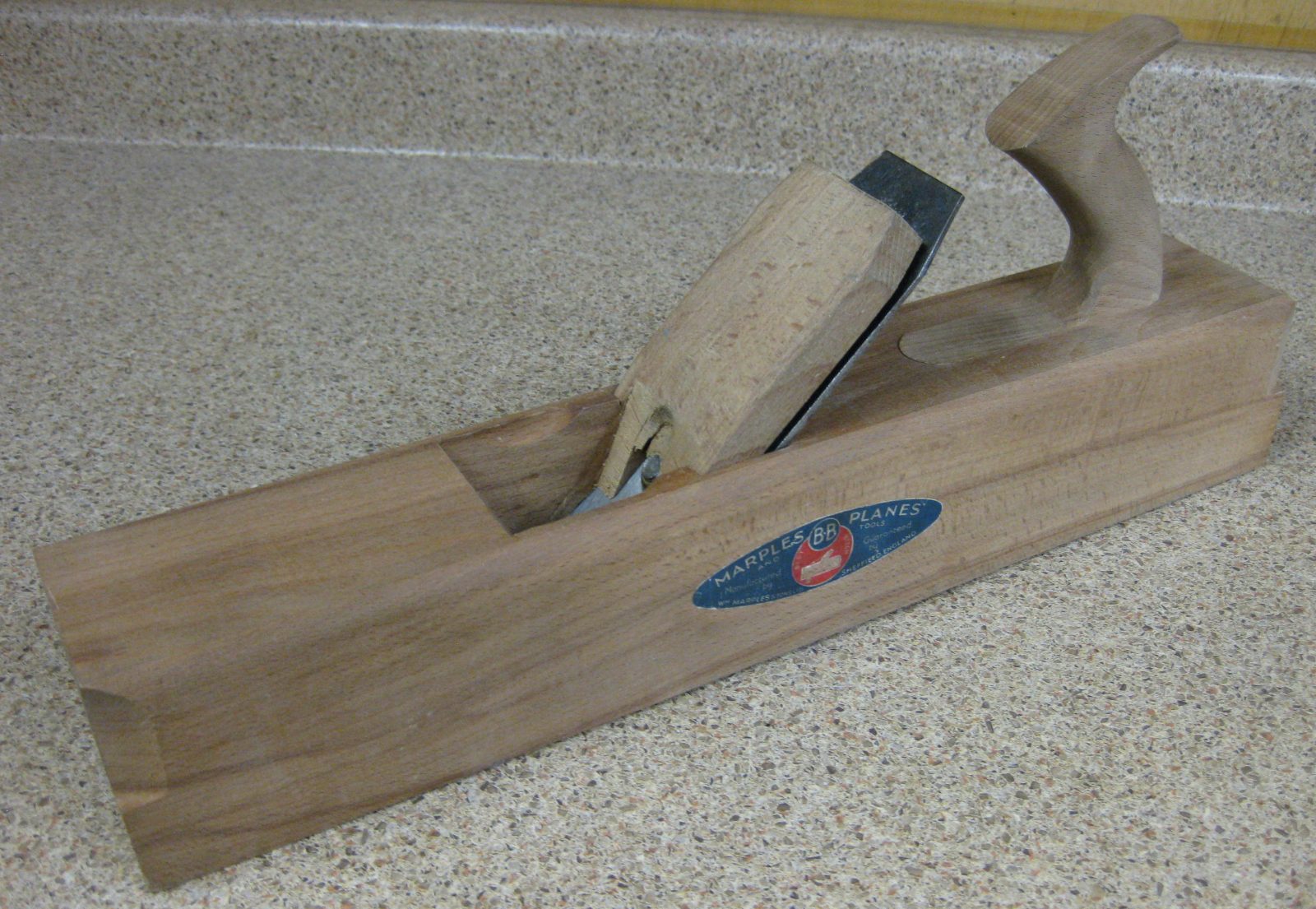
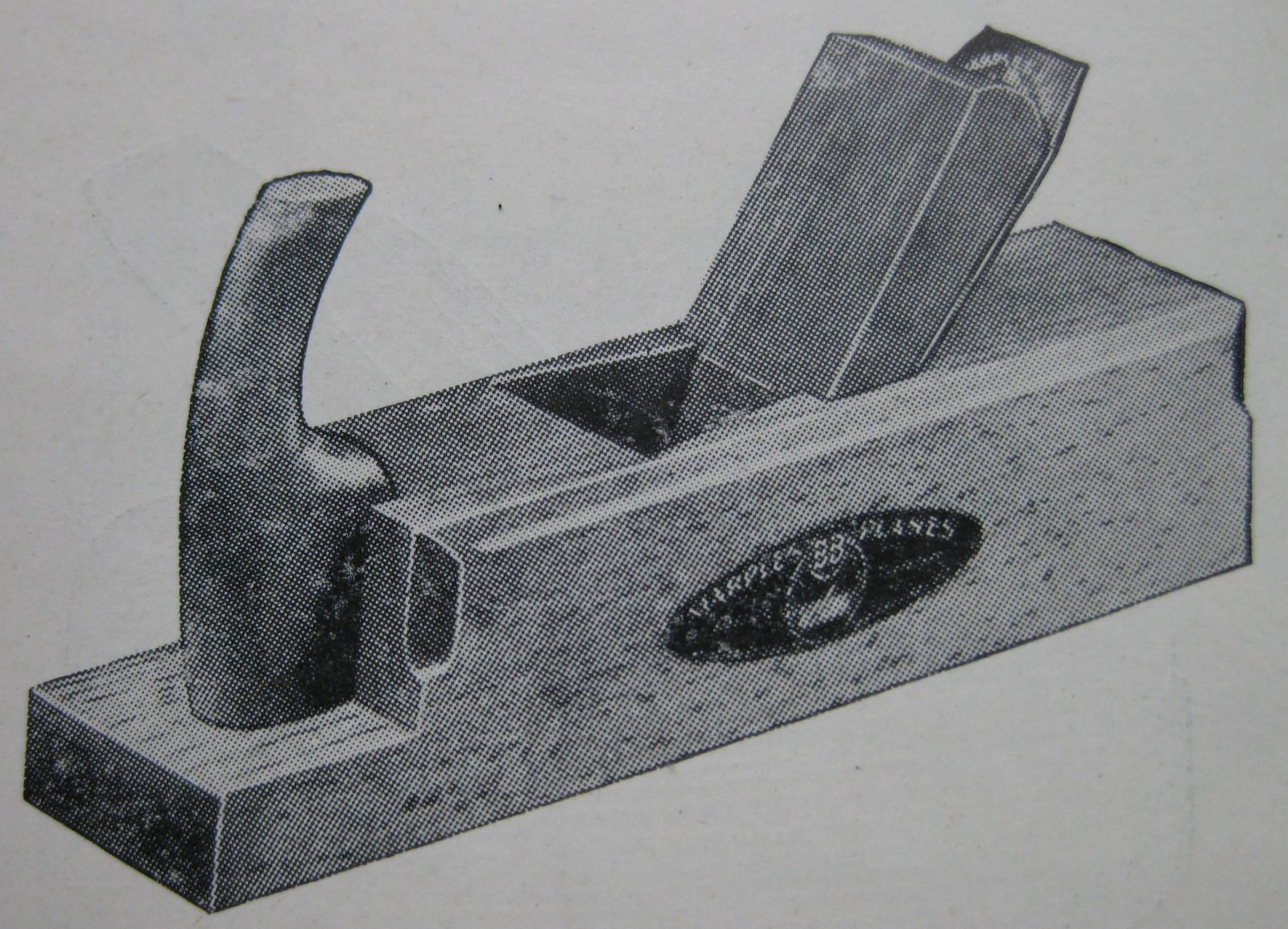
The Pocket Catalogue of February 1933 introduced a new line of wooden planes called ‘BB‘ Brand Beechwood Planes. ‘BB‘ officially standing for ‘BritishBeechwood‘, The above quote from the 1938 Hard Cover Catalogue is significant, although it does not mention that these planes were introduced as a lower priced competitor to MARPLES ‘Shamrock Brand‘ Hand Made Planes and also does not indicate that these were machine made planes [only indicating that these planes were priced lower because of ‘new manufacturing methods’]. They are first seen in the February 1933 Pocket catalogue, but it is strange that they are not shown previously with any fanfare or indication that they have been ‘newly introduced’, which leads me to suspect that they may have been on the market for a few months prior to that date. The quality was always not equal to the hand made planes and the range of planes available was quite limited. The different planes were introduced at different times and not all together on one date…see the sections below. However they were good quality user planes for anybody but the strict Master Craftsman. It is strange that MARPLES never did ascribe Item numbers to these planes and they were always listed by name only. It is hard to judge, given insufficient evidence, whether these planes were produced during the War, but it would stand to reason that the Hand made ‘Shamrock Brand‘ planes may have thus suffered in favour of the Machine made ‘BB‘ planes during that confrontation. [Because many of the Hand Craftsmen would have been conscripted into the Forces]. I also cannot presently state that all the planes were supplied in cardboard boxes as I have only seen boxed examples in some of the planes, but it seems most likely. Below you will see a small leaflet that was included with BB planes to indicate that only a very light coat of Linseed Oil ‘occasionally‘ was recommended. So many of these planes turn up with an incorrect full coat finish. All these planes would be supplied with ‘Tapered blades’, as opposed to ‘Parallel blades’ and the ‘BB‘ planes were not made from the same quality ‘Quarter Sawn’ Beech as the Hand made planes…..you will find some slightly inferior wood here, more so in the later issues. The 19cm x 14cm advert [below] is c.1933.
One of the first adverts c. 1936. Other side is below.
Therefore I will be writing about the individual planes and will try to show you good examples of each, all except where I cannot locate photographs. Please note that all dates are plus/minus 3 months.
Double Iron Smoothing Planes:
These planes were introduced in Feb 1933 in blade widths of 2″; 2.1/8″; and 2.1/4″. The 1.3/4″ size was first available in Sept. 1935.
But around March 1964 only the 2″ and 2.1/4″ are listed. They are not listed in Cat. #15 of 1965 so may have been available 2/33 – 6/64. The introductory prices varied according to size and were 5/6d – 6/- each.
Double Iron Smoothing Plane 1938A Mint in Box 2″ Smoother
You may find this Mark on the toe of later planes:
Single Iron Smooth Plane:
This is a small almost one-handed block plane of 6″ long and having a blade 1.1/2″ wide. It is eventually described as being of Polished Beechwood, the only wooden plane so described, as MARPLES always issued their planes with noadditional surface coating. So why this plane is Polished is a mystery. Available 12/34-6/64 and introduced costing 3/- each. Listings after c.1954 seem to call this plane a ‘Toy‘ Smooth Plane.
The ‘Toy Plane’ is Polished. Note the different wooden wedge.
Double Iron Trying Planes:
These planes were 22″ long with a 2.1/2″ wide blade and only ever supplied with a closed handle. Available 2/33 – 6/62 In 1938….10/- each… but a ‘PriceReduction‘ insert in this Catalogue states that the price is 10/6d!!
Trying Plane 1938
Double Iron Jack Planes:
These planes were supplied in 3 sizes: 16″ long with a 2″ blade; 17″ x 2.1/8“; and 17″ x 2.1/4″. Available 2/33-6/64, but in March 1964 only the 2″ and 2.1/4″ sizes are listed. From early 1950s onwards they were available with either an ‘Open’ or ‘Closed‘ handle.
Double Iron Jack Plane 1938
Below is a 2.1/4″ Double Iron Jack plane in the box:
Double Iron Technical Jack Planes:
These planes were slightly smaller than the Double Iron Jack Planes, had a Boxwood striking nub in front of the mouth and a stepped down [‘sunk’] lower rear handle area. [These characteristics were shared with the ‘Shamrock Brand‘ Hand Made planes.] They were manufactured in 2 sizes, 14″ long with a 1.3/4″ wide blade and 14″ x 2″. Available 2/33- 6/64. 1933 prices are 9/- each. From early 1950s onwards they were available with either an ‘Open’ or ‘Closed‘ handle.
Double Iron Technical Jack lane 1938
Skew Rabbet Planes:
These came initially [2/33] in 3 sizes of 1″; 1.1/4″; and 1.1/2″. All priced at 3/6d in 1933. In 4/35 the 3/4″ size was introduced. Available 2/33-6/64, although in March 1964 only the 1″ and 1.1/4″ were offered.
Skew rabbet Plane 1938
Skew Rabbet showing an ‘early’ label.
Adjustable Rabbet and Fillister Plane:
This adjustable [‘moving’] bottom fence plane came with a 1.1/2″ wide cutter. It was offered for sale between 1/34 and 6/62.
Adjustable Rabbet and Fillister Plane 1938
Adjustable Rabbet and Fillister plane
Fixed Grooving Planes :
These were first supplied in 2/33 with a single 3/16″ Iron and could be had for 4/- in 2/33 & 3/3d each in 1938. They were available for only a short time between 2/33 and 6/40. Another victim of Mr. Hilter!
Fixed Grooving Plane 1938
Moving Grooving Planes:
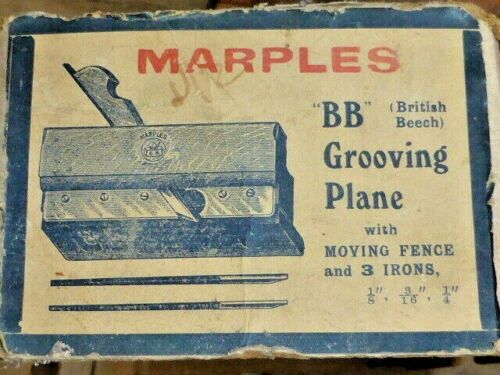
Although these planes may sound very ‘Hip’ they served a worthwhile function. Introduced in 2/33 at 6/6d each they came with 3 blades, 1/8″; 3/16″ and 1/4″ widths. A ‘Price Reduction‘ insert in the 1938 Cat states their new price as 5/6d each. These planes were available 2/33- 6/62.
Moving Grooving Plane 1938
Most often found with only 1 blade.The fence is adjusted via 2 screws under the main body.
Plough Planes (Wedge Stems) :
These always came with a matched set of 8 Irons [1/8″- 9/16″] and the complete plane could be initially bought for 15/- in 2/33. These planes also had a Screw Stop plate actuated by a brass Thumbturn screw on the top of the plane. Available 2/33- 6/62.
Plough Plane with Wedge Stems 1938
The arms had no brass ferrules at the ends. Early model shown here.The Boxwood wedges are plain tapered with no fancy head.
The cutters were straight tapered with no curvature at the top end:
Box end shown below:
Plough Planes (Screw Stem):
Again, below is another casualty of Mr. Hilter in that this plane was only available 12/34-6/40. The arms and securing nuts each side of the body were all of Beech, but the nuts were ‘polished’. 1933 price of 17/6d each.
Plough Plane with Screw Stem Arm 1938
The wedge here looks as though it has had a hard life!Note the BB marking on the skate.
Single Iron Roughing Planes:
The real introduction of this plane is in question. It is first seen in the May 1938 Hard Back Cat. but does not show in the October 1938 Pocket Cat. or even that of the March 1940 Pocket Cat. Perhaps nobody remembered to update these smaller Catalogues?? They were issued with Square Irons as standard in 3 widths, 1.1/2″; 1.3/4″ and 2″, but round nose Irons could be supplied at the same price on request. It would therefore appear that this plane was available 5/38 – 6/62. Because they were ‘Roughing’ planes and subjected to hard use in hogging down a board’s surface not too many of these planes can be found intact. Therefore they may now be considered to be somewhat ‘rare’.
I have a BB plane with a rounded edge original cutter that has this label affixed to the wedge. The label size is 2.1/2″ x 1.5/16″ wide.:
Presently I do not know whether this label was a standard label on these planes or whether these planes were destined for export only.
BB Plane Labels:
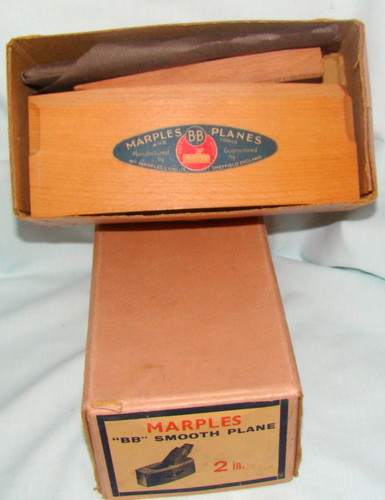
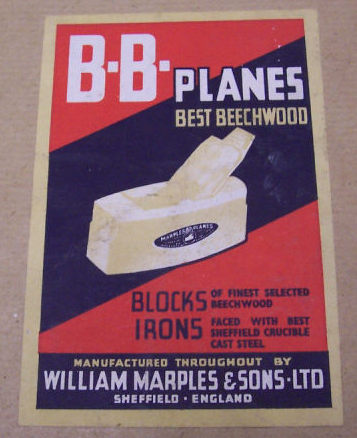
So far I have found only 2 styles of paper labels that were affixed to the Left hand side of the BB plane bodies. I believe that the BLUE label is the earlier version and may have been replaced by the more colourful variety around 1936. This earlier version indicates ‘BRITISH BEECHWOOD‘ whereas the later coloured variety shows ‘BEST BEECH‘.
The Wedge label seen below is quite rare and it is a wonder that any at all survived. I do not know when these labels were used, but probably only on the earlier BB planes.
Here is what is says:
MARPLES
This is a MARPLES “BB” PLANE. It is made from BRITISH BEECH, the best timber for the job. The hard close grain only found in British Beechwood means that it will weather better and withstand the weather better than Europ ean timber. The cutting iron is faced with MARPLES world-renowned Crucible cast TOOL STEEL. especially heat treated to retain a keen cutting edge without const ant regrinding. First cost is not everything. As Plane makers for more than 100 years we fully GUARANTEE this tool. Wm Marples &Sons Ltd. SHEFFIELD, England.
The cardboard box always had the colourful label, shown below, attached to the Top of the box. But I have discovered that 2 styles of this label exist, shown right below. You will note that the label marked ‘Best Beechwood’ appears to be later than the one marked ‘British Beechwood’. [Also note that the ‘British Beechwood’ label shows that the plane is made of ‘Fine Selected English Grown Beechwood’].
And the end of box label followed these lines:
BB Planes ‘stamp’.
The image below depicts the only stamp that was used to mark the Toe of all BB planes.
OTHER WOODEN PLANES
The name ‘BB‘ Plane seems to have ceased when C&J Hampton [RECORD] took over the Marples firm c.1962 but planes [shown below] are listed in the 1965 Catalogue. These did not carry the ‘BB‘ insignia, but were a continuation of that line until c.1968. These planes were numbered #2694 to #2699 and the toe was marked as being Wm. Marples & Sons.







 .
.


 The mark on the toe [above] looks similar to the c.1960 Cap Iron marking.


 HIBERNIA is shown on the blade, but no mention here of ‘Sheffield‘ or of ‘England‘. Therefore C.1890? Which explains it having no transfers, since these were introduced, I think, around 1905. There is a letter mark here of ‘L‘. Heel marking of 2.1/4 but no ‘IN‘ seen. Is the exclusion of the INches mark any indicator of the age of the plane?. But again I have to research as to when the blades had a stamp that included a Letter, and what did this Letter denote… A












 Again, an almost complete set of #845.