The premier site for William Marples & Sons Tools.
Author: Roger Ball
Gauges
Gauges may have been the first tool that William Marples Jnr. produced and probably totally by himself in a small workshop. All of the components would have been personally produced by him and then the items put together for sale. Unless the quality was good it is unlikely that the venture would have flourished as it did, thus allowing William to expand and eventually have various Little Meisters around Sheffield produce components for him.
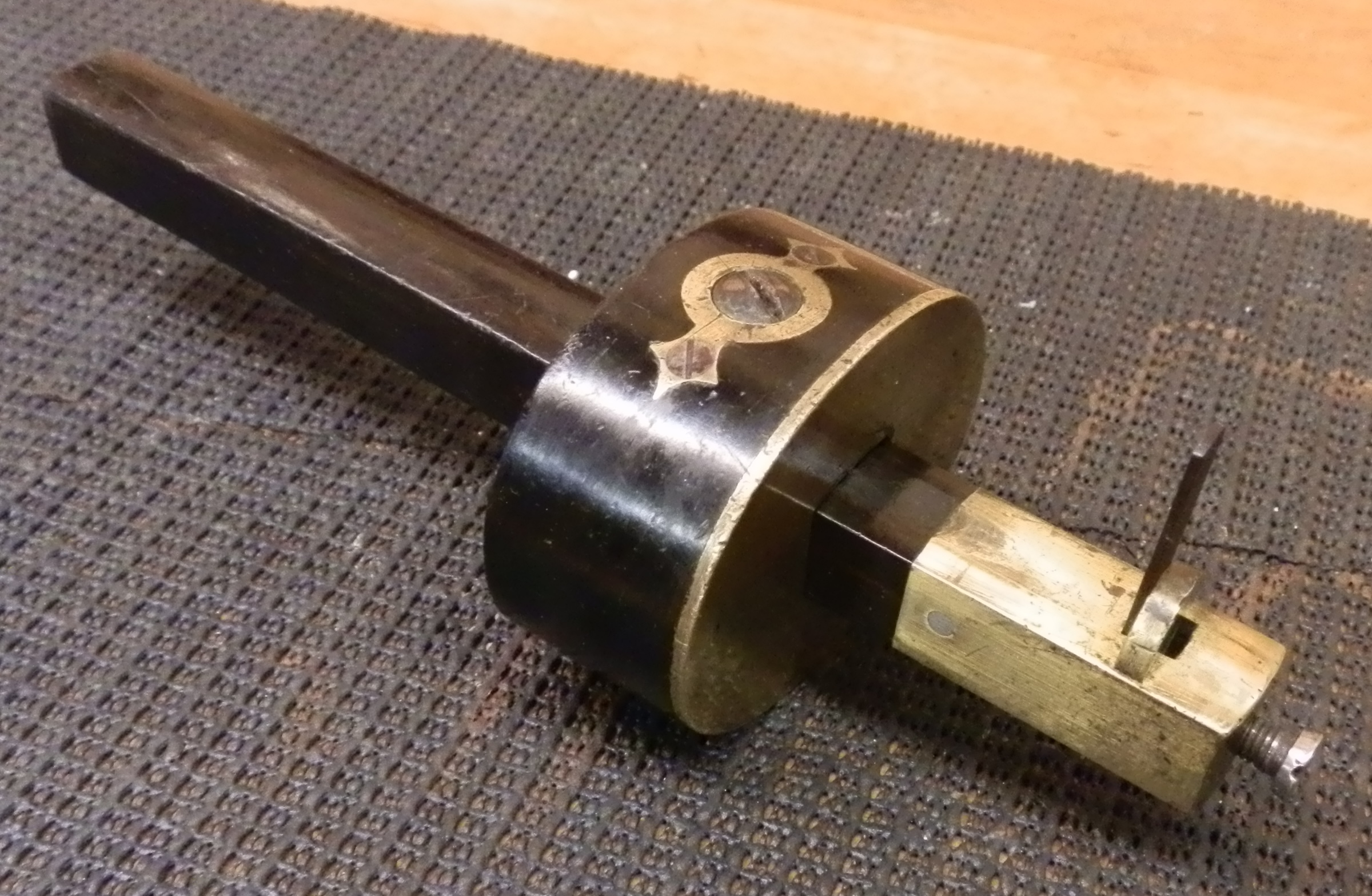
One of these first Gauges is shown below and I believe was personally made by William Marples Jnr. . It perfectly displays the first mark that we can associate with MARPLES…. W. MARPLES JUN and shows some wonderful irregularity in the handmade Brass shield plate.
Presently, I am unable to positively locate this Gauge in the 1846 Broadsheet Gauge descriptions, shown below. Perhaps it is a ‘Mortice Gauge, Head faced withBrass,Turnscrew Screw Slide‘ 56 shillings per dozen!!
Here below is what I think is listed in the 1846 Broadsheet as ‘ ImprovedMorticeGauge, with Improved stem‘. [96/-doz.] The difference to the Gauge above is that the brass is continued as a strip back to the front tip and provides a bearing surface of Brass for the Head screw to bear against, rather than just the wood. Everything about this slightly later gauge is as per the first Gauge, except the brass wear strip on the top surface. Again the wood from which this Gauge was made is not mentioned, and at this stage it is hard to discern whether it is Rosewood or Ebony. But the weight would indicate Ebony.
The mark [ 3/4″ wide] on the Gauge is one I have never seen before, but since it states ‘Hibernian‘ this must refer to the ‘Hibernian‘ works, which the MARPLES factory was called up until 1859, when MARPLES moved to Westfield Terrace, and then the name was changed to ‘Hibernia Works‘.
Below are 2 ‘Improved Mortice Gauges with Improved Stems‘ showing the Anchor Mark [1838-1859]. The stems are 6.3/8″ long and the gauges are identical except one is Ebony and the other is Boxwood. Note the Round escutcheon plate rather than the earlier ’round plate with ears’.
Here is the section of the 1846 ‘Broadsheet’ that shows the Gauges that were available. This sheet shows no images so it is hard to guess how some of these tools looked. [Gauge, Rowters, per set of 8 ?]
The Mortice Gauge below is what I believe to be shown in the 1846 List as an ‘Improved MorticeGaugewith Improved Stem Patent with Rack 120/- per doz. The wood is Boxwood and the solid brass edge on one side is ruler marked up to 4 inches. The Head position is set by rotating a slot screw on the side which is directly connected to a gear wheel that engages the steel slotted toothed ‘rack’, [which runs the length of the gauge on the side opposite to the ruler markings]! The Head is then coarsely moved along the shaft and then fixed at the dimension needed on the shaft by the usual slotted bolt on one side of the Head. [see photos below]. The slotted screw at one end of the shaft moves the moving point to select the mortice width against the stationary point.
This gauge may have only been manufactured c.1840-1850. It does not appear in the 1861 Catalogue.
The 1861 Catalogue below lists the Gauges available and with some copper etched engravings to show the actual tools. But there are no Item numbers allocated to each tool, which would have made ordering somewhat difficult! Luckily, by 1873 this had been corrected.
Pictures below are of the ‘New Cutting Gauge’ shown on the pages of the 1861 Catalogue listed at 30 shillings per Dozen. It is made of Boxwood and the stem is 10.1/4″ long. I think the screw in the end should be ‘cheesehead and that the brass keeper may not be correct, This Boxwood variety does not appear in the 1873 Catalogue:
The entries in the 1873 Catalogue are shown below.
The REGISTERED MORTICE GAUGE shown listed in 1861 and 1873 [above] was a strange device whereby the Head was moved along a threaded rod via a slotted screw mounted on the end. The point closest to the head was itself internally screw regulated from the end of the stem:
As a continuation of the REGISTERED Mortice Gauge I should report that the above ‘External thread’ pattern shows no MARPLES marks but I have found yet another gauge that I believe fits the ‘Registered‘ description. This gauge has internal screw controls at each end of the stem. One of these adjusts the point closest to the Head and the other controls the Head position. The point closest to the end of the stem is stationary. When looking at the photos below please appreciate that I believe this gauge has been modified in that the stationary point has been filed off and the moving point has been broken/removed and a cutting gauge point fitted. Also the mechanism that connects the Head with the internal screw thread has been lost. This is a mechanism that I cannot fathom as to how the Gauge was assembled!! The Head has MARPLES markings as can be seen, namely: W.MARPLES, the Anchor Mark [1838-1859] and SHEFFIELD. Then below that is REGISTERED No 1398 and MARCH 23 1848. [This date has been confirmed by a UK Patent office search].It is very possible that both internal and external head adjustments were covered by the same Registration number. I do note that the ‘External’ version has no Head securing screw. I am still pondering which version came first but I suspect that the internal version was first and failed in actual use, so was converted to the external threaded rod version. I do not know when this ‘Registered‘ design was no longer manufactured but it is not mentioned in the 1888 catalogue. Photos follow:
The Head adjusting screw
The movable point adjusting screw [above].
Note the filed off stationary point and the missing movable point with a cutting edge inserted behind.
The internal screw thread to which the Head was attached
MARPLES mark and Regd. markThis is a look thru’ the brass faceplate that shows the T shaped cutout in the wood to accommodate the attachment mechanism of the Head to the Stem threaded rod. But how?
The 1888 entries are next:
The 1897 catalogue has the entries shown below:
Next here are the 1909 Catalogue entries:
The 1921 entries are below:
1928 entries below:
Shows a vast increase in the number of models then available.
1938 entries are now shown below:
Below are the 1959 entries:
Here are the 1965 Catalogue entries:
I note that in 1959ALL Marking/Cutting Gauges have a plastic thumbscrew, [but the old pictures show Boxwood Thumbscrews!!] that may have been a milky/Cream colour. The 1965 Catalogue [above] gives us a better clue in that the pictures now show a yellow transparent plastic thumbscrew. You may also find a translucent milky thumbscrew [see later]
This 1965 Catalogue [with new pictures] shows that at that time, SLOT screws were still used [as opposed to the Cross Head (Phillips) screws. But the picture may not be accurate as Phillips head screws were used from 1963 onwards].
1971 Catalogue entries:
This catalogue still shows plastic thumbscrews to secure the Stock and has the same pictures as in 1965.
I think that this [below] example of M2050 is slightly after 1971. At that time the plastic thumbscrews had been replaced by Round pot metal or Steel [brass finished] knurled screws:
1977 Catalogue entries show that Gauges 2052 and 2040 are no longer listed.
1996 Catalogue entries shown below:
Indicate that new Stock designs were available from those previous, but these may have been introduced earlier than 1996 But the MR2049 Economy model has ‘brass’ [probably plated steel] thumbscrews to secure the Stock to the Stem.[see an example below] {MR=Marples Ridgway} The #2120 is by now no longer available. Only the deluxe Model #M2154 had brass facing strips on the Stock face. All these models were made from ‘Hardwood’.
The photo below shows the MR2049Marples Ridgway marking gauge:
This MR 6828 is first shown in the May 1991 Catalogue and is shown in the November 1991 Catalogue. [Both shown below] It was short lived under this number and it looks like a progression of the M 2153. MR definitely means it was produced under the Marples/Ridgway banner. But the mystery is why the picture below and the description of 11/91 indicate a ‘pull slide’, whereas the picture of 11/91 shows a screw slide??
1998/9 Catalogue entries:
Of note here is that the Gauges have been completely redesigned.
They are now made of ‘Plantation grown’ Rosewood, only the Gauges with brass thumbscrews have a polyester friction pad between the thumbscrew and stem. Previously this would have been a circular steel washer to prevent damage to the stem from the brass thumbscrew. All but the Economy MR2049 have ‘brass facing strips’ [plated] on the front of the Stock.
Below is the MR2049 from that era:
Irwin Jan 1st 2006 Catalogue:
Only listed here are TM2050; TM2153; TM2154; TMR2049and TM2083 –probably all manufactured in Sheffield.
Presently I have no idea what the prefix ‘T‘ denotes. [Maybe Thumbscrew]
Below you will find a table depicting the availability of MARPLES Gauges plotted against time up to 1965. After that time I have just included further notes.
This has been a very large task, extracting the information from the Catalogues that I have and plotting them against time. Then again, the descriptions given to the Gauges varied over time and this has delayed the process in order that I may confirm that the details are accurate. Add this to the fact that there were three changes of Item numbers [1873, 1897 and 1909] for any one single item and you can imagine the problems involved to sort these Gauges out into a correct and chronological sequence.!!
Of necessity I have had to truncate the descriptions of the items in order to get everything into a table format [1861-1965] and therefore I have produced below a ‘translation’ of necessary short forms.
Below here is some additional information that is very difficult to incorporate into the above Charts:
#2051 was delisted c.1963
#2080 was delisted c.1963
#2081 was delisted c.1963
#2153 was delisted c.1963
#2117 was delisted c.1963
#2123 was delisted end 1963
#2140 was delisted c.1963
#2154 was delisted c.1963
#2154T is still listed in 3/64
#2153T is still listed in 3/64
There is just not sufficient Data presently available to establish the ‘withdrawal’ date of items after 1938 until 1959, but the January 1955 Price List does give us the following information:
#2153.1/2 still listed in 1/55
#2154.1/2 still listed in 1/55
#2042 still listed in 1/55
#2116 NOT listed in 1/55
#2119 NOT listed in 1/55
#2123E NOT listed in 1/55
#2120 still listed in 1/55
#2150A NOT listed in 1/55
#2151 NOT listed in 1/55
Plain, Faced, Plated or Ring-Plated?
Below you will see the differences between these configurations.
Left to Right: ‘Ring-Plated’, ‘Faced’, ‘Plated’ and [below] ‘Plain’.
‘Plated’ does not mean that the metal is coated with a thin layer of Brass!
Examples of some Marking Gauges:
Gauge #2040, Beech, Unpolished Square head, Iron Thumbscrew, Ruled.
From this example I deduce that the Iron Thumbscrew was Brass Plated [as evident from the threads.] It was not issued with a circular protective iron/brass ‘keeper’ at the end of the screw in order to prevent damage to the arm. The Iron Thumbscrew was used up to at least 1939 but after the War the Catalogues indicate that the Thumbscrew was made of Plastic.
[On all quality Gauges which had a metal screw or thumbscrew to secure the Head, there was always an indentation at the inner thread end of the head to encompass a ‘keeper’ and so that the keeper could lie level to enable the shaft to be inserted.]
2040 gauges shown below:
Another example is below:
But after the War we see Plastic!:
Gauge #2053R Rosewood, Half Round Polished Head, Brass ‘plated’ with Boxwood Thumbscrew. Listed first in 1928 but not shown in 1938.
A very late model M2050 is shown below Left, and to the Right is No. 2050 that is c.1965-71
Sometime around the 1965 era a translucent milky white plastic thumbscrew is to be found. Probably it came after the clear Yellow thumbscrew:
Another M2050 is shown below in original late Record/Marples packaging:
Marking Gauge #2054
This Beechwood Marking Gauge is shown in the 1897 Catalogue as being item #632..’Beechwood Marking Gauge with [Boxwood] Thumbscrew and with a Brass-Faced head’. In 1909 it was re-numbered to #2054 and existed under this number until the 1928 Catalogue. {But is not shown in the 1921 Catalogue.} It did not appear in the 1938 catalogue. It may therefore have been available before 1897 and up to c.1930.
Gauge #2066 Patternmakers Small Beechwood, Unpolished with Wedge. 1909-1928+ These had a Registration # 321295 [1898] and a Patent # 14734 It is not shown in the 1921 Cat. but re-appears in 1928, but no further. In 1909 they were listed at 5/6d per Doz.! The tapered holding wedge slides in a groove along the arm.
Another is shown here:
8 inches long.
I have found that there was a larger produced variety of this marking gauge, still with the same Reg. number and Patent number. But it does not show in any catalogue. Below is a photo of it on the right with 3 of its’ smaller brothers:
Gauge# 2052 Beechwood, Half Round polished Head, not plated and with a cream coloured Plastic Thumbscrew. This one below is from around 1960. Issued from the very beginning and until 1965+
.
The #2052 below is from c.1938 is Beechwood, with a Half Round Polished unplated Head and Boxwood Thumbscrew.
Gauge # 2052B. below is c.1928 and has a Polished Half Round unplated Boxwood Head and Stem with a Boxwood Thumbscrew. [Unfortunately the latter was not restorable to its’ original colour]
Above are 2 types of #2053, both with slot screws but the Thumbscrew has changed from Opaque to Clear Yellow Plastic. [The latter were not marked as MARPLES]
Here below is another Marking Gauge that I cannot positively identify . In the 1888 Cat. it is shown as ‘London-pattern’ Oval Head Beech gauge with [Boxwood] Wedge [#635]. [shown immediately below] But no mention is made of a Boxwood version.
The same Beechwood gauge is shown in 1897 as #635, but again a Boxwood gauge is not mentioned. So I wonder if this totally Boxwood gauge [below here ] is #636 which may have been listed in a catalogue before 1888. In the 1888 Cat. a #636 gauge is mentioned but is totally different in description.
Here below is a really strange Marking Gauge. It is made of beech and has a six sided head. The set marking dimension is locked in by turning the stem into the Head because the stem and head are formed in an offset elliptical pattern. As the stem is turned it locks into the head. Hard to explain, see the photos. I find an illustration in the 1888 Cat. listing a#626 ‘Registered SelfFastening Marking Gauge‘, but the picture shows a Cutting Gauge. The Cutting Gauge is actually #629[plated] whereas this Marking Gauge is listed as ‘Plated’ and numbered #627. I cannot see it in either 1873 or 1897 Catalogues., so it was available only between maybe 1885 and 1895?
Regd. #2411 was from 1884 when the Registration Numbers started, but I believe that this Gauge comes from before that time…c.1875.
Examples of some Cutting Gauges:
Gauge #2091. This Rosewood Cutting gauge with Boxwood screw was only listed in 1909 and was closely related to Item#2092 [below].
Gauge #2092. Rosewood with Boxwood Thumbscrew, Brass Hooped. Was available as #640 in 1888 Cat. and in 1909[#2092] but was not listed in 1921 [dropped in WW1?] but again is listed in 1928, but no further.
Gauge #2095. Ebony ‘New Pattern’ Cutting Gauge. Brass Hooped with end securing screw. This is a very old gauge available since 1861, [numbered 472 in 1873; 643 in 1888 and finally 2095 in 1909]. Not shown in 1921 but reappears in 1928 and no further. The Stem on this Guage is 10″ long. Two different Gauges are shown below.
Gauge #2096
This Ebony Cutting Gauge appears in 1873 as #475 and in 1888 as #646 ‘Ebony ImprovedCuttingGauge‘. Faced Oval head with a 10″ stem. It became #2096 in 1909 and persisted through 1928, but is not listed in 1938.
Gauge #474
Ebony with Boxwood Head Screw with both Head and Stem Brass ‘Faced’. c.1873
The same reference is seen in the 1888 Cat. with again only Ebony being shown but the number is now #645. In the 1897 Cat. it does not appear.
#2090c.1909 is the closest that I can come to identifying this all Boxwood guage [below] , but this item number makes no mentioned of the Stem being ‘Hooped’.
This Cutting Gauge below may be a modified #2066 Patternmakers’ Marking Gauge, since I can find no reference to this Gauge.
Gauge #2083. Beechwood, Half Round [?], Polished and Plated Stock[Head] This example is c.1973 with Phillips screws and plastic Thumbscrew. Later models show no ‘MARPLES’ insignia on the Plastic Thumbscrew. [last photo below]
Below is a late model M2083 Cutting Gauge. Not ‘plated’ and with Steel Brass plated head screw.
#2090 [below] is a Cutting Gauge that I can only find in the 1909 Catalogue, so it may have been short lived.
#2110 [below] was originally introduced in 1897 as Item #647 and then changed to #2110 in 1909 or before. It is a Beech ‘Combined Pencil-marking and Cutting Gauge’, plated with a Boxwood thumbscrew.
Below are 2 more pictures of a different #2110 Gauge.
Mortise Gauges:
Having being unable to give a number to these 2 full Boxwood gauges, I am tending to assume that maybe [unless specified differently] ALL the very early gauges were made of Boxwood, and therefore why need to mention it in the listings! These 2 are obviously very early as shown by the ‘fancy’ brass inlays around the head securing bolt.
More examples will show whether this theory is correct!
REVERSE END TURNSCREW SLIDE:
This unusual Mortice gauge is listed in the 1846 list, but with no picture.
The 1861 catalogue does give us a picture but again no wood type is mentioned, but I am sure that this would have been Ebony. In 1873 the gauge is given a #486 which changed to #661 in the 1888 Cat.where it is stated to be made of Ebony. Although noted in the 1897 Cat. the gauge has been changed slightly in the the head is brass ‘faced’, as opposed to ‘plated’. It is not seen in the 1909 Cat. The gauge below has been put together incorrectly. The head tightening bolt should bear on the brass strip that runs along the full length of the arm opposite to the moving point arm.
This gauge is different to most other Mortice gauges in that the moving point is on a T slotted brass runner which is controlled from the frontend by a slot screw
‘MORTICE gauge, Thumbscrew Slide, Head faced with Brass.’ 68 shillings per dozen in 1844. [Shown below] Full Boxwood.
In c.1861 this may have transitioned into Rosewood, becoming #484 in 1873 and eventually #2121 in 1909, and available until c.1928.
Again, all early Gauges had no description of the Wood employed, but Boxwood was plentiful and in large sizes at that time.
In the 1897 Catalogue the Mortice Gauge below was numbered #650, but was re-numbered #2116 in the 1909 Cat. It was a Rosewood, Plain Head, with Brass shield and a Pull Slide available…1873-1928< It does not show in the 1938 Catalogue .
The #2117 gauge was a standard gauge between very early times and 1959<, but of course with various number changes [see chart]. A standard low cost gauge [because it was not thumbscrew operated]. Made however with Rosewood and with ‘fancy’ brass and ‘plated’ head. Of course, in these early times, Rosewood would have been readily available from South America.
Below is a very early ‘Anchor‘ marked #2118 Rosewood Mortice gauge with a brass slide and full faced brass wear surface. Note the circular brass head insert with an included cup-shaped brass washer.
Gauge #2119 [below] was produced for only a short time [c.1928- 1938+] Although made of good Rosewood it was not plated but did have a Thumbscrew slide. Note the fancy circular head insert.
On the opposite side to the water transfer was stamped this mark:
The Mortice Gauge #2120 [below], seems to be the bog standard for Mortice gauges as it lasted for eons [c.1861-c1965<].
It had everything……Rosewood; ‘Fancy’ Head; plated Head; and Thumbscrew operation. I have noted that the earlier ones had the ‘fancier’ brass inserts, ….more delicate with smaller screws.
{If the head has slot screws to the top head brass ‘fancy’ insert, the head will be 2.5/8″ long x 2.1/4″ wide}.
When the Top Head screws holding the ‘fancy’ brass insert [and not necessarily the surface plate screws] changed to ‘Phillips’ the dimensions were 2.5/8″ long but only 2.1/16″ wide. There was a time when the top Head screws were slot and the face screws were Phillips.!! [see below]. Again here the rounded ‘fancy’ brass insert is the later product.[extreme Left below] The earlier variety [right in the photo below] does NOT show a knurled ring surrounding the brass adjusting Thumbscrew. [see the RHS gauge, left] But then again when there were Phillips face screws and Head top screws, there was no knurling. This latter type also shows a pronounced increased roundness of the Head on the top and
bottom edges. The 2 photos below show that the gauge with ALL Phillips screws [ right] has a more pronounced curvature to the Top and Bottom of the Head and was thinner at 2.1/16″
Below is another #2120 showing Phillips head screws throughout and more curvature to the Top and Bottom edges than previously seen..
The photo below shows that when the ‘Fancy’ insert screws were changed to Phillips, the Thumbscrew had no knurling. There seems to be such variation in the Brass slide castings around this time. Second from Right has Phillips on Stem and Brass head ‘plates’, but Slot screws for the ‘Fancy’ insert.
Mortice Gauge #2120E [below] was made of Ebony and had a plated head. It was originally introduced around 1897 as item #655, became item #2130 in the 1909 Cat. then #2120E in 1928-c.1938.
Below is an example of what eventually was numbered #2121 Rosewood, Fully plated with a Thumbscrew slide [see above details] This example may be c.1890.
Below is a later M2120 [1980’s] Record/Ridgway
# 2123 [3 photos below] Rosewood oval head gauge with circular face Ring wear Plate was made c.1909-end of 1963. It was NOT a Combination gauge.
An Ebony version of this #2123E was made c.1928-c.1938.
Below is Gauge #2125 and it was in ‘Plated’ Rosewood and had a Turnscrew end in lieu of a Thumbscrew. Available c.1861-c.1928.
These Brass Stemmed Gauges [below] with Full Brass faced Oval heads are #2140. The Brass stems seem to vary in length, earlier seem to be longer. Available since very early on up until c.1959. See the chart.
The later versions show the ‘fancy’ brass head insert as having rounded aspects whereas earlier versions show a double-star appearance. This holds true for many Marking Gauges.
Of the earlier versions I seem to find that the Head clamping screw is slightly larger than later, as is the brass insert. They always had steel countersunk oval head slot screws, being discontinued in c.1959. The length of the milled slot in the brass stem also appears to vary, earlier were longer.
Below is information on the #2145 Mortice Gauge. It is listed with no number in 1861 but the picture is not complete to show the points!! It is always described as an ‘Ebony ‘Improved’ Mortice Gauge with Oval Head, faced and with an Improved stem [the latter means that the length of the stem is brass clad on 2 opposing sides]. Listed in 1873 as #488; in 1888 &1897 as #664 and finally in 1909 as #2145. It does not show in 1928. The older unit is shown on the right [unfortunately modified to have 2 ‘cutting’ type points] and this one has a circular cup ring as the ‘shield ‘for the head tightening bolt. Note the later change in position of the screws to put them both ‘staggered’ and further from the end of the stem, due to wood breakout.
Below are pictures of a #2146 3 pin Mortice Marking gauge :
It has 2 screw adjusters, 1 at each end of the arm with each controlling one of the 2 points closest to the Head. The other point is stationary. Look at the photos below. The head is stamped with the 3 leaf clover, HIBERNIA, WM MARPLES & SONS and SHEFFIELD. Circa 1910? It is only shown in the 1909 Cat.
Note the pressed steel ‘cup’ to shield the brass on the arm from the ravages of the head securing bolt.
The photo below shows the V slot cut in the head to accommodate the point closest to the Head so as to convert the Gauge to a Regular Mortice Gauge.
But why have 3 points??
#2150 was an all Beech Combination gauge with a brass plated steel head lock screw and brass pull slide. Available 1909-c.1938. The later gauges show that the brass slide is made of narrower stock than previously, such that there are no finger indentations on each side of the brass slide ‘handle’. [Cheaper!]
Below are pictures of the short lived #2153T [Thumbscrew Head securing bolt]. This was available c.1959-1965+.
Below are 3 examples of M2153 produced by RECORD/MARPLES showing a Brass plated Thumbturn screw, ‘Hardwood’ with brass slide and still in the original Plastic moulded boxes. The left one is the earliest because of the larger brass grip area on the sliding point arm. The one on the right is the latest, despite having again received a larger brass grip area.
Below is a great example of Mahogany gauge #2153 with box c.1950?
The #2154 Rosewood, end thumbscrew operated mortice gauge with platedhead was available c.1938-1963. The head was secured by a oval headed slot bolt and earlier examples had only the mortice pins on one side. { A combined Mortice/Marking gauge was available in 1939 with 3 pins at that time {#2154.1/2}[see below] . The 2154 was eventually replaced with #2154T [below], but in 1959 both were available, the #2154T having a ‘Thumbscrew’ head locking screw. Also in 1959 both Gauges were ‘combined’ and made of ‘Hardwood’. The ‘knurled screw’ Brass plated steel round head lock bolt was introduced to the #2154 sometime before #2154T was officially introduced. Both the #2154 and #2154T always had ‘non-fancy’ heads. Below are pictures of the #2154: Note the earlier head clamping screw in the second picture.
The 2154T here [second photo above] seems to have no knurling to the slide Thumbscrew compared with #2154 immediately above here, showing knurling. But a later example below shows knurling!!
The #2154.1/2 with the additional pin, [making it a combination Mortice/Marking Gauge as opposed to the initial 2 pin Mortice Gauge of #2154] is only found in the 1938 Catalogue, so I am unsure as to when it was actually introduced and then withdrawn, 3 different examples shown below:
The M2154 was introduced with Rosewood, had brass plates and was made during the Record/Irwin Marples era c.2000. The head securing thumbscrew and the moving pin end turn screw are only steel being brass coated, not solid brass. Note the end adjusting screw is not a Thumbturn screw. [below]:
This example [below] of Combination Mortise gauge 2153T [with a Brass plated circular steel head tightening bolt] was made c.1959-1965<. and shows the slide ‘finger grip’ area as being the same thickness throughout as the actual slide. Not plated and with a non-fancy Head, the 2153 and 2153T followed the specifications of the #2154 line. The older version [#2153 second photo below] was a very old pattern that was discontinued around 1959 but it also had a non-‘fancy’ bolt to secure the head. [‘fancy’ being the term MARPLES employed to denote that the bolt hole on the Head was surface surrounded by an inserted brass plate of various designs.] Note the wider width of the brass slide finger grip area on the older pattern. The M2153 re-introduced Rosewood, had brass plates and was made during the Record/Irwin Marples era c.2000 [the last 2 photos below].
The washer to prevent damage to the stem of the M2153 was made of nylon [below left]
Above right is a later 2153 probably c.1962, not ‘plated’ and made of ‘Selected hardwood’, but showing the circular head tightening bolt. It had the additional point so as to act as a Marking Gauge, very similar to the #2153.1/2 gauge of 1938. Not marked as #2153T, but it should be!
But here [above] is the original #2153T with Iron Thumbscrewc.1959 with a Slim finger grip area and made from an unknown [probably African] hardwood
#2155 [below] was available 1873-c.1909, and this Ebony based Combination gauge is quite rare. It has a brass slide circular faced head secured by a brass screw. The under marking gauge side has a ruled brass surface. .
Here below is a Rosewood, ‘plated’ with Brass Thumbscrew slide. Non-fancy Head. Still trying to identify it!!
But the gauge above may be a #2154.1/2 as shown below. It was only listed in 1938!
A warning ticket [below] was included in the box of most later Gauges
And below we see the worst of the worst, which I cannot find in any of my catalogues. They do not come any cheaper, made of Beech with a plastic head screw and bent up brass slide. A Combination gauge that should never have been. Probably around c.2002.
And then see the next Gauge, it too a Mystery:
A Combination gauge in Beech, with a slide and marked MW 8. Made in England and therefore before 2008, but I cannot find it in my catalogues.
Other similar marks [Mitre Boxes MW3] suggest that this is circa 1989, but one example shows a finger/thumb brass slide whereas below the capture is a rounded and presumably screwed in affair. Until I can locate more info…this is all I can tell you.
Another mystery Gauge, but an important one as shown below. Comparing the impressed MARPLES mark on the head to other marks, I deduce that this gauge is c.1910. But I cannot find it listed in any catalogue. Possibly it was introduced just before WWI and did not last through that war. It has an oval Rosewood plated Head with a Thumbscrew slide, but it has a Combination stem that contains a Cutting Gauge, a Marking Gauge and Mortice gauge ability. It shows a PAT No. of 10786
OLYMPUS DIGITAL CAMERA
Bench Planes (Metal)
BENCH PLANES
Please see under INFILL PLANES for some c.1880 metal Bench Planes issued by MARPLES.
This section has been a long time coming, mainly because behind the scenes I have been collecting planes and information/pictures from Internet sites for study to determine slight differences in construction according to basic type. I will be assigning ‘Types’ to the study according to the modification/changes made over time to the last ‘Type’. These Types may be subject to change as new information is received, so do not think that the published information here is the ‘last word’.
Suddenly the William Marples bench planes, and others [including RECORD], were issued around February 1933………….. WHY? To quote from Leslie Harrisons‘ RECORD Catalogue #15 reproduction [ISBN 0 904638 146……the very best evaluation of the RECORD line of planes]…
…”The British Government import tariffs of the late 1920‘s assisted British manufacturers in combating the influx of foreign manufactured planes, mainly from the U.S.A. which at that time dominated the market. A “BuyBritish“campaign was launched to combat the depression in the United Kingdom during that period”.
Which is why so many British manufacturers got into the making of ‘Stanley’ type planes at that time!
Preamble: NOTES: The Feb/1933 (pre #3 introduction) shows no ‘Toe-screw’ for the rear handle of the 4 and 4.1/2 planes. In Jan/1934 Pocket catalogue the spare Plane Irons are described as …’to suit American Iron Planes’. Some bright spark at MARPLES must have said that this did not exactly advertise their line of new ‘M’ planes, so by the Dec/34 catalogue this has been changed to…’to suit adjustable Iron Planes’.
February 2021.. A reader has alerted me to the fact that the newly introduced M3 plane does not measure 8″ long, as advertised, but is indeed closer to 9.1/4″! It would appear that this length was maintained through Type 2 [until at least c.1937 when the Cap iron ‘grind angle’ was introduced.] This length has yet to be noted on the first M3 plane that has the number cast in the base [Type 4a.]
William MARPLES Bench Planes were introduced in the February 1933 Pocket catalogue, shown below.
[Although it may have been in the September 1932 Pocket catalogue, which I do not have!]. These planes were in fact not made at ‘Hibernia Works’ until after the war, but were made pre-war at ‘Northern ToolWorks‘, a factory owned by Turner, Naylor and Co. Ltd. [a Company with close associations to Wm. Marples & Sons Ltd.] Is is probable that most iron planes and spokeshaves of MARPLES have the same history.
By January 1934 there were some additions to the range [as shown below the 1933 issue], namely the M3 and M7. I am sure that the printers or proof readers got absolute hell for allowing the M7 to be shown as 5 shillings each, when they should have been shown as 25/- !
The tables below show the figures involved in the MARPLES manufacture of Bench Planes as time progressed. These charts are not totally finished and will be added to as new information is received.
Above :
A = Available
Blank space = Not available
* = assumed available
WD= Withdrawn
? = Presumed to have been withdrawn during the war effort.
The chart above is a summary of the prices that were asked [Price fixed] of the planes according to date. This chart should be used in conjunction with the above table so as to obtain a good idea of Bench Plane production.Not having enough money to buy 10 of each type of plane in order to write this study, I will just have to rely on observation, intelligence and a modicum of luck to deduce the Types that were issued over time, so do notblame me if I make a mistake. [I will be continually looking out for any new information that may change these Studies.] So I decided that any change in one of the major components of structure in the plane will trigger a new type. You will find that some basic components described in Type 0 endured for many years. My assumption here is that the same changes occurred roughly across all sizes of Bench Planes and so I have written thisstudy based upon the No. 3 and No. 4 plane. But please remember, that the ‘Types’ are presently not set in stone, since if I discover a new ‘Type’ I will slot it into order and then re-assign all the Type numbers
TYPE STUDY
Type 0:
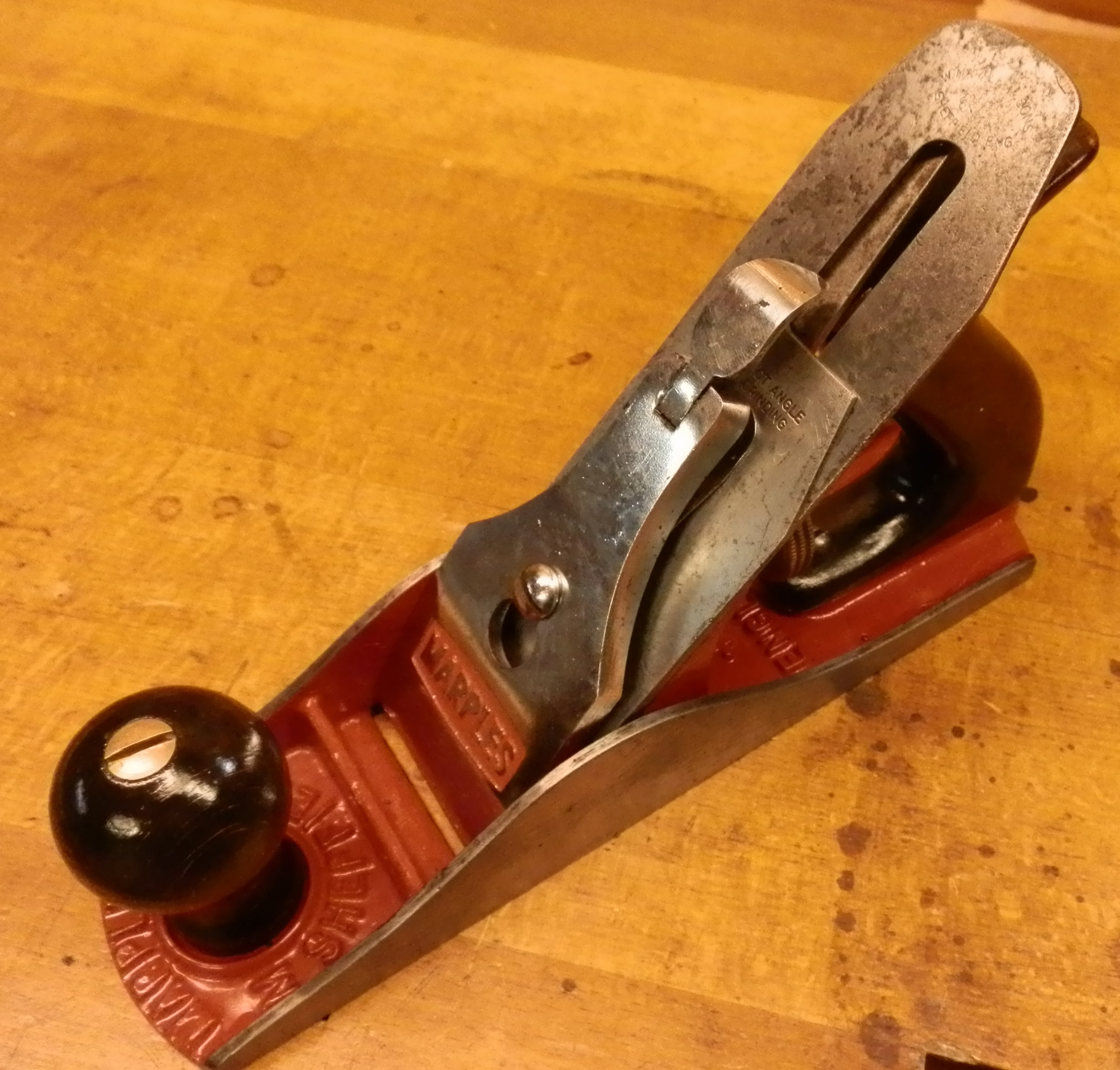
The Type 0 plane is the first metal bench plane of this series that was issued by MARPLES in 1933 or maybe late 1932. It was styled after the USA STANLEY plane and followed this route for some time before some MARPLES innovations were introduced. The example that I have is an M4.1/2 bench plane that in allrespects is the same as the Type 1 described below, except:
a] The sole is totally flat from front to extreme back with no slant to the rear tail portion.
b] The base casting around the front knob has NO Markings at all. [This is the same as the R&D plane described elsewhere] In other words the plane is NOT marked MARPLES except on the Lever Cap and the transfer to the rear handle, but is identified by the Trefoil in front of the Handle. It does have SHEFFIELD and ENGLAND each side of the handle.
So here are some other pictures of this plane:
Type 1:
Base:
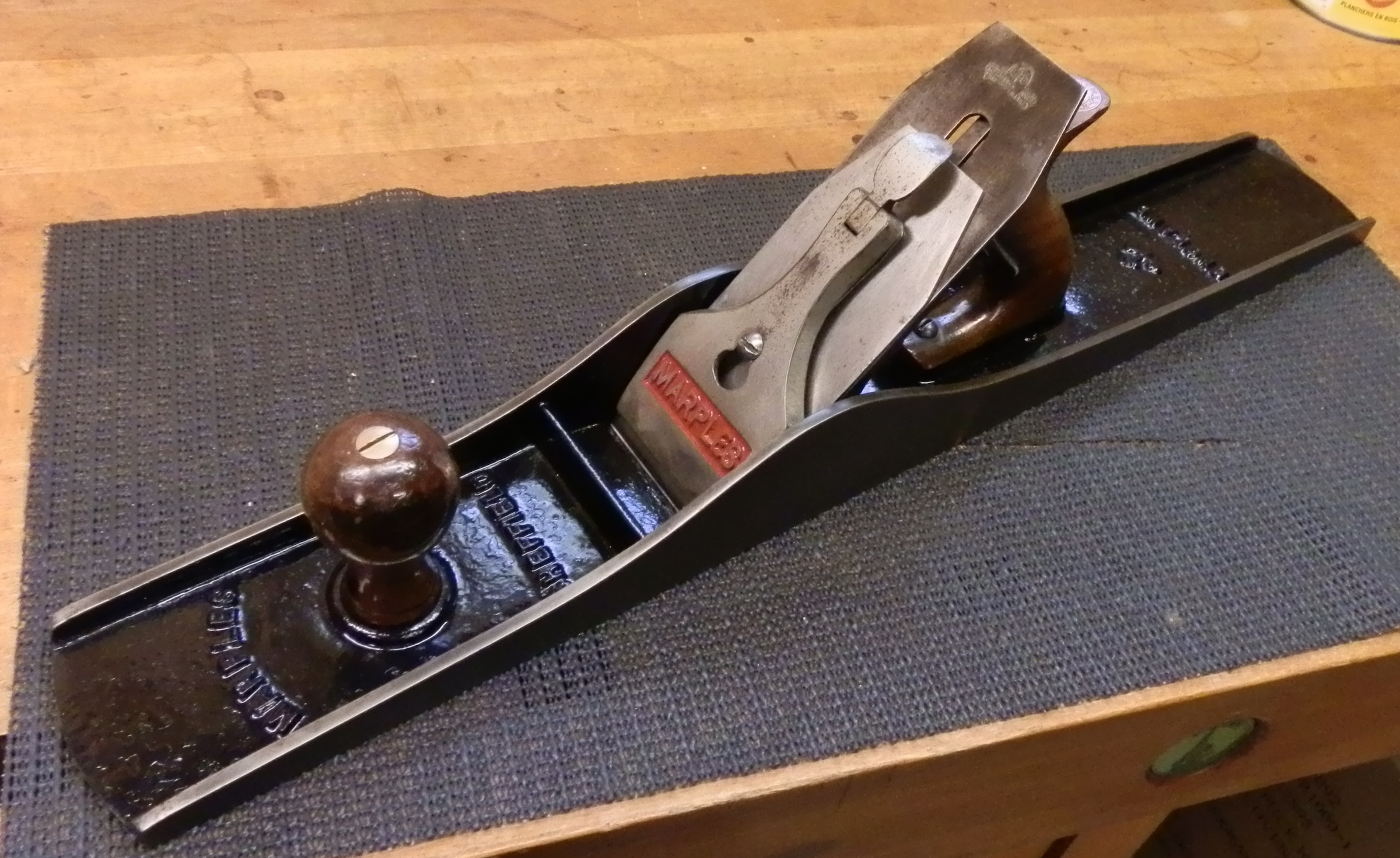
The base is painted BLACK and has the word MARPLES, in raised cast script, around the front of the knob, but there is no plane number shown. Each side of the rear handle are the words [again in raised cast script] SHEFFIELD and ENGLAND. Just behind the frog in raised casting is the ‘Trefoil’ emblem. The front edge of the base is not painted. There is now a slant on the plane bottom at the rear.
Handles:
The wood used at this time was good imported Rosewood and was Gloss varnished. The rear handle is a standard STANLEY shape and does not have the elongated top curvature as is seen on later MARPLES models, and the front knob does not have a circumferential incised line close to the base. [This may help to identify if a knob is original or not]. The Rear handle has the small MARPLES SHEFFIELD ENG. transfer affixed at the top horn end. All MARPLES Bench planes now, except No.3, have a bolt through the front nose of the rear handle. The threaded rods used to fix the handles into the base have rolled threads and are topped by the standard slotted and waisted brass cap screws.
Frog:
Again, like the base, the Frog was painted Black, except on the blade upper contact side and has a slightly curved [not Ogee] top edge. The circular disc on the lateral lever rotates and the 2-piece lateral lever has no inscription on it. The Y lever that engages the blade is cast and is not a 2 piece pressed steel affair, that came much later. [Type 7]
The Brass circular depth adjustment wheel is 1.1/4″ in diameter and appears as such on all sizes of planes. It has 3 circumferential lines of fine radial knurling and is a quality piece that has no writing inside the hollowed out recess. The frog adjuster screw, located in the base, has no knurling and the Frog is secured to the base by 2 cheese headed slot screws [that have sharp top edges] and washers.
Above shows the ‘cast’ Y adjuster and the ‘fine’ knurling of the Brass Depth Adjuster which changed later in Type 4 to a coarser knurling.
Please note the almost sharp top edges [with a slight chamfer] to these Frog Screws compared with Type 8 where rounded over screws were introduced.
Frog Adjuster screw [above], has no knurling.
Blade and Cap Iron:
The blade has the mark at the top, as shown below.
The Cap Iron is notable in that there are absolutely no markings on it and it does not have the ‘Grinding angle‘ advice cutout at the top [see Type 2]
The Cap Iron screw has fine vertical knurling.
Lever Cap:
The Lever Cap is Nickel plated and has the word MARPLES impressed into the front lower section and this was highlighted by a RED background paint.
The design of the spring affixed to the back of the Cap-Iron is unusual in that it has a bend in its’ profile as shown. Most other manufacturers used a straight spring. I have recently acquired a Type 1 #6 and this shows distinctive ball pein hammer marks on the rivet holding the spring, maybe indicating a hand assembly process. As of December 1949 the Lever Cap is described as being ‘Nickel Plated and polished’. I think that Nickel Plating might have endured until c.1950 [but was discontinued during the War years because of the need for nickel in ammunitions]. Chrome plating was introduced probably in the early 1950s.
Note the bend in the spring, probably not seen in any other maker. This shows just one aspect of the extra quality and care afforded to these MARPLES tools.
Type 2: Type 2 has all the characteristics of Type 1 except that the marking on the blade has changed. As with all MARPLES marks, they were sized according to the space available on that tool, and therefore to give dimensions of the stamps is of little value, since many different sized stamps of a similar mark would have been available.
Here again I have obtained a blade with a very similar mark [above] but with a slight variation [‘ENGLAND‘ in full]. Presently I do not know definitively into which Type it should be placed, but the total width of the mark is 13mm and total height is 6mm, which is quite a small mark. The ‘ENGLAND‘ mark may well be in the Type 3 area.
Major difference with Type 2, the previously plain Cap Iron is changed to now have a profile on the top edge that can be used to judge the ‘Correct Angle For Grinding‘ of the iron. This new feature [above] is shown in the 1938 catalogue, so it may have been introduced slightly before then.
[I just wonder how often this modification was actually used, having seen so many planes with this cap iron but which had wildly incorrect grinding angles! [Some as steep as 60 degrees, no wonder they were for sale!….” Damn tool doesn’t work worth a spit!”] It is now possible that the number 3 planes had a screw inserted through the toe of the handle and into the base, but this has yet to be verified.
In planes larger than 4.1/2 the word ‘SHEFFIELD’ is cast behind the front knob and the word ‘ENGLAND’ and Trefoil are cast behind the handle, due to space availability.
Type 3:
The major change in Type 3 planes is that the Ogee frog has been introduced and this can be seen in the 1938 catalogue, so it may have been introduced shortly before then.
You can see that this frog has 2 connected ‘windows’ cast into the lower section and 2 oblong sections cast into the upper section,
{This is the only example I have that shows these ‘windows’, all the rest of my planes show a totally flat finish to this top surface. So a possible explanation is that the ‘windows’ may have been ‘cast in’ to enable the depth of the hand finishing process to be more easily judged [?] . [Surface grinding or sanding]}
The circular disc still rotates, the wood is still Rosewood and the paint is still Black on Black.
Type 3a:
Has a Non-OgeeBlack Frog but is on a Red base. The Y lever is still a one-piece casting and the 2-piece Lateral Lever ‘disc’ still rotates. Rosewood is still used for the handles. BUT the Brass wheel is a SOLID casting having no indentation on the back surface. [The example shown is an M3 so there is no room for SHEFFIELD to be cast behind the front knob]. This is the first Type actually marked with the ‘M‘ number just forward of the mouth crosspiece.
Type 3b:
The wood is still Rosewood, solid Y lever,and the Solid nut has 3 fine circular rings of straight knurling. The Black OGEE frog does not have re-inforcing around the lateral lever attachment point. The base still has the M number casting behind the front knob. There are no markings on the 2 piece lateral lever. The Lever Cap is still nickel plated. The blade marking is shown below. Base paint colour shows as a Crimson Red not Flame Red as later.
Shown here is the new mark but most often the lower left corner outline is reduced, possibly a stamp failure/wearing, as seen left.
IMPORTANT NOTE:
It is entirely possible that around this time [post-war] many planes may have been assembled from a mixture of old parts in stock just to get the orders out of the door. Did ‘users’ really care about what shape or colour was the frog?
I am trying to put some rationality into the production line, but maybe, at this time, there was none!!
I am now in ownership of an M4 Black Ogee frog on Red base with Solid nut and Beech handles. WD 1941. and also a WD 1941M5 Black Ogee on Red Base with Nickel plated Lever cap and Beech handles.
Type 4:
Still shows the Black on Red (Black Ogee Frog on Red Base).
[December 1949 information says that the bases were enamelled RED, but for how long this had been in effect is pure conjecture. I suggest since c.1944, but it could have been late 1930s. I have now seen a Military issue M4 Type 4 with a Rosewood knob and Beech handle but with a date of 1941, which suggeststhat bases may have been Red from 1941 onwards. But I still think that the Frogs were painted Red after c.1944.] The mark on the blade is as Type 3b. The base has the same casting as before with a Number M4/M5 etc. directly behind the front knob accompanying the word ‘SHEFFIELD‘.
The Circular disc on the lateral lever may or may not rotate, I have conflicting evidence in my samples.
The Round Brass depth adjuster knob has a coarser knurling than before, but is indented now on the back face.
See the coarse knurling shown on the Right above.
Type 4a:
Again an inclusion here for a Type that I am trying to slot into the progression, but not all parameters presently fit.
It has Beech handles that are grain painted to emulate Rosewood. [ I have a Military example dated 1951thatshows grain-painting] Solid Y lever; Red on Red!; 2 piece unmarked lateral lever held by a rivet in the Ogee frog that is not reinforced, same cutter markings. But it has a solid Brassdepth adjusting nut that has very coarse parallel knurling with no circular grooves. The Lever Cap still looks to be nickel plated and therefore pre-1951. {I have found an M4 with exactly the same solid Brass depth adjustingnut, Beech handles, Ogee Frog, Black on Red, no Lever Cap plating, but is a Military Issue and dated1943! (And I have also foundexactly the same plane marked 1944) Perhaps therefore Type 4a is c.1948-51.}
It could possibly also be called a Type 5a !!
Type 5:
Here again we have a major change in that the wood has been downgraded to Beech which is overlaid with a light or dark varnish, with no attempt to emulate Rosewood. But my example shows Black on Red!?
To date this changeover is difficult. The 1959 catalogue does not describe the wood used but the 1965 [No.15] catalogue says it is ‘Selected Hardwood’ [i.e. NOT Rosewood].
The Ogee frog still has the cast Y lever and the Circular disc may/may not rotate.
The handle still has the small ‘MARPLES‘ only water transfer applied to the top horn but the direction of the transfer seems to vary.
Type 6:
Major change here is that the Base and the Frog are both painted RED [Redon Red], everything else stays the same, except that the Frog has been changed in that it now has a new casting that has a raised circular re-inforcement area around the back of the lateral lever rivet, as shown on the right below. This modification started here but the Y lever is still one solid cast affair. The previous Frog casting is shown on the Left below.[Black]
Type 7:
Type 7 displays a few changes, the most notable of which is that the Y lever is now a 2 piece pressed steel affair, joined by a rivet.
Also the frog holding screws appear to now have a rounded-over top edge. [see photo below]
The new base has a cleaner sharper look and has smaller lettering than before. Note the truncated ‘Trefoil‘!
The following table of ‘widths of lettering’ applies to the No. 4/5 size plane. I cannot say that the other sizes followed the same changes as I do not have enough samples.
‘MARPLES‘ is measured from top of ‘M‘ to the top of ‘S‘.
Type 6
Type 7
ENGLAND
40mm
37mm
SHEFFIELD
45mm
42mm
MARPLES
45mm
41mm
Above: Type 7 is on the Left
Above shows the rounded over frog bolts
and above you can be seen the 2 part Y lever.
Above: Type 7 is on the Left, but the Trefoil looks nothing like a Clover leaf!
Type 8:
Type 8 shows again a totally different casting, but I can only show here the No.4 plane. The larger planes may be different, but I have no examples. The casting shows a circular wording of SHEFFIELD around the front knob.
Everything else is the same as Type 7 … Nickel plated lever cap; Beech handles are either dark or light varnished; the decal on the rear handle is the same; and it has the same blade marking and cap iron. The Nickel Plated Lever Cap shows that this Type must have been in effect until at least December 1949. but pre 1951.
It is only around this time that I can identify that a totally different box was temporarily assumed.
This box was different to those of before in that it had a transparent insert into the top. I do not have enough information to correctly suggest any dates that this may have been in favour, and I do not have sufficient examples in order to draw a definitive conclusion. But of the examples I have seen the box may be associated with Type 8 or Type 9 planes.
Type 9:
This type is the same as Type 8 but the 2 part lateral lever has the vertical wording ‘ M A R P L E S ‘ visible through the cutter opening. It probably has a Chromed Lever Cap. Therefore after 1950
Note above: the thumb section of the 2 part Lever peeking through, above the letter ‘M‘
Type 9a:
This plane is the cross-over to the Type 10 in that it has:
a] Lateral Lever is Chromed with MARPLES impressed vertically
b] The Frog Y adjusting lever is two-part and the lateral lever has a non-rotating circular disc.
c] The Cutter has rounded top shoulders
d] The wood is of Beech and varnished a dark brown colour.
e] The Lever Cap is Chromed, therefore 1950<
f] The frog adjustment screw is Chromed
g] The Lever cap screw is Chromed.
h] Frog Adjuster bracket is Chromed, but the holding screw is not blued.
A small detail here is that the bottom of the rear handle brass nut hole has a washer. This may have been a standard on planes for some time.
Type 10:
The same as the previous Type, but this one has a curled top to the lateral lever, [very similar to the X4 plane..c.1954-c.1965] and still with a non-rotating circular disc and with MARPLES impressed vertically down the lever. It is possible that this lever may also occur without the MARPLES impression..
The cap iron still has the grinding angle shape on its’ top edge.
The cutter again has rounded top shoulders.
The Lever cap is Chrome plated. But be warned here that Lever Caps are so easily switched around!
Type 10A:
I believe that this rare type may have been retailed shortly after the acquisition of MARPLES by RECORD around 1965 as there seems to be a mixture of old MARPLES features [stock left on hand] and newer RECORD styles that were needed to complete the offering!.
The whole unit is painted RED and the cap iron is as before ,showing the correct grinding angle. The cutter is also as before with the rounded top corners and the semi-circular wording [see below] .
The base casting shows the same as in Type 8 with again a circular arrangement of words around the front knob securing circle.
The wooden handle and front knob are of Beech with a dark stain and over varnish.
It is in the Frog and Lever Cap that the RECORD influence becomes apparent. The ovolo Frog has indentations on the working slope, just like RECORD planes of that era and the letters Q and A can be seen, representing the Foundry that produced the frog [Qualcom]. The Y-lever is a solid casting, again in line with RECORD planes. [But by this time MARPLES planes were furnished with the 2 pressed metal arms]. The Lateral Lever circular disc is fixed [non-rotating] and the lever itself is 2-piece with no vertical writing on the top surface. There is no ‘thickening’ circular surround on the rear aspect of the frog to secure the Lateral Lever rivet .
The Chromed Lever Cap shows a totally different ‘MARPLES‘ casting and seems to echo the one fixed to the ‘really strange one‘ shown below!!
Here are some photos:
Type 11:
This Type again shows a change in the lateral lever in that now it is a single piece of steel with rounded butterfly wings at the top that have been folded down about 45 degrees. I have noted this style in the 1965Cat.#15. and here are also shown planes that have no toe screws to secure the rear handle. The cap iron is no longer shaped at the top with a grinding angle guide, but is marked with that information on the face [As apposed to Type 10A above [see below] . Unfortunately I am not able to put total faith in the accuracy of the cutter markings, as the drawings of the actual planes show 2 other different markings! But below is an actual example.
A Really Strange one!! [also see above under Type 10A]
This is the only one of its kind that I have seen and I do not know where to slot it into the ‘Type’ progression. In essence it is entirely a RECORD plane all except the rounded top blade is marked MARPLES, the rear handle has a MARPLES transfer, and the chromed Lever Cap seems to have the SEOVAL [semi-Oval] impressed MARPLES. The lateral lever is the standard 2-piece affair of an Ogee frog. It is Blue on Blue labelled No. 7. and the box has no applied labels.
{A No.4 [Type 10A?] size plane of this type has been seen and this may indicate that all sizes were made.} I genuinely think that these planes were a stopgap for RECORD Tools until they could get the MARPLES parts stock piled to fulfill at takeover c.1963?
Irregular Plane:
So just when I thought that I had this Study nicely in order, along comes a mongrel to throw a wrench into the study. I have now seen one on the internet pictured and I have one in my collection.
a) Red on Red
b) Rosewood handles
c) Straight across Frog, not Ogee. [ Frog has a ’rounded’ top aperture on the top side, the earlier version]
The Frog has a raised circular re-inforcement ring around the lower aspect of the Lateral Lever rivet which again says that this plane was put together from 4.1/2 plane parts that were lying in stock.
d) ‘MARPLES ‘ vertically on the 2-part Lateral lever.
e) ‘Y‘ lever is a 2 part affair.
f) ‘SHEFFIELD‘ and ‘ENGLAND‘ are each side of the rear handle.
The Rosewood handles I can explain: The 4.1/2; 5.1/2; 6 &7 were ‘unusual ‘ planes to purchase for the average home user and therefore the pre-war stock of these size handles [and the older style bases] would be available post war and beyond. These planes would have been put together from the available stock at the time of receiving a bulk order from the Wholesaler. This would explain many other peculiarities here.
The raw base would have been drawn from stock at the time of painting, and therefore the paint colour would reflect THAT time.
Similarly with the frog having the Lateral Lever installed at this time and may well have been the stock lever available, since this lever would have been located on the whole range of planes and therefore would have been ‘up-to-date’. But I think that MARPLES vertically on the lever was introduced after the 2-piece lever had been replaced..
The SHEFFIELD and ENGLAND raised casting each side of the rear handle harks back to an earlier time again as the words M and 4.1/2 appear each side of the front knob and that SHEFFIELD is not wrapped around the front knob.
They must surely have just been using up old stock castings, as we have a non-ogee frog painted Red AND with a more modern curled and marked Lateral Lever. I cannot see any markings on the blade but the cap-iron has the Angle grind cutout on the top edge. I also notice that SHEFFIELD is not wrapped around the front knob. BUT this is an M4.1/2 plane and is probably an older casting.
I will venture here into the types produced during the reign of RECORD over MARPLES, but only briefly, as these types had the MARPLES name on the article only as an historical nod. They were just pure RECORD planes and nothing else from 1983 onwards.
RM1 [Record Marples Type 1]:
This type has Beech handles with a dark stain.
A Chrome Lever Cap, cast with ‘RECORD‘. Medium Blue paint.
Frog adjusting Screw…one piece screw and thick washer fits into a slot cast in the frog. Blade marked ‘RECORD‘. RECORD MARPLES around knob front [04] or behind knob [05]
Common denominators on all these RM planes: Top edges of sides always painted. ‘Y‘ Depth Adjustment Lever is 2-pieces of pressed steel riveted together and the Cap Iron is still always marked with the ‘Correct Angle forGrinding‘.
I believe that the No.7 plane below falls into the RM1 category.
RM2:
Handles still wood but possibly lighter stained. Blade not marked.
No Frog Adjusting screw, but a slot is still cast in the Frog!
‘Lever’ Cap is now painted totally Blue and has a Brass screw to apply pressure to secure the cutter. The underside shows that it is an old style Cap but with the Spring removed. The Lever Cap shows a circular transfer close to the Brass screw.
I believe the full plane shown here [above] has been owner modified by the removal of the blue paint on the top edges of the sides, and front. It is possible that the wood handles may also have been changed in colour.
RM3:
Wood handles now show as Beech with a light varnish coat.
Blade has no marks. No Frog Adjuster screw, but still has slot in Frog casting. No transfer on Blue ‘Lever’ cap.
RM4:
Handles are now of Dark Plastic. Paint is now a lighter Blue.
Everything else is as before.
CORRUGATED BASE PLANES:
It is difficult to determine just when the Corrugated Base [CB] was introduced to the MARPLES Bench Plane line, although it should be noted that the M10 and the M10.1/2 never had a CB issue. The Pocket catalogues never did mention a CB plane, probably because of space limitations, and so the first literature on the subject is seen in the 1938 main Catalogue, showing CB was available in all the regular bench planes. The April 1962 Price List [PL] indicates that the M3C had been withdrawn, but all the rest remained in production, yet the April 1961 PL shows that all were still available. [Therefore the M3C was the first to be withdrawn around November 1961?? ] The March 1964 PL shows that none were then available and this is backed up by the fact that the 1965 main Catalogue does not list them. So it would appear that the CB planes were available c.1957-1963 [ 1957-1961 for the M3C]
The M5.1/2 PLANE:
The M5.1/2 plane was issued initially [1933] with a blade width of 2.1/4″., but in the Export Cat. 1954 the width is listed as 2.3/8″ But it is more likely that to keep in line with other manufacturers (i.e. RECORD),MARPLES increased the cutter width [and hence the base casting] around c.1948 or maybe earlier. I have several ‘Maroon‘ coloured [c.1944] M5.1/2 with the 2.1/4″ blade.
Dating of MARPLES Planes:
I have much information recently that leads me to conclude that the dating of these Bench Planes can become quite involved.
I have deduced [maybe erroneously] that the #4 and #5 planes were produced in great numbers and boxed up ready for shipping to Wholesalers.
However the M4.1/2; M5.1/2; M6 and M7 were not flying off the shelves and could therefore have been made in small batches and stored unpainted in the MARPLES warehouses, ready to be assembled.
When an order was received from a Wholesaler for x number of y plane, the components could have been pulled from the shelves, painted in the correct colours of that day, and everything then put together with the hardware available at that date and shipped out. Therefore you may well find an older style Base casting with either a correct to that style or a later Frog, correct to that casting or later Woods etc, etc, and painted not in sympathy to the base castings. In other words a mish mash of styles.
Dating these planes is extremely difficult, because do you date according to Base Casting or according to Paint??
The Walker Triangle Variation
A very good friend of mine and fellow MARPLES plane enthusiast, David Walker in the UK, recently contacted me to advise that he had found some planes that did not conform to my Study. So together we have analysed the planes that we both have and suggest the following as an explanation for what we have found. The M4.1/2 and M5.1/2 planes were never as popular [based upon sales] as any of the other MARPLES bench planes. Since plane bases and frogs were cast in multiples, it is logical to assume that the extra castings would be stored in the warehouse until needed and then made up to form a complete plane. With all bench planes, except the M4.1/2 and M5.1/2, [and probably the M6 and M7], the extra pieces of the plane would conform to a pattern relative to time and would be similar in all aspects…hence enabling a Study as shown above. But being not huge sellers, the batch runs of M4.1/2 and M5.1/2 bases may have been incorrectly calculated initially and it therefore was necessary to immediately produce some more castings of each size. These castings may have been a ‘stop-gap’ issue and may have been produced off-site by another smaller unknown foundry to the usual foundry. [ ‘Sorry, cannot do just now, we are inundated!] So consequently when orders for these 2 sizes of plane were received at the factory, the planes could have been made up using the parts readily available at that time, the new castings and all painted according to the standards of that time.
So here is what we have found: a) The bases have a Raised Triangle casting underneath the frog adjusting screw, which may be accompanied by a tree casting number. b) The ‘Y’ stirrup Depth Adjusting Lever is always a 2 piece steel item. c) The Frog and Base are always both painted RED. d) The Frog is always ‘Flat-topped’ and therefore from old stock [since a Red Frog is only associated with an Ogee Frog]. e) The Lever Cap may be either Nickel or Chrome plated [Old or New stock again.] f) The Lateral Lever is always the 2 piece affair and may or may not have ‘MARPLES‘ impressed vertically down the top side. g) The Wood handles may be either Beech {maybe grain-painted} or Rosewood {old stock}.
We therefore can ascribe these planes to being not beforeType 8 and not afterType 10
Above is shown the Triangular Casting mark with the ‘tree’ number.
IRREGULARITIES: Naturally the Quality Control Department missed a few items that got out into the Public Domain, and this first example is one of those!
This cap iron for an M3 has reverse stampings of the ‘Correct Angle For Grinding’. Oops, how did that happen!
And lastly here is the creme de la creme extremely rare Type 1 MARPLES M7:
THE DRONFIELD PLANES
Please go to the Dronfield Planes section for the information on these tools.
Metal Spokeshaves
METAL SPOKESHAVES
What must be the earliest of MARPLES Iron Spokeshaves was Patented on 12th March 1885, Patent # 3227. I only have the photos below of this fragile looking shave and I note that it does not appear in the 1888 Catalogue. [See the Wooden Spokeshave section for a Wood equivalent shave]
However, in the 1888 Catalogue {none other} there are shown a series [below] of metal spokeshaves which were made by STANLEY USA but marketed in the UK by MARPLES. They were not a MARPLES product.
The MARPLES ‘M‘ Iron bench planes were introduced in February 1933 with no mention of any forthcoming additions to the line until in the December1934 Pocket catalogue, wherein it is stated: ‘Also Routers, Scrapers, Spokeshaves, etc.’ This continued in the Pocket catalogues until only in that of March 1936 are we actually shown a full description with drawings of the Spokeshave line. It is stated that ‘Cutting Irons of Marples Special EdgeTool Steel. Crucible Cast.’, as shown below. What you see here was the full line of MARPLES Iron Spokeshaves, as no others were ever introduced and there was only a line reduction from this time forward.
The March 1938 Pocket Catalogue does indicate that the base castings were of ‘Best Grey Iron’ with the cutters still being supplied as above. PLEASE NOTE here that the Spokeshaves of pre-war production were manufactured at the ‘Northern Tool Works‘ [a facility owned by Turner Naylor & Co Ltd. a Company very closely associated with Wm. Marples & Sons] and it was not until after the war that production was started at ‘Hibernia Works‘.
The chart below will show the availability of the Iron Spokeshaves over time, shown with prices:
No.M51 M51R M151 M151R M53 M64 M63 M55
Date
3/36 1/6d 1/6d 2/3d 2/3d 2/- 1/3d 1/3d 2/-
9/36 2/- 2/- 2/9d 2/9d 2/6d 1/6d 1/6d 2/3d
3/40 2/- 2/- 2/9d 2/9d 2/6d 1/6d 1/6d 2/3d
12/49 5/- 5/- 6/3d 6/3d —- 3/6d 3/6d —-
11/51 6/- 6/- 7/3d 7/3d —- 4/3d 4/3d —-
4/52 6/- 6/- 7/3d 7/3d —- 4/3d 4/3d —-
9/55 6/9d 6/9d 8/3d 8/3d —- 4/9d 4/9d —-
12/59 7/6d 7/6d 9/- 9/- —- 5/3d 5/3d —-
4/61 7/6d 7/6d 9/- 9/- —- 5/3d 5/3d —-
4/62 7/9d 7/9d 9/6d 9/6d —- 5/6d 5/6d —-
1/64 7/9d 7/9d —- 9/6d —- 5/6d 5/6d —-
3/64 7/9d 7/9d —- 9/6d —- 5/6d 5/6d —-
4/65 —- —MA 12/6d MA 12/6d —- —- —- —-
11/69 —- —- WITHDRAWN —- —- —- —-
RECORD took over MARPLES in 1962 and consequently withdrew the M151 Flat Bottomed Adjustable Shave. Apparently they must have re-introduced that style as the MA151 (and the Round Bottom variety as MA151R) prior to 4/65, these being the only ‘MARPLES‘ Spokeshaves then produced.
Do not forget that RECORD also produced Spokeshaves in direct competition to MARPLES, so this was just a fading out of the MARPLES name. Sometime before the Price List of November 1969, these MA examples were themselves phased out of production.
So now I will try to Analyse each Iron Spokeshave in order for you to gain a greater depth of understanding. Please Note: that the information to be found below under ‘M51 and M51R‘ spokeshaves applies to all of the shaves, so reference should be always made back to this section.
M51 and M51R:
This was the standard large non-adjustable spokeshave produced in both Flat and Round base varieties. Manufactured 1936-1964, the Iron body remained unchanged throughout its’ history. As with all the spokeshaves they were initially introduced with a Black body and a Red Lever Cap, changed briefly c.1942-4 to a Green colour and around 1944 to a Red Body and Black Lever Cap. It is difficult to determine any closer dating. The body was 10″ long and the Cutter was 2.1/8″ wide. The bolt running through the Lever Cap, and thereby applying pressure to the cutter edge, was 12mm diameter and had vertical parallel knurling on the side, which was 4mm thick. As with all the shaves, the water transfer was applied to the Left Hand Side handle on the Black Body shaves and to the RHS handle on the Red Body shaves.
Now, due to the fact that the only other distinguishing feature to help us date shaves is the marking on the cutter, and given that the cutters can be so easily replaced, we cannot place good faith in the cutter markings to establish a date for the shave and neither the Body nor the underside of the Lever Caps had any markings.
The undersides of the Lever Caps were always un-painted.
At some time these spokeshaves were released having the body painted a Gold colour and having Red Lever Caps. I had always thought that these shaves were made of Malleable Iron, but I am unable to find ANY reference or Price Listing for such an item. Other Manufacturers [e.g. RECORD] offered Malleable Iron shaves but these were always at a higher price. If the MARPLESGold shaves are Malleable Iron, I would expect a similar pricing difference to show up in the Price Lists. But no such reference can be found. I believe that the Gold shaves were produced after 1944 because the Water Transfer seems to occupy the RHS handle [as with the Red body shaves].
When the Body colour was changed c.1944 from Green to Red I think that the Red was initially a Maroon colour and then changed swiftly to a realRed. [I have a Gold M51 with a Maroon Lever Cap, and a totallyMaroonM53 {with a transfer on the RHS handle}.]
Transfers: The usual transfer found is the round ‘MARPLES‘ only transfer [below Left] but an earlier one may be the transfer shown on the middle and right below.
The 2 photos above right are of course confusing as the same transfer appears on an early Black bodied shave and on a much later Red bodied M55. But between these 2 shaves appears the Round transfer above Left! I cannot explain this.
At some time the Black bodied shave was replaced by a Green body with a Green Cap and I now have surmised that this occurred in the ‘Green‘ time of MARPLES . The cutter markings seem to back up this fact and it is therefore possible that the Black body was changed to Green c.1942 [and then to Red around 1944/5?] The ‘Green‘ castings seem quite rough, as if cast by unskilled hands and this may have been due to the fact that many of the ‘apprenticed’ expert male personnel were conscripted into the Forces and women had to be quickly introduced into the MARPLES [and other manufacturers] foundries having literally to learn on the job, with little expert guidance. See below.
I have found two cutter markings on the ‘Green’ spokeshaves and the earlier one [left below] shows the trefoil, whereas later this is omitted:
PICTURES MISSING
M151 and M151R:
These spokeshaves were the Adjustable brothers of the M51 and M51R. The M151 was produced from 3/36-1962 and the M151R from 3/36-1964.
All the characteristics described under M51 apply to these adjustable spokeshaves. [Note: the earlier shaves had blued cutter adjusting nuts.]
Obviously the castings were different because the M151 had to have threaded rods inserted into each side handle and also provision was made here for a Thumb Rest each side of the cutter. This makes guidance and control so much easier that I wonder why this feature was not incorporated in all the other spokeshaves.
What may be the very first M151 Flat bottom Spokeshave is shown below….please note the transfer….
But below is a photo of 2 of the black bodied shaves each having a different water transfer. I think the top shave is the later transfer, having a green leafed trefoil. Sorry but these are the best photos I could get!
Below you will see the ‘Maroon‘ version c.1944, just before a real Red colour was adopted.
Above is an MA151, produced by RECORD/MARPLES approx. 4/65-11/69.
The above ‘Gold‘ coloured variety is actually a Brown/Gold variety and I have no idea where this fits into the manufacturing. [Maybe the very first introduction of the ‘Gold‘ colour?] But of more interest is that the body is marked ‘No. 151’ on the back! It has a clear original water transfer so is not another manufacturers’ shave . This is the only Marples Spokeshave that I have seen with this casting mark. Cutter marking is also shown here and indicates c.1944.
Above here is one of the Green painted MARPLES spokeshaves [repainted], but the Cutter blade mark seems to put it around 1944. The castings are not as goodas usual for MARPLES , but this may be explained by the date. MARPLES did go through a GREEN phase for which I am trying to narrow down the date. c.1942-44?
M63 and M64:
These 2 spokeshaves were again introduced at the onset of Spokeshave production and lasted until circa March 1964. The M63 was Round faced and the M64 was Flat faced. Both of these smaller shaves were described as ‘Straight handled’ and were 9″ long, having a 1.3/4″ cutter width. The pressure applied by the Lever Cap always comes from a Thumbturn bolt [pushing against the back frame], and the cutter has a vertical slot in it to accommodate this Thumbturn.
M53:
The M53 was the only Spokeshave that had an Adjustable mouth width and it was produced first around 1936 and was phased out around 1944. This latter date I have established because though the Price Lists that I have only show a production period to March 1940, I have a MAROON coloured example [below] which I believe is the first colour introduced by MARPLES after deciding to transition from Black to a Red bodied handle. [Maybe a ‘Green‘ variety was never produced].
The shave was 10″ long and had a cutter width of 2.1/8″. The pressure bolt diameter was 9mm. and impinged directly on the back frame, not the cutter. [much like the M63 and M64 above]. The cutter was held directly captive by a Round headed slotted bolt.
M55:
The M55 Spokeshave was introduced at the beginning of MARPLES Spokeshave production c.March 1936 and lasted until at least1944 and maybe later, as it is not shown in the 12/49 Brochure. This minimum 1944 date is established because I have an M55 with Red main body paint [Shown below] and this paint configuration was introduced around 1944 as a transition from a Black body paint. I have also seen an M55 with the Maroon body paint…c.1944. [Again, I have yet to see a ‘Green‘ variety of this shave]
Once again, I simply cannot explain why this presumably very earlyMARPLES transfer would turn up on a c.1944 Spokeshave. If you have any ideas, please email me!
The above tool is in my collection and denotes a pre-war edition.
Cutter Markings:
I have placed here drawings and photos of the Cutter stampings that I have seen on MARPLES Spokeshaves. I have tried to identify a proposed cronological date of issue, but I may be wrong! As I have previously stated, the markings, though present, may well not identify the dating of Spokeshaves, because the cutters may be so easily inter-changed and the Spokeshave bodies give us no clues as to production dates, apart from the paint colour.
I think that the above is the first mark to be seen on spokeshave cutters.
Note the rounded corners to the rectangle in this rare mark [above].
This mark above is around 1936-1944 as it is seen on both Black, Red and Green handled shaves. Note the Square corners to the rectangle.
The mark above is seen on the shaves having either a Maroon cap or a Maroon body and on the early ‘Green’ shaves. c.1945 Square corners.
This mark above also occurs as 5mm x 12.5mm, which is earlier, and is seen on Black body shaves. Rounded corners.
Only seen on Red body shaves so far.
Rounded corners…..which I had thought was an earlier shape to the Square corner variety??
All of which again proves that cutter markings are NOT a good indicator for dating.
M40 Plane Study
The M40 Plane was listed in all catalogues as a Grooving Plane and ‘with Adjustable Depth Gauge and Adjustable Fence. Complete with 3 Cutters, 1/8″, 3/16″, 1/4″. Will cut grooves 1/2″deep up to 3″ from edge.’ In all catalogues it appears with exactly the same line drawing.
The M40 appears first in the September 1935 catalogue listed at 6/6d, and it makes its’ last appearance in the March 1964 edition of catalogue P61. However the March 1964 Price Listdoes not list this plane. It is not listed in the D65/4 April 1965 Price List either. This 4/65 list does however show the MA43, the direct improved double arm descendant of M40.
Here follows a synopsis of M40 prices as I have noted to date:
9/35-3/40 6/6d.
11/51 16/6d.
9/55 18/6d
1/61 22/-
4/61 22/6d
9/61 25/- Catalogue P61
4/62 25/-
3/64 still listed as available in 3/64 P61 Catalogue….see above.
In 1962 Wm MARPLES & Sons was bought out by RECORD [C&J HamptonLtd] and the M40 survived intact until around March 1964. But around early 1965 the frame was changed to support double arms for the fence. (A superior method of holding the fence as the single arm fence tends to spin around in use because the user cannot tighten the arm sufficiently to lock it into place, altogether a poor design). The new 2 arm design was called the MA43, however this design had been used by RECORD since approx 1935, so it is a mystery as to why MARPLES never copied this design improvement from the start. From the very few examples in my collection, from which I can draw conclusions, there appear to be only 6 major Types of the M40, as outlined below. I have listed any differences under the headings: Body; Lever Cap and screw; Fence and Rod; Thumbscrews and Depth Fence; Box and Label. The M40 was always supplied with 3 blades and these were always unmarked. [1/8″; 3/16″; 1/4″] and were packed inside a small brown paper envelope [or later within a plastic wallet] within the box.
Type 1:
The body and fence were painted Black and it had a Red Lever cap. All other parts [except the cutters] were nickel plated. Body dimension heel to toe was 13.6cm. [Although the 9/35 Catalogue indicates 5.1/2″ which is 14cm]
The Cap screw head seems to be plated and is 14mm diameter x 6mm deep, and is chamfered slightly on the top edge, with fine knurling. The thumbscrews are plated and are 18mm wide x 9.5mm deep at the thumb area, and have no knurled central diamond pattern. (only seen after WWII).
The Fence was 3.3/16th” long.
In this Type 1 [compared to Type 1A below] it should be noted that the hole size for the rod in the fence is 3/8″ diameter and this rod was screwed into the body [aided by a 2mm hole in the rod at the distal end]. This explains why the line drawing on the box does not show a bolt capturing the rod. Type 1 existed until maybe June 1937, because I have a plane of that date showing the smaller 9/32″diameter rod.[Type 1A]. Note the larger diameter rod hole on the Type 1 fence shown on the left in the above photo.
Type 1A:Is exactly as per Type 1 but with a smaller diameter [9/32″] fence rod which was captured in the body by a small bolt. [See photos below]. This change in design must have been prompted by the rod working loose during usage. No other reason seems feasible.
Above is a Type 1A box Label.
Type 2: The M40 was produced throughout the War but had a ‘Cadmium‘ plated finish applied [similar to RECORD planes] so as to comply with Ministry of Supply Order No. 1048. Could this mean Oct 1948? This finish is described by MARPLES as ‘Rustless plated’ and I note that as early as 3/36MARPLES lists Rustless plated on some of their planes. This Cadmium finish is quite rough to the touch and is Dull compared to a Nickel finish.
My example below indicates a price placed on the article of 13/6d, no matter when it sold. This would put the date as around 1946?
[The rod diameter and depth of Lever Cap screw both remained reduced at this time.] These were all Cadmium plated but in all other respects were exactly the same as Type 1A, except that the Lever Cap screw head seems to be reduced in depth and with coarser cross knurling. The MARPLES lettering on the base is again highlighted in Red. This Type 2 may have been produced until around 1944/5, when Red paint was introduced. The fence rod seems to be still Nickel plated and is 11.8cm long and 7mm in diameter.. The body remains 13.6cm long. The wing bolts are Nickel Plated[?] and again do not have any central ‘Diamond’ raised pattern.
The Box end label [shown below] is exactly the same as Type 1A. The box lid is 14.7cm long x 7cm wide and 4cm deep.
The Box top label shows some differences to Type 1A in that the ‘WmMARPLES‘ etc printing is in Black, whereas Type 1A box shows this as Gold.
Type 3:
Probably 1944/5 onwards. Body and Fence are both painted Red and are still 13.6cm long.
Lever Cap: Painted Black. The screw head appears to be again less deep than Type 1 but has fine vertical knurling.
Thumbscrews: seem to have a central Diamond shaped raised casting .
Type 4:
This Type was manufactured from at least 1954 onwards, and probably just before this date. .
Body: The Body is Nickel plated and the ‘MARPLES’ letters cast onto the RHS of the ‘handle’ are highlighted in Red paint. The total body is now 13cms in length.
Lever Cap and Screw:
The Lever Cap is still painted Red and the screw is nickel plated. The screw thread is 5mm diameter and has a 13mm diameter head with deep coarse knurling. Each edge of the screw head is chamfered.
Fence and Rod: The nickel plated fence is 8cm long and 14mm high. The single Rod is 7mm in diameter and 11.8cm long and has a circular indentation close to the outer end. The function of this indentation is unknown to me.
Thumbscrews: These are nickel plated, 14mm wide and 9mm deep at the oval thumb part and have a central Diamond cast pattern. [as seen above]
Depth Fence: The plate portion is Nickel Plated and 2mm thick, 6.6cm long and 12.5mm wide
Box and Label: The box lid is 14.7cm long and 7.2cm wide and 3cm deep. The end label is fixed to the end of the box lid and is mounted slightly over the top of the box lid.
Type 5:
Body: The Body has now been increased up again to 13.5cm long . This dimension is indicated in the ‘Woodworker Magazine’ of January 1961, so Type 5 may have been manufactured since a little before this time.
There is also a change in the casting since Type 4 castings have a fine stippling to the finger grip area whereas Type 5 castings show a much coarser stippling. [shown here [below] with Type 5 being below in the photo]
You will also note that the lettering is slightly different, in that the letters used to cast the word ‘MARPLES‘ [especially the ‘S‘] are not the same.
Below is Type 4 shown with Type 5 below .
Fence and Rod: As before.
Lever Cap: Still is Red.
Thumbscrews: The Thumbscrews are still nickel plated and have raised central Diamond type castings, which are now smaller at 13mm diameter and 8mm deep.
Depth Fence: Same as before.
Box and Label: The box lid has of necessity been increased in size to 14.7cm long and 7.2cm in width with a depth of 3.8cm. This therefore allowed the end label to be applied totally to the end of the box lid with no overlay applied to the top surface. [cf Type 3]
Type 6:
The example below is from a time when the spare cutters were delivered in a red plastic wallet. But of interest is the fact that the Box is much larger!
But there is a disparity here…. The thumbscrews have a diamond pattern of 13 X 8mm? and the MARPLES raised mark on the handle is more in line with the Type 4 design than the Type 5? Body length is still 13 cm. The box is 5″ x 5.1/2″ x 2.1/2″.
It simply cannot be that MARPLES would introduce a box designed to house the whole plane and then downsize again to a smaller box that requires the owner to build the plane from its’ parts. Unless my one example is totally incorrect. Can you see now the problems involved in Type casting a plane??
Nevertheless at a marked retail of 25/- on the box I can only assume that Type 6 planes were available from c.September 1961 onwards.
Photos of my ‘Type 6‘ are below:
General , Box and Labels:
The box on the left is dated September 1960 and is 2.7/8″wide, 1.1/4″ deep and 5.3/4″long [Type 4]
The box in the middle is 2.7/8″ wide 1.9/16″ deep and 5.3/4″ long. [Type 5]
The oldest box on the right [dated 6/37] is 2.5/8″ wide, 1.5/8″ deep and 5.3/4″ long [Type 1]
Turnscrews
TURNSCREWS later known as SCREWDRIVERS.
From the catalogues it appears that ‘Turnscrews‘ were one of the earliest tools manufactured by Wm. Marples and the earliest reference I have is the 1846 Broadsheet shown here:
By the time we get to the 1861/2 Catalogue the range has increased somewhat, but keeping the same prices:
The 1873 Catalogue shows these pages:
1897 Catalogue:
1909 Catalogue:
1921 Catalogue:
1928 Catalogue:
1938 Catalogue:
1959 Catalogue:
1965 Catalogue:
1971 Pocket catalogue and Supplement:
The Two Tables presented below represent the Screwdrivers listed by both Description and then Item Number. The third Table describes the Short Forms used to describe the items therein listed.
The Table [below] shows the Item # against the Description and an estimate of the Years that model was available. Again, it must be noted that the years given are the years that the Screwdrivers can positively be identified in Catalogues and therefore were probably available slightly before and after the dates given.
GALLERY of SCREWDRIVERS:
This Turnscrew is I believe only mentioned in the 1897 Catalogue as #723 a Gent’s Fancy Turnscrew2.1/2″-4″. Also stated as being made of ‘Best Hardwood’ this example shows Rosewood, but Boxwood and Ebony [above] was also available:
The earlier screwdrivers of this type had a longer wood ‘cylinder’ immediately above the ferrule, shown below. The earlier being at the top:
#1996 below is a Short, strong Cabinet blade Motor turnscrew with a Boxwood Crutch handle. 1928-1959.
Above is Item#1997 Engineer’s Square Shank 1938-1965. This one is War Dept. from 1952. I also have a 1.3/4″ example [shown below] which is not shown in the main catalogues of 1938 or 1959. It is however is also marked WD 1952. This small size may have been short lived.
Above is Item #2016 Radio Screwdriver and was available in assorted colours of [Age variable] Brown, Green and Red. 1931-1971
Later versions were Black, Green and Red.
Lengths changed with years: 1938 2.3/4″ 1959-71 3 or 4″
Below are Items #1988 Round Blade [Electricians’] Screwdriver with Insulated Plastic Moulded handle. Available 1931-1971.
4″ Black
5″ Green
6″ Red
8″ Black
Here below is what I believe to be Item# 1977 Dumpy Electricians’ Screwdriver.These were available 1955-1965 and this example is a later one.
At first glance just a Screwdriver, but in reality a great ‘turnscrew’ for adjusting the Cap Iron/Cutter screw on plane blades, but was described as a ‘Short, Strong Flat-Blade Motor Turnscrew‘. Beech Handle.
Available #1972 (1909 Cat.) 1.1/2″-2.1/2″.
Available #1992 (1928-1938 Cats) as 1.1/2″-3″.
Available #1992 (1958 Cat.) as 1.1/2″-2.1/2″ .
Not shown in the 1965 Catalogue.
A Short Cabinet blade Motor Turnscrew is first found in 1909 as Item #1973A:
At that time is could be had as 1.1/2″ ; 2″ and 2.1/2″. It was always a Worked Oval Beech handle.
In 1928 it was re-numbered to #1995 and a 3″ size was added to the range. The 1938 Catalogue shows exactly the same listings and it was not until the 1959 Catalogue that we see that only a 2.1/2″ size was available.
I have no doubt that the range was reduced starting in the War years. It was last listed in the Nov. 1963 Price List. Note the bulbous nature of the blade:
Above is an Old and trusted Screwdriver pattern #1950.LONDON PATTERN
Beech handled and Brass Hooped 1897-1965+
Sizes by years: 1897-1909: 3;4;5;6;7;8;9;10;12;14;16;18″ 1921: 3;4;5;6;7;8;9;10;12″ 1928-1938: 3;4;5;6;7;8;9;10;12;14;16;18″ 1959: 3;4;5;6;7;8;10;12″ 1965: 4;6;8;10″
These are GREAT screwdrivers!
Below is Item #1985 Electrician’s Round Blade Black Fluted Hardwood handle with Steel Ferrule.
Available 1938-1959+ 1938: 1.5;2;2.5;3;4;5;6;8;10″ 1959: 3;4;5;6;8;10″
Below are #1984 Electricians’ Round Blade Turnscrew which was re-numbered from #1976 in 1928. Available 1909-1965. Octagonal Boxwood handle with a Brass Ferrule.
Earliest variety has 2 incised rings at the top and bottom of the Octagon. [Top in the photo below] The ‘MARPLES, SHEFFIELD ENG.’ impression is shown in the 1959 Catalogue and was probably in effect before that. The second style is shown in the middle of the photo and has 2 incised rings at the top of the Octagon and 2 down close to the Ferrule. [Also see photo below that gives a better view]. The third style has 1 incised ring at the top of the Octagon and 2 two rings down close to the ferrule.[below]
The newest 4th style shown above has 1 incised ring just below the octagon and one above. The blade is first described as being 3/16″ in the 1938 Cat.
As can be seen in the above Catalogue pages, the length of the blade did vary widely with time, from 1.1/2″ to 10″. [I may have to re-visit this issue soon as it may not be totally correct]
Below is shown the short lived Item# 1989 Electricians’ “Safety Turnscrew”. It was made in Red or Black coated plastic. Introduced in April 1935, it lasted until 1938+ .
Here is another short lived Electrician’s Turnscrew numbered #1979.1/2‘Electrician’s light Cabinet Turnscrew with Octagonal Boxwood handle and brass hoop’. It had an almost ‘London Pattern’ handle but without the bulbous end and came in inch sizes from 3″ to 10″ but and can only be found in the 1928 and 1938 catalogues, wherein both listings are exactly the same:
Item #1966 [above] is a Turned Oval Ash Cabinet screwdriver with a Steel Ferrule . Marked on the handle with a Black Semi-Oval MARPLES mark and having a Brown ‘hat’!
The 2 examples shown here above illustrate that they were manufactured with both a stamped mark or an electro-etched mark and are seen in the 1971 Catalogue. They were probably a replacement for #1967 which had a Turned Oval Beechwood handle.[below]
This #1967 was available 1909-1965+ and was replaced by #1966 around 1971. The SEOVAL mark on the handle is in Silver. But below is a later example having the same inscription in BLACK.
The very latest examples of #1967 show that the Ferrule is now steel with Chrome plating but the blade is not marked at all. [below] . This is probably from around the latter part of production of the #1967 …..c.1978.
Item #1968 is a Turned Oval Boxwood Handled Cabinet Screwdriver with Steel Ferrule. Similar in all respects to #1966 and available 1909-1971+ it again is to be found with stamped and/or electro-etched markings and Black SEOVAL mark .
Sizes are to be found in the Catalogue listings.
There were 2 different fonts that show the differences from the ‘stamped’ [S] variety and the ‘etched’ variety [E]. Not only were the [S] earlier and with better Boxwood but they had a different script to the later [E] variety. The top photo below shows the [S] is more upright… (the ‘M‘ in MARPLES has a more vertical style ) whereas the other ‘M‘ in the later [E] variety has the M in MARPLES showing the legs splayed outwards. Basically on the same length Screwdriver the earlier variety [S] will have a shorter lengthscript on the handle. [See all of this below]
A very late example of this #1968 Turned Oval Boxwood handled screwdriver is shown below having an applied MARPLES sticker over where previously had been a stamped in MARPLES mark. Probably c.2000
I have never seen this before…The item # 1968 being stamped into the Boxwood handle….?? War Department?…
In the 1909 Catalogue there appears a slim screwdriver, Item #1977 ‘Electrician’s Cabinet-blade Turnscrew’, worked-oval Boxwood handled. In 1928 this item# became #1983 [available 3″-10″]. This was a much slimmer version of it’s larger brother Item#1968. It endured thus until c.1965. Below is the larger #1968 {above} with the Slimmer #1983 {below}
Below that again are the two stamped marks on each side of the blade close to the shoulder of #1977, and there was no order as to what inscription was to be in line with the MARPLES stamp on the wooden handle.
Midget or Lock Turnscrews were available 1928-1965 in sizes 1″; 1.1/4″ and 1.1/2″[only the latter in 1965]. Item# 2010 had hardwood handles and 2010B had Beech handles. Presumably therefore #2010 [more expensive] may have been Rosewood. Below is #2010B at 1″ and having room only for a stamp ‘Marple & Sons‘
Below is another example of #2010B:
The Ratchet screwdrivers shown below # 1994 had ‘worked-oval’ handles and available 3″-10″ long 1959-1965. These are later examples.
Here above is a perfect set of ‘SlimGrip‘ screwdrivers.
Item #1964. is shown in the 1965 Catalogue and may have been available for only a short time before/after that date.
Splitproof and Flameproof handles were available only in 4″; 6″ and 8″sizes as shown here.
Above is an old Copper engraved printing block from probably c.1900.
Item #1986 [above] was available c.1955-1971. ‘Electrician’s Round Blade screwdriver with Transparent ‘Splitproof’ Handle. The 1959 Cat. shows an available range of 3-10″ [above] but by 1965 this had been reduced to 4,6and 8″ only. The picture above shows a full Red handle but this was changed to the well known Splitproof yellow and red handle later [below]
Item #1976 Round Blade Turnscrew with ‘Splitproof’ Transparent Handle moulded on to Flanged Blades. [ with Cross-Ground Point] was available c.1955-1969. Available initially in 4″ [1/4″ shaft]; 6″ [5/16″]; 8″ [3/8″] and 10″ [3/8″] in 1965 only the 4″;6″ and 8″ are offered. The last listing that I can find for these screwdrivers is in the Price List of 1st November 1969. See photo below of a 4″ and 6″ 1976 , I presently do not know whether they were issued with Bright or Blackened shafts:
Below is Item#2015 which was available c.1931-1940. ‘Radio Turnscrew’. It had a 2.3/4″ blade length and a knurled Ebonite handle.
The Screwdriver below I can identify in the 1897 Catalogue where it is described as a ‘Cabinet Turnscrew ‘Firmgrip‘ with Boxwood handle’. Item # 709 available 3″-10″. The one shown here has the early Registration ‘Diamond’ which would place it pre-1884, but it is not shown in 1873. In 1921 it is described as having a ‘Fluted handle’and available 3″-12″. It remained in production until c.1935.
The Screwdriver below is an oddball! It was manufactured specifically for the War Dept and is dated 1941 but does not appear in any MARPLES catalogue. The shaft is made of BRASS and I must surmise that it was to be used in Munitions factories because it could not ‘spark’. Unfortunately the end of the blade has been misused.
The Screwdriver set [below] is numbered #2002 and had a Phillips head on one end and a Flat screwdriver on the other end, the ‘blade’ being reversible in the handle. I can first find it listed in the Catalogue No.15 of 1965 but then the Price List of 1st Nov 1969 indicates that this product was ‘Withdrawn‘.
So it was introduced just before 1959 and withdrawn around 1969.
M77 Plane Study
The M77 is listed as a Bull Nose Rabbet Plane and first appears in the October 1938 mini catalogue. It is not shown in the large May 1938 catalogue, so it must have been introduced around August 1938. It is, and was always, 4″ long and has a 1.1/8″ adjustable cutter.
There are few other details ever listed apart from the above rudimentary information, so I do not know whether it was originally introduced as totally Nickel Plated (in which case I feel sure that would have been mentioned) nor whether it was painted. In keeping with other MARPLES planes prior to c.1944 I would expect the base colour to be Black, then changing to Red after 1944+. But I have no evidence, as yet, of that being correct for this plane. The paint was initially applied all over and then the sides and bottom were machined and polished . The 1959 Catalogue does tell us that ‘The bottom and sides are accurately machined and ground‘.
Of note here is that the Revised Price List of 1st November 1951 (referring to the ‘Brochure dated December 1949) was not printed as showing that the M77 was a re-introduced line. My copy shows the M77 available, but as it has been hand written into the Price List,this is not assured.. This list is rubber stamp dated 8 April 1952.
Therefore we can conclude that the M77 was dropped from production around 1940 and re-introduced into the line around March 1952.
According to Catalogues and Price Lists here are the price increases over time:
October 1938 – March 1940 10/- Spare cutter 1/6d
April 1952 15/-
September 1955 19/6d Spare cutter 3/3d
April 1961 21/- Spare cutter 3/6d.
April 1962 22/6d. Spare cutter 4/-
The last reference to the M77 that I can find is in the Price List of April 1962. [ A Price List that still emanated from ‘Hibernia Works‘] In consideration of the facts that C&J Hampton [RECORD] acquired MARPLES in 1962 and that the M77 was then in direct competition with the RECORD 077, it seems logical to assume that this line would have been dropped from manufacture upon that acquisition or shortly thereafter.
Type 1:
As mentioned above we must conclude that the first M77 was issued in Aug1938, and based upon other information gleaned from other MARPLES planes at this time (all MARPLES planes were painted Black.) there is good evidence to suspect that the M77 would have been likewise treated until at least c.1944, when the RED base colour was introduced across all the MARPLES lines.
I presently have no internet photos or personal information to support this intelligent supposition.
Type 2:
Again Type 2 is based upon the standards and marks of this time, but I could be wrong in the time line here.
Body: Was painted Red and has the circular ‘MARPLES’ transfer on the front of the plane that does not show as ‘Wm.MARPLES & Sons.’ The mouth on the base seems to be smaller than Type 3 since it has a 3mm mouth whereas Type 3 [below] shows a 4mm mouth.
Lever Cap and screws:
These screws are more finely knurled than later variations. (see Type 3 for pictures)
I have also noted that the Lever cap, at the pressure point, shows a ‘Triangular’ casting as opposed to Type 3 which has a more rounded casting and the side pivot points are thinner at 5.5mm average diameter. [see below : Type 2 is above and Type 3 is below]
Blades and Marks: The markings on Type 2 are shown here [BM10] and the blade was always stamped out at 114mm long and 23mm from the cutting edge to the shoulder.
Adjustment screws: [ blade adjustment and Pressure Cap screw] are knurled finer on Type 2 [above] than on Type 3 [below].
Box and Labels:
Type 3:
Body: The body seems to be the same as Type 2 but has a wider mouth on the base at 4mm
(cf 3mm for the Type 2) [Type 3 shown above in the photo below]]
Blade and markings:
Has the BM9 stamp.
Lever Cap and screws:
The pivot points on the Type 3 have been increased to approx 6.5mm and the Lever Cap now shows a more rounded aspect towards the front pressure point. [Type 3 is shown below in the photo ]
Adjustments screws: As can be expected these screws have now a much coarser knurling than Type 2. [Type 2 is shown above in the photo below]
But the dimensions are still the same…19mm diameter and 10mm depth of knurled finish.
Wooden Planes
Looking at the photo above [c.1909] it would seem that MARPLES employed at least 10 skilled craftsmen to produce by hand the Wooden planes that they sold. What you see here may be the remaining workers of John Moseley and Son, which was taken over by MARPLES in 1892 and the workers etc. removed from London to Sheffield. I note the worker in the second booth [left] seems to only produce 24″? large planes, and the chap, [second up from the right], seems engaged in the production of some larger Rabbet Planes? But just look at the tools that they each needed to use to produce their wares! These guys are to be admired and revered for their skill and beautiful work, but what a shame it is that they never were recognised for such. They died in relative obscurity and may never be known. But we are searching!
William Marples started to produce/sell wooden planes [the only sort then available] after 1846, since the 1846 Sheet makes no mention of ‘Planes’. The 1861/2 catalogue does indeed list this sort of plane, but it is doubtful that MARPLES produced these articles. It is not known at what date MARPLES formed a relationship with the firm of John MOSELEY & Son, but it seems likely that this was the only firm with which Marples cemented a deal to produce Wooden Planes for him and under his name. For WilliamMarples Jnr. to have ventured so far afield as to London before 1860 shows his remarkable skills at sourcing out reliable manufacturers for his business. The planemaking firm of John MOSELEY & Son was formed in 1730 and the 1883MARPLES Catalogue states that MARPLES is the ‘sole wholesale agent for ‘John Moseley & Son‘. But it was not until January 1st 1888 that ‘Moseley & Son‘ was registered as a Trade Mark of Wm. Marples & Sons. After this time it is stated that the Wooden Planes could be had with either the ‘ ‘John Moseley & Son‘ mark or the ‘Wm. Marples & Sons‘ mark, at your discretion’. There was obviously more to this than meets the eye and though we will never know, we can keep searching for further information..
Below here are the pages from the 1861/2 Catalogue , the first catalogue listing Wooden planes, and these would have been made for MARPLES by Moseley &Son at that time.
Below are shown the 1873 Catalogue entries for Wooden planes, showing that a numbering system has now been employed. [The number system was actually employed since 1868!]
Below are the 1897 entries:
The 1909 Catalogue [below] shows an increase in the number of wooden planes available, but showing a different numbering system!
As would be expected, after the Great War there was a reduction in available styles of wooden planes as shown below in the 1921 Catalogue.
And here are the 1928 listings:
The 1938 listings below show some differences in that the first 2 pages are devoted to the newly introduced machine made ‘BB‘ Planes and then are listed the traditional hand made wooden planes [see the ‘BB‘ planes section for more detailed information]:
The 1959 Catalogue listings are shown below:
And thus by the 1965 catalogue we see the demise of the Marples wooden plane:
So there above has been a good overview of the Wooden planes that MARPLES ‘made’ over time. If you wish for more detail about any one sub-category [i.e. Bench planes; Moulding planes etc.] please seek out those specialised sections in the Index.
Prefabricated Planes
MARPLES Beechwood Adjustable Bench Planes No. 2690 and No. 2691 were a brave attempt by MARPLES to combine the ‘feel’ of a wooden plane with the blade adjustments available on a metal bench plane. They could therefore be considered to be ‘Transitionals’ like those STANLEY planes. The planes were advertised as ‘prefabricated’ with an adjustable cast iron frog held inside a four piece quartersawn red beech body which was put together with strong resin glue. The planes were shaped to look like metal hand planes and were maybe cheaper to produce than full metal planes. They offered the feel of a wood plane with the repeatability of easy blade adjustment and placement inherent in a metal frog. Unfortunately the general public did not support this venture sufficiently to make a success of this great idea which resulted in the planes only being manufactured for a brief period. The fact that C&J Hampton took over MARPLES in 1962, and cheapened these planes in their construction is certainly what would have hastened their demise. Since the only differences between the two planes was in their length, I decided to treat them both under one study. The No. 2690 was a Smoothing plane and No. 2691 was a Jack Plane. One of the first adverts c.1961 is shown below.
After a couple of years the design of the planes was recognised by the Design Centre of Great Britain and then a triangular sticker was applied to the box lid to advertise this award, as shown below. A page from Catalogue No.15 in 1965 is shown below that.
The first reference that I can find to these planes being offered for sale is in early 1961, they do not appear in the 1959 hard-back MARPLES catalogue. By November 1969 both planes are listed as ‘withdrawn’.
Here are some dates with prices for 2690 for 2691
May 1960 32/6d 40/-
April 1961 35/9d 44/-
September 1961 35/9d 44/-
October 1962 37/9d 46/3d
March 1964 40/6d 50/6d
April 1965 42/- 54/-
May 1966 46/3d 59/6d
The planes both remained roughly the same dimensions throughout their manufacture being 2.3/4″ wide times 10″and 14.1/8″ long respectively. I will attempt to show the different ‘Types‘ of these planes as time went by, but only the differences will be explained, all other points being the same as the previous ‘Type‘.
Type 1: Body: Both planes have a Beechwood open handle secured into a milled slot in the base by resin glue. The word MARPLES is longitudinally impressed into the top of the front ‘boss’ This impression is the single most easy way to identify a Type 1, for it was dropped in Type 2 and beyond. A colourful MARPLES water transfer was applied to the left hand side of each plane. Type 1 was made until at least 1963.
Cap Iron: The cap iron is made from stamped steel and painted a silver hammered colour on the top surface only, the underside remains as clean steel. The top edge is shaped to indicate the ‘CORRECT ANGLE FOR GRINDING‘. The cap iron screw shows coarse vertical knurling I have recently discovered through purchases that some Type 1s had Cap Irons that were not painted with the hammered silver finish and this may have endured until at least 1963. Unfortunately, I am unable to pin down any dates or reasons why this should be so but I do not think that this is because the original items were later replaced. [the planes do not show that much usage]
Cutting Iron: At 7.5/8″long, 2″ wide and 3/32″thick it is finished with Matt Black paint all over, except for the lower portion of the back of the Iron [shown]. The iron is impressed with the following MARPLES mark [BM6] at the top. As with the Cap Iron, some blades up to at least c.1963 appear to be unpainted.
Lever Cap: The lever cap has a Satin black finish on the top surface but is clean on the lower surface. The later planes of this Type had a smoother casting …….shown on the right below. The spring to the Lever Cap has a distinctive downturn on each side edge [shown below]. [As seen on the Iron Bench Planes.]
Frog: The Frog was sprayed GOLD on the underside and the stirrup shows overspray, indicating that the whole frog was assembled and then spray painted. The stirrup is made from 2 pieces of pressed steel that are riveted together by a hollow brass rivet through which passes the securing pin to hold the stirrup to the Frog body. The 2 pieces of this stirrup are also mildly welded together and may be ground at the top cap iron contact end. The Frog is secured to the base by 2 flat cheese head slot wood screws with nowashers. The lateral lever is probably nickel plated and has MARPLES impressed vertically on the top upper surface [shown] and it has a distinctive curl at the top adjusting end. The circular disc of the lateral lever rotates, thereby reducing wear on the wheel.
Brass Wheel: The Brass depth adjusting wheel is again distinctive having a rounded front face, enabling it to be moved close into the frog. Something generally not seen on other planes.
Box and Labels: Shown below is the end of the box lid label and the colourful label applied to the top of the lid. The wrapping paper within the box is a supple paper/cardboard material, NOT wax paper.
Type 2: Body: The body of a Type 2 was re-designed so that the top of the side curve was placed further back from the toe of the plane. From 5.5″ to now 6.5″ on the 2691. The word MARPLES is now not present on the front boss. The wood received a pleasing ‘honey’ varnish and is very smooth to the touch and it retains a feeling of quality.
Cap Iron: The cap iron remains the same but the cap iron screw may be seen to have a finer knurling.
Frog: The bottom face of the frog seems to have been cleaned and fettled.
Box and Label:
The end of box label may show as a Typed Label, possibly used as a stop gap measure due to a lack of labels at that time. I am uncertain as to whether this would apply to the whole of Type 2 or just my example.
Type 2a:
Type 2a seems to be a transition at the takeover of MARPLES by C&JHampton in 1963, as it shows the same frog with a curled Lateral Lever, but has the changed wooden structure as shown in Type 3 [Raised front boss]. The beech wood is still sprayed with a pleasing yellow toned varnish and the side transfer is still present. The cap iron has been changed to a rounded top edge and the Grinding guide for the cutter thereon is not present. The unpainted cleaned cutter also has no markings. The Box seems to have had the end label covered up by brown paper, but the top label is as before!? All these facts seem to fit into describing this plane as on the cusp of the takeover. I doubt that this plane [shown] was a one-off, but it is the only one that I have noted.
Type 3: The Type 3 planes were manufactured from 1963 at the takeover of MARPLES by C&J Hampton and it can be seen that many details show the ‘RECORD‘ influence. Body: The sides of the body have been lowered, I presume for both planes, and the word MARPLES is still not impressed into the front boss. A defining point is that the front boss is raised above the sides at the front of the mouth and shows a distinct edge between the sides and top. This change is first seen at Type2a above. Shown here against a Type 1 [on the right below]. The varnish is lighter than in Type 2a.
Cap-Iron: The cap-iron is no longer painted and now has a semi-circular top end with no impressed markings at all. [As per Type 2a] The cap-iron screw has coarse knurling.
Cutting Iron: Is now unpainted and is impressed with a different mark (BM7)
Lever Cap: Is essentially unchanged except that the MARPLES casting mark now has a curvature to the top and bottom lines. The spring now conforms to RECORD standard flat spring with no turned down edges.
Frog: The Frog is sprayed a Deep Gold on the under surface only, the upper blade contact surface remains clean. The Lateral Lever has become the standard RECORD2 piece construction, and the Brass Wheel no longer has a rounded nose.
Box and Labels: Remain unchanged, perhaps using up old stock.
Type 4: This is a perfect example of the result of cheapening a product and driving it into obscurity by allowing bean counters at C&J Hampton to get their fingers sticky.
Body: The finish applied to these planes is a cheap translucent lacquer over a coarse wood substrate. The result is a product that has had its’ quality compromised. There is no colourful water transfer applied to the left hand side of the plane nor again any MARPLES mark on the front boss.
Cap-Iron: Is as before but the cap-iron screw shows a vertical knurling that is chamfered on the top edge and has a machined ridge on the bottom edge. See it on the right compared with a Type 3 screw on the left.
Cutting Iron: The cutting iron or blade now shows a different impression (BM8) and is reduced in total length to 7.7/16″long.
Lever Cap: Now is painted a semi-gloss black.
Frog: Unbelievably the frog is now spray painted a Medium Gold ALL OVER!! and the basic casting looks rough. The frog attaching screws are now 3/4″No. 12round head slot screws, but still with no washers. The Brass Wheel displays a softer more rounded aspect to the circular knurling, shown below on the right in the photo.
Box and Labels: The same end label is still applied to the box lid end, but the ”Cutter’ circle no longer has a yellow sticker indicating 2″. The colourful MARPLES label, seen on the top of the lid in all previous issues, has been dropped.
Uncommon 2691 Jack Plane: I introduce here the fact that the 2691 Jack Plane was issued, maybe as ‘special order’, with a closed handle both during MARPLES production and RECORD-MARPLES production. I have yet to see this closed handle on a 2690 plane.
It is possible that both #2690 and #2691 later planes were furnished with round top cap irons with no inscriptions.
Below is a late example of a #2691 with enclosed handle, rounded top to the cap iron, no MARPLES on the nose:
M102 Plane Study
The M102 started out life around 1925 when it was labelled No. 3105. It appears first in the 1928 CENTENARY Catalogue page 77, and I am presuming that this plane would probably have been available a few years before that. Below is that 1928 listing.
The 3105 was Black Japanned all over the body and Cap and probably the sides as well. The listing shows that the Cap was pierced by a threaded hole for the pressure wheel. It was listed at 24/- per dozen (The catalogue being skewed to Ironmongers and other Trades). 5.1/2″ long with a 1.1/4″ wide cutter. Throughout its manufacture it always had a somewhat boat shape as the sides were certainly not parallel as is found on other planes.
The M102name was officially first introduced in the February 1933 soft cover catalogue along with others of the M line. M presumably standing for Marples not Metal. Interestingly enough the 3105 Block plane persisted alongside the M102 up to the 4/35 catalogue and both at 2 shillings each and I am suggesting that this was merely in order to dissipate overstock of the 3105. The 3105 was therefore available for about 10 years 1925-1935. In 9/36 the M102 the price was raised to 2/6d which persisted to at least 3/40. A ‘revised’ price list of Nov 1951 indicates that the M102 was manufactured throughout the War. After that date catalogues were not issued until approx 1959 by which time separate price lists were in favour due to ever increasing and frequent price hikes. Dec 1949 shows 6/6d, Nov 1951 shows 8/- each, 1961 is at 9/9d and it is at 10/- in the April 1962 Price List. It does not appear in the 1st March1964 Price List.
What follows here is an attempt to put a sequential order to the 102/3105 plane as changes occurred over time. Under the different headings I will list any perceptible changes that I have found which were different from the previous ‘Type’, but these changes may be updated as new information is discovered. I have difficulty differentiating blade markings as MARPLES had very similar markings used on planes over a 20 year span. Faith should therefore not be placed in the accuracy of these reported marks ( referenced as BM2,BM3 and BM4)
Type 1:
This plane may really be the Type 2 as it does not resemble the pictured article or the box label. This study is therefore not yet finished
No doubt it was issued in a box that was labelled 3105. but no number was indicated on the plane itself.
Paint: The body and cap were black japanned but the cap may have been changed to red soon afterintroduction, but in either case the underside of the cap was not painted on the lower half. Both front and back edges were japanned as was the 3mm diameter crossbar. The mouth slope was clean and had no gullies at either side and the outer sides were also painted Black.
Body: The body is 5.1/2″ in length and 1.5/8″wide at its’ maximum width. Around the front finger ‘button’ is marked in a raised casting the words WM MARPLES & SONS, and SHEFFIELD ENGLAND is similarly cast around the Triple Shamrock behind the cutter seats. The crossbar is pressure fitted and not screwed into one of the sides as is the case in the other larger block planes and there is a half ”cone’ cast onto the middle of the rear edge. The base shows a ‘wavy’ pattern that is only found on Types 1 & 2.
Lever Cap: As stated before may have initially been Black but is more usually found as painted RED, but not on the underside lower half towards the blade contact edge. The 3.2cm diameter wheel is Black japanned and constructed from Brass with 12 large castellations. It has an old transfer on the upper surface which is only seen on Type 1 planes.
Blade: Is 1.1/4″ wide and shows a BM1 type stamping.[Below]
Box and Labels: Not currently known.
Type 2: Type 2 is probably still named No 3105. This plane is essentially exactly as per Type 1 but the transfer on the Lever cap has been changed to the Round format.
Paint: Black Base with a red/Orange Cap.
Body: Is the same as Type 1
Cap: Is painted Red/Orange with a Round water transfer applied to the palm rest. The underside still shows the lower half to be unpainted.
Blade: May have BM1 BM3 / BM4 markings.
Wheel: The wheel is the major indicator for this Type because it is now cast in Iron with large castellations and painted all black.
Box and Labels: Probably unchanged from Type 1.
Type 3:
Type 3 still does not show any designation that it is an M102 but the increased blade width of 1.3/8″conforms to the M102 description. My assumption is that THIS is the first M102 issued in 1933 and ran alongside Type 2 for 2 years.
Paint: The main body is still painted black all over including the front and rear edges. The Cap is still Red/Orange but now shows no bare metal on the underside.
Body: The Body is now a different new casting but retaining the same dimensions as before…5.1/2″long and 1.5/8″at the widest point of the still boat shaped sides. The raised letter casting at the front around the finger indentation now only reads MARPLES but the raised castings behind the blade support posts are the same…SHEFFIELD ENGLAND surrounding a Triple SHAMROCK. The back slope to the mouth is devoid of paint and there are ‘gullies’ at each side of the slope next to the vertical sides.
Cap: Is now painted Red/Orange all over and the black Wheel still has large castellations. 3.2cm in diameter. The Cap has the Round water transfer applied to the palm rest area.
Blade : At 1.3/8″wide it is stamped with BM3 markings.
Box and Labels: This information is currently not available, but is presumed to be the same as the last Type.
Type 4:
The November 1951 Price List indicates this is for sale at 8/- and I have a boxed example priced at 8/6d. Therefore this Type 4 was in production until at least 1952.NOTE: this issue seems to not show the same ‘quality” as previous Types.
Paint: The body and cap switched colours and the body is now painted RED all over, including the mouth slope and crossbar. The cap is painted BLACK all over. I guestimate from observation of other MARPLES planes that this switch over occurred around 1944 or just immediately after WWII.
Body: Painted Red and is marked MARPLES around the front of the finger indentation and M 102 just in front of the mouth. The body casting is reduced in length to 5.1/4″ (cf 5.1/2″) and slightly less in width to 1.9/16“. The crossbar is much thinner than previously at 2mm. The half-cone, SHEFFIELD, Triple Shamrock and ENGLAND remain at the heel of the plane.
Cap: Is painted Black all over and has the round MARPLES transfer on the palm rest
Blade: Is reduced in width to 1.9/32″ and shows a BM4 impression.
Wheel: Is painted Black all over having a diameter of 2.8cms but now cast with 23 small castellations.
Box and Labels: Has the ‘RED stripe at the top end label ‘and a colourful top label. These labels were probably used since the introduction of the M102.
Type 5:
This is the configuration that stayed in production until the M102 was discontinued c.1962.
Paint: The body remains Red all over except that the mouth slope is not painted, or maybe was ground clean again after painting. The body sides are ground smooth and are now not painted and the Cap remains painted Black.
Body: The body castings have been increased to pre-war sizes at 5.9/16″[5.1/2″] long and 1.5/8″ wide. There are gullies cast at each side of the mouth next to the vertical sides, and the cross-piece is increased back to 3mm in diameter. The photo (below) shows the Type 4 on the left and Type 5 on the right…note the differences.
Blade: Markings are variable, as discussed earlier but my example of this Type shows a BM3 stamping [below] like a Type 3 and is again 1.11/32″wide.
Wheel: Still painted Black all over and having the smaller castellations and at 2.8cms diameter.
Box and Labels: The end label is the same but the Top label has been changed, but very slightly both in colour and font. [Note the lettering in Ltd.] Type 4 is on the left.
M130 Plane Study
The first evidence that an M130 Double-end Block Plane had been introduced into the MARPLES plane lineup was in the December 1934 mini catalogue wherein a new line of metal planes was listed—Marples “M” Planes.
However there was no illustration and buyers had to wait until the March1936 mini catalogue to see what the M130 was all about. Hardly a good method of introduction! But it seems more likely that there were other more complete advertisments to introduce the line.
The illustration below, from 3/36, is the only illustration ever used throughout the life of the M130, despite physical changes that occurred.
The M130 was priced at 6/- each until March 1940. Shortly after that time the plane was dropped from the line because of the war and was only re-introduced around April 1952 priced at 15/6d. In 1961 it is priced at 19/6d and in April 1962 it is sold for 20/6d. Soon thereafter MARPLES was acquired by RECORD Tools and the M130 was subsequently not manufactured so as to not compete with the RECORD 130 Block Plane. By March 1964 it is not listed in the Price Lists and it is doubtful whether, unlike other MARPLES Block Planes which were taken over by RECORD and were continued in production, there was ever an MA130 (Which is what RECORD would have named it).
What follows is an attempt to put into some semblance of order the ‘M130‘ Block Plane in a sequence according to manufacture date. Under these ‘Type’ headings I will list any perceptible changes that I have found to have occurred from the previous Type. But these results could change if more contradictory evidence is found either from you, the readers, or my future plane acquisitions. I will try to categorise the study according to the following points: Paint; Body; Lever Cap; Cutting Iron; Wheel; Knob; Box and Labels.
Type 1:
Paint: As with the other Block Planes the M130 was first introduced with a Black base and a Red Lever Cap. [But I do not rule out that the Cap may have initially been Black for a short while]. The rear and front edges and the outer sides were not painted. The mouth slopes were machined out after the paint process and show no paint.
Body: ‘MARPLES’ was cast raised up in front of the wooden knob and ‘SHEFFIELD‘ appears similarly behind the knob. Down the middle, between the blade supports, was raised cast the 3 leaf clover emblem + ‘ENGLAND‘. The unpainted cross rods were screwed into the body from the right hand side.
Lever Cap: Was painted Red all over, back and front. But on the back it was only painted down 3/4 of the way. An early water transfer was applied to the top of the Lever cap, probably similar to the Type 1 #110 block plane.
Cutting Iron: Was probably stamped with a BM4 marking, like Type 2, but I think that it would have been furnished with this impressioin initially:
Wheel: Was painted black all over and had 12 large castellations.
Knob: Was fixed to the base by a ‘hanger bolt’ and had more shape to it than a Type 2 front knob.
Box and Labels: Unknown at present.
Type 2:
Paint: The colour scheme is now reversed and there is a Red base with a Black Cap. Since MARPLES changed the colour scheme around 1944-5, and the M130 was not available between 1940-1952, we can assume that the Type 2 plane came after 1952.
The example that I have is a dark Cherry Red. [I have seen this same colour on bench planes and spokeshaves from this same period] Boths ends of the plane were not painted, but the mouth slopes and cross pieces are painted.
Body: As seen above the body casting and marks appear to be unchanged from a Type 1, although at this time, I do not have a Type 1 for direct comparison. The body measures 51mm wide and 203mm long. As seen below, a previous owner has cleaned off the front mouth slope, but the rear mouth slope seen above is how it would have looked.
Lever Cap and Wheel : Remain unchanged from Type 1 and are painted Black.
Cutting Iron: Has a BM4 marking and is 41mm x 115mm.
Knob: Has now become a shapeless varnished Mahogany offering.
Box and Labels: Unknown at present.
Type 3:
Paint;Body and Cap are all unchanged from Type 2.
Wheel: This wheel has now been re-cast, and now has 29 castellations [shown on the right in photo below], but still has a total diameter of 37mm although it has a deeper casting at the perimeter, as seen.
Knob: Shows the same as Type 2.
Cutting Iron: The Cutter is still the same dimensions as previous Types, but it now is stamped with a BM3 marking.
Box and Labels: Unknown at present.
Type 4:
My only example is in the original box and this is marked at 19/6d, and upon this evidence we can suppose that the Type 4 is dated around 1960/1961
Paint: The Red body paint seems closer to scarlet than crimson. The mouth slopes appear to have been machined clean at the factory.
Body: The base casting seems to have now been changed since the Type 3, in that now although still at 51mm wide it appears to be shorter at only 199mm (cf 203mm). BUT this shortcoming may be due to a more aggressive grinding at each end of the plane. The internal dimensions seem to be exactly the same as Type 3, but the more important casting differences of the Type 4 are the additional raised castings each side of the front knob…..’M 130′.. (The first to identify this planes’ number)...and the letters between the blade supports being different.
The metal on the base of the casting that runs down the middle section between the blade supports is quite noticeably thicker than the 2 strips that run down the sides. It seems to be level with the top of the mouth slopes. [right here below]
Note here the changes that occurred in the raised wording between Type 2/3 on the left and the Type 4 on the right.
Cap: Is still painted Black all over but now has a small Multi-coloured water transfer on the palm rest. This unique transfer (only showing ‘MARPLES’, not ‘MARPLES & Sons’) should also be found on previous Types, but due to wear may well be missing.
Wheel: The wheel adjuster is still the same as Type 3 [with 29 small castellations) but in this Type the ‘nose’ of the wheel may be much longer than previously.[see on the Right below]
This would therefore mean that the wheel did not have to be unscrewed as much from the cap in order to exert pressure on the cutting iron. This helps to prevent stripping of the wheel threads towards the end of the threads, as has been seen on so many older STANLEY block plane Lever Cap Wheel threads. [Because the end threads bore the brunt of the downward pressure exerted by the Lever Cap].
Knob: May now have been made from a ‘hardwood’ and thinly varnished.
Blade: Still shows the BM3 markings.
Box and Labels: The boxtop label [right below] shows the included circular label with ‘& SONS‘ shown.